6 Easy Lower Back Stretches to Do at the Office

Do you suffer from lower back pain? Tight hips from sitting all day? Hamstrings so tight you can’t touch your toes? Whether you have one of all of these symptoms now is the time to do something about it. Lower back stretches at work can help!

According to Joan Vernikos, former NASA scientist, sitting for prolonged periods of time leads to back soreness. This is caused by muscle deterioration, nerve damage, rounding of the upper back, and lumbar disc compression. Sitting is inevitable but back pain from sitting is preventable.

For many executives our job likely requires us to be seated for the majority of the day, so by implementing lower back stretches at work, we can help stop the effects of this.

To stretch the lower back, we must first realize why there is pain or tightness there. This could be from compressed discs in the low spine or, it could be from tight muscles in the hips and legs. Likely, it is a combination of both.

To help combat this in the office setting we can use a standing desk. As executives, most of our day is spent seated performing our daily tasks.

By utilizing a standing desk, we can continually strengthen and tone muscles, support the spine by counteracting pressure on the spinal discs. Standing desks can improve posture and any low back issues that may stem from it.

But, you can also do some easy lower back stretches at work, you can even do them right at your desk!

Executive Summary:

lower back stretches

1. Toe Touch

A great stretch for the lower back and hamstrings and can be done seated or standing!

When the hamstrings are tight they start to pull on the muscles of the lower back and create tension and/or pain. Start by taking off your jacket to allow yourself some relaxation.

Begin in a standing position and slowly hinge at the hips reaching for the toes. Try to keep the spine long and not round at the shoulders. Take five deep breaths here.

Try doing this (or any low back stretch) before an important meeting or presentation, you’ll be surprised by how much this lower back stretch at work can help calm stressful feelings.

2. Seated Twist

Twists are a great stretch for the upper and lower back. They can release tension in tight muscles and relieve some discomfort from sitting.

Sit up tall in your chair, bring your left hand to rest on the outer right knee, right hand comes to the right hip or armrest. Inhale and sit up a little taller to lengthen the spine, exhale and gently twist toward the right side looking out over the right shoulder. Continue for five deep breaths. Repeat on opposite side.

*Pro tip- Make this stretch even more effective by adding heat!

Try a heated neck and back massager that goes right in your office chair and you can turn on whenever you need some additional relief. Adding some heat to stretches is great because it helps the muscles relax and open.

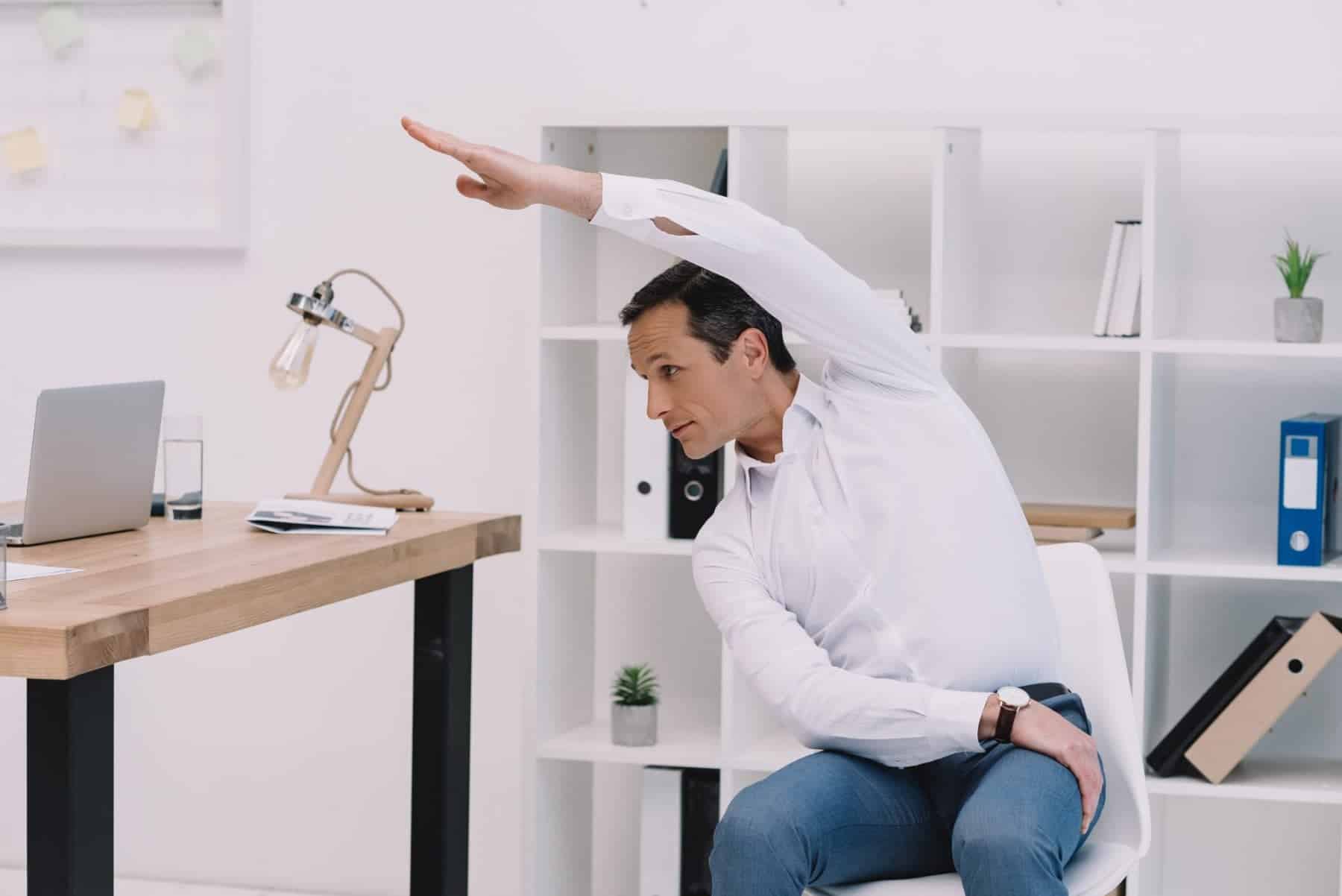
3. Side Bend

This stretch helps to lengthen the low back and side muscles that become cramped from sitting and slouching at our desks.

Inhale and reach the right arm up and over the head slowly bending to the left, left arm hangs by your side. Take five deep breaths.

Don’t bend too far or else more tension will be put on the lower spine!

Repeat on opposite side. This can be done standing or seated.

4. Quad Stretch

Don’t forget to stretch the front of the body! Tight quads and hip flexors can create tension and pain by pulling on the low back muscles. Standing, ground into the left foot and start to pull right heel up towards your glute (can have left hand on the desk for balance). Continue for five breaths and switch sides.

5. 90 Degree Lat Stretch

Place hands on desk or table at work, take a step backward as you bend forward with hands still on the desk. Continue moving feet backward until hips are stacked directly over heels and back is flat, hips should be close to 90 degrees.

The goal here is to lengthen the leg and low back muscles. Hold the stretch for five deep breaths.

6. Seated Figure 4 Stretch

This stretch is a holy grail hip opener. When the hip flexors and glutes are tight they can cause tension or pain in the lower back by pulling on the muscles.

The figure 4 stretch can release much of that tension.

Begin seated in office chair, keep left knee bent at 90 degrees and cross right ankle to come atop left knee making a figure 4. Keep right foot flexed to protect the knee, sit up tall and lengthen the spine. Take five deep breaths here and repeat on left side. To make this a more intense stretch start to fold forward, hinging from hips, while creating the figure 4.

Conclusion

All of these low back stretches can easily be implemented into your daily workday routine. By doing these low back stretches at work we are able to combat the effects of sitting and help relieve some tension and stress in the process.

Need extra encouragement? Try utilizing a posture coach! This small device is worn near your collarbone to help you sit taller and stand straighter. One of its main benefits is to reduce back pain.

Do you have any tips and/or stretches for releasing lower back pain? Any lower back stretches you do at work? Please comment below and let us know!

How to Be Fit Over 40 As a Busy Executive

You work hard to achieve the results you want in your career, but are you functioning at your optimal level? What if you could program your body to work as efficiently as your computer- like a well-oiled machine that delivers speed and perfection under even the most strenuous demands?

Take steps right now to shape and redefine the new you.

fit over 40

1. Setting Goals

The first step to achieving success in your endeavor to be fit over 40 is to set goals. As a busy executive, you know this and do it quite well. Now it is time to apply what you are already so good at doing on the job to the rest of your life.

Your goals must be measurable, not vague. Stating that you want to get healthier is not a measurable goal. Be specific in your language just like you would when setting expectations for your employees.

What exactly do you want? Perhaps finishing a race would satisfy your competitive edge. Or maybe you’ve always wanted to cross chin-ups off of your bucket list. Could it be time to listen to your doctor’s advice and finally shed that extra 10 pounds? These are things that can be definitively measured and tracked on your journey to being fit over 40.

Go ahead and make a list. Like rungs on your business career ladder, those little checkmarks might be just the motivational push you need to press on. Engage your entire office in this new way of life. Set up office fitness goals and competitions, such as who can walk the most steps or who can climb the most stairs. Keep the time ranges small in order to keep spirits high. Provide incentives in order to motivate your employees.

2. Formulate a Plan

Your list of accomplishments is long in the workplace. How did you get there? You made plans and followed them. If you plan to be fit over 40, think of this new lifestyle change as your job. Approach it with focus and determination and write down your plan of action. Start simple, and stay consistent. You didn’t go from college graduate to CEO overnight, nor will you move from couch potato to gladiator in one day.

As a busy executive, your time is valuable; use it wisely. If exercising before work is the only way you’ll get it done, lay out your workout clothes the night before, and get moving first thing in the morning.

Perhaps your workout is your de-stress time after a busy day. Pack your gym bag, and take it with you to work so you can head straight to the gym with no excuses. Stay active on your lunch break, move your body whenever possible.

3. Invest Well

Stay focused on the expertise and accountability of a personal trainer. A trainer can assist you in formulating a detailed blueprint of your fitness and nutrition plan. Consider this a valuable investment of your time and resources.

4. Settle In

Rome wasn’t built in a day. Brick by brick, you will lay this foundation for your new lifestyle. If these changes are to stick, it will be the every day, small steps that get you where you want to be, fit over 40.

Focus on the small changes, such as parking your car farther from the office, forcing yourself to cover more ground and boost your step count each day. View the elevator as “in case of emergency only”; the stairs are your new best friend.

Set a reminder on your phone to get up and move every 30 minutes. Buy a standing desk. Staying sedentary for extended periods of time does not jive with the new you, the you that is fit over 40. Keep that metabolism revved up with frequent trips to the water cooler. Not only will you stay hydrated and not miss a morsel of office gossip, but you will also log more steps.

5. Power of Positive Talk

How you think and what you say greatly influences the hormones responses coming from your body. Commit to stop using phrases such as “I want” or “I wish”. Replace them with powerful phrases, including “I will” and “I am”. Your language is a reflection of what you believe, and what you believe defines who you are. Your lifestyles choices are in your hands. Dominate your decisions with the power of positive self-talk.

6. Time as Currency

You have a busy schedule to maintain; you don’t have hours to linger in the gym. Try some High-Intensity Interval Training, or HIIT cardio, to get more bang for your buck. This can be done using any format, including running, swimming, rowing, biking, or stair climbing.

SEE HOW EASY IS TO GET FIT!

Warm up in order to prevent injury and set your body up to burn fat rather than sugar. A thorough warmup will elevate your core temperate and deliver oxygen to the working muscles. After a warmup, alternate periods of high intensity with recovery.

For example, run hard for one to two minutes, and then walk briskly for one to two minutes. Continue this pattern for 20 to 30 minutes. Cool down with a comfortable walk to allow the blood to return to your heart. Stretching or foam rolling afterwards will help the muscles recover and prevent soreness.

Leave a comment detailing how you’re doing on your journey to being fit over 40.

Busy schedule? How to get the most out of your workout.

The average busy executive doesn’t have time to do a ‘Rocky-style’ training montage each day, even if he does have the perfect soundtrack to go with it. No matter how organized you are, you probably don’t have the luxury of spending hours a day in the gym or devoting as much time as you might like to leisurely get into shape.

Many have found that they can only visit the gym 1-3 times a week and spend every time about 45-60 minutes there and that this time often ends up unproductive or it doesn’t produce the desired results. How to get the most out of your workout?

Be as productive in the gym as you are at your office. Learn how to get the most of your workout. CLICK TO TWEET

Executive Summary:

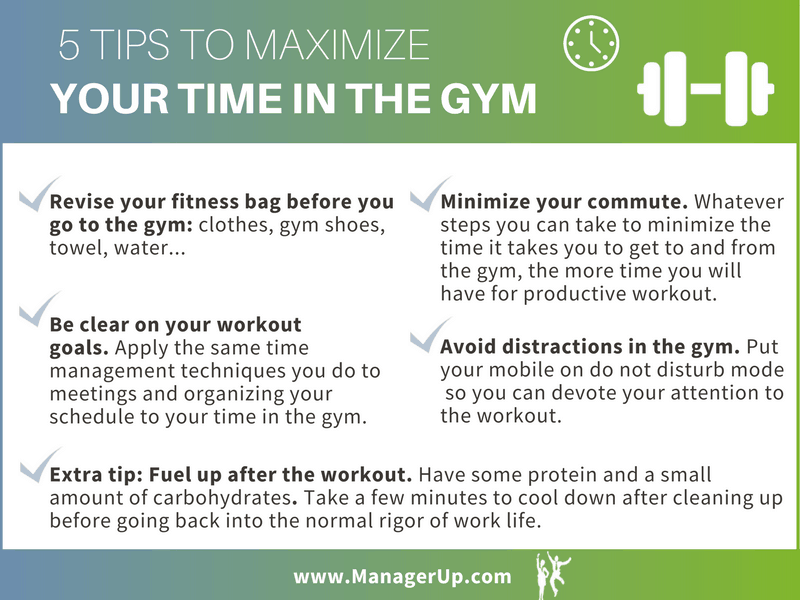
get-out-the-best-of-your-workout

1. Revise Your Fitness Bag

If you only have an hour or so to go to the gym, you need to prepare in advance. Have a bag packed with everything you need. Finding you forgot your clothes, shoes or socks is sure to discourage you from making the extra effort to hit the gym. Don’t forget to pack essential items, such as clean workout clothes,  gym shoes and socks, towel and shampoo if your gym doesn’t provide them and other toiletries like deodorant and hair products.

Most people like to listen to music when they work out. If the gym’s sound system selection isn’t working for you, create a playlist on your phone and buy some gym-friendly headphones so your tunes are ready when you are. Many enthusiasts prefer Bluetooth headphones since there are no wires, which provides better freedom of movement while exercising.

2. Minimize Your Commute

Even a ten-minute drive to the nearest gym cuts into the time you can spend working out. If you work in a large city business center, there are usually gyms on site. Although they often charge more than one that may be down the street, the time you save can make it well worth your time.

Occasionally there are physical therapy businesses that also allow a limited number of people in the building to pay to work out there as well. Whatever steps you can take to minimize the time it takes you to get to and from the gym, the more likely you will have a productive workout.

3. Be Clear on Your Workout Goals

We’ve probably all seen the guy in the gym who is clearly aimless. Usually, he’s out of shape, wandering randomly from one machine to another and absorbed in his phone. You should apply the same time management techniques you do to meetings and organize your schedule for your time in the gym. You wouldn’t schedule an hour-long meeting with no agenda, and you shouldn’t go to the gym without one either.

Make a plan in advance. It may be as simple as some notes on your phone about what body groups you will work out each day. Others use apps like Seconds in order to create time-based workouts ahead of time.

Another way to optimize the limited time you have is to hire a personal trainer. Their advice will help you be more productive in the gym. You can find some great 45-60 minute workout routines to try.

4. Avoid Distractions

If you keep your phone with you during your workout, it will likely distract you. Put it on do not disturb mode or airplane mode so you can devote your attention to the workout. A good workout needs to keep your heart rate elevated for at least 30 minutes to have a lasting impact on your metabolism. If you stop to take a 5-minute phone call or put together a quick email, you will cause your heart rate to drop down again.

It can take some self-control, but try to view it like you would a meeting. The workout has an agenda, you aren’t going to deal with other things during it and you’re going to give it the attention it needs.

5. Fuel up After the Workout

Post-workout, your goal is not just to get back to your desk before your next appointment but also to fuel up. In the first 45 minutes after a workout, you should have some protein and a small number of carbohydrates in order to refuel efficiently.

You’ll, of course, also want to give yourself time to shower, redress and clean up. Depending on your hairstyle, this can be a few minutes or a larger amount of time. You should calculate this into your time for working out.

Many like to take a few minutes to cool down after cleaning up and listen to some relaxing music before going back into the normal rigor of work life. Many “lunchtime” fitness enthusiasts enjoy the flush of endorphins the workout gives them and use this to fuel their afternoon.

Do you use other strategies for maximizing your time in the gym? Feel free to leave your comments.

Have You Ever Tried Working out at Work?

11 IDEAS TO GET STARTED AND BE MORE ACTIVE IN THE OFFICE!

Yoga at Work. What Are the Benefits for Executives?

Does it feel like you’re becoming more overwhelmed by work by the day? You’re not alone. According to the third annual  Work Stress Survey  by Harris International, eight out of 10 Americans are stressed about their jobs. Feeling stressed and anxious at work often turns into a vicious cycle, as feelings of stress and anxiety negatively affect job performance, making existing problems even worse.

Increasingly, workers are turning to yoga to manage feelings of stress and anxiety in the workplace. While engaging in yoga, you must focus on breathing and staying calm while assuming difficult or stressful poses. In so doing, you essentially  retrain your brain  to deal more effectively with such feelings. With regular practice, yoga at work can strengthen your ability to cope with stress and anxiety on the job.

That’s not the extent of its benefits, however.

Executive Summary:

yoga at work

5 Ways in Which Yoga at Work Can Benefit Your Career

Countless studies have been performed regarding the benefits that yoga brings to the table. When such benefits are discussed, it’s usually in the context of everyday life. However, business professionals can derive special benefits from engaging in yoga on a regular basis–and reducing stress and anxiety is just one example.

1. Yoga at Work Increases Focus

While engaging in yoga, the instructor will gently remind you to focus on your breathing and to clear your mind. On paper, this probably sounds simple enough to do. In reality, however, it takes a lot of practice to achieve any level of proficiency in this area. You are expected to hold complicated and sometimes difficult poses for extended periods of time while maintaining a calm breathing pattern and a clear mind. At first, this will be very difficult. With practice, though, it will get easier and easier.

In real life, an improved ability to focus will come very much in handy in the workplace, where distractions are constantly coming at you from every direction. As you gain more experience and skill, your ability to focus on what matters at work will improve. In turn, your productivity will go up, as you won’t be constantly interrupted to attend to distractions.

2. Yoga at Work Reduces Stress

As mentioned earlier, stress and anxiety tend to have a snowballing effect. When you become overwhelmed by stress and anxiety, your ability to cope with even simple matters becomes compromised. In turn, your performance may falter, and you’ll run into more and more problems. These problems will increase your stress and anxiety levels even more.

While engaging in yoga, the meditation and breathing help you learn how to free your mind even in the face of very stressful situations. The more experienced that you become, the easier it will be for you to hold difficult poses while remaining calm and at peace. This skill translates well in the workplace, where it will come in handy while giving presentations and in other situations where stress and anxiety are sure to strike.

3. Yoga at Work Alleviates Physical Ailments

Have you ever tried to focus on work with a stiff neck, a sore back or other physical issues? It isn’t easy, is it? Yoga can make a huge difference. You may be thinking that those very ailments will prevent you from engaging in yoga at all, but that’s not the case. The reality is that yoga is a very low-impact activity. Rather than exacerbate existing physical ailments, it improves them. Over time, you will notice that those pesky aches and pains that used to plague you have all but disappeared. When you’re not preoccupied by pain, you’re better able to focus.

At work, this means that your productivity will improve. Your overall mood and outlook will too. Suddenly, work doesn’t seem nearly as difficult as it used to.

4. Yoga at Work Unleashes Unparalleled Creativity

The daily grind often saps even the most talented professionals of creativity. If you’ve become stuck in a rut, yoga might just be the answer. One of the key tenets of yoga is freeing the mind of your worries and staying in the moment at hand. This is also referred to as “freeing your mind,” and it isn’t just advantageous while engaging in yoga. Its benefits spill over into work in many ways too. When your mind is freed of the usual worries and cares, it is free to move into unexplored territory.

This is how the best, most innovative ideas are born. With regular practice, yoga can give you the creativity that you need to achieve new levels of success in your career.

5. Yoga at Work Increases Energy

Are you often dragging by the middle of the workday even after getting a full night’s sleep? Chances are that it’s because you are working too hard over excessive periods of time without any breaks. Research has shown that when workers step away from their desks here and there throughout the day, they tend to be less fatigued and have more energy. If you engage in yoga while stepping away–even if only for 10 minutes here and 10 minutes there–the benefits are even better.  Numerous studies, including one that was published in the Journal of Physical Activity and Health, have shown that yoga improved workers’ performance. Much of that likely has to do with the increased energy that goes along with practicing yoga.

One of the best things about yoga is that it’s easy to get started. You don’t even have to sign up for a class-free tutorial are readily available on YouTube and around the internet. Yoga may be the key to unleashing your full potential at work, and the sooner you get started, the sooner you can find out.

Are you looking for easy poses to do at work or at home? Check out our yoga books exclusively selected for executives. Read how yoga helps you calm your mind and body and integrate yoga into your busy schedule.

Have you already introduced yoga to your life? Is yoga helping manage your thoughts, reduce stress or increase focus at the workplace?

Share your comments with us!