Transforming Stress into Success: 15 Simple Mindfulness Exercises for Busy Leaders

Picture this: you’re a busy leader juggling deadlines, managing teams, and making high-stakes decisions while your inbox explodes and your phone never stops buzzing. Welcome to the executive hot seat! Feeling stressed? Maybe a tad overwhelmed? Don’t worry, you’re not alone.

Between the relentless workload and those pesky things like “a personal life,” life as a leader can get downright chaotic. 

But what if, instead of letting the stress control you, you could harness it? Think of it as the spicy kick that actually makes your success taste a whole lot sweeter. That’s where mindfulness exercises come in. Think of them as little mental resets – simple, quick, and perfect for busy executives like you. 

They’ll help you find calm in those chaotic moments, sharpen that decision-making muscle, and maybe even rediscover that elusive thing called work-life balance.

Ready to upgrade your leadership toolkit? Let’s dive into some practical mindfulness exercises specifically designed to combat stress and boost success. Get ready to transform from a frenzied executive into a focused, empowered leader!

Mindfulness Exercises to Beat Workload Overload

Let’s be honest: sometimes, your to-do list looks like it was written by a particularly ambitious toddler with a grudge. But fear not, stressed executive! There are mindfulness tricks to make even the most monstrous workload seem slightly less intimidating.

Click on the image to see a full infographic (opens in new tab)

Exercise 1: Task Prioritization Meditation 

Think of this as sorting your mental inbox. Sit down, close those tired eyes, and visualize your to-do list. Now, mentally file those tasks into these oh-so-helpful categories: 

  1. Must do NOW
  2. Kinda important, but it can wait a bit and 
  3.  If I never do this, no one will probably die. 

Feel that weight lift just a bit? Nice!

Exercise 2: Single-Tasking Focus 

Multitasking is a myth, my friend. Turns out our brains are like squirrels trying to concentrate in a room full of shiny objects. An analysis of 49 studies found that multitasking negatively impacted cognitive outcomes. 

“Individuals are not adept at multitasking; they are deceiving themselves if they believe otherwise,” noted neuroscientist Earl Miller. He also mentioned, “The brain excels at convincing itself of falsehoods.”

This exercise is all about giving ONE task your full attention. Set a timer (20-30 minutes) and silence all distractions. You might be amazed at how much you accomplish.

Exercise 3: Mindful Breaks 

Remember when your mom forced you to take a break from playing outside? She was onto something! Short mindfulness breaks can help reset your overwhelmed brain. Try simple breathing exercises (breathe in, hold, breathe out – you get the idea) or even a quick walk around the block. The goal is to give your brain a micro-vacation.

A study shows the efficacy of micro-breaks for increasing both well-being and performance

Mindfulness Exercises to Combat Chronic Stress

Stress is a pesky little shadow most executives can’t seem to shake. According to the American Psychological Association, chronic stress can lead to a variety of health problems, including high blood pressure, heart disease, and anxiety disorders. The cost of mental health conditions and related consequences is projected to rise to $6 trillion globally by 2030, up from $2.5 trillion in 2010, according to a study published by the World Economic Forum. By 2030, the cost of poor mental health is expected to surpass that of cancer, diabetes, and respiratory ailments combined.
Let’s turn those stress hormones into chill vibes with a few targeted mindfulness exercises:

Click on the image to see a full infographic (opens in new tab)

Exercise 4: Deep Breathing Technique 

This one’s a classic for a reason. Sit down, breathe in through your nose like you’re smelling the most fantastic croissant ever made, and breathe out like you’re trying to fog up a mirror. Repeat until your inner monologue stops screaming and starts… well, maybe not singing, but humming contently?

A study published in the International Journal of Stress Management found that deep breathing exercises were effective in reducing stress and anxiety symptoms.

Exercise 5: Progressive Muscle Relaxation (PMR) 

Remember how good it felt to flop on the couch after a tough day in 3rd grade? That’s PMR! Tense muscle groups one by one, hold the tension, then BAM! Let it all go, focusing on the sweet release of tension. Work your way through your body, and prepare to feel surprisingly boneless (in a good way).

A study confirms the effectiveness of progressive muscle relaxation, deep breathing, and guided imagery in promoting both psychological and physiological relaxation states. 

Exercise 6: Gratitude Reflection 

Turns out forced positivity can actually work! Take a few minutes each night to write down 3 things you’re grateful for. It can be as simple as “didn’t spill coffee on my white pants today.” Focusing on the good stuff helps retrain your brain away from the stress spiral.

A study published in the journal Personality and Social Psychology Bulletin found that practicing gratitude can lead to increased happiness and well-being. 

Mindfulness Exercises to Outsmart Decision Fatigue

Executives make about a gazillion decisions a day: “Which tie will best assert my dominance? Paper or plastic? Email or text that passive-aggressive threat?” (Okay, maybe not that last one…) Decision fatigue is REAL, and it can make the smartest leader feel dumber than a bag of hammers. A Journal of Personality and Social Psychology shows that decision fatigue is a real phenomenon that can lead to poorer decision-making. Combat this with mindfulness:

Click on the image to see a full infographic (opens in new tab)

Exercise 7: Mindful Decision-Making Process 

Before making a big call, pause. Take a few breaths – no one expects you to have an epiphany in under 3 seconds. Then, mindfully assess the situation. Are you too stressed, tired, or hungry to think clearly? Address those needs FIRST, then make your decision.

A number of studies have shown that mindfulness can improve decision-making skills. 

Exercise 8: Visualization for Outcomes 

Picture your decision and its possible outcomes. Do any make you feel particularly stressed, excited, or just plain “hmm”? Let those feelings be your guide.

A study highlights the importance of considering motivational factors, such as achievement goals, in enhancing the effectiveness of imagery techniques for performance improvement. 

Exercise 9: Intention Setting 

Start your day by asking yourself, “What kind of leader do I want to be today?” Write down a few words to guide your decisions (patient? decisive? the boss who brings donuts?). This simple intention-setting practice can streamline your decision-making process like a hot knife through butter.

A research paper shows that implementation intentions, as if-then plans, facilitate behavior change by linking goal-directed actions to specific situational cues, thus enhancing goal achievement. 

Mindfulness Exercises to Reclaim Work-Life Balance

Oh, the elusive work-life balance. Most executives imagine it as a mythical unicorn, occasionally glimpsed in blurry photos but never in real life. Mindfulness can help you tame the imbalance, even if that unicorn remains out of reach.

Click on the image to see a full infographic (opens in new tab)

Exercise 10: Transition Meditation 

As you leave work, find a quiet corner and close your eyes. Focus on slow, deep breaths, and mentally say goodbye to work stress. A study shows that Daily deep breathing exercises can lead to beneficial physiological changes, and DBE is a feasible intervention option for improving health and productivity in the workplace. Visualize stepping into your home life fully present. Now, go be the best darn spouse/parent/dog-walker you can!

Exercise 11: Mindful Walking

Go for a walk on your break with zero purpose other than to, well, walk. Feel your feet on the ground, look at trees instead of your phone, breathe. That’s it! Surprisingly effective at separating work-you from awesome-home-you.

A study suggests that mindful walking may effectively reduce perceived psychological distress, offering a promising avenue for stress management with minimal cost and ease of implementation.

Exercise 12: Family or Personal Time Intentionality 

Schedule time for the people you love, LIKE your most important meeting. Turn off your phone. Resist the urge to answer “just one more email.” Be present. Be engaged. The emails can wait, but those precious moments with your people? Can’t get those back.

Time management specialist Laura Vanderkam advises that to ensure quality time with loved ones, it’s crucial to proactively plan and schedule these moments ahead of time.

Mindfulness Exercises to Resolve Interpersonal Conflicts

Disagreements in the workplace happen. But with a little mindfulness, you can avoid full-on gladiator mode and try something a bit more civilized – like an emotionally mature chat! The research on team mindfulness suggests its significant role in reducing team conflict and social undermining, thus highlighting its potential as an intervention for fostering positive team dynamics and improving overall team functioning.

Click on the image to see a full infographic (opens in new tab)

Check out these techniques:

Exercise 13: Empathetic Listening Practice 

Pay full attention to the other person. Don’t just wait for your turn to talk; really hear them out. Summarize what you understood to avoid misunderstandings. Basically, be the kind of person you’d actually WANT to talk to!

According to a journal, supervisors’ active, empathetic listening significantly contributes to employees’ work engagement, emphasizing its importance in promoting supportive leadership and enhancing organizational well-being.

Exercise 14: Response Pause Technique 

Feeling flustered? Take a breath before you say something you’ll regret. This simple pause gives you a chance to calm down and choose your words wisely, potentially saving you (and your colleague) from future HR meetings.

Based on the extensive research presented, it is evident that self-control plays a crucial role in organizational settings, affecting various aspects of behavior and performance. 

Exercise 15: Common Ground Meditation 

Remind yourself of the goals you shared with your colleague. Picture working together successfully towards that goal. According to research, participants who were encouraged to work collaboratively persisted with their tasks 64% longer than those working alone, reporting higher levels of engagement, less fatigue, and greater success rates. Additionally, these effects continued for several weeks.

Sometimes, just focusing on the “why” behind the work can help diminish that urge to go full-on WWE on them. Well, slightly diminish it, maybe.

Conclusion 

Think of these mindfulness exercises as power-ups for your executive brain. They won’t unlock a secret level where work magically disappears (sadly), but they CAN help you handle the relentless boss battles of leadership with more zen-like calm. Whether your nemesis is a never-ending to-do list, chronic stress, or that colleague who always “just wants to pick your brain” for an hour, these techniques offer an edge.

The best part? You don’t need to retreat to a mountaintop or wear anything resembling yoga pants to practice mindfulness. These exercises are designed for busy leaders like you. So experiment, find what works, and customize them to your own leadership style. Who knows, maybe you’ll discover your inner calm is surprisingly good at making tough decisions, calming chaotic meetings, or just getting through the day without wanting to scream into a pillow. That, my friend, is the ultimate executive success.

Let’s see how well you understand this post. Take a few minutes to attempt this quiz and evaluate your understanding.


0

Mindfulness Exercises

Check Your Understanding of Mindfulness Exercises

1 / 10

What is a key benefit of mindfulness for leaders?

2 / 10

Which exercise involves organizing tasks by priority?

3 / 10

What is a common misconception about multitasking?

4 / 10

Which exercise gives your brain a quick rest?

5 / 10

What is the purpose of the Mindful Decision-Making Process?

6 / 10

How does practicing gratitude benefit executives?

7 / 10

Which exercise helps you mentally leave work stress behind?

8 / 10

What is the goal of Common Ground Meditation?

9 / 10

Which method helps reclaim work-life balance?


10 / 10

How can leaders help reduce stress in the workplace?

Your score is

The average score is 0%

0%


The full body workout for desk potatoes that can save your life

Hello desk potato! Did you read the title carefully? This post is about a full body workout for beginners that can be a matter of life and death for you.

Sounds exaggerated? Maybe. But it is true!

If you have started reading, you are very likely a non-exerciser. So please memorize this: out of those who die over the age of 35, for 20% it is due to physical inactivity. Do you want to become a part of these statistics?

Of course not! The solution is very simple: you have to get moving!

Do you need specific and SIMPLE reasons to start? If so, you are in the right place. Here we will describe a full body workout for beginners. 

But first, let’s take a look at what being a desk potato can do to you.


But Who is a Desk Potato?

You must be familiar with the term “couch potato.” However, “desk potato” isn’t all that familiar, because this new “vegetable” is a product of recent times.

Desk potatoes are typically busy executives, managers or entrepreneurs who are stuck to their desks for hours on end. They only leave their desk perhaps to visit the restroom or go home.

Can you find yourself in this description?

Being a desk potato has given rise to a new word – “sedentarism.” According to well-known statistics, on average while at work, most Americans sit for about 11 hours a day. $24 billion is the amount estimated that gets spent annually on medical treatment related to a sedentary lifestyle.


What Health Problems Arise From Being a Desk Potato?

Leading a sedentary lifestyle as a busy executive stuck to a desk day in and day out can lead to:

Slouching

– Joint disorders

Low back pain

– Cardiovascular health issues

– Type 2 diabetes stress

– Eventually obesity


All these issues are interrelated. Importantly, our full body workout for beginners can help you prevent them.


Why Strength Training for a Sedentary Lifestyle?

Although it is very difficult to avoid long hours at your desk, there are some things you can do to counteract its adverse effects. Among several measures you can take, exercise is one of the most powerful.

There are three basic types of exercising: aerobic training (like jogging), strength training (like exercising with weights or your body weight) and stretching (for example yoga).

We recommend strength training for a sedentary lifestyle. In our opinion, it alleviates the health problems you are likely to experience from being a desk potato better than other forms of exercise.

There’s no point in telling yourself that you don’t have time to exercise. A relevant quote comes to mind by Earl Edward Stanley, a British nobleman of the late 19th century who served as Secretary of State for Foreign Affairs for his country. He said, “Those who think they have no time for bodily exercise will sooner or later have to find time for illness.” This simple but astute statement says it all.


What Is A Strength Training?

Strength training is a specialized form of exercise that uses resistance to promote muscular contraction.

Some people work with weights or use special machines, but the type of strength training we will focus on in this article is simply using your body weight. This is why our full body workout for beginners does not require any equipment. You can do it at home, outdoor and, of course, in the gym.


Before Beginning Our Full Body Workout

Since you are likely doing this for the first time or after a long break, you are probably not aware of what you need to get started. Here are a few useful tips:


1. Get Clearance From Your Doctor

Even if you aren’t aware of any underlying health issues, you need to ensure you are fit enough to undertake a full body workout for beginners. If you have problems like knee pain, a weak back or perhaps a frozen shoulder, all the more reason to consult your doctor.


2. Warm Up and Cool Down

It is crucial to increase the general mobility of your neck, shoulders, arms, torso, neck, hips and legs. Therefore, please make sure to do simple warming up exercises for at least 5 minutes before starting. Even better if you can invest 10 minutes in your warmup.

Importantly, warming up will help prevent injuries.

To cool down, go for a short walk or stretch your body.  Cooling down brings your body to the resting state, preventing dizziness or even fainting. 


3. Maintain a Diary

A good thing is to maintain a journal in which you record details of each training session and the progress you make.

Please write the dates, times, number of sets and repetitions.

You can use a paper notepad or record the information on your phone or computer. Many apps help you record data in an organized way.


4. If There Is Pain During Exercising, STOP

Don’t be too ambitious with your exercising initially. You may experience some pain or discomfort when you first start, which is normal.

However, if you feel pain in a particular area, stop that particular exercise.

You can try the exercise during the next training session. If the pain continues, please visit a health care professional.


5. Be Prepared for Muscle Stiffness Over the Next Day (s)

It is bad to experience pain during exercise, but it is normal 24-36 hours after.

The reason you experience pain in the days following a full body workout for beginners is that during strength training, tiny tears occur in the muscles. Your muscles grow when these tears form a knot.

Thus, take time between sessions is to give your muscles time to repair themselves.


6. Test Your Initial Strength

Our full body workout for beginners has seven different exercises. Six are typical strength exercises and one involves yoga.

The first week should be a test week for you.

Every day, test your strength performing only ONE strength exercise in order to find out how strong you are.

For example, on the first day, do as many pushups as you can and then note the number of push-ups in your diary.

Testing yourself will help you to monitor your progress and will motivate you as well.

Importantly, even if this is just testing, warming up is crucial!  The last thing you want is to injure yourself.


7. Give Your Body Time To Rest

It is not reasonable to work out every day. You need to give your body a resting period of at least 36 hours between workouts. I recommend pausing for two full days. A good idea is to exercise, for example, on

– Mondays, Wednesdays and Fridays, or

– Tuesdays, Thursdays and Saturdays

The gap between workouts gives your muscles time to grow and helps your body recover.


8. Be Patient and Start Small

Our full body workout for beginners is simple and easy. Still, it may be a challenge for those who have had a long break in exercising or suffer from significant obesity.

It took months or maybe even years to bring you to the current poor fitness and health level. The times when you were fit are long gone.

Do not expect to achieve a huge improvement over night.  It will take time. Be prepared for that and start small.

The first training session can be short. Even 5 minutes is better than nothing. Then slowly increase the duration.

It is best to exercise 3 times a week, but at the very beginning, even once a week will do.

The training must be challenging and should make you sweat; but it should not be too hard and demotivating.


9. Important Vocabulary: Sets, Repetitions and Rest Intervals:

In the exercise descriptions, we use notations that need clarification:

– Repetition (rep): This is when you complete a single exercise, such as one lunge or one push-up. In other words, one rep is the complete motion of one exercise.

– Set: This is a series of reps performed without pausing. For example, ten squats done without break counts as one set of that specific exercise.

– Rest interval: A rest interval is the time you take to rest your muscles to allow them to recover before you take up the next set or another exercise.


The rule of thumb is to do three-five sets of each exercise and, in every set, do 80% of the maximum number of repetitions you are able do.

You should rest one minute between sets and three minutes between two different exercises.


10. Do Not Make It Too Light

When undergoing the full body workout for beginners, it is essential to create enough resistance through your exercises to provide the right stimulus to your muscles.

There is an “overload principle” that applies to strength training exercise programs. For the creation of physiological changes, you need to employ an exercise stimulus with an intensity that is more than your body is used to. Thus, your muscles receive added stress.

If you exercise using the same number of sets and repetitions during each training session, you will not see fitness gains over time.

Therefore, try to increase the number of repetitions during the next training session.

In order to increase the resistance after 2-3 months, you may introduce weights to your full body workout for beginners.


11. Control Your Heart Rate

 Although it is not an aerobic exercise, your heart rate will increase during each exercise. Please make sure that you know your maximum heart rate and you should work-out at the 60% level of your maximum heart rate. 80% is the absolute maximum. Never go beyond.


Strength Training Exercises

The exercises we have chosen as part of our full body workout for beginners are simple and challenging at the same time.

They are simple because you probably know all of them. You don’t need any equipment. Most simulate standard, daily body moves.

They may be challenging because you are not used to exercising, and the first training sessions may be difficult for you. Be prepared for that!

Here is a description of the main strength training exercises:


1. Pushups


Although several variations exist, here are the steps to follow for the classic form:

STARTING POSITION:

– Bend on the ground, placing your palms shoulder-wide and flat on the floor.

– Kneel on your knees with your calves extended behind you, parallel to the floor.

– Ensure that your feet are perpendicular to the floor.


FINAL POSITION:

– Lower your upper body so that your chest is parallel to the floor.

– Do not rest your body on the floor.

– Ensure that your shoulders are in line with your arms.

– Keep your face parallel to the floor as well.

– Raise your body back into the original position.


REPETITIONS AND SETS:

Do three sets during your first training session. Pause 60 seconds between them.

– In the first set, do the number of repetitions equal to 80% of the maximum number of pushups you can perform.

– In the second and third sets, do as many as you can. Warning! It will be damn difficult!


DURING THE NEXT TRAINING SESSION:

– In the first set, try to do more pushups than you did in the first set of the previous training session.

– In the second and the third set, do as many as you can


2. Squat


The squat is a simple exercise you can do practically everywhere, and you don’t need much space.

STARTING POSITION:

– Stand with your feet about two feet apart.

– Extend your arms in front of you.


FINAL POSITION:

– Sit back as if you are in a chair.

– Straighten your legs back into the original position.


REPETITIONS AND SETS:

The same instructions as in the case of the pushups apply.


3. Crunch


This is an excellent exercise for strengthening the abs. However, incorrect crunches could damage the spine. so, follow the steps described here carefully to avoid a painful outcome:

STARTING POSITION:

– Lie flat on the ground, raise your knees and keep your feet flat on the ground.

– Press your back firmly against the ground.

– Place your hands behind your head as in the image below.


FINAL POSITION:

– Now, keeping the rest of your body firmly on the ground, raise your upper torso as much as it will go comfortably towards your knees. See the image below:

– Lower your upper torso, neck and head gradually back to rest on the ground.


REPETITIONS AND SETS:

The same instructions as in the case of the pushups.


4. Cobra Pose


This pose is based on the stance that a cobra makes when threatened. The cobra raises its body, facing the source of the threat. You can perform this exercise on a yoga mat or a rug.

This exercise is good for strengthening the abs. Although the cobra position is more of a yoga exercise, it is quite effective in preventing slouching and low back pain.

STARTING POSITION:

– Lie on your stomach, keeping your forehead flat on the ground.

– Press your feet flat on the ground with the balls of your heels facing upwards.

– Place your palms face-down on either side of your chest with your elbows bent and pressed against your sides.

– Ensure that your fingertips are in line with the tops of your shoulders.


FINAL POSITION:

– Gradually raise your chest above the ground, eyes looking forward.

– Raise your head further until your eyes are looking upwards, simultaneously raising your upper torso.

– Stick out your tongue and inhale at least five times.

– Now lower your upper torso until your body rests on the ground again.


REPETITIONS AND SETS:

– Repeat this exercise at least five times, which will be one set.

– Do three sets.

– You may increase the number of reps per set every time (10 being the maximum)


5. Plank


The plank comes under the category of “isometric exercise.” An isometric exercise is where you cause a static contraction of a muscle without moving, and the angle of the joint remains the same.

Planks are good for strengthening the muscles of the abdomen as well as those of the buttocks. The plank strengthens the “core” of your body, which includes the abs, back, hips, shoulders and chest:

– Get onto the ground as if you are doing a pushup.

– Rest your body on your elbows, keeping the line of your elbows. Keep your hands parallel to the ground and in the direction of your body.

– Ensure that your shoulders are perpendicular to your forearms.

– Your legs should be straight, and your stomach lifted.

– Your body should form a straight line from your head to your toes.

– Inhale and hold your breath for ten seconds.

– To come out of it, just lower down to your knees.

– Repeat this exercise at least five times, increasing the number daily.

– Increase the time that you hold your breath until you can do it for a minute at a time.


6. Lunge


The lunge is good for strengthening the knee muscles. Here is how to do a lunge if you are a beginner:

STARTING POSITION:

– Stand straight with your feet placed slightly apart, hands on the hips.


FINAL POSITION:

– Put one foot in front of the other and place the other one behind you.

– Let your arms hang down freely, but perpendicular to the floor, keeping your shoulders straight.

– Now drop your body straight down bending both your knees, until your back knee touches the ground.

– Raise your body back into the position where you started

– Ensure that your head and chest are straight and that you look forward.


REPETITIONS AND SETS:

The same instructions as in the case of the pushups.


7. Calf Raises


Calf raises are very beneficial to the muscles of the lower leg, specifically for the ankles.

There are different variations of calf raises. You can perform a calf raise standing up or while seated (see the above image). Here’s how to do a simple, standing calf raise:

STARTING POSITION:

– Stand with your feet flat on the surface of the ground.


FINAL POSITION:

– Raise your heels so you are standing on your tiptoes.

– Hold the position for ten seconds and then release your feet to the original position.

You can also do calf raises while sitting down. The steps are more or less similar. The only difference is that you sit while you perform the exercise. This version is excellent to do at your desk.


REPETITIONS AND SETS:

The same instructions as in the case of the pushups. 


Let Your Journey Towards Health and Fitness Start Today!

If you follow these simple strength training exercises, you will gain more stamina, get rid of excess fat, develop muscle tissue and become a healthier, more productive and successful person.

We hope you derived great benefit from reading this article and are able to begin your strength training program and the full body workout for beginners with effective simple exercises.

If you do, we would love to hear about your experience. And we would also like to know about any other exercises you include in your personal workout program. Start your strength training program today: there is no better time than now!

This Yoga Workout Will Make You A Better Decision Maker (Proven!)

Do you make good business decisions?

It’s an important question as good decision making is a trait of successful executives.

The quality of your business choices can determine if your new business initiative flies high or if you get promoted faster than your peers.

What qualities are actually needed to make good decisions?

Naturally, in order to make good business choices you need to have the right business information but, there are also some soft factors which can determine success or failure.  Namely, executives must have a sharp mind and be focused, positive, calm, and confident but, not overly confident.

Are you aware that a simple and specific yoga workout can improve all these soft skills?

According to several studies, yoga can help the decision-making process and allow people to make smarter choices. Yoga workouts not only strengthen your physical body but, strengthen and sharpen your mind. Both qualities that can help executives excel in business.

Very recently, yoga practice has even been suggested as mandatory for members of the British House of Commons! This is a great idea since yoga workouts can give them better judgement and allow them to make smarter decisions.

This yoga workout is designed to promote effective decision making at work. Some benefits this yoga workout will give you are to calm your mind, give you serenity, focus, concentration, a global vision and refresh your brain for creativity. Better decision making can start here, with this 30-minute yoga workout!

Start Practicing This Yoga Workout To Improve Your Decision-Making Skills and Stay on the Top of Your Game! CLICK TO TWEET


Yoga Workouts to Strengthen the Executive’s Business Making Skills

This yoga workout gives executives better decision making power but, it is not for beginners. If you’re new to yoga please read our article about beginner yoga routines as a starting point.

This 30-minute yoga workout is broken down into four types of yoga poses. Breathing poses are to help you gain serenity and focus on the present moment. Standing poses promote mental clarity. Balance poses promote concentration and focus. Inversion poses promote blood irrigation in the brain, which leads to increased creativity and new ideas.

If you’re ready to start making better decisions, let’s get started with the 30-minute yoga workout!


1. Easy Pose (Calm the Brain)

Easy pose is the natural starting point for this yoga workout because of the breathing mindfulness benefits for executives. By starting here, you will calm the mind and start to increase your focus on the yoga practice and, in turn, increase focus elsewhere in your life.

Start in a seated cross legged position that is comfortable for you, bring the hands to the knees with plams face up and body relaxed. Sit up tall with spine long and the crown of the head reaching toward the ceiling. Relax the shoulders.

Start to concentrate on your inhales and exhales, taking them slow and steady through the nose. Begin here with 15-20 breaths to start your workout.

Tip: If you have tight hips, sit up on a yoga block or a pillow to allow the knees to fall more comfortably to either side.


2. Pranayama (Breath Control to Increase Mental Strength)

Pranayama is the practice of specific breathing techniques. Prana is this Sanskrit word for “life energy” while ayama means “to extend” for a translation quite literally meaning breath.

For executives, practicing breath control is beneficial to increase mental strength.

It will also calm your nervous system and increase perception, which are essential in decisive decision making.

Start seated in easy pose and bring one hand towards your face, folding the three middle fingers down so that the thumb and pinky finger and extended.

Exhale completely and use your right thumb to close your right nostril. Inhale through your left nostril and then close the left nostril with your pinky finger. Open the right nostril and exhale through this side. Inhale through the right nostril and then close this nostril. Open the left nostril and exhale through the left side. This is one cycle. Continue this for 5-10 cycles.

Tip: This breath exercise takes patience and concentration, so don’t give up if you don’t control the breath right away. Practice overtime will increase it’s benefits.


3. Cat to Cow Posture (Creates Emotional Balance)

Cat/cow pose promotes emotional balance, necessary for effective decision making.

It is also a gentle stretch for the back, stomach and chest. This is nice for executives because it can help to open up the chest and counteract slouching and rounded shoulders from hours of deskwork. 

Start out on hands and knees with wrists directly beneath shoulders and knees beneath the hips. As you exhale press into palms while rounding the shoulders and tucking chin to chest, pressing the upper back towards the ceiling and pulling the navel in towards the belly button. This is cat pose.

As you inhale reverse the posture letting shoulders fall away from the ears and stomach drop towards the floor. Your belly should be more relaxed while your chest is opening up. This is cow pose.

Try doing this for 10-15 breaths to warm up the spine and continue controlling the breath with movement.

Tip: Put a blanket under the knees if they need more support or cushion. This pose should be gentle and comfortable!


4. Tree Poses (Enhances Confidence and Create a More Positive Level of Self-Esteem)

Tree pose is a standing posture that takes balance, confidence, and concentration to master. All key characteristics an executive must posess for good decision making.

By practicing this posture, it will enhance confidence and create a positive level of self-esteem.

Start by grounding into your right foot and making sure all four corners all pressed evenly into the ground. Once you feel balanced, bring the left foot off the ground and place the foot on your calf or thigh, do NOT place foot directly on the knee! Press thigh into foot and foot into thigh.

From here stand up tall, relax the shoulders away from the ears and keep your gaze steady. Hands can be placed on hips or in prayer pose at the heart. From here, just breathe! Stay in the pose for 8-10 breaths and then switch to the left side.

Tip: If your balance isn’t great, keep your toes on the gound and just lift the heel onto the opposite leg, using it as a kickstand.

As you start to gain confidence in the posture, you can slowly bring the foot up a little higher each time.


5. Warrior II (Develops Concentration and Energy)

Warrior II is a strong standing pose that will help executives develop concentration and energy, which are obviously needed in making critical decisions.

Because almost every muscle in the body is activated while holding this pose, it can help improve circulation while energizing the mind and the whole body.

It is a challenging posture!

To start, step your right foot back into a lunge but, instead of staying on the ball of your foot ground the right heel and have the toes face out at about 3 o’clock. You left knee will bend to a 90 degree angle (or whatever angle you can manage), and toes will stay pointed forward at 12 o’clock.

Bring your arms to a T position to that left arm is toward left foot and right arm is toward right foot. Keep your gaze forward, looking out past your left hand. While here remember to breathe! Stay like this for 8-10 breaths. Switch sides and begin again.

Tip: If you feel like this is awkward or painful for you back knee, turn the back foot to about a 45 degree angle. Right toes toward 1 o’clock or left toes toward 11 o’clock. This should take some pressure off the knee and allow you to fully express the pose and gain its full benefits.


6. Warrior III (Your Brain Thinks Sharp)

Warrior III is the second balance pose in this yoga workout. Just like tree pose, it takes patience, confidence, and concentration to master.

As executives, we will benefit from this pose because it will help to make the brain think smarter and sharpen our focus.

Start by grounding into the right foot pressing all four corners of the foot into the ground. Once you feel grounded, start to lift the left leg up while bending forward from the hips. Keep lifting your left foot up until it is at hip height and bring the chest forward, so it is parallel to the floor. Reach arms forward, bringing triceps by the ears. Keep your gaze steady and focus on your inhales and exhales. Stay here for 8-10 breaths and then swtich to the left side.

Tip: This pose takes a lot of shoulder and hamstring flexibility. To ease up on the hamstrings don’t lift the back leg so high. For tight shoulders, keep hands on hips or bring them to prayer at heart center.


7. Side Plank (Develops Your Concentration Skills)

Side plank is a major core and arm strengthing exercise.

Along with the strength gain, executives will see developments in concentration skills, which is helpful in making executive decisions.

This can be a challenging posture, so make sure to modify if need be.

Start on hands and knees, keep the right hand on the ground and reach left arm up towards the ceiling. Straighten both knees so that you’re balancing on the outer edge of the right foot and the inner edge of the left foot. Make sure your right wrist is directly under your right shoulder. Keep your feet stacked and hips and head in line with the spine. Also keep your core tight to maintain balance. Gaze can be up toward the ceiling or down to the ground. Stay here for 8-10 breaths and then swtich sides.

Tip: To modify this pose, bring your bottom leg to the ground resting the knee and shin. This will help with balance and take soe pressure off your wrist.


8. Wide Legged Forward Fold (One-Pointed Attention)

After practicing this inversion pose, executives will notice more focused attention and concentration.

When you focus on this pose, it cultivates an ability to shift from ‘executive brain’ to that of one-pointed attention. This focused state will allow other concerns to dissolve so that you can focus on the task at hand.

Wide legged forward fold is also a deep hamstring and lower back stretch

Start with feet wider than hip width apart, inhale, and reach the crown of your head toward the ceiling to lenghten your torso. As you exhale, start to fold forward at the hips reaching hands toward the ground. As you fold forward, let the crown of your head fall toward the ground. Stay here for 8-10 breaths. Slowing rise back to standing. Once you feel ready, repeat the forward fold 1-2 more times depending on how you feel.

Tip: If this pose makes you dizzy when you return to standing, try not folding over all the way. As you fold, bring hands toward the ground and chest parallel to the floor.


9. Shoulder Stand (Positive Energy to Your Body and Mind)

Shoulder stand is an inversion and should be practiced with caution.

Inversions increase blood flow to the brain, which can calm the mind, relieve stress, and mild depression.

This can also help improve memory and concentration. Overall it can bring positive energy to your body and mind.

Start lying on your back and bring feet towards the ceiling so that legs are straight. There can be a slight bend in the knee if needed. If you have high blood pressure stay here in the inversion. To proceed to shoulderstand, press hips into the air and rest them on your hands, elbows are still on the ground. Stay here for 8-10 breaths before slowly coming down to your back and staying there for a few moments before proceeding.

Tip: When you’re in this pose, DO NOT move your head from side to side, keep gaze toward the ceiling. Your neck is in a very vunerable position, so take caution.


10. Corpse Pose (Calm Your Systems)

Corpse pose or savasana is the normal way to end all yoga practices. By taking a few moments to consciously rest you allow yourself some serenity, calmness, a decrease in blood pressure and it will improve brain function.

This is especially beneficial for executives because calming the nervous system allows you to decrease anxiety and stress, which will help sharpen brain function.

For this pose, simply lay on your back and take rest. Palms go face up towards the sky, eyes close and body completely relaxes.

The only wrong way to do savasana is if it isn’t comfortable. Cold? Use a blanket to cover you. Lower back pain? Place a pillow under the knees.


Conclusion

This yoga workout will strengthen your body and your mind. As executives, we need to stay at the top of our game and decision making is something we do daily. Start practicing this yoga workout to improve decision-making skills ,concentration, and confidence.

Do you practice yoga? What poses help you with your decision-making skills and your everyday executive life?

22 simple and discreet exercises to do at your desk

Exercising at your desk is easier and more effective than you might realize. Have you ever exercised at your desk before? If not, why? Exercise is not limited to running on a treadmill or lifting weights at a gym. You can do quick workouts anywhere and still reap the benefits of an active lifestyle.

These exercises are great for the executive who utilizes gym workouts but, also for those who never exercise at all. They will complement your workout routine or kickstart one!

By adding some quick and effective exercises at work it will boost your brain power and allow you to work more efficiently.

In fact, exercising at your desk makes a lot of sense and its effectiveness has been confirmed by a few studies. According to research done by the Mayo Clinic, nonexercised activity thermogenesis (NEAT) is an important factor in aiding those with sedentary work environments to exercise at their desk. NEAT translates into our common daily activities that we do, usually while sitting. Fidgeting, walking, standing, and pacing are all considered NEAT activities.

Other research has shown that the use of NEAT movements can increase your metabolic rate by 17.6%, as opposed to 7% for normal sedentary behavior.

While NEAT is a great starting point for exercising at your desk, there are so many more effective ways to do this. In this post, we will give you excellent tips on how to perform workouts at your office and exercise at your desk.

Exercise at Your Desk? Yes! 22 Simple and Effective Ways to Step-Up Your Productivity at Work. CLICK TO TWEET

Stretching Before Exercising- Desk Stretches

Before doing any desk exercises, stretch first! Sitting at a desk all day forces the muscles to be still and stagnant. Stretching is a must if you plan to exercise at your desk. For some examples and ideas please read our post about Office Stretches.

20 Simple Stretching Exercises To Boost Your Productivity!

Silent Exercises To Do at Your Desk

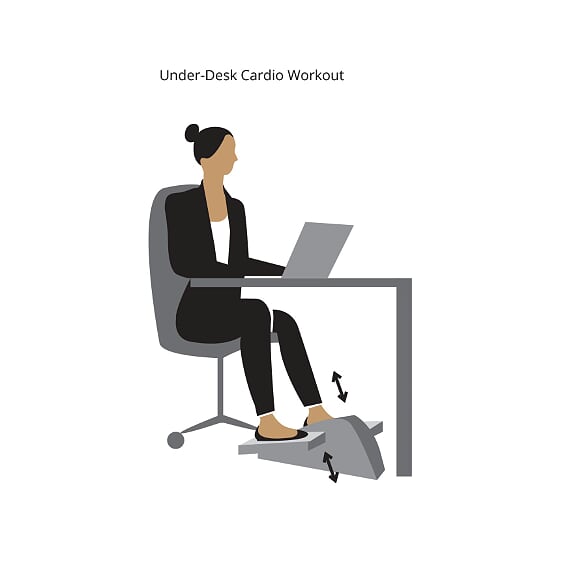
1. Under-Desk Cardio Workout

exercise at your desk

Under-desk cardio is a great option to exercise at your desk. You can keep moving even when you have to sit all day! Keep your heart pumping while using an under-desk elliptical or cycle.

 To start, try using the under-desk cardio for 2-3 minutes at a time and gradually working your way up. Start slow so that your legs don’t get too tired right away and/or so you don’t break a sweat. Work your way up to 10 to 15-minute increments for a calorie burning workout without leaving your desk!

Make sure you’re drinking plenty of water during this! Even though you might not feel like your working up a sweat, your body is still working and using energy.

Drinking water will help you recover faster and avoid dehydration.

Bonus- drinking water also helps increase productivity!

5 Science-Based Benefits of Drinking Water To Conquer the Work Day

2. Ab Squeeze

exercise at your desk

While we sit, we tend to slouch. For assistance on your core and proper posture, try doing an ab squeeze. You can do this while walking or seated in a meeting or on a call.

To perform, take a deep breath and tighten your abdominal muscles. Slowly bring them in towards your spine as you exhale. Keep your abs tight for 5-10 seconds and then release. Repeat this exercise 10-15 times. Remember to breath normal!

If you’re having trouble visualizing what to do think of tensing your abs and bringing your belly button toward your spine. This should feel intense like you’re doing a sit-up or ab crunch.


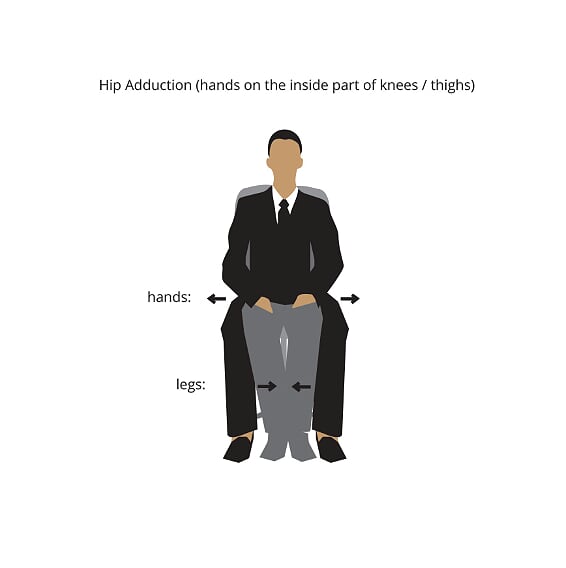
3. Hip Adduction Exercises

exercise at your desk

With too much sitting and not enough exercise, you may lose muscle strength and endurance in your legs. Seated hip adduction exercises are great for inner thigh toning and slimming!

You can do these exercises at your desk while you’re on a call or reading reports, nothing too involved as you’ll need your upper body as well.

Sit in your chair with knees bent at 90 degrees and feet flat on the floor, keeping knees hip-width apart and place your palms on the inside of your knees/thigh area. Press palms away as you squeeze thighs together, creating resistance. Squeeze hard enough for your hand to touch and then return to start. Repeat 15- 20 times.

Remember to sit upright and engage your core the whole time and to breathe continuously.

4. Hip Abduction

exercise at your desk

Another exercise to do at your desk that is great for your thighs!

This exercise works the outer thighs and is the opposite movement as hip adduction.

While seated place hands on the outside parts of the thigh, creating resistance try and press thighs/knees away from each other. Press until knees are hip-width apart then return to start. Repeat 15-20 times.

You can also use elastic exercise bands for hip adduction and abduction instead of your hands!

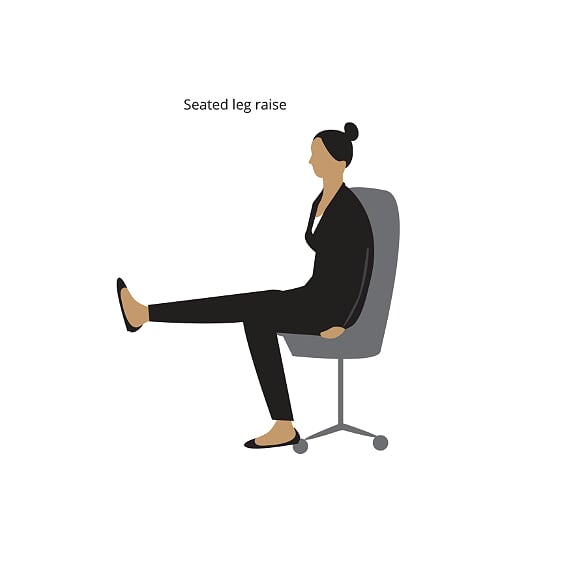
5. Seated Leg Raise

exercise at your desk

A seated leg raise is perfect for an easy quad and lower ab workout. Just make sure you’re practicing good posture while doing this move or else you’ll put unwanted stress on your back.

Sit tall with feet flat on the floor, and abs pulled in. Straighten right leg and lift it, so your foot is in a straight line with your knee. Breath. Hold for two breaths and release. Repeat on the left leg. Perform 10 times on each leg.

To modify and help with any lower back or knee pain, try bending the knee slightly when lifting the leg. This keeps stress on the body to a minimum, and you can work up to keeping legs straight.


6. Standing

exercise at your desk

This falls into a category that’s not technically an exercise, but it helps to combat all the sitting executives do.

By standing more throughout the day, you can discreetly strengthen your legs and abdomen by exerting more energy and working the muscles instead of relaxing and sitting.

 You can add movement by using a balance board or standing on one leg and then the other. A  standing desk is a great option for this! For more ideas read our article here- Stand Up and Feel More Energetic Today!

7. Squeeze the Buttocks

exercise at your desk

You spend long hours sitting at your desk. To tone and firm the bum, try squeezing the buttocks while sitting.

You can easily implement this exercise into your work routine as you sit at your desk. It takes no equipment and really no brainpower. You just need to do it.

Squeeze the muscle in your buttocks and hold for 10 seconds then release. Repeat 15- 20 times.  This shouldn’t be a strenuous exercise, but you will feel this after a few repetitions.


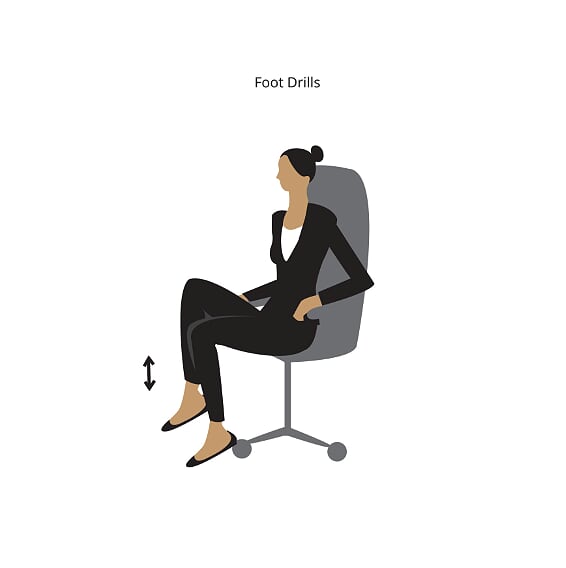
8. Foot Drills

exercise at your desk

To get a little more movement while staying seated, practice foot drills.

This simple exercise at your desk may reduce the impact of your sedentary life by increasing blood flow.

Similarly to when football players practice agility and speed and tap their feet continuously, you can do the same at your desk. Staying seated, tap your feet for at least 30 seconds. 30 seconds of work and 30 seconds of rest for five minutes total. Once you’ve mastered that, try upping the time to 45 seconds or a minute.

Don’t forget your seated posture while doing this. You’ll be engaging your core as well so no slouching!

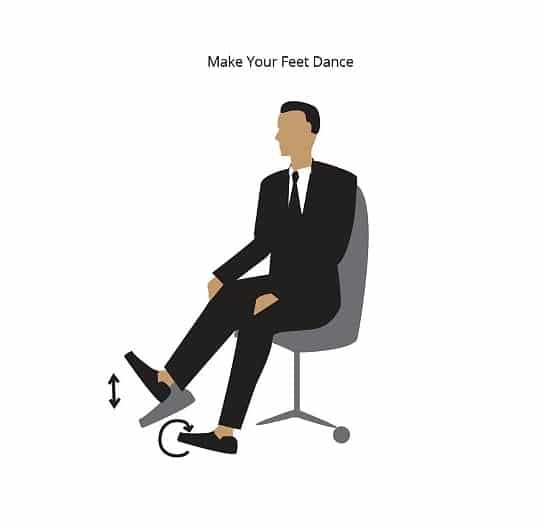
9. Make Your Feet Dance

exercise at your desk

For an easy exercise at your desk, try making your feet dance. Ankle strength and flexibility are important for balance and lower leg strength.

While seated slowly flex, point and rotate the ankle by drawing circles with your big toe. Doing this slow and steady will help reinforce the joint and prevent any injuries.

For more impact do one ankle at a time. This will allow you to focus on one ankle and notice any pain or weaknesses in the joint.


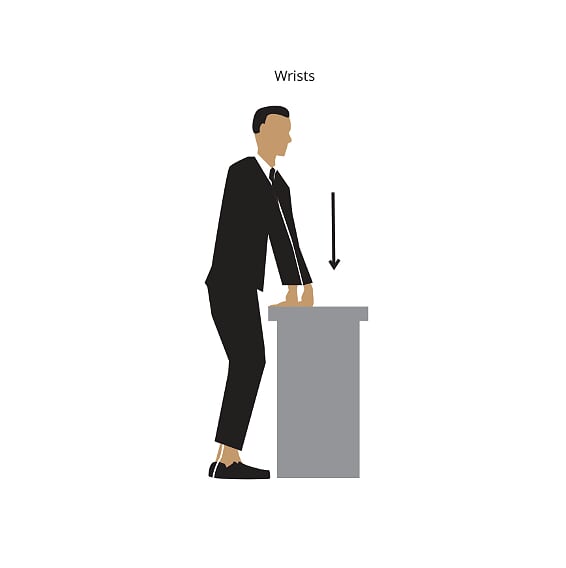
10. Wrist

exercise at your desk

To counteract typing and writing all day long, don’t neglect your wrists!

Being proactive about wrist health can prevent carpal tunnel syndrome, which is common among people who work at computers daily.

Stand at your desk and flip your palms face up so that your fingers are pointing towards you. Gently put pressure on the back of your palms pressing them into the desk. Take a few deep breaths, relax, and then repeat 1-2 more times.

If there is any pain when you do this stretch, just be gentler and put less pressure on your wrists during the stretch.

Want to be more active in the office? Get in some movement and activity that can easily be added to your daily work routine.

These 11 workouts are simple and you can do them in any office setting with minimal equipment.

Get Moving and Start Working Out at Work!

Moderate Exercises at Your Desk

1. Treadmill Desk

exercise at your desk

Utilizing a treadmill desk is a great option to really move while working. This piece of equipment is a bit of an investment, but it’s worth it for the executive who has to stay planted at the desk for most of the day.

The treadmill desk is great to exercise at your desk because, well, it is your desk!

While you are preparing a presentation or a report, you can get in some cardio with a treadmill desk while also strengthening your legs.

Start out slowly with this one as working while walking may take some getting used to.


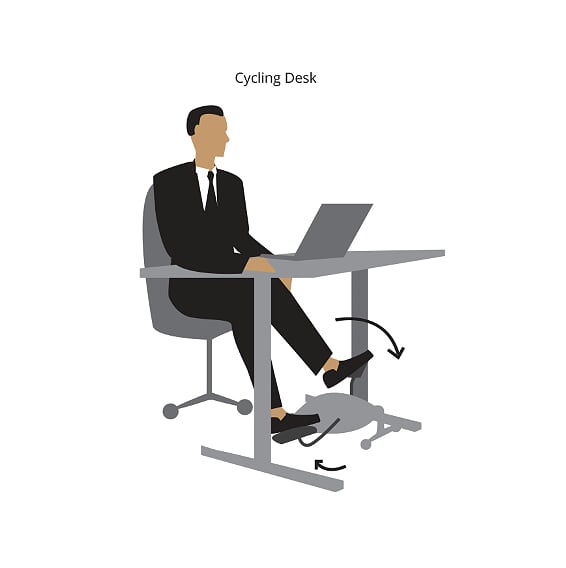
2. Cycling Desk

exercise at your desk

A cycling desk is another great option for exercising while sitting at your desk. Again, this can be a bit of an investment, but it’s a great option for executives.

Using a cycle desk is another great option to burn calories, develop improved muscle strength, and increase cardiovascular fitness.

Try a cycle desk as it allows you to work from your laptop- great for at work or home.

Pedal Your Way To Productivity Today!

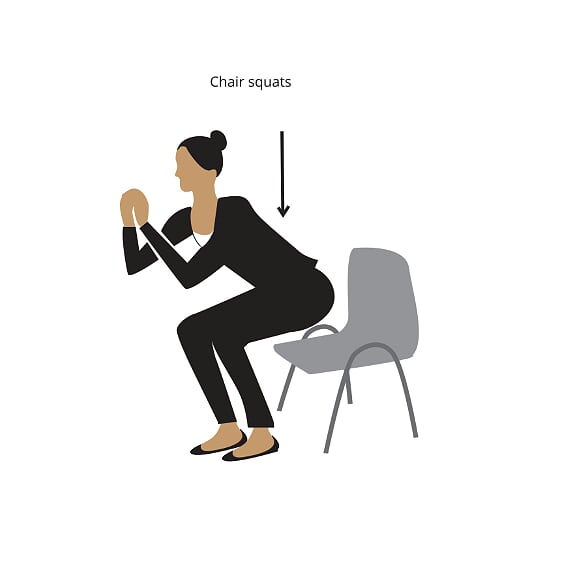
3. Chair Squats

exercise at your desk

You can do chair squats easily at your work station and engage most major muscle groups.

Squats are great for strengthening the legs.  The extra muscle activation can also help stimulate your body for more brain power throughout the workday.

 Stand with your feet hip-width apart, keep abs engaged and torso tall. Slowly bend your knees towards a 90-degree angle until your buttocks just touch your chair. Then straighten the knees to return to standing. Repeat 10-15 times.

Take note of your clothes and shoes before attempting this exercise. Pants or skirts that are too tight can restrict the movement. Heels are not recommended so slip off your shoes for this quick exercise at your desk.

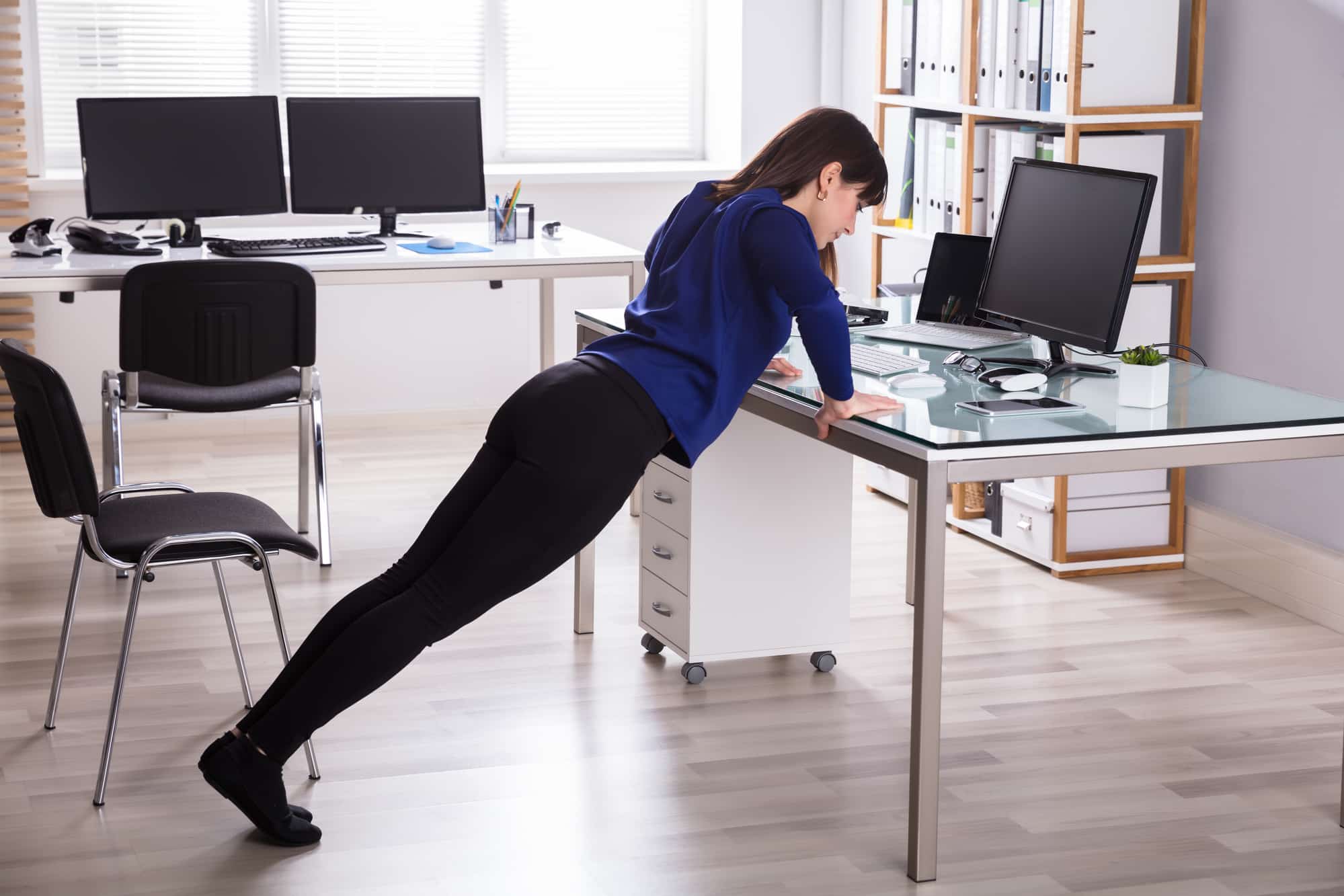
4. Desk Pushups

exercise at your desk

These pushups are a great option for some upper-body work at your desk.

Push-ups create a strong upper-body and engage your core for a very effective exercise.

First, check the sturdiness of your desk. You want it to stay in place when pushed lightly. Place hands on the edge of the desk and take a few steps back, far enough that your body is slightly diagonal with arms straight. With core engaged bend the elbows to a 90-degree angle and then press into hands to return to starting position. Repeat 10-15 times.

To modify this exercise, keep feet closer to the desk and bend more at the waist as your elbows bend toward 90-degrees. To make this more intense, do regular push-ups on the floor, if possible.

5. Chair or Desk Dips

exercise at your desk

These exercises are other upper-body exercises that work the chest, shoulders, and triceps.

Chair or desk dips can counterbalance the constant computer work executives must do daily.

 Again, check your desk or a chair to see if it is sturdy enough to hold your weight. Stand with your back to the desk and place your hands on the edge with fingers wrapped around the edge and elbows straight back. Step feet out as far as comfortable, engage the core and lower bending elbows to 90-degrees. Repeat 10-15 times.

This exercise is more challenging because it involves strength and chest flexibility. To modify, keep feet closer to the desk or bend knees slightly when doing the dip.

6. Side Lunge

exercise at your desk

Another effective lower body strengthener is the side lunge. This is great for the quads and hamstrings as well as the inner and outer thighs.

Start with feet together, press into the left foot while lifting the right and slowly stepping it out to the right creating a wide stance. Once the right foot is firmly on the ground start to bend the right knee towards 90 degrees while keeping the left leg straight. Press into the right foot to straighten the leg and then return to starting position. Repeat 15-20 times on each leg.

This is a more advanced exercise, so if you have any knee or hip issues omit this one. To modify, place your hands on your desk or something sturdy to help with balance.

7. Side Leg Raises

exercise at your desk

With too much sitting in the office, you may lose muscle strength in your legs. Side leg raises target the outer thighs and help with balance.

 Stand upright with hands placed on the desk or something sturdy. Press into the left foot, lift the right foot, and keep ankle flexed. Keeping right leg straight lift the leg as high as you can while still keeping your torso upright and then slowly return to start. Try doing 20-25 repetitions on each side.

Want to test your balance? Try doing this without holding onto anything!

8. Knee Pull-ins/Knee Pull-ups

exercise at your desk

These exercises are great for core work!

Knee pull-ins and ups at your desk may also increase your blood flow and reduce the negative impact of your sedentary life on your heart and health.

 Sit up tall on your desk chair with abs engaged. Lift both feet off the floor and pull knees in towards the chest, straighten legs back out so feet aren’t touching the floor. Repeat 10-15 times.

If this puts too much pressure on your back try lifting knees up then tapping feet back on the floor.

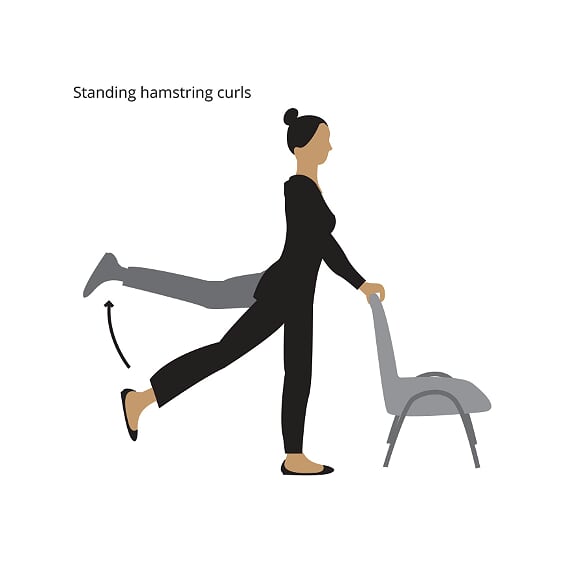
9. Standing Hamstring Curls

exercise at your desk

Standing hamstring curls help to work the buttocks and create a strong backside.

Stand up tall with hands on the back of a chair. Slowly lift one leg kicking it back behind you while bending your knee bringing the heel towards buttocks. Straighten the knee and return to start. Do 10-15 repetitions on each side.

Remember to keep your core engaged, don’t lean forward, and breathe deeply.

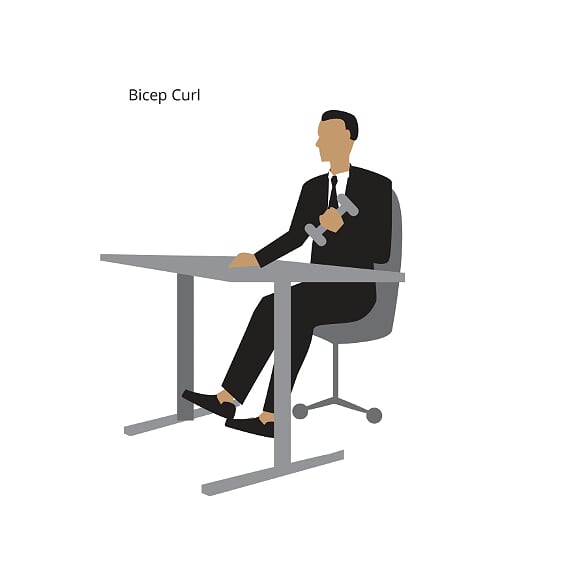
10. Bicep Curl

exercise at your desk

For an easy arm exercise at your desk try a bicep curl. To keep this office-friendly use a full water bottle or heavy object.

Place a water bottle in one hand and slowly bend elbow bringing hand towards the shoulder. Slowly return back to straight arms. Repeat this for 10-15 repetitions on each arm.

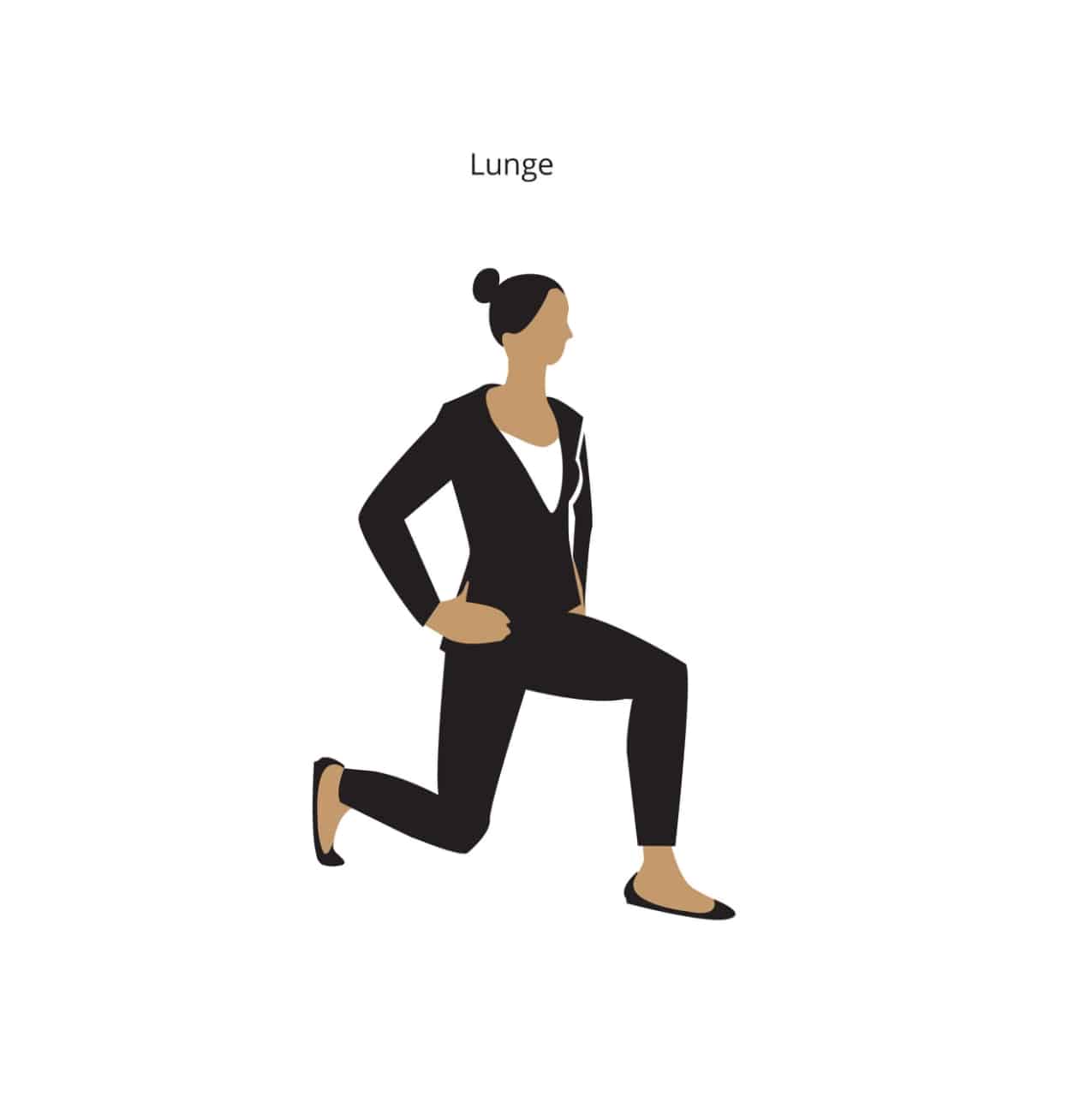
11. Lunges

exercise at your desk

Lunges are an easy exercise to execute at your desk during the workday.

Step right foot forward as if you’re taking a long step. Once your foot hits the ground bend your right knee so you’re in a lunge position. Straighten leg and return back to start. Repeat on the left side. Continue until you’ve completed 10 repetitions on each side.

12. Wall Sit

exercise at your desk

A low impact lower body exercise that won’t make you break a sweat is a wall sit!

Sitting often increases our chances of back problems that you can solve with this exercise at your desk.

Stand with back against the wall and bring feet 6-12 inches away from the wall. Squat down until knees are at 90 degrees and back it flat against the wall. Stay here for 20 seconds. If you need more of a challenge, try staying for 1 minute!

Remember to keep core engaged by pulling navel back towards your spine. Pants or skirts that are too tight can also restrict the movement. Heels are not recommended so slip off your shoes.

Extra Bonus: What Not To Do

exercise at your desk

Don’t sit on a stability ball at your desk! This may seem like a good idea, but your posture will suffer as we tend to slouch when sitting on them.

Do you have any back pain? There are many benefits to correcting posture and combating slouching.

Get 5 Simple Ways for How To Stop Slouching!

You can exercise at your desk and now you have some examples to follow!

What exercises at your desk have you tried? Do you have any suggestions for other executives? Please leave them in the comments below!


20 Great Office Stretches to Chase Aches Away

Perhaps you chose a desk job thinking that it wouldn’t cause you nearly as much strain as someone that does manual labor. But guess what? You’re just as susceptible to getting aches, pains, and even injuries as an executive spending 40 hours or more behind your desk.

Luckily, there is something you can do about it! Office stretches are a great way to help your muscles and joints, relieving the aches and pains that come with being tethered to your desk all day, week after week. If you’re been experiencing pain, give these easy office stretches a try. They take no time at all and will help you feel better immediately as well as down the road.

Plus, you’ll be more productive than ever when you feel good, which means you can finish work faster and spend more time doing the things you really love.

We’ve created this list of 20 office stretches that will make you feel great and release the tension, allowing you to boost your work productivity. You should aim to take a break to do these stretches every 45 minutes to an hour. Hold them for a minimum of 15 seconds before moving on to the next stretch.

If you’re been experiencing pain and aches, give these easy office stretches a try. Feel better Immediately! CLICK TO TWEET 

1. Up and Down Neck Stretch

This simple neck stretch technique is great for relieving you from the tension you get from staring into your computer screen for hours on end. First, tuck your chin down toward your chest. Then, slowly move your head back to a normal position. Now, look up. Hold it until you feel the stretch.

2. Side to Side Neck Stretch

Your head doesn’t just move up and down though, does it? We want you to get the best office stretch in your daily routine, so after you move up and down, try this move.

Sit straight up at your desk and tilt your head toward the side, like you’re trying to touch your ear to your shoulder. Don’t move your shoulder though! With the same arm your ear is now above, gently apply pressure downward to your head so you can feel the stretch. Switch sides to complete a full rep.

3. Shoulder Extension Stretch

For this office stretch, get out of that desk chair and push it away. Stand up straight and raise your arms in front of you, then clasp your fingers together. Slowly bring your linked arms over your head. Hold it, then slowly lower your adjoined arms so they’re straight in front of you again.

4. Behind the Back Stretch

Loosen up everything that’s tight in your upper body with this office stretch! You’ll be more refreshed than after your morning coffee!

Keep standing and stretch both arms behind you as far as you can. Link your fingers together and stick your chest out as you raise your arms up as high as is comfortable. This is a stretch, not a gymnastics move so go only to the point that you can.

There’s no need to look graceful, and should you be worried others will see you, close the door to your office or perform this one in one of the empty meeting rooms.

5. Shrug It Off Stretch

Taylor Swift sang about shaking it off, but for office workers like you, you need to shrug it off. You can stand or sit for this office stretch, whatever works for you.

Simply raise your shoulders up at the same time toward your ears, as if you’ve just been asked if you can turn that project around in less than an hour, only do it repeatedly. When lowering your shoulders, roll them back at the same time to really loosen things up.

6. Trunk Twist Stretch

Sitting at your desk day after day can really mess with your posture. And let’s face it. You need good posture to command confidence in your team and with clients. Don’t be a slouch!

Sit up in your chair and twist from your waist without rotating your chair (if it has wheels) so that you try to grab the back of your chair with both hands. Switch sides for a full rep.

7. Lower Back Love Stretch

Help improve your posture, your confidence, and the way you feel at work with these two office stretches  that will work in tandem to help you rock out more hours at work.

First, sit in your desk chair with your back straight. Then use your hands and pull your knee up toward your chest. Switch legs for a full rep. After doing as many of those as you can, lower both feet to the floor and sit up. Then, lean over your knees like you dropped your pen again but this time, hug your legs while you’re down there and enjoy the release.

Are you an executive that suffers from lower back pain?

Try These 6 Easy Lower Back Stretches at Work Today!

8. Legs for Days Stretch

All that sitting in your office chair can do a number on your circulation. You probably already know how doctors recommend you move around after sitting for a while, but that’s only part of it. You’ll lose mobility if you don’t keep them limber.

Sit down on the edge of your chair and extend both legs out in front of you on the floor. Lean forward, bending from your waist to bring your chest toward your knees. You’ll feel a glorious stretch through the back of your legs.

9. Butt-Kicking Quad Stretch

Your quads are one of the biggest muscles in your lower body. Help them help you by giving them some stretch time during office hours.

Get up out of that chair and stand on one foot. As you balance, lift your other leg back so your heel kicks your butt (no actual or repeated kicking is necessary). Grab that foot with your hand and hold it, then switch legs.

10. Torso Stretch

Here’s another office stretch we know you’ll love for helping keep you from hunching back down at your desk.

You’ll get a nice stretch through your entire upper body and your muscles will breathe a sigh of relief before you dig into your next project.

Stand or sit, whatever feels best, then lace your fingers together and reach them up toward the ceiling, breathing deeply as you do. Exhale and open your arms, flourishing them with drama back down to your sides (drama optional).

11. Triceps Stretch

You might be surprised how much relief you get at the office if you just take the time to stretch your triceps.

Raise one of your arms up above your head with your hand facing forward. Bend that arm at the elbow so your forearm goes behind your head. Take your other hand and grab that bent elbow, giving a little bit of pressure to stretch that backside of your arm. Do the other arm next.

12. Forearm Stretch

It’s likely that you’ve never thought about how typing affects your forearms. We’re right, aren’t we?

You don’t need to be a master typist either to suffer the consequences of tight forearms from working at your desk all day.

You can sit or stand for this office stretch too. Take one arm and stretch it out in front of you with your palm facing downward. Then take your other hand and use it to gently pull your fingers toward you. Not too hard! You don’t want to sprain anything! Just pull enough where you feel the stretch. Then release and switch arms.

13. Wrist Stretch

Tension also builds in your wrists. You know this to be true if you have carpal tunnel. The last office stretch starts to help that feel better but this one will seal the deal and make your boss of your own domain.

Stand up and put your palms flat on your desk, then push down to stretch your wrists. Again, not too hard. You don’t want to upend your desk and cause a scene.

14. Hip Flexor Stretch

Shakira says your hips don’t lie, and we have to agree. Your hips get tight from all the desk chair action, day in and day out.

Stand up, put your right leg back at least a foot behind you, more if you can manage it. Bend the knee on your back leg in a lunge-like fashion. Then lower yourself like the elevators in the lobby, keeping that knee at a 90-degree angle and over your ankle. Squeeze your glutes while doing it to maximize your gluteus maximus and make your rearview more enticing while you’re at it!

 15. Seated Hip Stretch

Another one of the office stretches you should be doing for your hips is this one, which you can do right now while you’re reading this instead of answering emails about TPS reports.

As you sit there, cross your right ankle over your left knee, then sit up tall. Lean forward slowly, keeping your back straight and reaching out with your torso. You’ll feel the stretch in your right glute as well as your hip. Deepen the stretch by pressing down on your right knee. Switch sides for a full rep.

16. Inner Thigh Stretch

Here’s one you’ll want to do in private, especially if you’re in a skirt. Even in pants, you’ll raise a few eyebrows.

Stay seated for the starting position and open your legs wide with your toes out. Lean forward and put your elbows on your thighs. Keep your back straight and engage your abs. Now, press forward as you use your elbows to push your thighs further out to hold the stretch and feel the stretch.

17. Wall Push and Stretch

If you do pushups when you actually make it to the gym, try a modified stretch version of it for an office stretch.

Instead of going for the full pushup effect though, you’re going to push with one arm and then twist your torso away from the wall as you push. The result is a glorious shoulder stretch and a great way to release the tension.

18. Big Hug Stretch

Stressful times at work could do with a cuddle. And they say if you can’t be with the one you love, love the one you’re with. All alone in your office, that means you’ve got to be the one to love yourself. Show that love with a great big hug. It’s basically what it sounds like.

Pretend you’re hugging someone else but close the gap and wrap your arms around your own shoulders. It will open up the shoulders and back, and you will see how the power of a hug can brighten your day at the office, even if you’re only hugging yourself.

19. Working Warrior Stretch

If you’ve ever gone to a yoga class outside of work (either willingly or being forced by a friend), you’ll likely recognize this as the exalted warrior pose. But it also serves you well as an office stretch because it opens up the chest, the shoulders, the legs, the abs, and the hips.

Stand up straight and step back with one leg into a lunge. Then raise both arms above your head and feel that stretch.

20. Rockette Kick Stretches

Whether you were born to dance or cringe at the mere mention of it, using some techniques the Rockettes use to master office stretches will bode you well.

Simply kick each leg up just over your desk one at a time while sitting at your desk. Hold each leg up as high as you can for 2 seconds each before releasing. Kick as high as you can without kicking your desk.

So get off your duff, or merely sit on it and enact some of these office stretches. We’d love to know what you think or if you started a desk exercise movement in your office, fell out of your chair and drew the snickers of other employees, or if you came up with a new office stretch everyone will love! Got one? Leave it for us in the comments below!

How to be fit over 50 if you are a busy executive

For business executives, being fit over 50 isn’t just about looking good; it is an essential part of the job.

According to the Center for Creative Leadership, senior executives who are visibly out of shape are perceived as being less effective in both performance and interpersonal relationships. A few extra pounds around the midsection are equated with poor leadership ability and reduced stamina in the workplace.

Take charge of your health, and commit to being fit over 50. Learn how successful executives over 50 stay at the top of their game.

Executive Summary:

fit over 50

1. Get With the Group

A great way to structure your workout schedule to include strength training and cardiovascular exercise would be to join a group fitness class. Group classes provide the camaraderie of others in your age group with the added bonus of motivation, accountability, and fun.

Don’t forget to integrate yoga, Pilates or another format of flexibility and balance training into your schedule. Try a desk exercise bike or an elliptical under desk machine.  Not only do these activities keep your muscles long, lean and limber, but they also empower the rest of your workouts.

Additionally, relaxing forms of exercises that are made of fluid, low-impact movements are great for the joints. They promote the production of the so-called “happy hormones” serotonin and dopamine, which combat the effects of cortisol caused by your high-stress lifestyle.

Find a senior league to help you work up a sweat. Consider slower-paced games, such as golf, water aerobics, or badminton. The goal is fitness and fun.

– Working out with others provides both motivation and accountability.

– A class with members in your age range will offer age-appropriate exercises with supervised modifications.

– Group classes take all of the guesswork out of your workout; show up, sweat and enjoy the music.

2. Enlist the Help of a Personal Trainer

If you prefer sweating alone, hire a personal trainer to help you design an appropriate fitness plan. This will ensure that you avoid injury and achieve maximum results. You don’t have to worry if your technique is off or if you are overtraining or undertraining certain muscle groups.

Additionally, financial investment keeps you accountable. No one likes to lose money; it’s a built-in guarantee that you will show up for your sessions. A personal trainer can offer nutrition coaching and assistance in creating healthy eating habits to support your goal of being fit over 50.

You can also invest in a book to get fit.

Take a look at our must-read books to take your fitness to the new level.

3. Fuel Your Day the Right Way

A healthy diet gives you the energy you need to tackle your day with vigor and be productive at the workplace. There’s nothing worse than nodding off during the most important meeting of your day because your blood sugar is dropping, and your energy levels have plummeted. Keep a stash of healthy snacks readily available in your desk to avoid a drop in your blood sugar midday.

Give your food choices as much attention as you give your job.

Focus on well-sourced protein and a rich variety of colorful produce. Stay away from processed and refined foods that lead to inflammation, which is the underlying cause of many chronic concerns in your 50s. Fill up on fiber from vegetables, fruits, sprouted grains, beans, seeds, and nuts.

Take your own food to work whenever possible to resist the lure of the vending machines. Here you have some great recipes ideas for busy working days.

4. A Little Friendly Competition

As an executive, you know that a little push might be all you need to get going in the right direction. Recruit your coworkers to form a team or individually sign up for a race.

Don’t limit yourself to running. Consider swimming, biking, rowing, or even forming a relay team for a triathlon.

5. Make Time to Relax and Unwind

Surprisingly, working in a high-pressure job with your brain fully engaged is actually better for your mental and physical health than you might imagine. However, this holds true only if you are managing your stress levels properly.

Spend time with people who uplift and encourage you rather than negative folks who bring you down. Consider joining a sports club to cultivate new friendships and challenges your current level of fitness.

If you’re not sure what you’d enjoy, check out your community center for a sampling of classes directed at your age group and fitness level.

Leave a comment to inspire other readers to step up, take charge and be fit over 50.

How to Be Fit Over 60 if You Are a Busy Executive

As you age, the body naturally slows down. If you are like most executives and entrepreneurs, creating space in your packed schedule for self-care can be a huge challenge.

But as a top executive, your lifestyle does not afford you the luxury of stopping. Let’s be honest, you’re a go-getter; you have no intention of slowing down. For this reason, you absolutely must commit 100 percent to lifestyle changes that allow you to be fit over 60.

There are simple actions you can take a few times a week that will keep you fit over 60, healthy and ready to tackle the challenges that your executive lifestyle demands.

fit over 60

1. Harness the Power of the Simple Done Well

Simple actions done with just your body and a flat surface can be performed right in your office and are easy to squeeze in between meetings or even on your lunch break. Squats, lunges, and planks, when done correctly, can improve your functional mobility and core strength and are easily modified to match any fitness level or accommodate any previous injuries or limiting conditions.

As you step toward being fit, remember that your muscles, joins, and tendons are not as pliable as they used to be. A strong body is your best defense against the natural trends of aging. Recovering from an injury takes far longer.

Choose simple yet effective exercises in your journey to be fit over 60,  such as a desk exercise bike or an elliptical under desk machine.

2. Get Moving

Just because there is a six at the beginning of your age does not mean you have to slow down. You simply must work smarter not harder to maintain the strength and functionality of your body. Most bone and muscle loss occurs when aging adults trade in their active selves for a sedentary version.

Being fit can ward off a host of degenerative illnesses and limiting conditions. Enjoy the benefits of a standing desk today and fortify and tone muscles, support the spine and counteract pressure on the spine discs, and improve lower back issues.

You can get stronger as you age.

Buck the trend of losing muscle mass and giving in to a slower metabolism. Integrate both strength and cardio into your busy week. Be mindful of eating whole foods that deliver maximum nutrition. Your couch is not calling to you; your life is calling out. Answer the call, and accept the challenge. Don’t just sit there getting old; fit over 60 is waiting for you.

3. Be a Flamingo

Standing on one leg may not seem relevant to your afternoon business meeting, but it is a fantastic way to improve your balance, coordination, and concentration.

The ability to balance and stabilize will help prevent the slips and falls that often plague us as we get older.

Most falls and injuries occur due to a lack of balance and overall functional strength. When you do simple balance exercises, you are forced to use stabilizing muscles that, when strengthened, assist in preventing nagging injuries like sprained ankles, twisted knees, and broken hips.

4. Try Tai Chi

It may seem like a waste of time when the goal is to be fit over 60, but there is a good reason these series of low impact, slow movements and breathing patterns are catching on around the world, according to the Harvard Medical School.

Not a sweaty, heart-pumping sport, tai chi promotes relaxation, balance, flexibility, and focus. It lowers cortisol output, which is the stress hormone responsible for belly fat. Best of all, it takes just a few minutes, needs no equipment and can be performed anywhere.

5. Get Outside

Being trapped in an office building all day every day can sap your energy and hinder your productivity. Consider packing a picnic lunch, and then taking a short walk afterward. The sunshine and fresh air will boost your vitamin D levels.

Vitamin D improves your mood and enhances your digestion while keeping the afternoon doldrums at bay.

Work productivity will increase with renewed vigor as you keep the blood pumping. Enlist the support of a friend to garner motivation and accountability as you seek to stay fit over 60.

6. Keep Up Your Core

The days of doing hundreds of crunches and sit-ups until your back aches are long gone. Modern research shows that core strength is essential to overall fitness, but there are many ways for you to keep your core fit over 60 that will not damage your body and put you at a heightened risk for injury.

When you are at your desk, sit up straight keeping your abdominal muscles tight as though you were anticipating being punched in the belly.

Try doing some light Pilates or yoga poses for a few minutes during a break in your tasks. Keep a stability ball in the closet of your office for some quick core work when you have a spare moment. You can never get enough core work. Keeping your core up as you age prevents those debilitating back injuries that can rob you of your livelihood.

To capture the concept of fit over 60, the goal for any busy executive should be to maintain functional strength and flexibility while reducing stress and preventing injuries as well as other limiting health conditions.

Bottom line: don’t stop moving.

Comment below to share how you are rediscovering your vitality as you harness the power of being fit over 60.

Easy exercises to do at home if you have no time for gym

The fast-paced life of an executive can make it hard to prioritize working out. Easy exercises to do at home can make this task a breeze!

Although it may seem like we don’t have enough time, the reality is that we must make time and exercise at home is likely our best option.

Find out Quick and Easy Exercises for Healthy Executives to do at Home.

A healthy body and mind are a necessity for running any company or corporation. As executives, we can’t afford to be constantly tired, sick or weak. Our livelihood and that of our employees depends on us. One of the greatest gifts you can give yourself is a break from a busy and stressful schedule with exercise.

According to a study, executives who are perceived as obese or overweight are also perceived as less effective in the workplace.

For some of us, this may seem like a harsh judgment but, the business world favors executives that hold their own personal life and health to just as high a standard as their job.

A heavy executive can be deemed less capable because of how weight affects health and stamina.

To overcome these perceptions and gain some healthy perspective in the process here are some easy exercises to do at home, before or after work, or whenever you have a few minutes of free time.

Executive Summary:

Easy exercises to do at home

1. Jumping Jacks

A healthy heart is immensely important for a busy executive. If there is one exercise that we can do to help beat stress, strengthen our bodies, and increase productivity it is some form of cardio.

Jumping jacks are good for the glutes, hip flexors, and quadriceps and you can do them at home, in the office, in a hotel room, or anywhere! No equipment is needed, except maybe some supportive tennis shoes.

To challenge yourself with this exercise try using a Fitbit Smartwatch. You’ll be able to track your heart rate and fitness level.

FIND OUT MORE NOW!

2. Resistance Band Set

Resistance bands are another great choice for executives because they are easily portable. Simply stash them in your briefcase, or suitcase while traveling, or keep them next to your bed so you can get in a short workout right when you wake up.

Try these simple exercises; bicep curl, tricep extension, chest press and bent over rows. These exercises are good for the chest, biceps, triceps and upper back; which are muscles executives need to strengthen to prevent slouching while sitting.

FIND OUT MORE ABOUT RESISTANCE BANDS HERE!

3. Plank

If you choose one strength exercise from this list, choose the plank! Planks are great for core strength and stabilization, as well as toning and shaping the muscles of the entire body.

Start out on hands and knees and place hands firmly on the ground with fingers spread wide for optimal balance. Lift knees so that you’re balancing on toes making a long line from the heels to the crown of your head. Engage core, breathe evenly and keep shoulders directly over wrists.

Stay in this position for 20-30 seconds and repeat. Challenge yourself to do this every day and see if you can increase your time!

Planks are also great at reducing belly fat, a problem that many executives share as a consequence of unhealthy eating habits and stress. Learn five more surefire ways to lose belly fat in the post Tips And Tricks For Battling Belly Fat.

4. Squats

Squats are an exercise any executive can do in any setting and with any clothing attire! Squats are good for calves, hamstrings, and quadriceps, muscle groups executives don’t use as frequently as they should as a result of sitting all day.

Start by standing with feet hip-width apart, lower hips down so that knees come to about a 90-degree angle (like you are going to sit in a chair), press firmly into feet and return to standing. Make sure to keep back straight and tall, no bad posture!

Try starting with 3 set of 10 reps. Want more of a challenge? Grab a weight (or heavy object) to add some resistance.

5. Walking Lunges

Lunges require a little more coordination and balance, something that all executives can use more of. Instead of just walking down the hallway to bed at night (or to your next meeting), try lunging!

Step right foot forward for a wide split stance, squat down so right knee comes to a 90-degree angle and left knee almost touches the floor. Straighten legs and step left foot forward and repeat. Make sure to get an even amount of reps in on both sides.

6. Push-Up

Push-ups are great for strengthening the muscles of the chest, abs, shoulders, and triceps. They can be modified or intensified for any level.

Start out in a plank position with core and legs engaged, lower body down so arms come close (but not less than) a 90-degree angle. To modify place knees on the ground or, bring the ground to you and start in plank position with hands on the side of your bed or a higher sturdy piece of furniture.

Try doing 20 push-ups every time you get out of bed in the morning! This a great way to get the blood pumping and start the day on a productive note.

7. Sit Ups On Balance Ball

Balance balls are great for added stability work, this exercise is great for any executive to promote a stronger core and better posture. This is important for executives because according to Research conducted at Ohio State University, it was concluded that with better posture, people were reported to have higher levels of self-esteem, better mood, and more confidence.

Start seated on the ball with both feet flat and firmly planted on the ground. Place hands behind head and slowly lean back, keeping core engaged and not rounding shoulders. Lean as far back as possible keeping good posture and then return to seat.

Try doing this every day for optimal core strength!

8. Jump Rope

Executives need a healthy heart! Jumping rope can easily be done at home with results after only a few minutes each day. This can be done with a jump rope or without.

Try switching it up by jumping with two feet, one foot, or even double jumps. This is an easy exercise to do at home every morning!

9. Triceps Dips

Triceps dips are a more advanced exercise but, great for strengthening the triceps and shoulders, while also increasing shoulder mobility.

Start in a seated position on a sturdy chair or the edge of your bed with feet firmly plants. Place hands on the edge of your seat with fingertips falling over the edge and the palm of the hand planted. Straighten arms and lift hips off the seat, bend elbows and lower hips down in front of the seat, straighten arms to return to starting position.

This exercise can put extra pressure on the shoulders and wrists; try relaxing the shoulders before doing this exercise and if there are any wrist or shoulder injuries try the triceps exercise with resistance bands stated previously.

10. Stationary Bikes

Stationary bikes are easy to use and something each executive should have in their home for a low impact cardio option.

Using a bike is a great easy exercise to do at home for executives because you’re able to place your work right on the desk and go over meeting notes, appointments, or take phone calls, all while riding the stationary bike.

Conclusion

Exercising doesn’t always have to be hard and all executives can make time in their busy schedule to get some form of activity each day.

These 10 easy exercises to do at home can be done all together or a single exercise at a time, executive’s choice!

Promote the perception of a healthy executive and the overall health of your company will reap the benefits as well. Find more advice on easy exercises to do at home on our top fitness books selected with executives in mind.

fitness and running books
HAVE A LOOK AT THESE POWERFUL FITNESS BOOKS!

Have you tried any easy exercises at home? What are your tips and tricks for other executives?

Working out at work

In general, when we think about what we do with our time at work it consists of meetings, to-do lists and overseeing the operations of our companies. Working out at work is likely never on this list and these activities usually require a lot of sitting.

Sitting increases our chances of back problems and is more likely to lead to obesity-related illnesses.

According to a study done by the Norwegian University of Science and Technology, they concluded that exercise has a tremendous and preventative effect on morbidity and premature death. We can conclude from this that exercise can increase our lifespan!

Part of leading an organization is caring for the well-being of yourself as well as that of the employees. Not taking care of yourself will reflect poorly on your company and subordinates.

 As executives and managers, we’re likely busy from the moment we walk into the office to the moment we go home, so how would there be any time to workout at work?

One solution is to try walking more. Walk to work or, park far away from the door of your office so you can get in a few extra steps before you start your day and before you head home in the evening.

There are so many easy ways to get in an easy workout at work! Don’t worry, you won’t be sweaty or out of breath for your next meeting but, you’ll be able to get in some movement and activity that can easily be added to your daily work routine.

Executive Summary:

workout at work

1. Take the Stairs

Taking the stairs is the single easiest way to get in a workout at work. Most office buildings have a few sets of stairs so challenge yourself to stop using the elevator and get your heart rate up. By taking the stairs you’ll be burning calories, building strong leg muscles, and working to keep your heart strong and healthy.

2. Use a Cycling or Treadmill Desk

exercise at your desk

According to a study done by the American Heart Association sedentary jobs have increased by 83% since 1950 and, with the reliance on technology, people are having to find more creative ways to combat this.

Enter the cycling desk or the desk exercise bike.  These are great options for someone who just really needs to stay put at their desk most of the day.

BURN CALORIES WITHOUT LEAVING YOUR DESK!

3. Under Desk Elliptical

exercise at your desk

Under Desk Elliptical is another great option for the executive who needs to stay put at their desk! This compact device sits under your desk and can help you stay more active while staying seated.

You can take phones calls and meet with others and not have to worry because it’s quiet and won’t bother anyone else. Just sit at your desk and use the pedals for an easy low impact exercise!

EXERCISE DISCRETELY AT THE OFFICE!

4. Have a Walking Meeting or Wander

Walking and talking, so simple. This is another easy way to kill two birds with one stone and work out at work! Wander is another way of saying, just get up and move.

An easy tip: set a timer on your phone for every 30 min, every time it goes off take a lap around the building. This can actually make you MORE productive by keeping your brain engaged and getting the blood pumping! Encourage your employees to try this, too!

5. Chair Squats

exercise at your desk

Squats are a staple in every workout routine, and for good reason! Think of how many times a day you stand up and sit down in your office chair, this small movement is essential to your corporate job function. There are many benefits an executive can gain from squats including improving the mobility in the hips and ankles, strengthen and tone the core and improve posture.

When you go to sit in your office chair squat down until you’re almost seated and then stand back up. Do this every time you go to sit and you’ll begin to reap the benefits!

6. Desk Pushups

exercise at your desk

Doing a pushup at your office might not be the easiest exercise to tackle but using your desk as a prop can help. Put both hands on the edge of your desk with your arms straight and walk your feet back until your body is slightly at an angle with your upper body leaning towards the desk. Bend your arms to 90 degrees (or whatever you can muster!) and push yourself back to the starting position. Try doing 2 sets of 10 every hour. That’s 80 pushups in a single day!

7. Arm Exercises

exercise at your desk

Have a heavy book at your desk? Grab it for some overhead triceps exercises! Hold the book overhead with both arms straight, lower the book behind your head until your elbows reach 90 degrees, straighten arms to starting position. Repeat!

8. Calf Raises

The next time you are waiting in line for the copy machine or for your turn to use the microwave start doing some calf raises. Calf raises will help tone your legs as well as help with balance. See how many reps you can get before you have to sit down again!

9. Hamstring Curls

Using a rolling desk chair press both feet firmly into the ground with knees bent at 90 degrees. Straighten both legs and then slowly return to the starting position by bending the knees. Want to make it a little more challenging? Try doing one leg at a time!

10. Leg Lifts

Seated leg lifts are great for the quads and abdomen. Sitting in an upright position with your back pressed into your chair, straighten both legs and left them up as high as you can. Engage your core and don’t slump over while doing this! If lifting both legs is too intense try doing one at a time.

11. Side Bends

A great core exercise, side bends can help strengthen the obliques and stretch out the side of the body. Place one hand on your hip while letting the other hand hang towards the floor, slowly reach the lengthened arm toward the ground. Go as far as you can without turning your torso towards the floor, slowly return towards the start. Repeat on both sides.

Working out at work doesn’t have to be complicated and it doesn’t have to be time-consuming. As executives, we need to change our mindset and attitude about working out at work. Begin with trying out one or two of the exercises listed every single day and work your way up getting in as much activity as you can throughout the workday.

These are also great tips to pass along to your employees, and by doing so it might even hold your more accountable as well! These 11 tips are simple and can be done in any office setting with minimal equipment. So, get moving and start working out at work!

Are you interested in seeing how easy it is to get fit? Check out our Books section exclusively selected for executives.

SEE HOW EASY IT IS TO GET FIT!

Any other tips or tricks for working out at work please comment below!

7 easy fitness guidelines for the professional executive

Starting an exercise regimen can be a daunting task for any executive, especially for a fitness beginner.

Our work days are usually packed to the brim with meetings, phone calls, and all the other important day-to-day tasks every executive faces, so adding a workout routine to the mix isn’t always a top priority.

There are many benefits for executives to start doing regular physical activity, one of them being to help reduce the rate of depression among managers and supervisors.

Research done at Columbia University concluded that leaders in a manager or supervisor role were 19% more likely to be depressed than their subordinates.

Instead of going right to medication or therapy, we can try exercise.

Regular physical activity can help curb symptoms of depression by releasing endorphins, taking your mind off work, helping to gain confidence, and facilitating healthy coping.  Resources geared toward fitness for beginners are abundant.

Give these tips a try, and let us know what you think!

Executive Summary:

fitness for beginners

1. Get A Fitness Assessment

It is wise to consult a doctor before starting any exercise program.

If you are a true beginner getting this initial assessment will allow your doctor to relay any health concerns and possible limitations for physical activity.

You will also be able to get your starting weight and muscle mass, good information to have as a reference when starting your fitness journey!

2. Choose A Program You Enjoy

All executives know that if you love the job you’re doing, then it doesn’t feel like work. The same can be said for exercise! There are many resources geared toward fitness for beginners.

Try looking into different classes at your local gym, free online workouts or possibly hiring a personal trainer. You won’t know what you like or dislike until you try it out!

Are you looking for inspiration? Check out our Fitness Books exclusively selected for Executives and Entrepreneurs with several fitness programs.

SEE HOW EASY IT IS TO GET FIT!

3.  Begin Slowly

If you’re an executive new to fitness this tip is pretty important. Starting out slow allows for your body (and mind) to get used to exercising with less chance that you’ll be discouraged.

Trying to do an intense workout, when you rarely or never workout, is going to leave your body sore and your mind weak.

This will likely cause you to want to forgo your next gym session. To help on a beginner fitness journey try using a fitness tracker!

Wearing a tracker will help you monitor your long-term progress and movement.

Starting with a fitness tracker and a beginner fitness workout will allow you to build muscle and endurance over time so that you will then be able to conquer the tougher workouts.

INCREASE YOUR PHYSICAL ACTIVITY NOW!

4. Bodyweight Exercises

Bodyweight exercises are great for fitness beginners because they allow you to build muscle and become more coordinated without the intimidation of weights.

Beginner friendly exercises include squats, lunges, plank, and push-ups.

For squats start outstanding with feet hip-width apart, keeping chest up and back straight lower down so knees come to 90 degrees (or as close as you feel comfortable), press into heels to return to standing.

In a lunge, we step the right foot forward and mindfully bend both knees until the right knee comes almost to 90 degrees and the left knee almost touches the ground. Press into feet to straighten legs and step left foot forward, repeat on this side.

For planks, we start on the ground on hands and knees keeping shoulders directly over wrists, curl toes under and lift knees so that your body is in a straight line from heels to the crown of the head.

Push-ups start out in a plank position, then, by bending elbows bring your body closer to the ground until elbows are close to 90 degrees. Press into palms to return to plank position. Plank and push-up can both be done modified with knees on the ground.

Take an executive approach to these movements and practice them until you are comfortable and have proper form. Once this is achieved slowly start to add weight. Don’t underestimate the power of bodyweight workouts!

5. Progression

Fitness for beginners can always be a good workout for an executive at any fitness level but, don’t let yourself get too comfortable or else you will become stagnant and possibly discouraged.

Progression in workouts is key to keeping the body strong and active.

Try out a new class, some different exercises or adding resistance to the exercises you already know.

Resistance bands are a great choice for executives because they are easily portable and can virtually work every body part.

Adding resistance bands to simple exercises, such as squats, can help burn more calories and increase muscle mass over time.

FIND OUT MORE HERE!

6. Accountability

Accountability is essential for a lifetime of health for any executive.

Some easy ways to hold yourself accountable are working out with friends or hiring a personal trainer.

Fitness with friends is a good option because someone close to you can hold you accountable, which will make you less likely to drive home after work instead of straight to the gym.

Personal trainers are great for executives because a specific time can be set each day or week to workout that revolves around your busy schedule.

Recovery is often forgotten in a workout regimen but it is just as essential as the actual workouts.

Working out breaks down the body’s tissues, rest days allow for them to recover and rebuild stronger than before.

Another essential aspect of recovery is hydration and fuel. 60% of our bodies are made of water and when we sweat we lose it, staying hydrated allows our bodily functions to work at maximum capacity and feel our best.

READ MORE ABOUT BEING HYDRATED AT WORK!

Along with hydration, the food we ingest must be nourishing, such as high protein and low-fat meals or snacks.

Conclusion

Executives need exercise for a healthy body and mind.

These are essential for running a healthy business. Fitness for beginners doesn’t have to be complicated!

Try starting out small with a fitness tracker and see how many steps you can get each day, continually try and match or beat yourself daily!

For instance, Leaf Urban Health Tracker is a fashionable fitness tracker for women.

FIND OUT MORE HERE!

After that try adding in some strength training and cardio, whatever works for you.

If you need some continued inspiration check out these books to help you get encouraged!

Do you have any suggestion or tip for fitness for beginners? Please share in the comments!