Emotions and success: Positive emotions and how they accelerate your success

While it is no secret that achieving success in one’s career requires hard work, determination, and a positive outlook. What is often overlooked is the powerful relationship between our emotions and success. Positive emotions, in particular, can yield significant power in the workplace. 

By harnessing your positive emotions, you can be more resilient, improve your emotional state, and better equip yourself to handle stress, pressure, and setbacks. 

As an executive, it is important to cultivate and maintain a positive emotional state, as it will have a direct impact on your success and the success of your team.

What are positive emotions?

Positive emotions are feelings that bring happiness, joy, and a sense of well-being. While these emotions are essential for our mental and physical health, they also play a significant role in determining our professional behavior, our decision-making processes, and how we interact with others. 

It’s common to see our emotions as a hindrance in a professional setting, but it’s important to recognize they can also serve several positive functions. For example:

  1. Motivation: Emotions can serve as a motivator and drive individuals to work harder and perform better. For example, feeling proud after accomplishing a task can lead to higher motivation.
  2. Communication: Emotions can help convey important information and facilitate communication with others. For example, showing empathy towards a colleague can help establish better rapport and foster a more positive working relationship.
  3. Decision-making: Emotions can influence decision-making by providing critical information about potential outcomes and their impact. For example, feeling nervous about a possible decision can signal to the individual that it may not be the best choice.
  4. Creativity: Emotions can also play a role in promoting creativity and generating new ideas. For example, feeling happy and relaxed can lead to more innovative thinking.

Having positive emotions at work can create a positive work culture and lead to improved relationships with colleagues, better job performance, and higher levels of job satisfaction.

How to use positive emotions to accelerate your career success

Positive emotions can play a crucial role in accelerating your career success.

Anecdotal evidence suggests that positive emotions are strongly correlated with success. Successful individuals often attribute their achievements to a positive mindset, optimism, and the ability to remain focused and motivated even during challenging times.

For example, Oprah Winfrey, one of the most successful media personalities in the world, has frequently emphasized the importance of maintaining a positive attitude, gratitude, and visualizing success as key factors in her success.

Similarly, Richard Branson, the founder of Virgin Group, has also spoken about the significance of positive emotions in his business ventures. In his book “The Virgin Way”, he stresses that positive emotions, including humor, kindness, and a sense of adventure, are vital to creating a positive work culture, building strong teams, and ultimately achieving success.

How you can use positive emotions to your advantage:

  1. Boost your confidence: Positive emotions like happiness, gratitude, and excitement can boost your confidence, making you more assertive and resilient in the face of challenges.
  2. Improve your relationships: Positive emotions help you connect with others and build strong, supportive relationships with your coworkers and colleagues. This can lead to opportunities for career advancement and increased job satisfaction.
  3. Increase your motivation: Positive emotions can increase your motivation and drive to succeed. When you’re feeling happy and fulfilled, you’re more likely to put in the extra effort and work towards your goals.
  4. Foster creativity: Positive emotions can enhance your creativity and imagination, allowing you to approach problems with a fresh perspective and generate innovative solutions.
  5. Improve your resilience: Positive emotions help you bounce back from setbacks and failures, allowing you to recover quickly and keep moving forward in your career.             

The consequence of too many positive emotions

As the saying goes, “too much of a good thing can be harmful’. The same can be said of positive emotions. Too many positive emotions can have adverse effects.

Let’s look at a few examples of how too much positivity can lead to negative effects:

  1. Overstimulation: When we experience positive feelings to an extreme, it can overstimulate our emotions, leading to exhaustion and burnout.
  2. Unrealistic Expectations: Excessive positivity can lead to unrealistic expectations about life, which can be devastating when reality doesn’t match up.
  3. Avoiding Negative Emotions: When we focus too much on positive emotions, we may avoid processing negative emotions and experiences, which can prevent us from growing and learning from them.
  4. Impairing Judgment: Being too positive can also impair our judgment and decision-making abilities. When we only focus on the positive, we may overlook potential problems and risks.
  5. Interpersonal Conflict: Excessive positivity can also strain our relationships, as others may see it as insincere or fake. Additionally, it can also lead to conflicts, as we may not be able to understand or acknowledge others’ perspectives and emotions.

It’s true positive emotions are important. But it is also necessary to maintain emotional balance and not become overly consumed by them. A healthy emotional life involves a range of emotions, including both positive and negative ones.

How to balance positive emotions and success at work

Positive emotions can help us to stay motivated and inspired, even when faced with challenges or obstacles. They give us the energy and drive to push forward, even when things get tough. 

Similarly, positive emotions contribute to better relationships with colleagues and clients. When we are in a positive emotional state, we are more approachable, friendly, and engaging, which helps us to build and maintain strong professional relationships. 

These relationships are essential for developing trust, collaboration, and cooperation, which are critical components of success in any industry.

As you can see, positive emotions can be a powerful force in the workplace. But it is important to note that while emotions can serve these positive functions, you must also manage them professionally. 

Harness positive emotions and success will follow

Positive emotions and success go hand-in-hand. Managing these emotions is crucial in the workplace. And managing them well can significantly contribute to helping you achieve your career goals. 

Not only do positive emotions increase job satisfaction, but they also improve your relationships with colleagues, enhance your decision-making abilities, and boost your overall well-being

By prioritizing positive emotions in the workplace, you can create a supportive and productive environment where everyone can thrive. 

How to Control Your Emotions at Work and Recognize Your Triggers

Have you ever experienced rage in the workplace? Or maybe overwhelming anxiety? It’s natural to feel emotions in all facets of our lives. And the workplace is no different. After all, our feelings are what make us human. Experiencing negative emotions in the workplace can be concerning, especially when they become more intense and frequent. Learning how to control your emotions or emotional responses is a critical professional skill to develop.  

Understanding how to control your emotions and recognize what causes them

Our ideas and experiences frequently influence our emotions. Our brains produce them to provide meaning to physical sensations based on prior knowledge. That’s why one situation can cause completely different emotions in two people. For example, your coworker may have had a past negative experience while presenting in front of an audience. This can make them feel nervous when giving presentations. You, on the other hand, may have always given great presentations. When you’re in the same situation, you probably feel incredibly excited to present again. Our emotional response varies depending on previously stored information based on our unique experiences.

Additionally, our brains often misinterpret our emotions. You might believe you are angry, but you may just be irritated. Or you could even be both.

The biggest problem arises when you can’t correctly identify your emotions. You can’t manage your responses if you don’t understand how you’re feeling. Learning how to control your emotions in the workplace can only happen once you correctly identify the emotions you are dealing with. The following strategies can assist you with that:

Become more emotionally literate

Words have power. Take time to think of a name for your powerful emotion. Label it. Once you’ve found it, don’t stop there; attempt to think of two additional words to express your feelings. You can be taken aback by the range of your feelings or by the fact that you’ve discovered a more profound emotion buried underneath the more surface-level one.

Think about how strong the emotion is

Even when our sentiments are far less intense, we often use simple words like “mad” or “stressed” to describe how we feel. By doing so, you invite equally severe reactions.

Pause for a moment before reacting. Consider the actual intensity of your emotions. It can help you understand if your extreme reactions are warranted.

You could even take it a step further and rate your emotions on a scale of 1-10 to help you recognize them appropriately.

Put it in writing

Writing about emotionally charged events can significantly improve your physical and mental health. It helps you approach your feelings differently and better comprehend them and their effects. When you express your emotions in writing, over time, you start to understand the meaning or lack thereof of your emotions.

Recognizing your emotional triggers in the workplace

When reflecting upon your emotions, you may notice a pattern in your emotional responses or see how specific situations or times of the day affect how you feel. While some emotions may occur without reason, many result from varying triggers, either external or internal. It’s important to trace these triggers back to their root causes. Maybe failure caused you a significant loss in the past, so experiencing (or the thought of) it now results in intense infuriation. Whatever your respective triggers may be, identifying them can help you control your emotions in the workplace.

How to identify your emotions before they occur

Once you’ve begun internally reflecting on yourself and penning your emotions, you will become more emotionally aware of yourself. You now know your triggers and understand when and why you react the way you do. The next time you’re in a situation that can cause you to react without thinking, direct your attention to your feelings as they develop. Then, call the emotion by its name in your head so you recognize it. Finally, question its intensity, accept its existence, and wait for it to pass without reacting quickly. This way, you can identify your emotions before they fully surface, giving you an edge in controlling them in the workplace.

Managing emotions in the workplace

After successfully identifying your emotions and their origins, you can begin managing them. Here are some strategies to help control your emotions in the workplace:

Savoring

Inhibiting negative emotions through positive ones can help counter them. Savoring means looking for the good in a bad situation and your surroundings. Focus on emphasizing positive feelings and not being overwhelmed by negative ones. One way to practice this is by being grateful for the things that did go right and learning from those that didn’t. For example, if your future project fails, don’t sulk over failing. Instead, celebrate how your team came together as one and tried their best, despite the result. By creating such positive emotional energy, you uplift everyone’s mood.

Similarly, avoid being pessimistic. Focusing on your employee’s flaws can cause negative emotions to linger. Avoid diminishing and devaluing their contribution to your organization the next time they make a mistake.

Mindfulness

In the corporate world, failing and winning are constants. We can be hard on ourselves when we don’t meet the goals we set out to achieve. This can significantly contribute to your increasing negative emotions.

Mindfulness is the practice of quietly observing and accepting your feelings, thoughts, and physical sensations while maintaining awareness of the present moment.

To practice mindfulness:

  • Take a few minutes to process and identify the negative emotions you’re undergoing when they come your way.
  • Let them flow as they are without passing any judgments.
  • Accept that all feelings are transitory. They emerge, remain for a time, and then leave. Your only responsibility is to let them exist and watch patiently as they repeatedly change until they dissipate.
  • Once entirely calm, examine your feelings in detail to determine what causes them and makes you uncomfortable.

Specific cognitive patterns could be the culprit. You might be feeling anxious because you were excessively worried about something at work or someone at home. Whatever the reason, you are in a much better position to manage it in the future.

Praying

We all experience dread, despair, and humiliation, which can be difficult to face in a work environment. Praying can help you cope with unfavorable emotional states by reappraising unpleasant situations and presenting them as an aspect of a cosmic battle. The difficulties of life that bring out negative emotions begin to seem temporal when you recognize them as part of God’s divine plan, which you will eventually get through.

So, the next time you experience such emotions, take a minute to ask God for strength and ease the journey for you, putting your complete faith in Him.

Learning how to control your emotions in the workplace, final thoughts

Initially, learning how to control your emotions may seem like an overwhelming task. You’ve likely lived your whole life reacting without thinking about your emotions in the heat of the moment. Of course, getting used to this change in thinking will take time. But all it requires is consistency and some conscious effort to reach a place where emotional control starts coming to you naturally. Remember, your emotions don’t control you, but you control them! So, don’t let your emotions keep you from reaching your utmost potential, and don’t give up if you fail initially.

The best books on spiritual energy for business people

The role of spirituality is growing in importance in the business world, especially in the field of entrepreneurship. It is a driving force that inspires business owners to operate in a way that not only allows them to make a profit but also to better serve their customers. A great way to get started on your path to spiritual growth is to read books on spiritual energy.

Why spirituality? Evidently, it aligns with the fundamentals of business, which is to serve the needs of consumers.

A true spiritual entrepreneur considers others’ welfare and their own while making business decisions. Their motivations transcend their egos or self-interest. That is undoubtedly the beautiful part of it. But it extends much farther than simply putting people first. The central aspect is that your drive comes from a place of kindness and love. There is no consideration of your own gain. And that’s the specialty of it; the belief that any firm that helps and aids others will flourish and reap financial rewards.

“Being an entrepreneur simply means being someone who wants to make a difference to other people’s lives.” Business Magnate, Richard Branson.

Spiritual energy and business

Harnessing spiritual energy can be especially beneficial for business owners. The principles of spirituality guide you to have solid values, a distinct purpose, and incorporate ethics in your dealings.

Reading is an easy way to begin your path to career success through spirituality. It challenges your thoughts, emotions, and soul while assisting you personally. Additionally, it enables you to reach your full potential by connecting you to your inner self. Indeed, there is no career success without personal success.

6 Must-read books on spiritual energy

Are you an entrepreneur with a vision you want to bring to life? Perhaps you find yourself overwhelmed by feelings of depletion, dread, or uncertainty about where the universe is leading you that prevent you from achieving your goals.

I recommend the following excellent books which will not only help you to recharge your spiritual energy but your mental energy too.

1. Endurance: Shackleton’s Incredible Voyage by Alfred Lansing

This thoroughly researched account describes how, when their ship, the Endurance, sank close to the South Pole in 1914, explorer Ernest Shackleton and his crew struggled against nearly impossible odds to reach civilization.

Although this isn’t like your usual business book, it’s a great analogy of the similarities between Shackleton’s path and those of new businesses. It highlights how a strong stance in tense circumstances may make or break one’s success.

2. Do the KIND Thing by Daniel Lubetzky

This excellent book highlights Lubetzky’s fascinating life while teaching valuable business lessons. Lubetzky is the CEO and creator of KIND, a food company that produces wholesome, practical snacks.

It is a great mixture of business with autobiography. It covers creating a flourishing company that is tied to your principles.

Lubetzky’s philosophy underlies all his ventures: little deeds of compassion, no matter how modest, have the power to transform entire societies.

His motivation is captured in the anecdotal story of a Nazi soldier who risked his life to give Lubetzky’s father a bad potato. A potato that he likely needed the most. The soldier helped Lubetzky’s father and mother escape the Holocaust.

The main outtake from the book is that you don’t have to give up your personal beliefs and objectives to achieve career success.

3. The Soul of Leadership: Unlocking Your Potential for Greatness by Deepak Chopra

The Soul of Leadership explores the human soul in great detail. It is intended to help the interested reader navigate the many connections in their life.

Don’t be misled by the title, it is not just for established business leaders. The book goes well beyond the expectations of the existing leaders.

Chopra claims that the synchronicity of the soul is the unacknowledged assistance of true visionary leaders. He suggests you can achieve synchronicity by changing your behavior and adhering to your beliefs as necessary.

Fully take in Deepak Chopra’s soul-nourishing advice to reap the most benefits from the book.

4. The Untethered Soul by Michael A. Singer

Beginners who are interested in awareness and spirituality should read this book. It emphasizes letting go of your limits and considering where they came from in the first place.

This book will teach you many things, including how to let go of unnecessary attachments that you may believe you need in life. It will change your life for the better.

What’s more, it teaches and establishes the importance of meditation. It provides a wide range of techniques to relax your anxious thoughts and give direction to your life. Both are extremely important lessons for a successful entrepreneur.

5. Personal Power Through Awareness by Sanaya Roman

If you want to broaden your perspective on the world and expand your horizons in order to lead a more fulfilling existence, you should read this book.

It will help you achieve the next level of awareness by being aware of your skills, how you can utilize them, and how you use your energy.

Instead of attempting to compel energy via the simple repetition of affirmations, you learn how to interact with and elevate your thoughts and emotions effectively.

This is a valuable lesson in today’s fast-paced business world. It guides you to not make erroneous conclusions or decisions due to all the noise that fills your life.

6. The Four Agreements: A Practical Guide to Personal Freedom by Don Miguel Ruiz

This book is excellent for altering your perspective on engagement and conversation with people.

The idea is straightforward yet unique, altering the way you perceive things. Entrepreneurs frequently experience stress from being overly preoccupied with others’ opinions.

With the help of this book, you can gain a new perspective on what’s most crucial to concentrate on and what to avoid to keep your motivation high.

Get started with one of these books on spiritual energy today

Read these books, make a commitment to live up to the principles they preach, and reap the benefits of the lessons they teach. Whether you want to be a spiritual leader, or entrepreneur or you’re just interested in getting started on your spiritual energy journey, there’s a book in this list to get you on your way.

5 popular mindfulness books that every business leader should read

Did you know mindfulness reduces anxiety and is strongly linked with creativity? Mindfulness has many benefits, especially if you are a business leader. Reading some of the top mindfulness books will undoubtedly elevate your problem-solving and can improve your leadership in a variety of ways.

Having trouble finding the right book to get started? Don’t worry. You’ve come to the right place. I’ve compiled a list of the top five interesting mindfulness books for business leaders. If you’re looking to embrace mindfulness as part of your leadership style – or even if you aren’t – I strongly recommend these books to get started on your path to mindful leadership.

What Is Mindfulness?

Mindfulness is a state of mind – or mental workout if you will – that enhances your brain and increases your capacity to cope with daily stressors and emotional upheavals.

Why is this important for business leaders? It’s simple, really. A mindful leader is present, self-aware, and approaches their workday calmly.

Mindful leadership has been found to inspire and motivate team members more so than traditional leadership methods.

While this list is by no means exhaustive, it’s a great place to get started on your journey to mindful leadership.

5 must-read mindfulness books for business leaders

“The Mindful Way Workbook” by Zindel V. Segal, Mark Williams, and John Teasdale

It is common for business leaders and entrepreneurs to suffer from anxiety, stress, and other mental conditions. The mindful way workbook uses a proven cognitive therapy program to help executives cope with daily stressors.

Written by three experts, it helps people understand mindfulness and the reasons why people get stuck in stress and a vicious cycle of negative emotions.

Even if you are not going through any complex emotional situations, this book can still help you. It can help you develop the skills to be more focused and relaxed while performing tasks and prevents stress and anxiety. After reading this book, you will be able to respond to feelings and thoughts in a more thoughtful way.

“Wherever You Go, There You Are” by Jon Kabat-Zinn

This book is an excellent tool to help you practice, learn, and apply mindfulness strategies in your daily life. It helps you understand how you can become mindful without doing anything extraordinary. You can achieve an enhanced level of mindfulness simply by improving and bringing small changes to your everyday life.

Kabat-Zinn, a professor of medicine emeritus, beautifully explains that every heartbeat and every breath is a new opportunity to try to live again. After reading this book, you will learn how to practice generosity, patience, judgment, concentration, humility, and simplicity.

Kabat Zinn is on a personal mission to connect science and mindfulness, and his book is proof of his great work. He highlights the best practices – based on science and mindfulness – for business success.

“Creating Mindful Leaders” By Joe Burton

In the age of disruption, Joe Burton, an entrepreneur and CEO of a well-being training platform, Know How to Thrive, has written a book: Creating Mindful Leaders. Burton’s book helps you learn resilience, emotional intelligence, and mindfulness skills and is full of practical tips to implement these skills.

The practices mentioned in this book are based on positive psychology, neuroscience, and brain training that put forward a roadmap of greater happiness, performance, health, and success for you.

Did you know? Outstanding leadership depends upon emotional intelligence. Various case studies and research show that emotional intelligence is increased by mindfulness, which enables leaders to solve challenging and mind-boggling problems.

“The Mindful Leader” by Michael Bunting

Michael Bunting’s book is considered the best reading choice for business leaders because it provides training for becoming mindful and enhancing leadership. It encourages and shows different perspectives and methods of mindfulness to the leaders to lead in the competition.

This book helps you understand the relationship between mindfulness and leadership. It hones in on the specific disciplines of mindfulness that will impact your leadership style. It will also help you make changes that will transform your organization, team, and whole life.

Michael Bunting has practiced mindfulness for more than 22 years and teaches it at Sydney University in a leadership context. He knows from experience how mindfulness can transform the life of a leader.

“Finding The Space To Lead” by Janice Marturano

Finding the Space to Lead is the best book if you are looking for something that offers a pragmatic and well-written approach to mindfulness. It contains various practical exercises that will help you significantly change your attitude towards your business operations and routine life.

It includes tools that you will need to develop leadership strength. As a senior executive, Janice Marturano writes from a position of personal experience about mindfulness.

This book will help you understand how your emotions affect your leadership and why mindfulness is essential, especially for business leaders.

Alternative books on mindfulness, especially for business leaders

While the above-reviewed mindfulness books are our top picks, I have a list of some extra great reads if you’re looking for more. And while they didn’t make the top list, these additional books also help people become great leaders and assist leaders in achieving greater success in their businesses.

  1. The Miracle of Mindfulness by Thich Nhat Hanh
  2. Practicing Mindfulness by Matthew Sockolov
  3. Altered Traits by Daniel Goleman and Richard J. Davidson
  4. 10% Happier by Dan Harris
  5. Whole Catastrophe Living by Jon Kabat-Zinn

Final words

I hope this list of mindfulness books helps get you started on your path to mindful leadership. Even if it is just a nudge in the right direction, I know it can help. Reading really is a great way to master new skills.

Find a great piece of advice from one of the above-mentioned books that genuinely resonates with you.  And use it to steer your leadership technique in a better direction.

As Max Depree said, “we cannot become what we want by remaining what we are.” So, why not follow his advice, choose a mindfulness book today and start working to become what you want to be in the future.

Have you read another mindfulness book that you feel I may have overlooked? Share it below in the comments so others can benefit from the same wisdom.

How to create a good LinkedIn profile that attracts headhunters

Are you considering a career change? Or maybe you just want to keep your options open? Whatever your job status or motivations, one of the most important tools for professional workers is their LinkedIn profile. So, whether you’re looking for a new job – or even if you’re not – there are some “must-have” and “nice-to-have” LinkedIn features that you should consider implementing (or enhancing) to ensure you have a good LinkedIn Profile. And, if you want to take it one step further, a maximized job search tool.

Whether you are a LinkedIn beginner or already have some LinkedIn experience, this post will walk you through the process of creating a good LinkedIn profile and getting the most out of LinkedIn. For experienced LinkedIn users, you can even skip ahead and discover some extra features that you might be missing out on!

Why LinkedIn?

Why is LinkedIn such an important resource when it comes to job searching? Simple connections that can spread beyond your immediate circle. If you’re looking for a job, you’re going to need recruiters and headhunters. Did you know that there are over 900,000 of them present on the LinkedIn platform? But the trouble is often having your LinkedIn profile noticed by the right people. The answer again comes back to having a good LinkedIn profile that will attract recruiters and help you land your dream job.

How to use this guide

For simplicity, I have separated this post into three sections to help you navigate the article and also to make sure you get started at the right spot. You can decide how committed you are to maximizing your LinkedIn profile.

The first section is my “ABSOLUTE MINIMUM,” “MUST DO LIST.” These are things which you HAVE TO do straight away – even if you are not actively looking for a new job.

The second section is for ACTIVE JOB SEARCHERS. While these tips are not “must do”, they’re necessary if you want to become an active LINKEDIN member and increase your probability of being seen on LinkedIn.

Finally, the last section is for those seeking to get the most out of LinkedIn. By implementing a COMPLETE LINKED PROFILE, you can leverage every possible element of LinkedIn in order to seize every opportunity and fully maximize your LinkedIn profile.

LinkedIn profile must-haves for professionals

  1. Use a Professional Headshot as Your Profile Picture
  2. Create a Compelling Headline
  3. Develop Your LinkedIn Summary into a Story
  4. Add Your Work History
  5. Include Most if Not All of Your Licenses and Certifications
  6. Fill in that Skills Section (And Get Some Endorsements)
  7. Hack the Honors & Awards Section
  8. Make Your LinkedIn Profile Visible to Everyone
  9. Work Keywords Throughout Your Profile
  10. Get Some Recommendations
  11. Disclose That You’re Open to New Opportunities
  12. Complete Skills Assessments
  13. Spotlight the Services You Offer
  14. Connect with your Current and Past Colleagues, Clients and Partners
  15. Add Your LinkedIn Profile in Another Language

LinkedIn Profile enhancements for active job searchers

  1. Direct Connect with Recruiters & Hiring Managers
  2. Follow Relevant Influencers in Your Industry
  3. Leverage a Custom LinkedIn Cover Photo
  4. Start Reposting Industry Relevant Content

LinkedIn best practices for a complete LinkedIn profile

  1. Fill Out Your Profile Completely
  2. Add Your Pronouns
  3. Customize Your URL
  4. Add Some Interests
  5. Customize Your Invites
  6. Make your LinkedIn profile buzzwords-free
  7. Use The Find Nearby Feature
  8. Publish Long-form Content and Add Comments

LinkedIn profile must-haves for professionals

LinkedIn profile photo

Use a professional headshot as your profile picture

Your profile picture is your calling card on LinkedIn, and a professional photo gets 21 times more views. It’s an absolute must-have to attract headhunters and recruiters.

If you’re looking for a surefire way to make your LinkedIn profile stand out, consider using a professional headshot as your profile picture.

A good headshot will help you appear more credible and trustworthy to potential employers. And don’t worry – you don’t need to be a professional photographer to take a great headshot!

Technical tip: Your LinkedIn profile picture should be 400 x 400 pixels in size. Larger file sizes are also acceptable (though 8MB is the maximum), but avoid using small, low-resolution images. 

LinkedIn profile photo examples

  1. Think about what you wear in your photo. Consider what other professionals in your target industry are wearing and dress accordingly. 
  2. Make sure everything looks neat and clean—make sure it reflects who you are!
  3. Finally, go ahead and upload the image.

Create a compelling headline

94% of recruiters use LinkedIn to vet job candidates. Optimize your LinkedIn profile and show that you’re a recruiter’s perfect candidate.

Your headline should convey who you are and what you’re about in a short, clear way that will get them interested enough to click on more information or call for an interview!

Don’t forget to include profession-specific skills and titles in your profile. This will ensure your profile is presented when someone uses keyword searches. For example, use “Shopify SEO Specialist” instead of SEO Expert. Do a little industry research to find the right terms.

How can you stand out from other HR leaders on LinkedIn? Include areas of expertise, results, and how you achieve goals. These LinkedIn headlines from HR managers are great examples of that.

LinkedIn example title

Why does this work?

Shayn included key phrases that will get the attention of recruiters and employers. “Delivering Projects” and “On Schedule and Within Budget” will grab their attention. They even explain how they get those results. This headline is the perfect sales pitch.

Here are some more examples:

LinkedIn examples

Develop your LinkedIn summary into a story

Your LinkedIn summary is the first thing recruiters read after your headline; it’s critical that you get it right. Moreover, they don’t have the time to read your entire profile from top to bottom – they read your headline, then your summary, and quickly decide whether you’re relevant for the position they’re hiring for.

Think about your summary as you would think about your elevator pitch. If you had 30 seconds to sell yourself, what would you say?

A good way of doing this would include the following:

  • Your years of experience in your current field.
  • A list of skills relevant to the desired position applied at the company (i.e., hard/soft skill sets)
  • What excites you about yourself?
  • Your recent job titles
  • Professional Accomplishments
  • What kind of job you’re looking for, and your target audience?

Here’s a good example:

LinkedIn example

And another good example:

LinkedIn example

Tiffani, International Finance and Economics Graduate, stands out because they:

  • Shows they value in-depth knowledge as a Chief Financial Officer by demonstrating pride in their heritage and world experience.
  • Presents a no-BS attitude that makes them likable.
  • Avoids jargon-filled phrases like “Highly motivated results-oriented recruiter with a proven track record” that too many of his peers use.
  • Lists a breadth of countries visited, helping candidates find common ground when connecting. 

Lines we love:

My job is to find an entry-level role to work for a large firm with integrity. Who seeks to excel in their field, who respects and values their employees, clients, and serves their community well.

Tips on How to Write the Good LinkedIn Profile Summary

  • Use clear, concise sentences and keep them between 3 and 5 paragraphs long.
  • Separate the information into well-organized paragraphs.
  • When appropriate, use bullet points.
  • People management? Include how many and in what context.
  • Be specific and use numbers – the number of people you managed, the range of the budget you handled, and so on.

Add your work history

If you’re a job seeker, your LinkedIn profile is a great way to showcase your skills and experience. One way to do this is to add a “Featured” section. To do this, go to your profile, click the “Add profile section” button, and select “Featured.”

From there, you can choose what you want to add, whether it’s articles you’ve written, projects you’ve worked on, or events you’ve organized. This is a great way to show off your skills and experience to potential employers.

Another way to showcase your work is by adding multimedia to your profile. You can upload photos, videos, or presentations that highlight your expertise. This is a great way to make your profile stand out and show potential employers what you’re capable of. So, if you’re looking for a way to showcase your skills on LinkedIn, add a Featured section and multimedia to your profile.

Here’s an example of what a good example looks like:

LinkedIn Profile

Include most if not all of your licenses and certifications

Professional licenses and certifications can help set you apart from other job seekers and show that you have the skills and knowledge required for the role. If you have any relevant licenses or certifications, be sure to include them in your LinkedIn profile. To do this, go to your profile, hit “add profile section,” and pick “licenses and certifications” from the drop-down menu. Then, simply add the relevant information about each license or certification. Including this information in your profile will help you to stand out from other candidates and show that you are qualified for the role.

Fill in that skills section (and get some endorsements)

Crafting a strong LinkedIn profile is essential for any job seeker. One important but often overlooked section is the “Skills and Endorsements” section. LinkedIn allows you to add up to 50 skills, so take advantage of this by listing all your skills, synonyms, and derivatives. For example, if you’re a web developer, you might include skills such as HTML, CSS, JavaScript, and responsive design. By including a variety of skills, you increase your chances of showing up in search results and catching the attention of potential employers. So don’t neglect this important part of your LinkedIn profile – take the time to list all the skills you have to offer.

Once you’re done building your LinkedIn job seeker profile, it’s time to get some endorsements. Contact your coworkers and former colleagues who are on LinkedIn and ask them to endorse your skills. To return the favor, you can also offer to endorse them. Why is this important? Because endorsements are social proof. They may not be the deciding factor for whether a recruiter hires you, but they will give your profile an added boost of credibility. Furthermore, endorsements from people in your field can help you to stand out from the competition. So, take the time to build up your endorsements, and you’ll be sure to see the benefits.

Hack the honors & awards section    

  1. Open your profile on LinkedIn. Scroll down to the section labeled “Honors & Awards.”
  2. Begin adding your accomplishments, one by one. For each accomplishment, include as much detail as possible. Where applicable, include information about the scope of the project, your individual contribution, and any challenges you faced and overcame.
  3. Be sure to add a mix of accomplishments, including both professional and personal achievements.
  4. Ask a trusted friend or colleague to review your job seeker profile and offer feedback on your Honors & Awards section. Make any necessary revisions based on their feedback.
  5. Save your changes and close the profile page.

Adding languages

In terms of languages, simply enter the languages you know along with their knowledge level (e.g., Beginner, Intermediate, Fluent, etc.), and you’re good to go.

Mentioning languages on LinkedIn is always useful, as many multilingual job opportunities are available in almost every field.

Here’s an example of a good awards section:

  • 2018, Bronze Clio Digital/Mobile & Social Media Technique Award
  • 2013, Smith & Company Marketing Campaign of the Year
  • 2008, JonesFlores Innovation Accomplishment Award

Make your LinkedIn profile visible to everyone

Anyone who is logged into their LinkedIn profile or the mobile app should typically see your full profile. So, make sure your LinkedIn profile is accessible to everyone. It’s an essential change if your objective is to find a new job, make new connections, post stories, and grow your network. This ensures you have the most visibility and the maximum chance of being hired.

Work keywords throughout your profile

When writing your profile summary, it’s important to use all 2,000 characters so that you can include as many keywords as possible. This will help your profile show up more often in searches. The same is true for each section of your work experience, education, and volunteer experience.

Use all the available space to include as many keywords as possible. Including relevant keywords throughout your profile will improve your chances of being found by potential employers and networking contacts.

Recruiters search for these in resumes using an Applicant Tracking System (ATS) , and in profiles by using the LinkedIn Recruiter platform. Plus, the top keywords for LinkedIn are all generally keywords that will be included on your resume, too.

Just like in an ATS, recruiters use the LinkedIn Recruiter platform to search for candidates by position titles, location, and skills. 

Here’s a list of top keywords for your LinkedIn profile, based on what recruiters search for:

Position Titles

Specific job titles are among the most searched keywords on LinkedIn. Recruiters aren’t just going to search for a “Tech Industry Leader.” They’re searching for “Senior Mechanical Engineer,” “UX Design Associate,” or “HR Manager.”

Make sure you don’t just include your current job title but the exact titles of prospective jobs you’re looking for too.

Location

Similarly, don’t just list your current location on your profile (though you should absolutely do that.) If you’re looking to relocate, be sure to mention the cities and states you’re interested in.

Skills & Certifications

Searching for skills and certifications is a surefire way to find profiles that fit the mold of the recruiter’s ideal candidate. Integrate names of specific software, methodologies, and both hard and soft skills throughout your profile.

Likewise, be sure to include important certifications you hold. Many job descriptions will call only for candidates who have a PMP, SHRM, or similar certification, so you better believe recruiters will search for those.

In all of these, use industry-standard language. If you’re a Certified Scrum Master, say exactly that instead of something like “Scrum expert.”

Here’s how it works in practice:

As a Ph.D., you have a wide range of technical skills.

These technical skills are also keywords to include in your LinkedIn profile.

A hiring manager or recruiter will look for people who possess the skills they seek in a job candidate.

Here are examples of Ph.D. skill sets keywords and ways to describe them.

  • Analysis & Problem-Solving.
  • Interpersonal & Leadership.
  • Project Management & Organization.
  • Research & Information Management.
  • Self-Management & Work Habits.
  • Written & Oral Communication.

Here are some good examples of how to do this:

LinkedIn

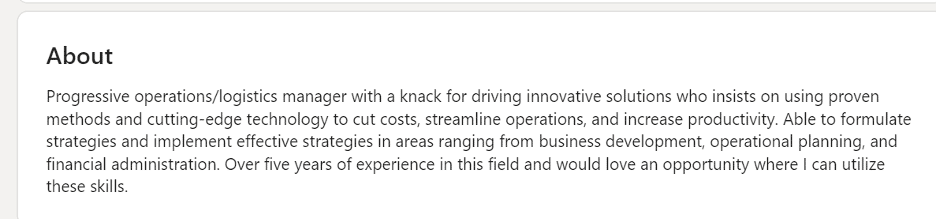
About section Keywords Insertion:

LinkedIn keywords

Professional Experiences Insertion:

For example, those aiming for marketing keywords for their LinkedIn could do this:

Get some recommendations

LinkedIn recommendations can add social proof to a job seeker’s profile and show that your coworkers and peers think highly of your skills. You can get the best, most meaningful recommendations from your direct management.

To get started, think of all the people you’re close to and have had positive interactions within your professional crowd. Then, contact them and ask them for a recommendation on your LinkedIn profile. By taking this step, you’ll be on your way to furthering your career goals.

Disclose that you’re open to new opportunities

A good LinkedIn profile is a job hunter’s best friend. Updating your status to “open to new opportunities” tells recruiters that you are actively looking for a job. This way, they will be more likely to approach you with potential job openings.

And don’t worry, your boss won’t be able to see your status; just make sure that “Share with recruiters only” is turned on. So, if you’re serious about finding a new job, make sure to update your LinkedIn profile accordingly.

Either way, LinkedIn gives you control over how visible you are to recruiters. You can use this to your advantage to get your dream job.

Complete skills assessments

Taking skills assessments is a great way to improve your chances of getting hired. Data shows that candidates with verified skills are around 30% more likely to be hired for the roles they apply for.

And displaying proof of your abilities strengthens your personal brand more generally as well.

That’s why taking a skills assessment and adding the results to your LinkedIn profile is a good idea. It’s a quick and easy way to demonstrate your abilities and show potential employers that you’re the right person for the job.

These quizzes are an excellent way to give proof of your proficiency in skills to potential hiring managers and others with whom you’re networking.

Why take assessments?

Assessments are free to take, and even if you fail, they won’t hurt your profile. 

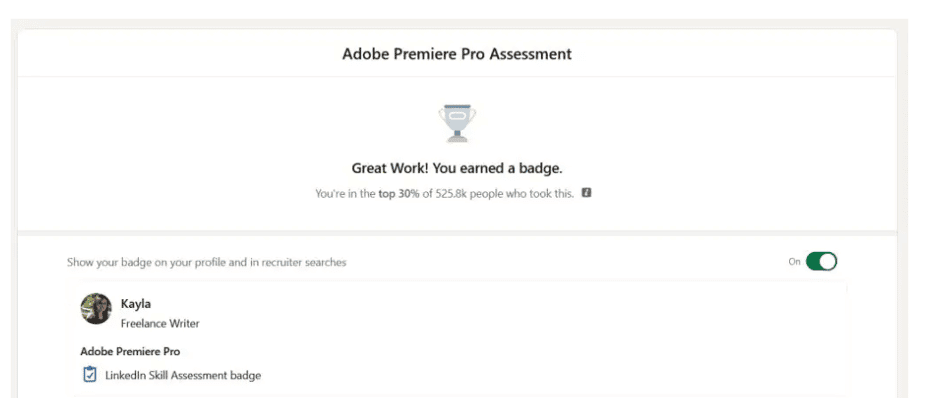
LinkedIn assessments

“Show your badge on your profile and in recruiter searches” make sure the switch is turned on. This way, your profile, and especially the Skills section, will look much more impressive. 

Also, when recruiters are searching for candidates on LinkedIn, if they have a filter on to look for people who have passed specific skill assessments, you’ll be sure to show up!

LInkedIn assessments

Spotlight the services you offer

LinkedIn services

Job seekers can use LinkedIn to find new opportunities and connect with potential employers. However, LinkedIn offers a unique feature to consultants, freelancers, and those working for smaller businesses.

The new Services feature helps these professionals showcase their range of services. Just as significantly, filling out the Services section of your profile can boost your visibility in search results.

This means that potential clients are more likely to find you when they search for someone with your skills and expertise. As a result, taking the time to complete the Services section of your LinkedIn profile can pay off in a big way.

For example:

Look at the example below with a ‘Marketing’ Business Focus to illustrate how to add services you provide.

LinkedIn marketing services

Connect with your current and past colleagues, clients and partners

During the hiring process, prospective employers look at your LinkedIn profile. Making connections with previous coworkers can significantly increase the size of your network and give the impression that you are more involved in your field. This raises your chances of connecting with a hiring manager, which could offer you an edge over the competition.

LinkedIn is the world’s largest professional network, so one new connection can lead to many others. You gain indirect access to former coworkers’ contacts when you add them to your network. This implies that if they like or comment on your posts, you’ll show up as a suggested connection in their network and your postings will display in their contacts’ newsfeeds. This will increase your visibility and help you connect with people who might prove valuable to your career.

You can share your profile with any of your 1st-degree connections and coworkers from the introduction section on your profile. This can help you to grow your network or to increase your chance of finding and securing professional opportunities.

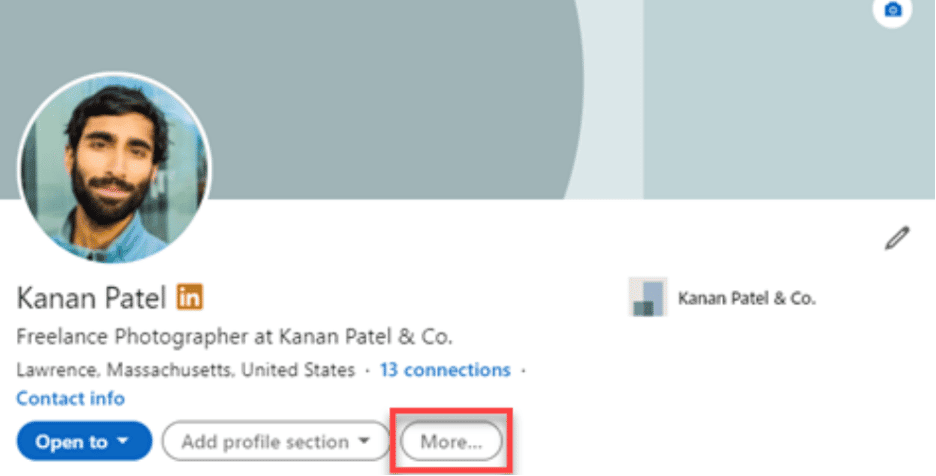
To share your profile:

  • Click the Me icon at the top of your LinkedIn homepage.
  • Click View profile.
  • Click the More… button in your introduction section.
Good linkedin profile

  • Select Share Profile from the dropdown.

Add your LinkedIn profile in another language

If you’re looking at international opportunities, or even if you simply want to interact with professionals in your sector in other countries through LinkedIn, nothing is better than putting your LinkedIn profile in a secondary language.

Creating a profile in the local language of that country is a great way to present your visibility.

To create your profile in a second language, visit your LinkedIn profile page. In the upper right-hand corner, click on “Add Profile in Another Language.”

LinkedIn Profile enhancements for active job searchers

LinkedIn networking

Direct connect with recruiters & hiring managers

LinkedIn is probably the only place where you can get a message directly to the person doing the hiring. Use it to connect with recruiters, hiring managers, and other professionals in your industry.

If you’re job seeking, a direct connection with recruiters and hiring managers is a must. One of the easiest ways to grow your LinkedIn network is to sync your profile with your email address book. This enables LinkedIn to suggest people you could connect with. LinkedIn will also show you how you are connected to potential new connections, which can be a helpful way to break the ice. You never know when a recruiter or hiring manager will check out your profile, so it’s always good to have a strong and up-to-date presence on LinkedIn. So go ahead and sync those profiles! Plus, the more connections you have, the easier it will be to find a job when you are ready to make a move.

To send an InMail Message, navigate to the profile of the member you’d like to send an InMail message to, or you can also search for a member and send a new InMail message from the messaging page or conversation windows. Click the More button on their introduction section. Select Message [Name of the member] from the dropdown. Type the Subject field (optional) in the new message pop-up window. Type the message in the text box. Click Send.

Example of InMail Message:

Hello {{prospect name}},

I came to know that you are using {{competitor’s product}} for {{purpose}}. So, I wanted to connect with you to introduce our new launch {{product name}}. It is quite similar to {{competitor’s product}} but is way better in functionality.

Without taking much of your time, here is a summary of its features:

{{advantages}}

Does it seem interesting?

Our company is offering a free trial for esteemed individuals like you to experience the effects for yourself.

Please let me know if the free trial interests you.

Thanks,

{{Your name}}

Follow relevant influencers in your industry

A good LinkedIn profile isn’t just a digital resume – it’s a way to show your professional personality and build a network of engaged contacts. One way to make sure your profile is engaging and up to date is to follow relevant influencers in your field.

This ensures that your feed is full of interesting content you can share with others, demonstrating your expertise and passion for your work. In addition, the following influencers give context to your profile, helping you to stand out from the crowd and connect with like-minded professionals and recruiters. So, if you’re looking to build a strong LinkedIn presence, don’t forget to follow the right influencers for you.

Leverage a custom LinkedIn cover photo

According to data, recruiters only remember 20% of what they read but 80% of what they see.

And as a result, people with custom cover photos receive more connection requests, messages, and job interviews.

Background photo tech specs

But here’s the twist… Almost no one takes advantage of this! For your cover photo to show up the way you want it to, you should pay attention to the size requirements. The recommended LinkedIn background photo dimensions are 1584 x 396 pixels. The quality of the picture you upload is essential as well. with 4MB and an aspect ratio of 4:1 ideally.  When it comes to formats, LinkedIn accepts JPG, GIF, and PNG.

LinkedIn banner

The background photo of your profile page is one major factor in attracting the attention and consideration of recruiters. It should highlight what matters most to you while setting a context for potential employers who may be viewing it at any time.

The right typeface can make all the difference when trying to stand out amongst other candidates – so be sure not only to choose wisely but tightly crop wherever possible!

LinkedIn banner

Start reposting industry-relevant content

Creating and sharing content on LinkedIn is essential to getting the most out of the platform. Hiring managers, recruiters, and business executives will see you more often if you consistently post high-quality content. This is very powerful as not only does this broaden the number of people who see your posts, but it also has the benefit of being viewed as worthy of engagement.

LinkedIn best practices for a complete LinkedIn profile

Fill out your profile completely

While it’s easy to skip over some sections, it is always more beneficial to ensure that you completely fill out your LinkedIn profile. Why? Well, the most filled-out profiles come up first during a recruiter search, and if yours isn’t fully completed, you risk that the headhunter will not see your profile as it will appear at the bottom of the search list.

Add your pronouns

Pronouns are an important part of language and communication, they are also key to a good LinkedIn profile for job seekers. By including your pronouns in your profile, you will avoid any awkwardness or confusion later on. You will also signal to potential employers that you are an inclusive and professional individual who is comfortable with using different pronouns and make your LinkedIn profile always worthy.

Customize your URL

Job seekers often create a LinkedIn profile in order to connect with potential employers and build their professional network. When creating a good LinkedIn profile, users are given an automatically generated URL that includes a string of random numbers. This URL can be difficult to find, read, and share. Having a professional and clean URL that includes only your name is much easier.

To change your URL on LinkedIn, go to your profile page and click “Edit public profile & URL.” Then click the “Edit” button next to your current URL. Enter the new URL and click “Save.” Having a name-only URL on LinkedIn will make it easier for people to find, read, and share your profile.

Add some interests

This is a valuable way to show some personality and stand out from the competition. If a recruiter from such a company is looking at your profile, they’re going to be more inclined to contact you.

To add an interest – just look up whatever company, group, or school you’re interested in, click on their LinkedIn page, and then select “Add to Interests.” That’s it!

 Just remember to keep it professional – no one wants to see that you’re interested in “partying” or “getting trashed.” Keep it job seeker-focused, and you’ll be on your way to impressing recruiters in no time.

Customize your invites

While many connections occur organically on LinkedIn, there will be situations where you’ll want to take a proactive approach and reach out to specific connections.

For this to be effective, you need to create a customized invite that provides a snapshot of your profile highlights — who you are, what you do, and why it matters — along with a personalized message about why this connection matters to you.

With so much competition out there, a generic invite is likely to get lost in the shuffle. But a well-crafted invite that is tailored to the individual will help you stand out and improve your chances of making a lasting connection. 

Here’s an example of what a good connection message looks like:

“Greetings, [First Name],

I’m currently looking for a new job and am expanding my network with HR professionals like yourself. Willing to discuss any opportunities at any time.

Best wishes,

[Your Name Here]”

Plus, adding a Skills Assessment badge to your profile makes you stand out from other candidates – which can make all the difference in getting hired. So if you’re looking for a way to improve your job prospects, taking a skills assessment is a great place to start.

Make your LinkedIn profile buzzwords-free

Do you have the word “driven” on your LinkedIn profile?

That could be a mistake.

According to LinkedIn, “driven” is one of the ten most overused buzzwords found in LinkedIn profiles — words that “make you go ‘meh'” and should be removed immediately (if not sooner).

A good LinkedIn profile will give a potential employer a well-rounded sense of your skills, experience, and character. However, many job seekers fall into the trap of using meaningless buzzwords in an attempt to make their profile stand out.

Why no buzzwords?

While it’s important to use language that accurately describes your abilities, overusing terms like ‘specialized,’ ‘leadership,’ ‘focused,’ ‘strategic,’ ‘experienced,’ ‘passionate,’ ‘expert,’ ‘creative,’ ‘innovative’ and ‘certified’ can have the opposite effect.

This is because these words are used so often that they have become almost completely meaningless. Instead of using buzzwords, focus on using clear and concise language. This will help you create a LinkedIn profile that accurately reflects your skills and experience.

Take this bio, for example:

LinkedIn profile buzzwords

I’ll give it a go at editing to make a buzzword-free profile.

LinkedIn profile buzzwords

Use the find nearby feature

A little-known feature on the LinkedIn Mobile app is “Find Nearby.” This feature allows users to see profiles of other users who are physically nearby and who have also turned on the feature.

This can be extremely helpful if you are attending a physical networking event, as it allows you to see the LinkedIn profiles of nearby attendees. This is a great way to make sure that your profile is seen by people who might be interested in connecting with you.

Publish long-form content and add comments

By sharing relevant content and adding comments, you can give yourself greater prominence in the LinkedIn feed and start to express why you think a particular piece of content matters. LinkedIn is also a great way to share a broader range of content. By adding comments to your shares, you can show potential employers your interest in a certain field or company and start to build rapport. Well-expressed comments also make it clear that you have something valuable to say and are willing to engage in thoughtful discussion. As a result, adding comments to your LinkedIn shares is a great way to improve your chances of landing your dream job.

You can do so by clicking on the ‘’Post’’ Button and Sharing Content related to your industry.

LinkedIn post

A little like this:

LinkedIn post

The bottom line

Craft a Standout Profile

Now that you’ve gone through the checklist of what makes a good LinkedIn profile, it’s time to sit back and wait for the job offers to start rolling in! By ensuring that your profile is strong and engaging, you’re setting yourself up for success in the world of online networking. So, take a deep breath, relax, and enjoy the fruits of your labor – a well-deserved job offer may be on its way. Thanks for reading, and best of luck in your job search!

Frequently Asked Questions

How safe is LinkedIn?

LinkedIn is as secure as any other social networking site. You can safeguard yourself by creating a unique password that is not shared with any other accounts. However, any information you post on your profile should be considered public information.

Can I add my resume on LinkedIn?

At the top of the LinkedIn homepage, click the “Jobs” icon. Select “Applied Jobs” (above the search bar). Select a job to view more about it and see the resume used to apply.


Mindfulness vs Meditation? Which is Better for Executives?

It’s fairly common practice to find mindfulness or meditation programs in today’s modern workplaces. While the overall benefits are still being debated, it is becoming increasingly evident that by including mindfulness or meditation in your work practices, you increase your ability to remain calm under pressure. You can also develop better skills to focus and enjoy clearer thinking. But when it comes to mindfulness vs meditation, which is more beneficial for busy executives?

The jury might still be out on which type of practice – meditation or mindfulness – is better, but I believe it really comes down to your individual needs and goals. It’s worth pointing out here that you don’t necessarily have to choose either. You can practice meditation as part of a greater mindfulness routine, and you can also practice mindfulness without meditation.

Still confused? Let’s take a closer look at the two practices to find out which one you can use in your daily work routine – or maybe you might choose both!

Mindfulness, Meditation, and the Workplace

Mindfulness vs Meditation
Click on the image to see a full infographic (opens in new tab)

Mindfulness and meditation in the workplace are increasingly being recognized for their role in developing essential employee skills. Research has found that employees or executives who practice meditation can maintain better focus on their work, will be more comfortable with themselves, can achieve better emotional awareness, and ultimately, will have better interpersonal relationships.

As companies progressively become more aware of both the physical and mental well-being of their executives, they also recognize the importance of workplace wellbeing programs. Many companies have even developed specific wellbeing programs. These programs include everything from psychological counseling, yoga, meditation, and relaxation, to family-building activities. They can also provide dedicated spaces for recreation and cultural expression.

Mindfulness vs Meditation

Mindfulness vs Meditation: How are they Different?

Mindfulness vs Meditation
Click on the image to see a full infographic (opens in new tab)

Mindfulness and meditation are often mistakenly considered to be the same thing. That’s not really the case, though. Practicing mindfulness does not always include meditation and likewise, meditation does not necessarily mean one is practicing mindfulness – although generally, meditation does include elements of mindfulness.

Mindfulness is the practice of focusing one’s attention on the present moment. And it can be achieved with or without meditation. To begin with, mindfulness generally starts by focusing on one thing, such as breathing. Alternatively, you can practice open monitoring, where you focus on breathing while also observing the thoughts that arise in your mind.

Mediation, on the other hand, is a mental exercise that helps achieve an overall sense of calmness and relaxation. It is the practice of focusing the mind internally. To do this, generally, people focus on a thought, an object, or an activity – for example, breathing. If you increase your focus, you can achieve mental clarity, emotional calmness, and stability.
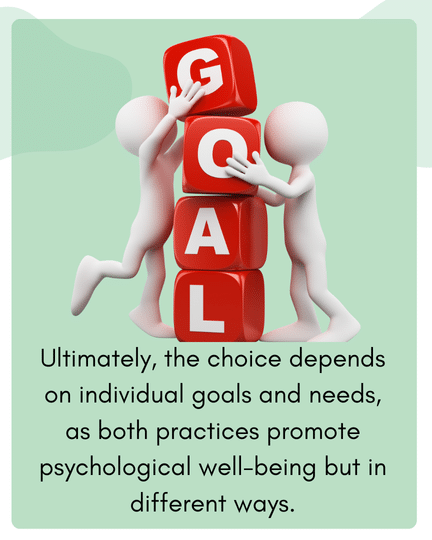
Perhaps the idea of mindfulness vs meditation is misleading. As you can see, while both practices are intrinsically related, each specific practice can be used to achieve different outcomes and they are distinctly different in the way in which they are practiced. Mindfulness is generally related to increasing awareness of the present moment, while meditation is related to achieving inner calm.

Mindfulness vs Meditation: What to Choose?

Mindfulness vs Meditation
Click on the image to see a full infographic (opens in new tab)

As I mentioned, the difference between the two generally comes down to your own personal goals and motivations for taking up either practice. Let’s take a closer look at how each practice can differ depending on why you do them.

1. What are Your Desired Outcomes?

Mindfulness vs Meditation
Click on the image to see a full infographic (opens in new tab)

When weighing up mindfulness vs meditation, which practice you choose really depends entirely on why you have decided to practice them. If you are trying to achieve a total disconnection from reality, even for a few moments, meditation would be the way to go. However, if you are trying to fully focus attention on the present moment, mindfulness would be the way to go. Or perhaps more simply, mindfulness seeks awareness of something, while meditation tries to achieve awareness of nothing.

2. Mindfulness vs Meditation: which has greater benefits?

Mindfulness vs Meditation
Click on the image to see a full infographic (opens in new tab)

Although both practices have their benefits, each one offers different results. Meditation can be especially useful to help you develop greater decision-making skills and better awareness of your emotions.

Alternatively, mindfulness can be useful to improve task efficiency, as it allows us to improve our ability to concentrate and focus attention. It can also be useful for managing stress and anxiety and achieving a better quality of sleep. Perhaps most importantly, it can help you make better, well-informed decisions by developing a greater sense of self-awareness. It helps you to analyze situations more consciously without making hasty judgments or getting carried away.

Which Practice is Better for Executives?

Mindfulness vs Meditation
Click on the image to see a full infographic (opens in new tab)

Still weighing up mindfulness vs meditation. Maybe you’re wondering which practice is better suited to executives. Remember, you need to first ask yourself what you’re trying to achieve.

Both practices are mental exercises that can help to promote the psychological well-being of executives, but there is no universal magic formula. Each person is different, so a very effective practice in one person may not work well for the next.

Mindfulness vs Meditation
Click on the image to see a full infographic (opens in new tab)

For example, executives who are experiencing high levels of anxiety related to their work may benefit more from mindfulness. As we have seen, practicing mindfulness helps you to improve concentration and increase efficiency.

Alternatively, for executives who are looking to hone their ability to remain calm and make effective business decisions, meditation might be the way to go.

Mindfulness vs Meditation

How to Include Mindful Practices in Your Daily Schedule?

It only takes a few minutes a day to incorporate mindfulness practices or meditation into your daily work routine. However, over time, you might be inspired to increase the time you spend focusing on your mental wellbeing after you realize the potential for benefits. In terms of reward for effort, it’s a simple equation. Just 5-10 minutes can improve your performance and have you feeling happier and more satisfied.

Are you ready? Take this quiz to see if you’ve mastered the material we discussed.

0

Mindfulness vs Meditation

Mindfulness vs Meditation? See if you know the difference. 

1 / 10

What is the primary focus of mindfulness?

2 / 10

Which practice is more about achieving awareness of nothing?

3 / 10

How does mindfulness help in the workplace?

4 / 10

What is a key benefit of meditation for executives?

5 / 10

Which practice is particularly effective for managing stress and anxiety?


6 / 10

What should you focus on during mindful breathing?

7 / 10

Which practice involves mentally scanning the body for areas of tension?

8 / 10

How can mindfulness apps help busy executives?

9 / 10

Which practice is likely to help improve quality of sleep?

10 / 10

What is the main goal of body scan meditation?

Your score is

The average score is 0%

0%

Money as spiritual energy: A quick lesson on the energy of money

Have you ever stopped to think about money? I mean what it really is. What if I told you money is more than the paper it is printed on? Well, it is more. Much more. Money is actually energy – spiritual energy. So now, with this in mind, I urge you to think again about what money is. But this time considers money as spiritual energy…

It might initially seem tangible, to consider money as more than its physical value. But if you do, you allow yourself the opportunity to harness its energy and use it to your advantage.

What does this mean for you, as a business executive? Well, you need to stop thinking of money as your next paycheck and instead think of it as the energy involved in earning and the energy expelled when using it. If change the way you think about money, you enable yourself to increase your financial success simply by harnessing money’s spiritual energy.

Before I tell you how you can use the energy of money, it’s important to first understand how money works, and then you can learn how to harness its power and use it for your benefit.

Money as spiritual energy

As I mentioned, money is more than just physical currency. If you look beyond its material qualities, you will discover that money is actually a social construct that has been around for thousands of years. Although it hasn’t always been in the form of money that we recognize today either. The earliest forms of currency were commodities like salt, cows, or even shells. Anything that had value due to its scarcity.

Money, in one form or another, has existed since humans began trading goods with one another. While the way we use money has evolved substantially over time, there are still some fundamental laws that govern how it functions—and those principles still apply to how we use money today.

Many people think that money is just about money—that it’s about making sure you have enough to pay your bills and do the things you want to do. But money is more than that. It’s a force that can be harnessed, channeled, and spent to help you reach your objectives– for yourself or the company you work for.

It has the potential to be used to create change in the world, affect other people’s lives, and make our communities better places.

So, what do I mean when I say think of money as spiritual energy? I want you to think of the energy it possesses and how it can be harnessed and used for good.

The benefit of thinking about money in this way is that it helps you to associate positive thoughts and intentions with money. Rather than dwelling on how much money you may or may not have.

The law of attraction

Now that you understand money is more than its physical value, it’s time to think about how you can use this knowledge to improve your financial position.

Let’s consider the law of attraction, it is one of the most popular and widely used metaphysical laws globally. It states that people attract what they focus on. Positive thoughts bring positive results and negative thoughts bring negative results.

Have you ever noticed that you tend to see and encounter more bad things when you are in a bad mood? And vice versa, everything seems to go your way when you feel good?

The first lesson here is to think about money and think about it in a positive, prosperous way. Associate productive qualities with money and attract its energy into your life.

The law of giving and receiving

Complimentary to the law of attraction, and equally applicable when it comes to money is the law of giving. Essentially this means the more you give, the more you shall receive.

This law applies to many things in life but is particularly poignant when it comes to money. Part of every healthy relationship with money is a balance between giving and receiving.

You cannot simply acquire money without giving, to do so will degenerate your spiritual energy as well as the presence of the energy of money in your life.

In order to open yourself up to receiving more money and harness the energy of money, you must first be generous with the money that you have.

Your thoughts, beliefs, and energy can impact your financial success

Let’s stop for a second and consider what we’ve learned so far about the energy of money. We know it derives from both physical laws and spiritual energy.

But what does this mean? Not only do you need to change how you think about money, but you also need to change your relationship with money. The right relationship can lead to more positive associations with money and in turn, you will attract more positive energy – in the form of money.

It can be very difficult to do this. We often have deeply embedded negative associations with money that date back throughout our lives. But this is the starting place to develop a healthy, bountiful relationship with money.

Harnessing your own spiritual energy first

What is needed to harness the energy of money is to harness your own energy first, specifically your spiritual energy.

If you want to be successful at work — with more money, better relationships, and more happiness — then you need to pay attention to what’s happening inside yourself first.

When you harness spiritual energy, you are able to bring your best self forward and achieve more than you ever thought possible. And when it comes down to it, that’s what we all want: to be our best selves and achieve everything we’ve ever dreamed of.

See 12 Ways Executives Can Increase Spiritual Energy Levels for some proven spiritual energy boosters.

Quick tips for executives to harness the energy of money

Now that we’ve established money as a spiritual energy, the next step is to use this knowledge to empower your life and connect with the energy you need for financial success. Here are some quick tips to get you started.

Develop a deep understanding of your relationship with money

The first step in harnessing the spiritual energy of money is developing a deep understanding of its nature. To do this, you need to take a step back and ask yourself some important questions:

How do I see money? How do I feel about having it or not having it? What does money mean to me? Do I believe there is enough for everyone or that there is not enough for everyone?

It is said that money is the root of all evil. However, this statement could not be further from the truth. The fact is that money is one of the most powerful forces in the world. It can be used to do great things, and it can also be used to do terrible things.

When you have money, you have power and influence over others. Money allows you to make changes in your life that would otherwise not be possible. You can use your money to change jobs, start a new business venture, or even pay off debt and get out of debt once and for all.

Embrace money as spiritual energy and experience more abundance in your life

Money is not just a tool for your financial needs. It is an energy that flows through and around you every day. It can be focused on your goals, or it can be spread out in many different directions.

The way you use your money is a reflection of what’s going on inside of you.

If you’re struggling with debt, then there’s something inside of you that needs to be healed.

Perhaps it’s fear. Or maybe it’s the belief that you don’t deserve to have good things in life because of past mistakes or other peoples’ opinions about who you are and what your worth is in this world.

As a businessperson or executive, give generously

As a businessperson or executive in any organization, the energy of money should be harnessed for the betterment of all involved. This means that if there are opportunities for charity work or helping others out financially or otherwise, then it’s important not to pass up on those opportunities.

Even if they seem small or insignificant at first glance, these actions can go a long way toward making an impact on the world around us and are often much more valuable than we realize.

Conclusion

Learning to view money as spiritual energy is a great way to increase your financial success. It will help you attract more positive energy in your life as well as more money. Your spiritual energy and money need to be considered as part of the same goal. They are one and the same, and no matter your beliefs about money, there is always a way for you to make more of it.

7 powerful leadership traits: understanding the mindset of a modern leader

Did you know that Elon Musk, the founder of SpaceX, is one of the most influential CEOs of 2021? If you look at the list, it’s quite an impressive cohort. But how did they become great leaders? What are the leadership traits they possess that set them apart from the rest? How do they manage to achieve the things we can only dream of?

There is so much we can learn from these iconic leaders.

Let’s explore the mindset of these modern leaders so that we can reach the level of their accomplishments and beyond.

1. A thirst for knowledge

When it comes to leadership traits, ensure you maintain a healthy thirst for knowledge. One of the best ways you can do this is by reading as much and as widely as possible. Seek advice from others, it’s fairly safe to assume that there isn’t a problem or a feeling that hasn’t been written about in some way in the past.

By reading a wealth of books, you can tap into a huge reservoir of knowledge, whether it comes from fiction, poetry, nonfiction, or all of the above. Bill Gates is a passionate reader and he shares a list of his favorite books each year.

It’s not surprising that his list features literature by some of the world’s greatest thinkers, including linguist Steven Pinker, historian Jared Diamond, and civil rights activist Michelle Alexander.

Don’t forget you can also include audiobooks into the mix as well. That way, you can soak up knowledge during your commute, while you wash the dishes, and almost any other time. Audiobooks could even make you look forward to boring chores.

2. Mindfulness

Being mindful and living in the moment is fast becoming a common leadership trait of the modern leader.

Some of the most successful leaders and influencers – think Tim Cook, Satya Nadella, and even Jeff Bezos – engage in mindfulness.

As ambitious people, it’s easy to lose sight of the present as we are often so focused on the future. But the truth is we must always tackle the present before we can reach the future. The biggest reward for our effort is in being mindful of our present.

By increasing our awareness of the present and living in the moment as much as possible, we can reap a wide range of benefits, such as reduced stress, clearer decision-making, and so much more.

While there are many ways you can boost your mindfulness and spiritual levels, practicing meditation on a regular basis is a great way to get started.

3. Self-awareness

A greater level of self-awareness translates into better leaders and in turn, also higher performing employees.

This is because leaders with a high level of self-awareness are better equipped to maintain and develop healthier work relationships.

If you understand yourself better and how you are likely going to react to situations in the office, you can manage your emotions, fears, and feelings before they arise.

Spiritual meditation, while not the only way, is one of the most effective ways to increase your self-awareness.

4. Emotional intelligence

Are you still wondering how to be a good leader? The best leaders have strong empathic qualities. Empathy is like a mental muscle, so it’s important to exercise it as much as possible.

In its most basic form, empathy allows you to feel and understand what another person might be feeling. Not only can this make you a more caring leader, but it can also make you more strategic. For instance, how do you know who your target audience is if you can’t envision what another person might feel or think at a given moment?

Be aware though, that there is such a thing as being too empathic. Being overly tuned in to other people’s feelings can drain you on an emotional level.

This is why it’s important to modulate your empathy as needed. It all goes back to honing your emotional intelligence.

Let’s look at Warren Buffet as an example of emotional intelligence, he felt the pain and suffering of his fellow man and knew that philanthropy was the best solution. In fact, he’s promised to donate over 99% of his wealth over the course of his lifetime.

Without the power of empathy, Buffet would never have been able to accomplish their great deeds.

5. Spirituality

Embracing your spirituality in the workplace means bringing your whole self to work. Spiritually energized employees can tap into their spiritual energy for greater business outcomes.

Spiritual leadership supports employees while providing a space for creativity and innovation. This style of leadership translates into strong united teams and employees with a sense of connectedness to one another.

By breathing life into everything you do, you can share as many positive qualities with others as possible, such as enthusiasm, meaning and productivity. You can inspire and influence your employees and unlock their full potential.

6. Bravery

Bravery is yet another indispensable leadership trait. It might sound a bit dramatic, but you may be surprised by how much bravery leaders need.

As a leader, you’ll encounter a variety of situations where hard decisions are unavoidable. Some people’s worst fears involve the judgment of others. Even firing an employee can end up being a traumatic experience if you’ve never done it before.

Courage also comes in handy when your company fails. Sometimes it’s easier to jump ship than it is to stick around for the long haul and turn a failure on its head so that it’s a resounding success.

We’ve all heard at least one story of a leader demonstrating their bravery during times of war, but there are other examples of bravery as well. For instance, there’s bravery in speaking out against discrimination, hostile workplace environments, illegal business practices, and much more.

7. Innovative

Many people repeat the old adage, “If it ain’t broke, don’t fix it”. While this can be true in a variety of situations, it can lead to complacency.

If you don’t try to innovate your products, services, or marketing strategies, you’ll never know whether innovation is even possible. Nor will you be able to realize any potential success. Innovation and persistence usually go hand-in-hand, and great leaders also need the persistence to see new ideas through.

Imagine where we’d be if CEOs gave up after the first few attempts at establishing an influential brand? What about the first few hundred? Instead, the best CEOS have persevered through countless obstacles to bring us evolutionary products made by Apple, Versaci, and Coca-Cola.

Ready to hone your leadership traits?

Now that we’ve covered seven of the most powerful leadership traits of the modern leader, you can start investing in your own mental and physical well-being. As you create the best version of yourself, you can also create a brand that people will connect with and support for many years to come.

Image attribution: Ministério Das Comunicações, CC BY 2.0, via Wikimedia Commons

How to pray for business success

Did you know that prayer is one of the most underutilized tools for business success? It’s true. We often focus all our energy on our productivity, drive, hard work, and goal-setting. And we overlook one of the most critical tools we have at our disposal – prayer and our connection with G-d. Our connection with G-d, which we achieve through prayer, is particularly relevant when it comes to our business success.

Once you understand this, it can change your entire life, including the way you approach your business.

From here, the next step is learning how to pray to unblock the heavenly channels. Then you can properly follow the key principles of praying to develop effective business prayers.

The book “How to Be More Successful in Business with Prayer” teaches you these concepts and tells you how to apply them to your personal situation to create prayers for your own business success.

If you follow our blog, you’ve likely seen our series of posts on how mindfulness and spirituality are critical aspects of success in business. Setting spiritual goals, harnessing your spiritual energy, and engaging in spiritual practices are all ways that you can start to find real meaning and fulfillment in your career. They help increase your professional potential and tie your business success to improving the lives of others.

When you bring your spirituality to the workplace, you bring a version of your “whole” self with you. You approach your tasks as a complete individual—a person with both a spiritual and physical identity. 

As you understand your motivations, drivers, and passions, you will increase your spiritual energy and can harness it to set both spiritual and business goals. Over time, you will learn how to transform these goals into actionable items and eventually into success. Your financial goals for your business will not be rooted in your “self,” but rather, in how you can make things better for others or solve problems around you.

You will also find that carrying your spirituality with you into the office increases your happiness in your personal life too. This is because it allows you to be your authentic self all of the time. This increased happiness will translate into more compassion, less stress, better communication, and more energy in the workplace. With these characteristics, you will grow into a higher-quality leader.

Spirituality and religion

Many spiritual people also consider themselves religious. They seek ways to incorporate their religious practices into their professional life.

While prayer is one of those common religious practices, it was traditionally considered inappropriate in professional settings. So many leaders who practiced their religion devoutly at home didn’t bring it to the office with them. But thankfully, times are changing.

Religious executives are increasingly practicing prayer in the workplace, and many see actual results from their efforts. They find that prayer guides their decisions, comforts them, reduces stress, and improves relationships.

Some individuals who recognize that G-d is the owner of their business have even started office prayer impact teams. These teams combine the spiritual and professional goals of their teams and unlock success through the act of many people praying for the same outcome.

Now look at your own business and professional life. Are you placing enough emphasis on prayer, or is it the one thing you are missing out on in your busy day-to-day schedule? Is being mindful and spiritual enough, or do you feel the calling to take it a step further?

Are you ready to incorporate prayer into your business strategy? Start by learning how to formulate specific intentional prayers for business. These prayers will help you in all different aspects of your business life, and yes, they really work.

How can prayer make me more successful?

In the same way, you would consult a mechanic if you have trouble with your car. You should also consult with your heavenly Creator whenever you face challenges in your personal or professional life.

Incorporating daily intentional prayers in your business life can help ensure you remain on track to run your business in a way that aligns with your core values. It can also help you hear G-d’s voice more clearly and make better decisions feeling confident that G-d is on-board with your plans.

For example, if you have a problem that seems overwhelming at work, you can ask G-d through prayer to tackle it with you. Prayer can even help you to find a more satisfying career because G-d alone knows what your heart truly desires and also the capacity of your talents.

Sounds great, right? It is. However, it isn’t always easy. Sometimes, you just don’t know the right words to say or how to make your prayers intentional and specific, so you give up or fall out of practice. When this happens, once again, you may find yourself regulating prayer to just your personal life.

That’s why, although prayer and a connection with G-d are very personal things, strategies exist that you can use to construct more effective prayers and keep your habit of prayer in the workplace until you see the results. Reading “How to Be More Successful in Business with Prayer” will help you understand the proper formula to use.

How to pray for business success?

As you read through the book How to Be More Successful in Business with Prayer, you will learn how praying can help you land a dream job, succeed in business, or accomplish specific business goals. You will also learn the right approach to effectively use the tool of prayer and how to formulate powerful prayers for business success.

The book covers the following topics, which are vital to learning how to pray for business success:

  • How to pray with humility— Learn how to pray without arrogance or pride to increase the chances that G-d will hear and answer your prayers.
  • How to pray positively —Understand the importance of staying positive and optimistic while remaining humble. You will learn to phrase your prayers positively and avoid any negative thoughts.
  • How to pray calmly —Learn tips to avoid the “fight or flight” mode in prayer. Learn to focus on calmly setting aside time and removing distractions so you can effectively devote time to proper prayer.
  • How to pray with intention—Learn how to craft your prayer so that it is intentional and ready to receive the answer from G-d you will need to implement it in your life.
  • How to pray simply —G-d appreciates simple and heartfelt prayer. As humans, we often overcomplicate things, even our prayer life. Learn how to pray simply and from the heart.
  • How to pray regularly —As with anything in business, it is through regular practice that you achieve things. The same rules apply to prayer. You will learn how to connect with G-d regularly to show Him he is a priority and make prayer a part of your schedule.

You will also learn the importance of:

  • Visualizing your prayers —Understand how visualizing the things you pray for will help you have the energy and motivation to achieve them.
  • Praying Aloud —Enact the practice of praying out loud and see the difference it makes in your prayer life and connection with G-d.
  • Asking Questions —Identify how to focus the questions you ask G-d the right way and avoid the wrong types of questions in your prayer life.

Start today to pray for success

By now, you’re surely asking yourself whether you are using the power of prayer to make good things happen in your life.

Maybe you do pray about your business but aren’t seeing any results. Changing your frame of mind and the way that you approach your conversations with G-d can make a world of impact on the results that you receive.

Remember, prayer is a powerful tool that you can use to unlock spiritual channels and change the path of your life. G-d is ready to listen if we open ourselves up to Him the right way and formulate our prayers using the right frame of mind.

Are you ready to unlock all the positive things that prayer can do for your business and professional life? If so, why wait any longer? Grab your copy of “How to Be More Successful in Business with Prayer” to learn tangible things you can do today to start unblocking the heavenly channels as quickly as possible.

We guarantee that once you find the right connection with G-d, the results you see will greatly surprise you.

Spiritual meditation: Greater self-awareness for better career outcomes

While the reasons people practice meditation can be varied, generally, the motivations are the same. On the surface, it might seem meditation is related to clarity of mind. Meditation is, however, also about seeking one’s life purpose and meaning. Spiritual mediation is particularly good at developing the latter.

I’ve already discussed the importance of spirituality on this blog, but now it is time to discuss how you can use meditation, spiritual meditation specifically, to truly understand yourself and what motivates you. To unfold the various layers of your understanding and beliefs to determine who you truly are.

By seeking to understand who you are and what truly motivates you will be able to harness the power of spirituality in the workplace.

Before I get started on how you can benefit from spiritual meditation, though, let’s take a closer look at what spiritual meditation is.

What is spiritual meditation?

While today the reasons why people practice meditation are wide and varied, historically, the art of meditation was intrinsically linked with spirituality. It was specifically related to the need to discover one’s depth while building self-awareness and connecting to the divine.

At its core, meditation is the practice of focusing the mind internally. To do this, generally, people focus on a thought, an object, or an activity – for example, breathing. If you increase your focus, you can achieve mental clarity, emotional calmness, and stability. However, it also increases your spirituality and through spirituality, you can discover who you are and what motivates you, both professionally and personally.

It’s been scientifically proven that meditation can increase self-awareness and elevate your happiness, mood, and memory, giving you the reigns of self-control, focus, and a clearer mind. It’s obvious that with these cognitive advantages, you will be better placed to achieve your goals.

In terms of your professional life, by developing a greater understanding of yourself by reflecting deeper and going beneath the surface level of your everyday life to discover your true self, you can tap into your true passions. If you identify what really drives you, you will be inspired to do your best.

Spiritual meditation in the workplace

Today, more and more companies are realizing the benefits of spiritual meditation in the workplace. Professionals and employers from all over the world are looking for ways to incorporate spiritual practices into the working environment.

Many workplaces are even actively hiring spiritual leaders or encouraging existing leaders to explore their own spirituality. You don’t need to look far to find successful spiritual leaders, either. Take, for example, Indra Nooyi, retired chair and CEO of PepsiCo after 24 years. During her time in leadership, she became renowned for creating a better working environment with more stability, improved communication, healthier products, and increased mindfulness.

She treated employees as individuals, distinguished them apart, and tended to their needs. At the same time, she nurtured a healthy increase in more compassionate leaders that thrived in the healthiest working environment.

The spiritual benefits of meditation

While the inclusion of spiritual practices in the workplace has been applied to varying degrees, one thing is clear– the companies that decided to incorporate spirituality into their business and apply it in a professional environment immediately realized its benefits.

Including spiritual mediation in the workplace – whether that be on a company-wide or individual level – helps employers and employees experience:

Greater self-awareness

Having a high level of self-awareness has been found to be crucial in maintaining and developing healthier work relationships –starting with yourself but also with your peers.

Increased self-awareness has been linked to being better equipped to manage your emotions, fears, and all your negative – and indeed positive – feelings that can happen in the office.

Although perhaps, most importantly – getting to know yourself also helps you to connect with yourself on a more spiritual level. You will learn how you can function better – as a human, as a person, as an employee.

Spiritual meditation, while not the only way, is one of the most effective ways to increase your self-awareness.

A greater level of self-awareness translates into greater leadership and, in turn, also better-performing employees.

Reduced levels of stress

Stress can take its toll on your body. And the ongoing stress executives must face in their working lives can be overwhelming. Living in a state of stress is like living in a constant state of awareness. Always “on”, always ready for action. Never in a state of calm, never allowing your body to reach its natural equilibrium.

Spiritual meditation can undo the effects that excess stress has on your body. It works to counter your body being in a state of readiness and instead triggers the body’s relaxation response. It resets the body to a calm state, helping the body repair itself and preventing new damage from the physical effects of stress.

By giving our bodies the opportunity to experience a sense of calm rather than stress, we allow ourselves more opportunities to make better and more logical business decisions.

How to practice spiritual meditation at work

First, find a quiet space where you can comfortably meditate. If you are in your own office, then it shouldn’t be hard to find a spot. If not, then ask the management whether they can provide a safe space for you. A simple technique to follow might look like this:

  • Find a comfortable position – your chair or the floor.
  • Let your body loosen and experience the process, letting it to happen.
  • Don’t try to push aside your thoughts. Acknowledge them.
  • Say your chosen prayer, increasing your spiritual energy levels.
  • Take a moment to reflect on yourself and become aware.

How to practice spiritual meditation outside work

While the process is more or less the same, you can choose to meditate for a longer time outside of the office. The beauty of spiritual meditation outside work is the freedom to pick a location. You might choose to practice at home, outside in a park, by the ocean, or in a forest; you could even go to your place of worship and simply close your eyes and begin.

Realizing the benefits of spiritual mediation

Getting to the center of yourself is no easy feat; for most people, it takes time, courage, and determination.

But by committing yourself to the process and maintaining a healthy level of spiritual meditation while in the office, over time, it can become a healthy, productive habit.