How to Change Your Mind Through Mindfulness? Can it Really be Done?

Wondering how to change your mind through mindfulness? It is an interesting concept for those striving to lead their team effectively by being mindful.

The answer can be as simple as reducing your brain’s “me center” activity. Sounds easy, right? But in reality, is it really that straightforward? The good news is mindfulness and meditation have been proven to reduce your brain’s “me center” activity. And as an added bonus, it also initiates brain activity changes that will make you a better leader.

Mindfulness and Effective Leadership are Interconnected

How to Change Your Mind Through Mindfulness
Click on the image to see a full infographic (opens in new tab)

A mindful leader is both effective and inspiring. They’re acutely aware of their surroundings and the feelings of people around them. They’re capable of keeping their emotions and anxiety levels in check and are often more motivating for their employees.

Ready to be a more mindful leader? Some people find it helpful to set aside time each day to practice mindful behavior, but mindfulness can also be practiced at the moment, such as when taking a walk or eating a meal.

Mindfulness Benefits Leaders by Changing Their Perspective

How to Change Your Mind Through Mindfulness
Click on the image to see a full infographic (opens in new tab)

Leaders can benefit from changing their thinking by looking at problems from different angles and making better decisions.

Mindfulness helps you keep calm while sailing through the sea of problem-solving. Still thinking about how to change your mind through mindfulness? Keep reading to find out how.

The world of work can be a fast-paced environment, but it’s important to take time for yourself and set your priorities. If you can slow it down and stay present, you’ll be able to make better decisions by being mindful.

Know the Science Behind Being Mindful and its Impact On the Brain

How to Change Your Mind Through Mindfulness
Click on the image to see a full infographic (opens in new tab)

We all know meditation benefits our mental and physical well-being, but do you know what meditation does to the brain?

Researchers have discovered that people who meditate regularly have thicker cortexes in their brains, which are associated with attention and mental processing.

In other words, you might find that practicing meditation helps you concentrate better. But it can also assist in mind-calming and relaxation. So, give meditation a try if you want to improve your focus, mindful behavior, and concentration or reduce stress and anxiety. You’ll be amazed at how it can impact your brain.

Mindfulness Changes the Behavior of Executives and Professionals

Mindfulness can help leaders, executives, and professionals be more focused and productive and create a positive work environment.

Ready to find out how to change your mind through mindfulness? Here’s a list of mindful behaviors to help you make better decisions.

Be aware of your own biases

How to Change Your Mind Through Mindfulness
Click on the image to see a full infographic (opens in new tab)

Mindfulness can help you to be more aware of your own biases. By being aware of your biases you can ensure that they do not interfere with how you view people, situations, or decisions.

It gives you an advantage when making crucial bias-free business decisions.

Understand the impact of your decisions

How to Change Your Mind Through Mindfulness
Click on the image to see a full infographic (opens in new tab)

When making decisions in the business world, it’s essential to consider the immediate impact of your decision and the long-term ramifications. You can’t be sure of the consequences if you don’t think through your decisions in detail.

Respect the perspectives of others

How to Change Your Mind Through Mindfulness
Click on the image to see a full infographic (opens in new tab)

It’s easy to get caught up in your point of view and fail to see things from the perspective of others. But when making decisions in the business world, it’s important to consider the perspectives of those who will be affected by your decisions.

If you’re not mindful of other people’s points of view, you could make a decision that doesn’t make sense for everyone involved. So, if you’re a leader, executive, or manager looking to make better decisions, mindfulness is worth a try! There’s nothing to lose anyway!

The Final Verdict

As a leader, sometimes you might wonder how to calm down in difficult situations. And while it’s hard to change how you think about things, it’s even harder to change the way you see the world. But it is possible with mindfulness.

Want to know how to change your mind through mindfulness and see things from a different perspective? Use mindfulness practices when making decisions throughout your workday. Apply the principles of mindfulness whenever you can and be present in every moment and every decision.

You can relax, pay attention in your meetings, and devise problem-solving solutions with simple mindfulness exercises. Mindfulness helps you change your mind and see the world differently.

Let’s put your memory to work! Answer these questions to check your recall.

0

Change Your Mind Through Mindfulness

Test if you know How to Change Your Mind Through Mindfulness.

1 / 10

What is the primary benefit of mindfulness for leaders?

2 / 10

How does mindfulness help in reducing the brain's "me center" activity?

3 / 10

Which part of the brain thickens as a result of regular meditation?

4 / 10

How does mindfulness benefit leaders during meetings?

5 / 10

What is the impact of mindfulness on biases?

6 / 10

How can mindfulness improve communication skills in leaders?

7 / 10

What role does self-reflection play in mindful leadership?

8 / 10

How often should leaders practice mindfulness to see benefits?

9 / 10

What is a key characteristic of a mindful leader?

10 / 10

Why is it important for leaders to slow down and stay present?

Your score is

The average score is 0%

0%

How to change your career successfully: sidesteps, industry change and career progression

Have you heard of The Great Resignation? I am sure you have! It has been all over the news recently. Has the sound of it inspired you to start thinking about changing jobs? Are you stuck on how to change your career though?

It is regularly being reported that following the pandemic and other recent global events, there is a wave of workers who are quitting their jobs. And the media would have us believe they are doing so in droves. But is it really a thing?

It’s more accurate than you think! Fortune Magazine states that about forty percent of US workers are quitting their jobs with no signs of slowing down. That’s quite a number! Even Microsoft is dreading The Great Resignation as forty-one percent of workers are thinking of quitting.

As unsettling as it may sound, thinking of making a career change opens new career opportunities. Given today’s fast-paced world, it’s always good to keep up with the pace and strive for growth opportunities simultaneously.

Are you finding yourself caught up in the hysteria? And wondering how to make a career change successfully. My tip, persevere!

Make sure that you aim for the right job. Look for something that not only fits your skillset but is in sync with your interests as well. You’ll thrive if you are passionate about it! Be consistent, do your research and understand how to change your career.

Become socially active, start networking and work on building relationships with people who are already in the field. You’ll be amazed to know how networking works to land a job or get a task done in the most impressive manner just because you have connections in the right places.

If you’re uncertain about where to get started, keep reading. Taking risks can be scary, but they can also be extremely rewarding! Don’t let fear step in your way. Let me walk you through some valuable tips and help bring your anxiety one notch down.

Why do people change careers?

Have current global events driven you to change jobs? Or do you want to change jobs for some other reason?

There are numerous reasons why people change careers and resign from their current positions.

Some may be unhappy with their current job or feel like they are not progressing in their careers.

Some might be looking for a change of pace or a more challenging job that keeps the thrill alive.

How to make a career change?

Or maybe they’re seeking a better work-life balance or more flexible hours to spend more time with family or juggle between two jobs.

Executive-level employees may have different reasons for changing careers than middle or lower workers. Driven by enthusiasm and hungry for growth, these executives might be searching for an opportunity to use their skills and experience in a new industry or to take on a new leadership role.

Or they may be looking at the bigger picture to make a difference in the world. Learn more about the highest-paid occupations in the US here.

Points to ponder when thinking of making a career switch

Let passion and yearning for learning be your driving factors, and focus on your strengths. Once you learn what you’re good at, look for opportunities where you can put these strengths to practice.

Change in career path means stepping out of your comfort zone and trying something new. Sometimes, taking a risk can lead to great rewards. Let me give you some insight as someone who has successfully helped professionals make the transition.

To make the transition smooth, ask yourself:

  • Are you motivated enough to deal with the risks?
  • Do you clearly envision where you want to see yourself?
  • Can you make the transition smartly?
  • Would you persevere in diligently working till you get the desired outcome?
Are you making a career change?

Once you have the answers to these questions, you can get started on your career change with these pro tips:

Make sure you have a focused vision

Always have a clear vision of what you want to do next. What are your goals and objectives? What are you passionate about? Once you understand what you want to do, you can start researching different career options and paths.

Differentiate between existing skills and transferable skills

It is also essential to consider your transferable skills when a question pops into your mind about how to change your career. Do you have skills that can be applied to a new field or industry? Utilizing your existing skills will make the transition into a new job much more manageable.

Step out of your comfort zone and take some risks. Success doesn’t come easy.

Don’t be afraid of changing careers. If your current job has you feeling stuck in a monotonous routine, it may be time to make a change and look for something that excites you. Sometimes, the best way to find success is to venture outside of your comfort zone.

The current job climate status? Extremely competitive!

The current job climate is highly competitive. With the recent recession, many people are out of work and looking for jobs. It has resulted in employers receiving an abundance of applications for each open position.

Do your research before changing your career.

The current job climate is an important factor to consider before changing careers. The job market is constantly changing and evolving, and it is crucial to be aware of the current trends.

For example, the rise of the gig economy has created new opportunities for freelancers and contract workers. However, it has also made it more difficult for full-time employees to find stable work.

The job climate also varies location-wise. Some regions are booming, while others are struggling. For example, the tech industry is booming in Silicon Valley, while the manufacturing industry is grappling in the Midwest. Researching your region’s job market before making a career change is necessary.

The job market is improving, but finding a job can still be very difficult. Since the job market is so competitive, only the best candidates land the top positions. Prepare yourself to answer difficult questions during an interview.

Fortunately, several websites offer job listings, and many books and articles offer advice on how to change your career. All you have to do is look for the signs you’re ready for a change.

Tips on how to change

A career change can sometimes mean a pay cut, at least in the short term. Make sure you have a solid plan to support yourself and your family during the transition.

A career change can be a great way to revitalize your life and get yourself out of a rut. Do your homework first, have a solid plan, and take advice from career changers.

Tips for changing career

Here are some guidelines on how to change jobs:

Changing within or outside your Industry

There are numerous reasons why you might consider changing careers, whether within your current industry or outside of it.

Perhaps you’re feeling dissatisfied in your current role or looking for a change of pace. Irrespective of the reason, it’s crucial that you are thorough in your research because good research will back up the decision you take.

Look around, and talk to your friends, colleagues, or mentors to get their insights if you are considering a career change within your industry. If you’re considering a complete career change, you’ll need to widen your research spectrum to explore more options.

Whether outside or within your industry, you will find many resources that will lead you to your final decision. Research online and speak to a career counselor to better understand your options.

With meticulous planning, you can make a successful career change that will lead to a more fulfilling and satisfying work life.

When is the right time?

The right time depends on your individual circumstances. However, it may be time to consider a change if you are unhappy with your current job or feel like you are not reaching your full potential.

Alternatively, a change may also be beneficial if you have been in the same role for an extended period and are starting to feel that your growth is stagnant.

Ultimately, the decision comes down to what you feel is best for your career and future goals. If unsure, speaking to a career counselor or advisor may help you.

Choose the right time to change your career.

Identify your motivators

Different people have different motivating factors that can lead them to change their careers. For some people, it may be a desire for more money or better perks. While others may be looking to make a difference in their community or the world.

Changing careers is a big decision, regardless of your motivations. So soul-searching and proper research are vital before making the switch. Once you get an idea of what you want and why you want it, you will find success in your new career.

Side-stepping

Side-stepping in your career can be a difficult thing to do. You may have spent years working your way up in a specific field. Looking for a new direction or starting from scratch can be overwhelming!

Take some time to assess your skills and experience.

  • What are you good at?
  • What do you enjoy doing?
  • What are your strengths?

You may find the idea daunting, but let’s be optimistic and consider it an opportunity to learn and grow.

Embrace the challenge and use it as a chance to build yourself up in a new career in a new manner. Strive for a new, better you!

Many people have gone through career changes, and they can be a great resource. Talk to family and friends, contact professional organizations, and look for support groups. These people can offer advice, guidance, and support as you navigate yourself through a career change.

Learn from past mistakes

The past shapes your future, and I can’t stress how true that is! You can take many different paths. After all, the only way to find the right one is by trial and error and see what works best for you. Be patient, flexible, and willing to put in the hard work. With persistence, you can find the perfect career for you.

Be true to yourself

Changing careers can be overwhelming but staying true to yourself is crucial. It’s easy to get caught up in what other people think you should do or what’s trending at the moment, but you need to make sure you’re choosing a career that’s right for you.

Simply changing careers won’t magically fix all your problems. Be honest about what you’re hoping to achieve and what you’re willing to sacrifice to make your career change successful.

Changing a career can be an exhausting yet exciting process. Make sure you stay true to yourself and your goals, and you’ll be on your way to a successful new career.

Plan your future

Are you feeling a little less overwhelmed now? I hope I have been able to help alleviate some of your concerns about changing careers.

Maybe you feel that your present job is not challenging enough, or maybe you think that your growth is stagnant. Maybe you’re seeking a better work/life balance or simply ready for a change but feel totally lost and don’t know how to change your career.

Irrespective of the reasons, changing your career can be a big decision. But also an excellent opportunity to start fresh, learn new skills, and pursue your passions.

Once you have a clear idea of what you’re looking for and how to change jobs. You can start to research different career options. Take the plunge and get started today. Update your resume, start networking, and apply for jobs.


Self-awareness: why it’s an increasingly important leadership skill

All leaders need a rich and varied set of skills and personality traits to be successful. And an increasingly important skill that has recently gained more traction is self-awareness.

Most people consider themselves to be self-aware, 95% in fact, according to studies at Harvard. But the reality is that this number is actually closer to 10-15%.

That’s a pretty low number for a skill that has been proven to be beneficial to leaders and in turn business.

Extensive research has shown that self-awareness in leadership roles creates many benefits for business success and helps set the tone for the growth of the whole company.

Let’s find out what it means to be truly self-aware and what you can do to build your own self-awareness.

What is self-awareness?

A generic, one-size-fits-all definition of self-awareness doesn’t really exist. Some people see it as a heightened state of self-consciousness. While others define it as the difference in the way you see yourself versus how others see you.

Some people believe that you are born with self-awareness, while others believe that you can master it through therapy. Insisting that in order to understand yourself, you must first understand your past. The premise of this idea is that in understanding where you come from, you also understand why you may react the way you do.

I tend to favor the latter and believe that self-awareness is a skill that can be learned.

What is the behavioral science behind self-awareness?

Psychologists say that self-awareness is the ability to focus on yourself. And perhaps most importantly, it is the ability to understand how your actions, thoughts, or emotions match with your internal standards – or indeed if they don’t.

Numerous studies into self-awareness over the past 50 years concluded that on a basic level, there are two different types of self-awareness:

  • Internal self-awareness: which is how we understand ourselves and our strengths, weaknesses and motivations.
  • External self-awareness: which is how we understand how we appear to other people and the impact we have upon them. This requires empathizing with others so we can understand their perspective.

Interestingly, people who have heightened internal self-awareness skills don’t necessarily have external self-awareness skills. This means that while they may understand their own motivations, they may be lacking in empathy and understanding of others.

An alternative way of approaching self-awareness is the principle of the 5 elements of self-awareness, which includes:

  • Your concept of yourself, or how you perceive yourself.
  • Understanding our thoughts, which helps us to become more aware of our emotions.
  • Recognizing our feelings, both when we speak about ourselves and when others speak about us.
  • Acknowledging our body’s physical responses, which are likely going to be automatic and beyond our control.
  • Honing your emotional intelligence, which is to understand your own emotions and also how they affect others.

It’s abundantly clear that to become more self-aware, you need to develop an understanding of yourself in many areas. It’s about knowing who you are and how you will respond to stimulation or external stressors.

Why is self-awareness an important leadership skill?

Self-awareness is increasingly being recognized as an important leadership skill because it creates harmony and collaboration in the workplace. It helps create a growth mindset where you show that you are happy to learn and to move forward. It also enables you to accept that like everyone else, you are not perfect.

If you are truly self-aware you will understand your purpose and the value that you bring to your role, your company and your team. You will appreciate your strengths and characteristics which will allow you to perform better – while also knowing when you need to seek support.

By developing your self-awareness, you will be better placed to understand when you should listen to others, or if you are in the position to assert your authority. A manager who knows when to listen leads an inspired and engaged team.

How leaders can use self-awareness to be more effective, productive and inspire better employees

Emphasizing self-awareness in leadership roles builds trust in employees and shows that your company is willing to evolve.

If your team knows that you are open and receptive to new ideas, it creates an environment that promotes better business performance all around.

Being self-aware enables you to become more approachable and humbler. It can be frightening for some managers to admit they don’t know it all yet having the strength and wisdom to accept that they don’t, helps your business grow and flourish in a collaborative spirit of success.

Self-awareness is all about adopting a growth mindset. Instead of asking why something has happened, ask yourself what could you have done to make it better. Once you can ask yourself this, you are on the way to self-awareness and an improved business future.

So how do self-aware leaders benefit from understanding their own behaviors and emotions?

As mentioned, self-awareness enables leaders to realize their strengths and to know when they should gain support or delegate duties if someone is better suited to the task.

It requires managers to put away their own egos and instead focus on collaboration. Which creates a business environment that inspires growth and development.

A self-aware person is willing to listen to others, is confident in their abilities and has a growth mindset that accepts that change and development on all levels is the best way to move the company forward.

Importantly self-aware leaders understand that like everyone they have their own set of unconscious biases and are likely to ask for input from other team members when it comes to decision-making.

What prevents people from being self-aware?

The most common reason leaders fail to develop self-awareness is ego. A business leader may believe that all their success comes down to their own hard work and commitment. This is called a self-serving bias and people with this mindset refuse to accept that they make mistakes, or their business success has anything to do with luck or other team members.

People that possess this mindset often blame external factors for mistakes or problems rather than taking responsibility. They blame external factors, like the economy, the delivery chain, the suppliers and anything else before they acknowledge their own contribution – or lack thereof.

How leaders can master self-awareness

Now that you know what self-awareness is and how, as a leader, you can benefit from it. Let’s take a look at how you can learn to develop a greater sense of self-awareness. 

Identify your emotions.

Acknowledging your emotions will help you identify what triggers them. Knowing what makes you feel happy, excited, worried or angry will provide you with the insight to control them – or better yet respond more appropriately. We often become stuck in behavioral patterns and react in the same knee-jerk way without asking ourselves why. The simple act of recognizing our emotions provides us with valuable insights into how we react.

Get some honest feedback

Asking your close friends, trusted colleagues or family for some honest feedback on how you present in various situations might seem daunting, but remember you are the only person who doesn’t witness your own behavior patterns. It is important to see yourself through other people’s eyes, as this will help you see how your communication methods and habits affect other people.

Realize that you have both strengths and weaknesses

Everybody has strengths and weaknesses. Even if you’re an important leader, this also applies to you. Once you have learned a bit more about yourself and can understand how others may see you, you can tailor your communication style to achieve the best results.

Successful leadership relies on delegation and self-awareness will help you understand when you are the best person for a job and when you are not.

Keep an open mind

All good leaders are naturally curious, they are always looking for new insights or innovation. Keeping an open mind and listening to colleagues and employees can help you develop new successful strategies. Practice active listening and guard against becoming judgmental of people or plans before you have heard them through.

Keep a journal

Keeping a journal can lead to improved self-awareness. By writing something down you are acknowledging that it is important to you. It can also help you see how you react to situations and when this can be improved in the future.

Be a better leader, be more self-aware

Science tells us how we can be more self-aware by understanding ourselves – both from within and also from how we are perceived by others. It’s about understanding what drives us and appreciating how we respond and react to our environment. It is through these lessons that we can overcome our egos and bias and be better leaders.

We are better placed to nurture and inspire others by leaning into our strengths and seeking support for our weaknesses.

Effective prayers for employment (Get your dream job!)

If you’re at a career crossroads, changing jobs or even starting a new career you might be asking yourself if there is any value in prayer for employment. The answer to this question, however, really comes down to several personal considerations and your existing connection with G-d.

Let’s be honest, prayer for a job is often at the end of a long list of things you might contemplate in your job application process.

Generally, when you think about applying for jobs, you often consider your cover letter, creating the perfect resume, making sure you have great references and highlighting the parts of your life that apply best for the position. 

Prayer shouldn’t be the last thing you think about though and I’m going to show you why you should consider changing your process. 

The digital job application process

In my opinion, it was easier in the past – in terms of applying for jobs anyway. I remember how we did it back in the day before everything went online. You simply put on your best slacks, a button-down shirt and blazer and waltzed into an employer and requested an application. You would fill out your application, ask to speak with the manager and have the opportunity to make a lasting impression. It wasn’t unheard of to get an interview on the spot, or even get offered a job that same day.

Things have changed dramatically though. I would say that the digital age has made job hunting more difficult and impersonal. You don’t have the opportunity to make a lasting impression, or an opportunity to explain how you are the right person for the job. Even though you may not be qualified on paper.

In this hands-off, impersonal process sometimes it is extremely beneficial to know someone to get your foot in the door. 

“If only I knew someone,” you say, “that could help me to move my application from the bottom to the top of the list.” 

prayer for employment should...

Prayer as part of your job application process

Well, there is someone who is available to help you. Someone whom you can reach out to for help. And they’re available 24 hours a day. This someone is G-d. And the easiest and most effective way to talk to G-d is with prayer.

When you pray for employment, you connect directly to Him. G-d is waiting and willing to help you with any obstacle you face, and that includes employment.

Prayer for employment is also a great way of releasing all stress and anxiety related to searching for a job, by entrusting G-d with your job-hunting process.

Prayer isn’t just part of the process

A word of caution, don’t expect to simply pray and be rewarded with the job of your dreams. Prayer is part of an ongoing relationship with G-d, it would be inappropriate to commence praying solely for the purpose of seeking a job and then ceasing all communication with G-d after finding a job – or failing to do so.

Prayer is part of an ongoing relationship with G-d. To pray as part of your job application process with an open heart and open mind can be truly beneficial.

Prayer for employment

Below is a series of prayers that you can use in your communication with G-d. Depending on your needs, you can use one on its, combine several together or mix components from one into another.

These prayers for employment can be used by believers from various religions. If you are Christian, you may finish each prayer with “In Jesus’ name, Amen.” Muslims can end with “Peace be upon you and God’s blessings”.

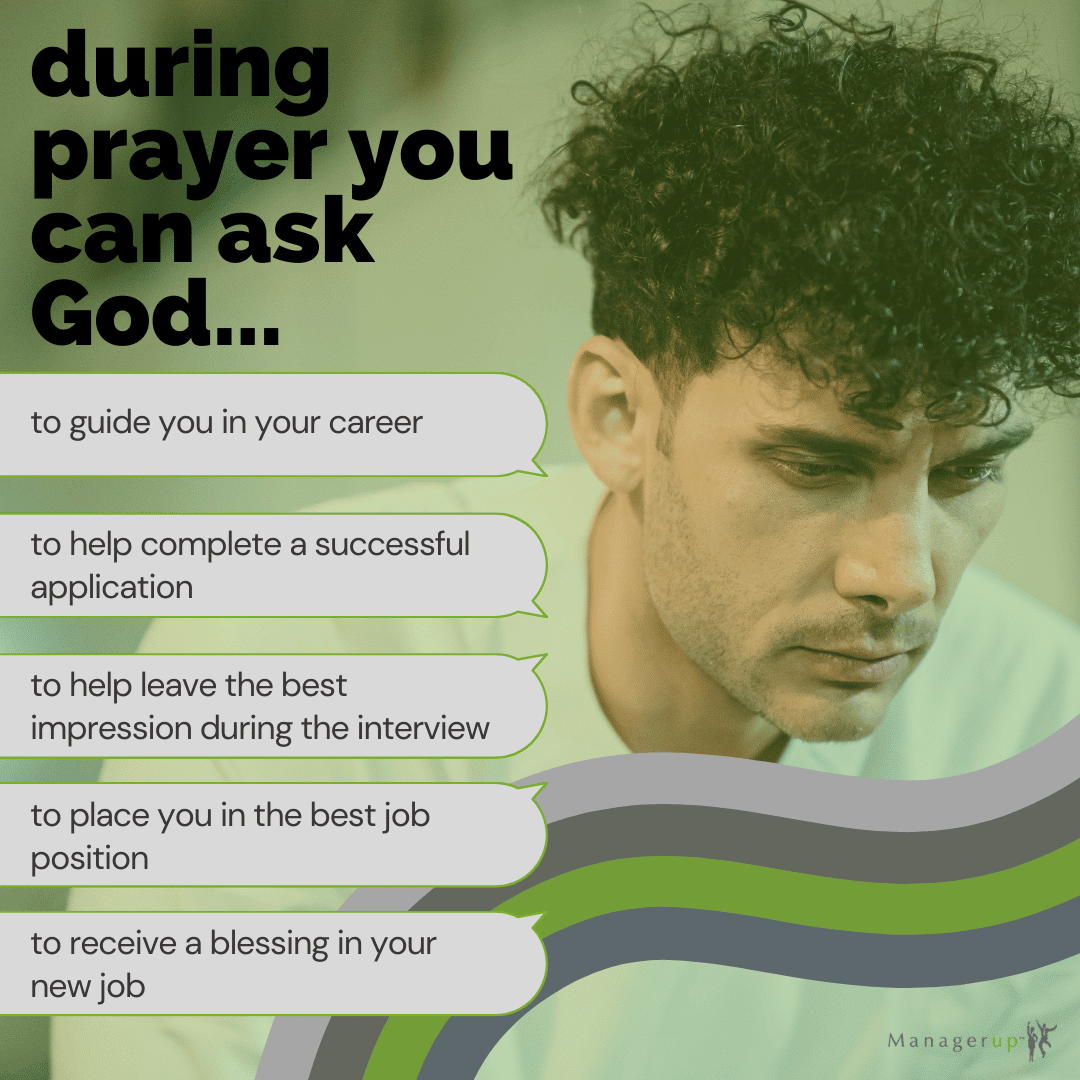
during prayer for employment you can ask God to guide you

Prayer to find a job 

Dear God, I thank you that your word says that you know what I need before I ask. I am seeking employment and trusting you to place me in the best position. Not only to meet my financial needs but to contribute to my success in future endeavors.

I ask that this position be in alignment with the schedule I need so that I may remain faithful in all other personal and professional commitments. I know that you have a job for me, and I will trust you in getting me there.

Prayer for a successful job application 

Applications can be overwhelming and even intimidating. So G-d, I ask that you help me to be confident in the skill, individuality, and gifts that you have given me. That I may complete my application in confidence knowing that I have something to offer and that you are with me making sure I get the job that is just for me. 

Help me gather all the information needed for the application and to relay my thoughts in a way that is personable yet professional. Help me to see what the specific employer needs so that I may tailor my application to fit their qualifications.

Prayer for success at the job interview 

Dear God, help me to see the great and undeniable things about myself that are only true to me. Help me to showcase myself in a way that highlights who I am as an individual, but also relates to why I would be an important addition to their company.

May your peace be settled in me so that I can convey my thoughts clearly and professionally during this upcoming job interview. 

Help me to answer all questions in a way that is authentic, yet honest and true to who I am and what I have to offer. May I leave a lasting, unforgettable impression knowing that you are always present with me.

Prayer for career guidance

God, I come to you knowing that you know all things and always have my best interest at heart. Lord, I come seeking your guidance today. Help me to understand which career path is right for me right now. I am choosing not to lean unto my own understanding, but to instead acknowledge you, thus allowing you to guide and lead my footsteps. 

It can be hard to see the right thing to do from my view within my own circumstances, so I am instead trusting your judgment and your direction to show me what to do and where to go in this season of my life. Give me eyes to see and ears to hear what you would have me to do.

Prayer to receive favor and blessing in your future job 

Dear God, I thank you that you have a job for me, and I know that in whatever position you place me, I will be blessed. I am blessed when I come and when I go, and I know that I am above only and not beneath. You have blessed me and called me your own. 

I know that my success is found in you and you have given me the ability to perform my job with excellence. It is in you that I receive a promotion, increase and success and I thank you that your blessing and favor will be awaiting me at the new job that you have for me. 

I am confident that these prayers for employment will contribute to your successful job search.

And remember that your relationship with G-d and your prayer habit shouldn’t end once you find a job. There is always room for prayer when it comes to other aspects of your career too – whether it be a new client, difficult co-workers or new business ventures.

Science Explains Why Gardening Makes Executives Happy

Can executives, managers, and entrepreneurs benefit from gardening?

Absolutely!

I can confirm it as gardening makes me happy. For me, gardening is the secret to good mood and high productivity.

On the internet I found this pertinent proverb:

“If you want to be happy for a day – get drunk, if you want to be happy for a month, get married, if you want to be happy forever, build a garden.” 

Some people say that the proverb is Chinese, and some say it is Dutch. 

For a long time I thought I was a weird guy, and probably the only executive who likes digging in the weeds, but then one day I realized that my feeling of happiness while spending some time moving the soil is actually backed by science.

Are you curious?

Let’s have a deeper look.


Get Your Hands Dirty for Happiness and Productivity

Often after a long working day, I am mentally drained. I am sure it happens to you, too. When the day has been really hard, I come home full of negative feelings and low self-esteem.

In such moments, gardening is my solution. I get my hands dirty, and suddenly, I start feeling better.

Do you think I have some magic soil?

I do! But you have it, too!

Science has discovered that working with soil is beneficial to your health and happiness. The reason is the soil bacterium, mycobacterium vaccae.  These microscopic bacteria enter into your body when you touch the soil.

The bacteria triggers serotonin and dopamine production, both chemicals that produce a feeling of happiness. By the way, they are chemicals normally present in antidepressant medication.

No doubt there are studies confirming that gardening improves general well-being. As a matter of fact, it is recommended to patients suffering from depression.

Isn´t it amazing? 

Your own garden can naturally trigger the production of anti-depressives! So get your hands dirty, be happy, and get ready for the next tough office day.

These ‘friendly creatures’ also improve the immune system, and many scientists believe that our modern society would benefit from working with soil to ward off instances of asthma, allergies, and other illnesses.

But digging in the earth is not the only reason why gardening makes me happy.


Emotional Well-being While Gathering Herbs From the Garden

Not only does digging in the soil increase dopamine production. Another way to get an additional shot of the happiness hormone is by observing flowers, fruits, and herbs growing in the garden.

After working a whole day in the office, I am often tired. So I take a walk in my garden and smell the herbs and flowers. Sometimes I pick the fragrant, fresh herbs for dinner. It is so relaxing!

Science has confirmed that even just looking at flowers or other organic products or picking herbs stimulates dopamine release in your brain.

By the way, you can get a similar benefit if you buy a few beautiful plants for your office. It will not only make you happy, but it will also do wonders for your creativity and productivity.

When your dopamine level is high, you start feeling the same way as when you get a bonus or receive positive feedback from a colleague – elated!

The fringe benefit is that dopamine reduces work stress too!

So what are you waiting for? After a tiring office day, just go to your garden and simply appreciate your plants.

Are you curious to learn more about why gardening makes me happy?


Take Your Beneficial Sunlight and Vitamin D in the Garden

Did you know that individuals who work outside are, in general, happier than those who need to work inside?

Yes, they are happier although they probably earn much less money!

The main reason is the sun.

Although many health care professionals suggest avoiding too much sun, not getting any can also be detrimental to your health and… happiness. The sun stimulates your body to produce vitamin D, one of the most important vitamins. This is why it is often called the sunshine vitamin.

A lack of vitamin D is one of the possible causes of depression. If you want to be happy, make sure you get enough of it.

A pilot study by Dr. Fatme Al Anouti, an assistant professor at Zayed University’s College of sustainability sciences and humanities in Abu Dhabi, confirms that time in the sun reduces depression.

Another study says that sunlight triggers the release of serotonin, which, as mentioned, triggers a feeling of happiness.

If, like most busy professionals, you spend the whole day inside a building with very little sun exposure, then you need to spend more time in your garden!


Breathing in Fresh Air in the Garden

The vast majority of us work in closed workplaces with air conditioners circulating stale air. This can be a health risk if you don’t make an effort to get some natural air whenever you can.

The benefits of breathing fresh air in the garden are astounding. It can help you digest food better, improve your blood pressure, and even help fight obesity!

But does fresh air make you happy?

It does!

The mechanism is very simple. The more fresh air you breathe in, the more oxygen circulates in your blood. And logically, more oxygen triggers more serotonin.  And serotonin makes you happy!


Conclusion

Spending time in your garden after a hard office day is a powerful strategy for being happier, having less stress, and enjoying higher productivity. It does not matter if you dig in the soil, smell the flowers, or simply enjoy the sun and fresh air. Gardening makes me happy, and it will make you happy too! It will increase your energy level and, importantly, the relation between gardening and happiness is backed by science.

Make sure that spending time in your green oasis is on your daily “to-do list.” Share your experience with us. We are looking forward to seeing your comments below.

Strong Prayers Only Successful People Say

Prayer for success? Does it work?

We all know that success is brought on by hard work, so what does prayer have to do with it?

Well, apparently, a lot!

Let me show you some hard evidence.

Many successful people pray. Top-level CEOs like Arne Sorenson, Indra Nooyi, and Tim Cook. Entrepreneurs like Tony Robbins. Hollywood celebrities like Richard Gere and many others.

Still not convinced?

Who do you think prays more? The American entrepreneurs or people employed on wages or salaries?

Do you think the latter?

Wrong!

American entrepreneurs pray significantly more than the rest of the American population. This has been confirmed in this study.

And who is more successful?

Again, the entrepreneurs. On average, an American entrepreneur earns up to 50% more than the non-entrepreneurial population.

I think you can now clearly see that there is a link between prayer and success.

Of course, success is not only measured in monetary terms.  The word “success” means something different to everyone.  For one, it may mean reaching the very top of the corporate ladder.  While to another, it may mean having their own business and quitting their day job. Regardless of what your personal picture of success looks like, prayer will be the paint to bring your picture to life.

As mentioned before, prayer for success at work is the driving force behind many successful people, whether talked about openly or kept secret behind the four walls of their homes. 

Prayer has been creating success for people as long as people have existed.  So why not let it do the same for you?

If you independently pray regularly or if you are new to the world of prayers. We have provided some powerful prayers for success below. 

They can be used regardless of your beliefs. If you are Christian, you may finish each prayer with “In Jesus’ name, Amen.” Muslims can end with “Peace be upon you and God’s blessings”. 

End each in a way that works for you and what you believe.

Prayers for Success at Work

1. Prayer to Prosper in a New Career

God, starting a new career can be intimidating and downright scary, but I believe this is where I am supposed to be. Bless the work of my hands, prospering everything that I do. 

Fill my mind with creativity and solutions to problems.  Help me to develop a work ethic that attracts prosperity, increase, and promotion. Keep me grounded and humble so that as I prosper, I never forget that it was you who helped me.

Make my light shine in my career where it is needed most. Make my talents clear to those around me that I may be placed in the proper places to prosper.

2. Prayer for Success at a Crossroad in Your Career

God, I don’t know what to do and what direction to take in my career.  Either decision that I make could be good for me, but I want to make the decision that is right. 

Only you know what is right and best for me. God, show me which way to go, and reveal to me clearly what the next step in my career is so that I may follow your direction with confidence.

3. Prayer to Receive Favor in Your Career

Because you love me, I know that your favor surrounds me and is everywhere I go, even when I don’t see it.  Help me to recognize your goodness and favor towards me.

Put me on the path of people that can help to take me to a new level of success in my career. Give me projects and opportunities that will lead to even greater projects and opportunities.

May I be favored among people at every level of my career. May they take notice of your divine hand in my life. 

4. Prayer for Guidance at Work to Success

Every day is full of decisions and choices, and I want to be sure I am making the right ones. 

Guide me throughout my daily tasks and decision-making to ensure that not only I am doing the right things, but I am also doing the things right.

Guide my thoughts and actions so they may be in line with your vision for my career. Show me in what ways I can use my skills for my advancement and success.

Prayers for Business

1. Prayer for Business Success, Growth, and Prosperity

God, only you know the meaning of success for me, and I am trusting that you know how to get me there. Show me the strategies that grow my business and help me to maintain steady personal growth.

Bless me with innovative ideas that will produce prosperity in my business. Show me how to attract consumers who not only remain but bring others with them.

Help me to run my business in a way that is reflective of your heart because with you is success, prosperity, and every good and productive thing that my business needs.

2. Prayer for Success as Your Own Boss

Since all things come from you, I thank you for the entrepreneurial spirit that you have given me. Thank you for the opportunity to be my own boss.

Help me to run my business with your wisdom and be led by your guidance continually. Give me the peace, patience, and leadership to manage others in a way that is fair, professional, and beneficial for the growth of my business.

Help me to make sure that everything is legally in place so that my business may operate as it should and send me the right people to help. 

3. Prayer for Success in My Business Plan

God, you are a God of order and planning. So I come seeking your wisdom for the perfect business plan that would cause my business to flourish. 

Show me step by step what needs to be put in place to breed a culture of success for my business.

You know the hearts of my customers and what they need from my company, so I am trusting you to show me a business plan that will allow me to meet their expectations. Help me to consider every angle of the business, making sure I cover everything and everyone.

No matter what your plan for success is if prayer has helped you get there, we want to hear about it. 

Interested in other prayers? Have a look at these proposals:

Why You Should Use Prayer for Stress, According to Science… (and 3 Different Prayers for Stressful Situations at Work)

Prayers for Employment

The Ultimate Anxiety Prayers Guide for Busy People

Prayers for Work That Empower Your Day

Leave us a comment; we would love to hear how prayers for success have helped you.

6 Reasons Why Vacation Is Important

“This vacation helped me re-enter the world as a healthy and well-adjusted human,” said Mr. A, a senior manager who I recently got to know a few weeks after he returned from a long-anticipated trip to Reykjavík.

His story has been the trigger that tempted me do a lot of research on “why is vacation important”. Despite his struggle with generalized anxiety disorder for most of his life, long before he even knew it had a name, his symptoms had been well controlled for years.

Perhaps this is why he proudly assumed he would be immune to the agony of the exhausting existence that is an “executive manager.” He believed he would be able to channel his daily stress into productivity.

That was until a couple of years ago when his anxiety insidiously crept back from the hinterlands of the amygdala, creating a constant and irrational loop in his mind of all the things that could go wrong. What if I make an idiot of myself at the party? Will I make it in time for the meeting? What if I screw up tomorrow’s presentation? Did I leave the heater on?

It is that kind of anxiety that makes you feel incredibly tired and overwhelmed when facing the simplest of tasks. The kind of anxiety that doesn’t stop even when you see the heater is off.

“After I’ve made it through the day, I go home,” said Mr. A. “I crawl under the covers and scrutinize each and every word, interaction and action that had taken place that day until I feel sick to my stomach.”

He admits that he always knew he could use some time off, but like many of you, he thought he had too much to do and would rather just spend the weekend home and stay in his cool dark room, distracting himself with mindless television shows.

Anxiety was keeping him from trying out anything that sounded remotely unfamiliar. Eventually, he made the decision to try and fight that shadow inside him.

According to him, travel and vacation have been a major component of keeping it at bay and helping cure his crippling anxiety.

No one argues that vacation is important for our minds and bodies, but the real problem is that no one thinks it is crucial enough to be a commitment.

Unfortunately, that makes it so much easier for the anxiety monster inhabiting our brains to provide endless excuses that kill any idea of going on vacation before it can be transformed into action.

According to a recent survey, the average U.S. employee only takes half of his permitted vacation time.

Furthermore, among those who actually do go on vacation, three in five admitted to doing some work while vacationing, and a quarter of them were contacted by a coworker or supervisor about a work-related matter.

Taking vacations on a regular basis isn’t a luxury or an option you can just skip. It is a priority and basic requirement essential to maintaining and promoting your physical and mental health.

It prevents a variety of diseases and helps you recover from the stress you face in your daily life.

Here are my top reasons, backed by scientific research, why vacations are important.


1. Vacation Reduces Stress and Depressive Symptoms

One of the principal reasons why vacation is important is the fact that they markedly reduce stress levels by removing people from the environment they associate with stress and anxiety.

Moreover, several scientific studies have concluded that vacation is associated with fewer physical complaints related to stress, such as headaches, back pain, and heart rate irregularities.   

In one study, data were collected from forty middle managers, after one week at a resort. The results indicated that one single short-term vacation has large positive and immediate effects on perceived stress, recovery, strain, mood and general well-being.

Interestingly, these effects were still detected six weeks after the managers were back from vacation!

Another study showed that taking a vacation is associated with lower stress on a molecular level by observing a decreased expression of FOXO3, a gene that orchestrates the stress response in the body. In fact, lower levels of FOXO3 are also proven to have a remarkable antidepressant effect.

Researchers suggest that even a short-term vacation might have beneficial effects on one’s well-being, strain level and stress.

In fact, it seems that short vacation of four nights is long enough to fully recover from daily work-related stressors, yet short enough to limit the pile of work you have to face upon your return, which is why it’s important to take periodic not overly lengthy vacations.


2. Vacation Can Cut Your Risk for Alzheimer’s Disease

This one is the probably the most interesting on this list. Vacation has been proven to reduce your risk of developing Alzheimer’s on a subcellular level!

One of the hallmarks of Alzheimer’s disease is the accumulation of hard, insoluble plaques between the nerve cells in the brain, a process that contributes in a major way to the dramatic neuronal degeneration observed in Alzheimer’s disease. These protein plaques consist primarily of Aβ40 protein.

A recent study measured Aβ40 levels after four days of vacation and found a significant reduction in its level in all participants!

The same study showed a decrease in the expression of CLU and PSEN1, two genes confirmed to be implicated in Alzheimer’s disease.


3. Vacation Improves Sleep

Good quality sleep is one of the major ways to help your body and mind recover if you suffer from stress at work. Unfortunately, job stress and poor sleep often go hand in hand. Stress leads to a loss of sleep and a loss of sleep leads to an increase in stress, which then becomes a vicious cycle that ultimately leads to less focus, less alertness, impaired memory, and a decreased quality of life. 

What’s even more alarming is the fact that the combined effect of work stress and impaired sleep is linked to a threefold higher risk of cardiovascular death in patients with hypertension.

Researchers say that vacations can help interrupt the factors that interfere with normal sleep, such as working late at night, drinking too much caffeine or checking work emails before bedtime.

Indeed, one study found that vacationers tend to show marked improvement in both sleep quality and quantity. Taking regular vacations is important to restore and maintain a normal sleep pattern.


4. Vacation Protect Against Heart Disease

Perhaps the best evidence of the benefits of vacations is highlighted in the landmark Framingham Heart Study, a long-term, ongoing cardiovascular study launched in 1948.

The study revealed that men who skipped vacation for several years were 30% more likely to develop heart attacks compared to men who took a vacation for at least one week a year.

Similarly, women who took a vacation only once every six years or less were almost eight times more likely to have a heart attack compared to those who vacationed at least twice a year.

Based on these findings, the study reported that skipping even one year’s vacation time may be associated with increased risk of heart disease.


5. Vacation Improves Productivity

Vacation is not about escaping or running away from one’s responsibilities. They are about being incredibly present and mindful in whatever new thing you may be experiencing, and that’s the real reason why vacations are important. 

This mindfulness and gratitude for the present moment helps to halt the wicked cycle of worry that sours our minds. Vacation time, in turn, restocks your energy stores, making work seem much easier when you get back to your office.

The professional services firm, Ernst & Young, conducted an internal study of its employees and found that for each additional ten hours of vacation time, their year-end performance ratings improved 8%.


6. Meditation While on Vacation =Loads of Extra Benefits!

Compared to simple rest and relaxation alone, engaging in mindfulness exercises while on vacation can have many superadded positive effects on health and well-being.

One study showed that individuals who practiced meditation during a four-day retreat significantly increased blood telomerase activity. Telomerase is an enzyme that functions to make our DNA longer. Hence it preserves cell DNA and literally increases cell survival and its ability to divide over time.

A shorter DNA length appears to be an indicator that predicts the onset of cardiovascular diseases, diabetes, stroke, dementia and other degenerative conditions such as osteoarthritis and osteoporosis, as well as certain cancers.

In other words, mediation works to combat ill health by increasing telomerase enzyme activity, slowing cellular aging and delaying the onset of the most common debilitating human diseases.

In addition, meditation and yoga boost immunity, increase the body’s defenses against viral infections and promote more complex genetic effects related to healthier aging.

So, what are you waiting for? Don’t overthink it. Plan your trip, pack your bags, and go!

You’ll understand why vacations are important and come back as an enhanced version of yourself; it’s all good for business!

How To Have More Energy After Work. A 7-Step Guide for Executives

Is work beating you down?

Do you find yourself not being able to do anything but just flop down in a recliner?

One of the Reddit users had this to say about coming home at the end of the day, “I’ve lost count of all the personal projects to do and books to read that have been piling up in my room for the longest time now. There are so many things I’d like to do and so much stuff I’d like to learn, but for some reason, I never manage to actually do any of that. When I get home after work, I just don’t want to think anymore. All I can do is sit in front of my PC and fall into an endless pit of video games and mindless internet browsing.”

Ever wondered how to solve the problem?

Well, we’ve got some solutions for you. We know this problem. We’ve seen the burnout that comes with stressful jobs. We know that you would like to get back to the fun stuff after work.

Below, we’re going to tell you how to have more energy after work. These tips and ideas will get you moving again. You’ll find yourself ready to hit the links, go to the ball games and enjoy your life outside the office once again.

Executive Summary:

more energy after work

1. Get More Time in Bed

Lack of sleep is a major reason behind after-work exhaustion. If you think you are not getting enough sleep, then go over this seven-point checklist from Real Simple. If sleep is the issue, turn in earlier. If you need to know how to have energy after work, then make sure your internal batteries are fully charged by sleep.

2. Find a Job that Makes You Happy

Fatigue is not always the No. 1 reason for feeling run down after work. Being happy is the best way to beat stress and develop ways how to have energy after work.

Every list that says why you are too tired points out the fact that having a job you don’t like is the culprit. Think about it. You get up in the morning to go to a place you would rather not be in. You take on a job that is not personally rewarding. You feel like you are not making the kind of contribution you need to be making. Worse still, you have maxed out and now you need a new challenge before you.

Neuroscientist Jaak Panskepp says the drive to find and to seek produces dopamine a neurotransmitter that is linked to reward and pleasure center stimulation in the brain. Philosophy has said as much for centuries. It’s the journey, not the destination, that matters.

How to have energy after work may mean a career change.

3. Test Yourself for Sleep Apnea

Sleep apnea is a major reason many people don’t get enough Zzs at night.

Apnea is particularly common in overweight people and older people. Pretty much like business executives who have been around a while. Couple this with poor eating habits and you have a recipe for disaster: being too tired to do pretty much anything.

Apnea may actually require a CPAP. The CPAP is an inexpensive device that keeps you breathing properly all night long. Yeah, it might look odd, but you’ll use it in your bedroom where no one is going to see you. If you get a better night’s sleep, it’s certainly worth it.

4. Ask the Doc

If you think medical issues are at play, we have to ask: when was the last time you had a physical?

Your doctor can give you more tips on how to have energy after work. A good physician is not just turning your head and coughing. You need to get a good workup, including blood, oxygen use and more.

As a business executive, you most likely have good health insurance. Use it. Then listen to what your doctor says.

Medical issues can play a factor in why you are too tired. Some common issues are anemia, underactive thyroid, diabetes, heart disease, depression, and chronic fatigue syndrome.

5. Ask your Partner to Help You

Stress is always a leading indicator of not having enough motivation after work to do other things. Stress carries over into other areas of your life. Having a supportive partner, on both sides, is an excellent way to beat down the stress that comes with a job.

We have all come home irked, irate and irritated about work. This study documents the importance of supportive spouses in coping with work-related stress.

6. Cut the Coffee

Caffeine plays a bigger role in poor sleeping habits than many people realize.

Knowing when to say when to a cup of joe is part of knowing how to have energy after work. Cut the caffeine.

Caffeine is a stimulant and it will keep you awake. It also burns energy, which is why you drink it. Caffeine can also enhance the negative physiological responses to workplace stress. Don’t drink any more coffee after the second or third hour at work.

Also, cut back on sugary drinks because sugar is a stimulant too. If you need tips on how to eat better, including planning food for meetings, we have that covered too in a previous post.

GET IDEAS TO SURVIVE THE UNHEALTHY MEETING FOOD!

7. Put This Advice Into Practice

What you are doing is returning your body to meet the demands you are currently putting on yourself. It is like everything else good in life. You just need to put it into practice. Once you get to the optimal point, then maintenance keeps you where you want to be.

We always want to hear from you. Know something we should write about? Have some additional tips on how to have energy after work? Let us hear from you. Leave the comment below.

Sex and Success in Business and How One Makes the Other Better

Is a better sex life really linked to success in business? Experts say yes. Sex and success are two of the most widely studied human activities on earth. Research on how the two are linked is showing surprising results. The short result is, more and better sex leads directly to becoming better at business. Here’s why.

sex and success

1. Better Sex – More Creative

Sex releases all sorts of hormones, including endorphins and other body-produced chemicals that improve your mood. If you are in a good mood, you’ll be better at work. The recipe is sex and success.

Ladies, science says sex does a lot of good for you. An article at Chatelain says, “…studies have found that semen does contain several mood-altering hormones that can reduce depression, testosterone, estrogen, follicle-stimulating hormone, luteinizing hormone, prolactin, and several different prostaglandins. Some of these changes have been detected in a woman’s blood within hours of exposure to semen.” Sex and success is a perfect combination for women.

But do these substances really make you better at work? IdeaFit says yes. The blog references a study in the journal Psychoneuroendocrinology. The blogger summarizes part of the study saying,”… women were generally found to be more creative when their levels of estrogen and luteinizing hormone increased.”

Gentlemen and ladies, oxytocin is something you need. Having sex makes sure you get a dose. “Oxytocin is released throughout the body, and it relaxes you and makes you feel closer to your partner. It’s also been recently found that this hormone enables cognitive flexibility pathways, fostering creative thinking and problem solving,” says an article at Inc Magazine. Want better business results? Punch up some Barry White on the stereo and have a helping of sex and success.

2. Better Sex – Sleep Better

The National Heart, Lung and Blood Institute says poor sleep and sleep deprivation is dangerous. “If you are sleep deficient, you may have trouble making decisions, solving problems, controlling your emotions and behavior, and coping with change. Sleep deficiency also has been linked to depression, suicide, and risk-taking behavior.” Risk-taking behavior of the bad kind, that is. Trying for the winning combination of sex and success is not risky.

Sex will help you sleep. “Yes, sex can actually make it easier to fall asleep. This is mostly because of the hormones that are released during the act. Sex boosts oxytocin (a hormone that makes you feel connected to your partner) and lowers cortisol (a stress-related hormone). Plus, having an orgasm releases a hormone called prolactin, which makes you feel relaxed and sleepy. All of that leads up to a nice, drowsy state that’s perfect for cuddling up and falling asleep.” says The National Sleep Foundation.

Sex can help you sleep better, which leads you to make better decisions. Yet another reason why sex and success are linked.

3. Better Sex – Less Stress

Every article that talks about the benefits of sex always lists stress relief as a reason to have sex. It is hard to be stressed while having sex. Stress just seems to melt away afterward. Plenty of studies show that the stress-reducing hormones hang around for a while. Stress hormones are more or less washed out. Less stress is a winner for you so sex and success needs to be a part of your business plan.

Sex and stress reduction is the most studied “sex and” correlation. Psychology Today takes a look at how sex reduces stress and how stress can actually limit sex. “Chronic stress affects the concentration of all sex hormones because the body produces stress hormones such as cortisol at the expense of sex hormones like testosterone. To fight stress, our body shuts down sex mechanisms so that we’re better able to deal with more urgent and immediate needs. This change, called the stress-shift in hormone production, helps us respond to life-threatening situations by focusing on hormone production for survival.” The article also has tips on how to overcome stress-related sex drive killers.

You’re going to perform better at work when you are not stressed. Sex and success continue to be a solid combination.

4. Better Sex – Better Immune System

Being out of work because of illness is a productivity killer. Sex boosts your immune system. The same articles and studies that give reasons for having sex also point to the boost to your ability to beat the bugs. Forbes refers to several studies in the article “Is Sex Necessary?” Having sex twice a week, according to the magazine, bumps your immunoglobulin A up by 30 percent. That’s not as much as 30 percent, but a solid 30 percent hike. That’s a healthy return on investment. We do not apologize for the pun.

Sex and success go together like a, well, yeah. As simple as that.

5. Better Sex – Feel Better

Sex leads to feeling better. When you feel better, you are going to perform better at work. A study of 40,000 people who had regular sex showed they also performed better at work. Business Insider even says regular sex can improve your chances for promotion. Certainly, the boost of creativity-spurring hormones is going to give your system a brain boost.

“10 Reasons to Have Sex Tonight” is a report on CBS News that covers the five points mentioned above and five more reasons. Science is still finding more evidence than sex and success go hand-in-hand.

You have the data from both sides of this equation. Think like a businessman and put the information to work. Your body and your business will certainly thank you.

Let us know what you think of this article. Got something you want us to write about? Drop us a line.

Too tired for sex. Powerful strategies for executives

If you get home in the evening too tired for sex, chances are pretty good that your business executive lifestyle is robbing of you the energy you need.

You spend all day confusing all your attention and energy on the job and that depletes your resources. All you can think about at the end of the day is some way to wind down, usually with a drink, and sleep. You can have it all, a great career and a great sex life.

Here are our top six suggestions to make sure you go back to having a great mattress adventure on a regular basis.

Executive Summary:

too tired for sex

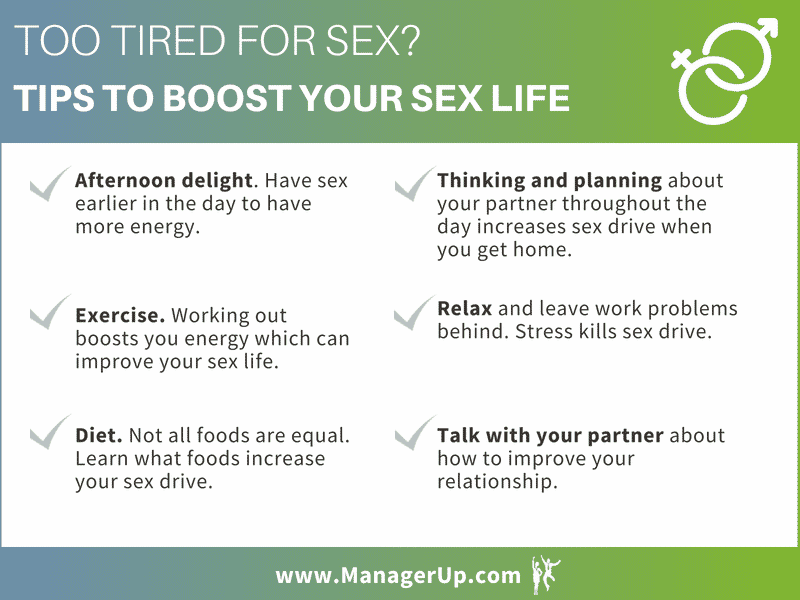
1. Afternoon Delight

Sex is not an activity you must do just before dropping off to sleep. Get up a bit earlier in the morning before you have to leave for work. You’ve got energy then, use it.

Do not wait until you are too tired for sex. Come home from work, and jump in the shower together, then you just go with whatever happens from there.

Barry McCarthy, Ph.D., a Washington, D.C. sex therapist, “suggests changing your routine to accommodate meaningful sex and sleep. Try sex in the morning, earlier in the evening, after a nap, or while the kids are at dance class or soccer practice.

You plan business meetings. You used to plan dates. Plan for sex.


2. Exercise

Short and quick weight lifting can be the boost you need, says Everyday Health.“Weight lifting causes the body to produce testosterone, which is the primary precursor for the male sex drive,” Pete McCall, an exercise physiologist, to the magazine.

He says lift enough weight to that you feel the burn by the 10th rep. Good exercise will not leave you too tired for sex.

Writer Jan Sheehan said, “some studies have linked short intense exercise, such as weight lifting, with increased testosterone levels.

To improve your sex life, do some push-upssit-ups, and crunches.”

That’s an exercise you can do on your lunch break every day, a few minutes in the morning and a few minutes in the evening. You can even do it while watching TV. Being too tired for sex will become a thing of the past.

Get more fitness tips on our executive library. See how easy it is to get fit!

Watching what you eat is good for your body and good for what Shakespeare called “making the beast with two backs.” Eat This has a list of 20 foods that are will boost your sex drive.

The best food on the list as far as we’re concerned is dark chocolate. Oysters are not on this list.

libido boosting foods for executives


4. Put Some Thought into It

You plan big business decisions. You plot our strategies and ways to get the work done in the office.

Remember when you were dating? You planned dates, what to eat and where to go. Just because you are in a long-term relationship does not mean planning gets tossed out the window.

Even the Wall Street Journal says thinking about your partner and then putting those plans into action makes sex better.

When you plan for something, your body starts building the reserves needed to carry out that plan.

You will also consciously start making adjustments to your schedule and your habits so that you can meet the demands needed for a great mattress adventure.

Think about that feeling you get when planning a big deal. The closer it gets, the more excited you become. Anticipation builds desire. If you approach sex the same way, it can blow your mind.

Planning ahead tells your body to be ready and you will not be too tired for sex.

Are you a businesswoman? If you’re a professional woman with children, you have another layer of responsibilities weighing you down that demands your attention from dropping off the kids at school to reading bedtime stories. Learn how to improve your sex life.

5. More Than a Late Night Activity

Kevin Thompson writes about relationships and sex. His article “When you’re too tired for sex” says, “A couple should take every opportunity to have as much sex as possible at a time other than the end of the day.” Why? Because late night sex happens when your energy levels are at the lowest ebb.

If you have sex during other times of the day, when your energy level may be at its peak or somewhere between the high and low levels, you share more than just sex.

He suggests taking a long lunch, coming home early, getting up earlier or set things up so you can come in late once in a while.

He says this might require a change in your mindset.

You already know that success in business means adapting and changing. Just apply that to your sex life.


6. Remember, You Are Partners

HealthLine says good communication leads to better sex. Think about this from a business perspective.

You have to let your partners and your staff know what you are doing. Pulling last minute surprises throws everything into disarray and can lead to disaster.

The article quotes Kate McCombs, a sex and relationships educator, who said, “When you avoid those vital conversations, you might avoid some awkwardness, but you’re also settling for suboptimal sex.”

By talking about issues, you will find even on those days you feel a bit worn down, you are still not too tired for sex.

So what about it? Do you think these ideas will help put more bang into your intimate moments?

Do you have some ideas to share with our readers who are too tired for sex? We would love to hear from you.


Is a better sex life really linked to success in business? Experts say yes. Find out the relationship between sex and success: how one makes the other better.

sex and success