Prayers for Work that Empower Your Day

Can prayer for work impact your workday?

Some of you will say: “Absolutely, it can”

Whereas for others, work and prayer do not seem to be directly related. Prayers are rather reserved for the places of cult, they say.

Some people say prayers for work when they have a big problem at the office, according to the motto: “When in fear, God is near”

There is no doubt that God helps us when we are in real need, but limiting our workplace prayers only to significant job challenges means that you do not fully understand the real power of prayers or how they can impact your day at the workplace.

Regardless of what we may experience throughout our day, workplace prayer is a way to keep us focused and performing at our best ability.  We can achieve it through a morning prayer before work or a workplace prayer during our office hours.

Everything you need for your workday can be found, obtained, and received through prayer. Do you want to stay focused on the task at hand? Do you need wisdom on how to do things better? Maybe you need energy for your long day and peace for difficult choices. Or maybe you lack stress resilience when facing an extremely difficult negotiation.    If your answer to any of these questions is yes, then prayer is exactly what you need.

Prayer is the confidence to speak at your business meeting and the bright idea that you need for your presentation.  Prayer is the peace to deal with unruly customers and to ask for that promotion you know you have worked hard for. The wonderful thing about prayer is that it can be whatever you need it to be.

Net, prayer is the secret weapon to success in the workplace.

Workplace prayer can seem more like an extra task on your to-do list and just another thing that you must make time for, but it is far more than that.

Once you begin to see prayer as the foundation that holds your workday together instead of just another thing to do, you will begin to see the difference in your day. Eventually, prayer will become as natural as setting your alarm clock for work or clocking in at the start of your day.

It doesn’t have to be some long ritualistic duty that takes all day. Prayer can be quick and said under your breath anywhere you are.

You can pray in your head and never have the words leave your mouth, and they can still be just as effective and produce the same results.

If you are interested in changing your workday for the better, check out these prayers for work that can be used by believers of different religions. If you are Christian, you may finish each prayer with “In Jesus’ name, Amen.” Muslims can end with “Peace be upon you and God’s blessings”.

Morning Prayer Before an Important Meeting at Work

Lord, as I wake up this morning, I am thankful for a new day. I pray that I may face the meeting ahead of me with confidence and assurance.  Help to settle my thoughts and to project the information for the meeting in a way that captivates those in the room.  Give me peace and calm any nervous jitters I may get, keeping my thoughts focused and my words intentional.

Help me to make eye contact with all those who may be in the room and to represent the company in a way they can be proud of.  May I have the perfect blend of personality and professionalism and help me to remember to gather everything I may need to pull off a perfect meeting.

Prayer for a Good Day at Work

Before I go to work today, I wanted to start off by asking you to prepare my heart for whatever may take place.  I ask that today may be a good day, which means that your peace is ever present with me to keep me in tranquility despite what may occur during the day.  Help me to organize my day in a way that would keep me free from rushing, wasted time, mistakes and anxiety. 

I ask that you would bless my thoughts, words, and actions today.  Help me to walk in your love, and do my job with a full heart, overflowing with kindness into the lives of others. Regardless of what transpires, may I be aware of your presence, knowing that as long as you are here, it will always be a good day. 

Strength To Do My Job

Some days at work may be more difficult than others; to be honest, sometimes I just don’t feel I have what it takes to get the job done. I need your strength.  I know it is in my weakness that you can show yourself strong and mighty on my behalf. 

Help me to remember that it is not about my capability and my strength but your ability to work through me when I allow myself to be used by you.

God, have your way in my life today and empower me to do my job in a way that brings glory to you.

Keep Me From Distractions

As much as I want to give all my focus to my job, I am often bombarded by distractions.  Help me to center my thoughts on fulfilling my obligations to my job in a way that is reflective of your character and goodness. 

Help me to silence the need for social media and constant attention to my phone and other devices.  Help me not to get so wrapped up in what is going on in the lives of others around me that I neglect the importance of my own responsibilities.  

Help me to set my notifications and alerts on my devices in a way that I may not be distracted but instead fully focused on the task at hand.

Give Me Directions in My Daily Tasks

There are a lot of things that come my way daily, and I am not always sure of what to do.  God, I ask that you not only show me what to do but help me to prioritize my daily tasks. 

Show me what needs to be done and how I can execute it in a way that requires maximum results with minimal energy. 

Show me who can assist me in completing these tasks.  Help me not to rush, to be fully engaged and not afraid to ask for help.

Bless My Creativity and Ideas

God, help me to utilize the gifts, talents, and ideas that you have given me to contribute to my company. Bless my creativity so that I may be able to produce new ideas and strategies that benefit my workplace.

Help me to see where my gifts and talents can be most useful and in what ways they will be beneficial.

Prayer for Workplace Prosperity

Thank you for my job. I ask that you bless my workplace with more business and revenue. 

Help me to develop ways to better serve consumers, thus making a more prosperous work environment.  Help me to gain new contracts and business deals that would further establish the brand as a company. 

Give me a clear vision of what the brand is and help me to project it in a way that attracts the right consumers.

Prayer is an easy way to take control of your day and you can allow prayer for work to change your day with three easy steps:

1. Start your day off with prayer.

2. Believe that your prayer was heard.

3. Expect to see the results of your prayer.


I am confident that these prayers will help you to establish success in your daily work environment.

Interested in other prayers? Have a look at these proposals:

The Ultimate Anxiety Prayers Guide for Busy People

Effective Prayers for Employment (Get Your Dream Job!)


We would love to hear how these prayers have empowered you work day.  Leave a comment and let us know how your day has been impacted.

Best Time to Drink Water to Boost Your Performance

Have you ever thought that changing the time when you drink water can have a big effect on your professional career, your life success and your overall health?

Sounds incredible? Hard to believe?

But this is true. By learning the best times to drink water, you can step change your daily energy levels and cognitive performance.  You will be less irritable, slimmer and healthier. You can simply be more productive and get more things done.

So please, read on to learn the best times to drink water throughout the day and excel at work!


Do You Really Need to Know When to Drink Water?

In the past, I thought it is important to continuously drink water — the more, the better. Then one day I realized that this is not entirely true.

When it comes to drinking water, there are two important guidelines:

– Drink the Right Amount — not too much or too little. Sounds logical, but very few people do it.

To know how much water, you should drink and why you should not drink too much, here are the questions:

Can You Die of Drinking Too Much Water?

How Much Water Should I Drink a Day?


Follow the Best Times to Drink Water: the water we drink lubricates many important body functions, such as digestion, muscle health, blood pressure, blood oxygen circulation, and brain performance.

For The body works better with proper amounts consumed at the right time. In fact, there are times when it is actually harmful.


Therefore, the answer to the above questions is yes: you need to focus on the best times to drink water to help your body work properly and be more productive and efficient at work.  


What Are the Benefits of Drinking Water at the Right Times?


There are many advantages to knowing the best time to drink water. Some of the benefits are directly related to productivity, brain performance and enhanced cognitive abilities, while others are related to your overall health, which indirectly impacts your success at work.

When you know the best time to drink water, you can step change your productivity by:


– Improving your brain performance

– Increasing your energy levels

– Boosting good mood and self-confidence

– Improving concentration and other cognitive skills

– Reducing headaches during the work day

– Resting better at night and starting fresh and energetic the next day

– Improving bad breath, which can be a big obstacle when working with others

– Boosting your immune system to reduce sick days


When You Drink Water at the Right Times You Also Can:

– Lose weight

– Improve your cardiovascular health

– Reduce your digestive problems

– Control your blood pressure

– Reduce cancer risk

– Purify the urinary tract

– Control body temperature


Let’s see how to achieve these benefits by drinking water at the right time. This can make all the difference in  exceling at work.


Best Times of the Day to Drink Water for Busy Professionals

As executive, manager or entrepreneur, you should know when drinking water can benefit your health and your performance at work. Here is a guide to be applied all day long:


1. Drink Water the First Thing in the Morning

Every time I see Japanese executives, I am surprised how healthy, slim and enthusiastic they are. During my visits to Japan and when talking to my Japanese friends, I learned that for them the best time to drink water is early in the morning, just after waking up.

Yes, they drink cold water on an empty stomach.

Scientists now confirm that this habit helps remove toxins and acid waste from the body as well as energizes the cells by supplying them with free oxygen. This is the key to treating many unpleasant health issues like constipation, bloating, headaches and joint pain.

Extra tip: after having your glass of cold water, wait for at least 30 minutes to have breakfast — the time your body needs to hydrate and flush out toxins.


2. Drink Water During Working Hours at the Office

 Absolutely the best time to drink water is when you are thirsty. Thirst is the alarm signal of your body. Don’t wait. Drink. Someone who is thirsty is normally already dehydrated (up to 2%!).

The mistake that many thirsty people make is to drink a lot and too quickly. You should start with just one glass and drink slowly. After that, pause for a few minutes, and if you are still thirsty, drink more.

Don’t drink coffee or soda. Plain water is the best liquid to quench your thirst.

Another best time to drink water is when you feel exhausted. Even small dehydration drains your energy.  Therefore, when you are lethargic and your energy level is low, just drink water. 

A glass of cold, fresh water will hydrate your body, give you an energy kick and step change your productivity at the office.

It is equally important to drink water when you feel ill or are around sick people at the office. Water is your secret weapon against viruses and germs. Have a glass and flush the intruders away.


3. Drink Water 30 Minutes Before Lunch

 Another best time to drink water is half an hour (or an hour) before your midday meal. You may have heard this advice before.  It is normally recommended for people who want to lose weight.

Drinking water before meals fills up your stomach, giving you the sensation of being full. As a result, during lunch you will eat less. It is good advice for sedentary executives who want to shed a few extra pounds as a consequence of those long-hours sitting at your desk.

But do not exaggerate the amount you drink before a meal. Normally, one glass should cover your hydration needs.

There is also another important benefit of hydrating yourself 30 minutes before lunch. This practice will immensely improve your digestion. It will prevent you from feeling groggy and tired a few hours after eating. You will feel lighter and more able to concentrate on your afternoon work tasks.


4. Drink Water 60 Minutes After Lunch

 Having drunk water 30 minutes before lunch, you should avoid drinking it during your meal because it will dilute the digestive juices, which is not necessarily what you want. Good digestion means superior work performance in the afternoon due to higher energy and less pain.

Drinking water half an hour before lunch and having vegetables and fruit on your plate should cover your hydration needs. If you really cannot survive without drinking water during your meal, then just have a small glass.   

How much time after lunch should you wait to drink again? The best time to drink water is one hour after lunch. 


5. Drink Water Before, During and After Your Workout

Many executives and office workers use the noon break to workout. It energizes your metabolism and helps you get some relief from your job responsibilities.

There is no better time to drink water than during and after the workout. Every time you hit the gym, take a big water bottle with you.

Physical exercise has a lot of important health benefits for sedentary executives, managers and entrepreneurs. It reduces stress, increases energy levels and metabolism. The downside of any workout is water loss, which can negative affect your performance when back at the office. None of us want to come back exhausted!!! We have many tasks to do in the afternoon.

Assuming that your workout lasts one hour, many experts advise you to start drinking 30 minutes before (8 ounces/0.25 liter). Then, sip water during your gym session (16 ounces / 0.5 liter) and drink another 16 ounces (0.5 liter) 30 minutes after leaving the gym.

Water is extremely important for muscles and joints. During your workout, your body temperature goes up. Water helps you to cool down your cells: hydration prevents cramps and injuries.

Finally, if usually you exercise after work, the recommendations are the same. However, try not to exercise close to bedtime, because exercise energizes the body and you want to relax and prepare it to fall sleep.


6. Drink Water 30 Minutes Before Dinner

 As you probably expect, another best time to drink water is half an hour before your final evening meal. The logic behind this practice is similar to drinking water 30 minutes before lunch. This habit will significantly increase your digestion and help you keep your waist expansion in check.

Should you drink water before going to bed?


7. Drink Water One Hour Before Bed

Is bedtime the best time to drink water? It depends on how many times you normally wake up to go to the restroom.

If it is just once, then you can have a glass of warm water one hour before you hit the sheets. It is important to be sufficiently hydrated when retiring. Warm water before bed can detox the body and reduce stomach discomforts after dinner.

Waking up two or three times at night may indicate that you drink too much water before falling asleep. If this is your case, I recommend visiting your HCP to check for any serious medical condition behind these frequent visits to the bathroom.

Waking frequently at night will disrupt your sleep, and you need good rest before the next tough day at work.

Find out 8 Ways Sleep Deprivation Affects Your Performance at Work


On the other hand, it is better to wake up twice at night than to go to bed dehydrated. 

The best you can do is to observe your body and find the right water amount that will keep you hydrated without the necessity of visiting the bathroom frequently at night.


8. Drink Water Before a Warm Bath or Shower

If you are accustomed to having a warm bath or shower to relax after a stressful job, drinking water shortly before is an excellent idea. You will regulate both your blood pressure and body temperature.

But the water should be warm, not cold. A warm shower will dilate your blood vessels from the outside and the warm water from the inside.


 How to Remember When to Drink Water?

 We know you have a busy schedule. To follow the advice from this article, most of you will have to adapt your daily habits at home and at the office.

Let me suggest some simple strategies to help you not to forgot to hydrate.

To drink water the first thing in the morning, place a post-it in the kitchen or simply leave a glass of water the night before in your bedroom. Please do not forget to cover your glass so that it stays clean all night.

Always have a full bottle of water at your office desk. Set alarms on your smart phone. Let your phone remind you to drink water 30 minutes before lunch and dinner.  

 For further advice, please have a look at this post: “Stayed Hydrated at Work in 7 Easy Ways.”


 Bottom Line

 It is not only important to hydrate but also to do it at the right moments. It is crucial to know the best time to drink water as it can step change your productivity and improve your health significantly.

Please, don’t forget to share your comments with us!

Productivity and its 12 Healthy Drivers

This article is your ultimate productivity guide. You will soon be able to define productivity and learn to adopt key strategies to boost it.

Productivity is the holy grail of the business world. Many confuse the word, however, with terms like profitability, performance, effectiveness, and efficiency.  In this article, I will provide a definition of productivity that is easy to understand.

I will also tell you about “healthy” productivity and its drivers. You have probably never heard this term before, but it is one of the key productivity concepts we use at Manager Up.

It is highly likely that you want to increase your and your team’s productivity. But how to do more with less effort? Maybe you think that only working longer hours will achieve better results.

Wrong!

The founders of Facebook, Google, and Amazon all had the same number of hours in a day as you have now, but their results were significantly different.

They simply had a different approach to productivity! So, how did they accomplish more with less effort?  Do you want to learn how?

If so, let me take you on a journey through the productivity world.  This is our road map:

– What is productivity?

– Are there productivity short cuts?

– What is healthy productivity?

– What are the 12 drivers of healthy productivity?

         – Positive drivers

         – Negative drivers

So, let’s start with answering the key question:


What Is Productivity?

We have already indicated that productivity is not the same as efficiency, profitability, effectiveness or performance.

 Personal productivity is simply defined as the ratio between the value generated by your activity and the resources used.

                                    The value generated by an activity

Productivity =  ——————————————————

                                    Resources used during this activity


Obviously, in order to increase your productivity, you should:

– Focus on activities that generate significant value

– Minimize the resources involved

It would be best to do both!


Are There Productivity Short Cuts?

When talking about productivity, some authors and bloggers try to convince you that an improvement of two or three elements in your business conduct will step up your productivity level.

You may try to “do the right things” and focus on those activities that generate high value. This is a good approach, but it has two weak points.

First, unless you are a CEO or own your own business, it is almost impossible to do only big things. Your daily business life consists of dozens of small things that need to be done.

Second, big projects often eat up a lot of resources. We end up exhausted and stressed out, drained of energy.

Therefore, simplistic approaches to productivity never work.  Productivity is a complex animal, and to see it roar, you need to leverage different drivers to maximize value and minimize resources.

What drivers am I talking about? You will soon see it.

Most of us fail to realize that to become more productive, we need to take a 360-degree approach to our well-being and the way we work. Our cognitive functions will never be at their best if we don’t pay attention to what haunts us in the course of our working lives. For instance, stress, mental fatigue and exhaustion.

Ask yourself, how long you sleep?

How energetic are you during the day?

How well do you manage your stress level?

How efficient do you use your time?

Do you procrastinate? And so on…

All these factors influence work productivity. If you overinvest your human resources, it may negatively affect your health. You must have heard that some executives and managers end up with serious diseases, so this shouldn’t come as a surprise.

Therefore, the question is not how to be productive, but how to be productive in a healthy way.


What Is Healthy Productivity, Then?

We said before that the productivity is proportional to the value you generate and inversely to the resources you use. In fact, the main resources we have are our physical and mental capabilities. In short, personal productivity depends very much on how much individual effort and energy we invest.

An extremely high personal investment makes our bodies suffer. In the long run, it may have very unfavorable consequences for our health and well-being.

Jim Rohn once said: “take care of your body. It is the only place you have to live”.

To be highly productive, it is important to invest our human resources in the healthiest way.

The healthy productivity ratio looks like this:


                                                            The value generated by your activities

Healthy Productivity =                 ——————————————————

                                                           Your healthy personal human effort


12 Healthy Productivity Drivers

At Manager Up, after carrying out massive in-depth research, we have identified 12 key elements that directly influence productivity and health. We decided to call them the 12 Drivers of Healthy Productivity.

Eight of the twelve drivers are positive and four are negative. To be more productive, your objective should be to maximize (or improve) the positive drivers and minimize the negative drivers.

Let’s first focus on the positive drivers:


8 Positive Drivers of Healthy Productivity

 1. Productivity and Human Energy

 This is the key driver of healthy productivity. I think it is not difficult to see the correlation between personal energy and productivity. When you are very tired, your productivity is close to zero. In fact, you often feel like sleeping.

On the other hand, when you have had a good night’s sleep, then go to the gym for a moderate physical workout and eat a good energetic breakfast, you feel like a young god or goddess.  Your energy makes you fly, and you are able to do a great many things with minimal effort.

In 2007, the Harvard Business Review published an excellent article: “Manage Your Energy and Not your Time”. The article says that a day has a limited number of 24 hours: it cannot be stretched. But our human energy can be increased in a practically infinite way.

Tony Schwartz and Catherine McCarthy point out that our energy originates from four different sources: emotions, body, spirit and mind. If you cleverly manage these wellsprings, you have practically endless possibilities to recharge yourself.


2. Productivity and the Quality of Sleep

Do you remember the last time you had a long business dinner and afterward you went to a bar with your team? And then you ended up in bed very late.  When the alarm clock rang the next morning, you felt like anything but working, but you had to push yourself out of bed. The meeting was supposed to start on time, and you didn’t want to arrive late.

How productive were you in that meeting? Was it easy to focus? Or you were simply trying to get through the day?

A lack of sleep undermines performance and productivity. Without enough sleep, we cannot think, learn and solve problems efficiently. Attention and memory are impaired. Our productivity is at the rock bottom.

By the way, sleep problems are not only caused by late business events. More common causes are stress, jet lag or eating too much for dinner.

One study estimates that sleep-related productivity loss amounts to almost $2,000 per employee each year. Plus, chronic sleep deprivation may lead to illnesses that increase absenteeism.  That, of course, decreases productivity in a significant way.

Sleep deprivation may be related to both sleep duration and to quality. Research shows that poor sleep quality makes us less stress resilient.

Do you want to be productive tomorrow? Make sure that you sleep like a baby tonight.


3. Productivity and Physical Exercise

 “I don’t have time for a gym” is something I hear from many readers.

The same readers complain that their careers are not progressing well. They are not as successful as they would like to be. Their relationships do not give them satisfaction and, and, and…

Your career and success depend very strongly on your productivity.  There are dozens of studies [1] [2] [3] that have proved that exercise boosts productivity. This means that gym goers do more in the same period of time than couch and desk potatoes.

Physical exercise makes you healthier, taking fewer sick leaves, while experiencing less disabilities. Furthermore, being fit will change your physical appearance. Believe me, people perceive obese individuals as less capable and successful.

No doubt, physical exercise is one of the foundations of healthy productivity.


4. Productivity and Task Management Systems

 Most of you have heard at least once about the Eisenhower Matrix or the Getting-Things-Done method by David Allen. Some of you use these or similar productivity systems at work.

But has science really proved that we need a task management system to be more productive? Our intuition says that we do and… that’s true. Science confirms what we know by instinct.

Task management systems are useful as they reduce the time needed to define priorities.  And it is proven that our brains work at their highest productivity level if there are clear directions and things are ranked in the order of importance.

They also serve as a kind of external memory. Knowing that everything is saved in one place and no critical data gets lost reduces stress and confusion.

It is said that the best task management system for productivity should measure the delivered results and not just the objectives and strategies. In this way, you can measure your real productivity.


5. Productivity and Time Management Systems

 Your day has 24 hours. Do you use them well?

Even if you have a good task management system, you must ask yourself if managing your time in the most effective practice.

Do you deliver projects on time or do you procrastinate? It is obvious that procrastinators are less productive, but how to stop procrastinating?

Do you do one thing at a time or juggle many priorities simultaneously? The former is typical of monochromic people and the latter for polychromic folks. Your attitude may be culturally driven.

Do you have days when you do more than on other days? Why? Maybe it has something to do with the way you invest your time on the productive days?

How do you manage interruptions? Do you know how to say no to incoming requests?

These are all important questions to be answered. It is crucial to analyze your time-wasting behaviors. Research shows that there is a relationship between certain time management systems and productivity.


6. Productivity and Personal Confidence

We seldom understand the real importance of self-confidence. Believing or not in yourself may decide not only your project’s but also your career’s success.  

All projects face issues, problems and obstacles. Self-confidence creates an inner strength to overcome any form of adversity. By being self-confident, you embrace challenges. You do not give up after failures. You simply deliver again and again.

Self-esteem moves us from thinking about something to really doing it. It speeds up the creation process. Thus, it increases your productivity.

Why productivity?

Richard E. Petty, a professor of psychology at the University of Ohio, says that without self-esteem there is no action. When facing a challenge, we first judge our ability to overcome it; and only if we are confident that we can do it, do we jump into action. For Petty, confidence is a magnifier of thought. Self-confident people have a growth mindset. This is a concept further developed by Professor Carol Dweck from Stanford University.

People with a growth mindset strongly believe they can achieve more. They are more stress resilient and challenge themselves more frequently.  


7. Productivity and Office Ergonomics

 When people are asked what drives productivity, office ergonomics seldom sits on the top of the list. People either do not understand the connection between ergonomics and productivity or they think that the influence is very limited.

Although from the short-term perspective the importance of ergonomics is not significant, the wrong ergonomics has significant consequences on productivity and health long term.

First of all, a lack of office ergonomics significantly increases the risk of back and neck pains as well as other musculoskeletal disorders. These medical conditions increase absenteeism and disabilities, which directly influences productivity.

Interestingly, sick leave days depend not only on the type of desk we have, but also on the type of office. For example, people working in large open spaces become ill more frequently than people working in small cells.

Furthermore, inadequate workplace lighting causes visual stress, such that our eyes suffer and our productivity decreases. The productivity difference between ergonomically optimized and suboptimal spaces could be as high as 17%.

Moreover, beautiful, well-lit offices are simply nice places to spend your time. Ergonomics likely indirectly influences employee motivation, which again raises productivity. Therefore, it makes a lot of sense to have a closer look at your workspace.


8. Productivity and motivation

The conventional wisdom says that motivated people work better and faster.

They are more creative and persistent. They are simply more productive.

Once again, the conventional wisdom is right. Motivation is the force inside which makes you do things. It pushes you to act.

What drives this force? People are motivated by many different things. Some by money and some by intangible benefits like recognition. We also are motivated by our goals and ambitions. The ambitious (and realistic) goals inspire us. But be careful not to set unrealistic objectives for yourself or your team.

Furthermore, we are driven by our thoughts and beliefs. If you believe that you are good at something, it is easier to be motivated during this activity. If you believe that your manager does not like you, your motivation drops, even if he/she really likes and respects you. Our thoughts and beliefs determine the things we will focus on and will do in the future.

Self-motivation determines whether you will adhere to your plan. This is especially critical if you find obstacles in the way. Your degree of motivation will decide whether you give up or continue on. To increase your own motivation or the motivation of your team members, please analyze first the motivational driver of a particular person.

I think you now get the point that motivation drives productivity. But how is it related to your health? Motivated people overcome life and work obstacles easier. They have higher stress resilience. They are simply happier.

The opposite is also true. People who are not motivated suffer in their jobs and are more prone to burnout and depression.


Negative Productivity Drivers

9. Productivity and Excessive Stress

Is feeling stressed a cheap excuse for lousy productivity? Stress belongs to an executive job, doesn’t it? So, what’s the deal?

While on one hand it is true that stress is a part of life, actually it is often helpful. Facing a challenging situation, we need a certain level to reach our goals. In this case, we speak about positive stress (eustress). A classic example is a job promotion.

The issue arises when this stress crosses a certain threshold and becomes really burdensome.  This is not difficult in our hyperconnected world. Then we speak about negative stress (distress).

Chronic distress is not an illness. However, not only does it make us unhappy, but it can lead to burnout and physical illness, too. In both cases, productivity will suffer.

Interestingly when you complain about stress in most of the cases you mean the “distress” rather than “eustress”. The eustress is perceived as something pleasant and motivational.

To sum up, we need the right amount of pressure to perform well, but distress decreases job satisfaction and mental well-being. And last but not least, it has a very high productivity cost both for you and the organization you work for.


10. Productivity and Illnesses

This is a no brainer. When you are ill, you do not work and your productivity is zero.  Well, not all people who report their illness, injuries or important medical treatments tell the truth, but this is a story for another post.

Today we are focusing on the real impact of illness on productivity. Especially in the wintertime during the so-called cold and flu season many people have to stay home. This has important benefits as our ill co-workers will not spread viruses in the office.

Additionally, the sick leave of chronically ill employees causes productivity losses in the billions of USD each year. By chronic illnesses we define, depression, diabetes, asthma, cardiovascular diseases, cancer and obesity.

How to avoid being ill? In particular, how to avoid the serious chronic diseases that can significantly decrease your and your company’s productivity. One of the ways is to follow effective stress reduction strategies. It is crucial to lead a healthy lifestyle, which is much easier than you think.


11. Productivity and Procrastination

Procrastination is defined as intention ally avoiding completing a task on time. It is actually one of the biggest barriers to productivity.

Procrastination is much more, however, than just postponing an important call from one day to the next or not delivering a management report on time. As Mel Robbins says, procrastination is a habit. The problem is not this particular call or that particular report. The problem is that procrastinators procrastinate again and again.

Have you ever asked yourself why people procrastinate?  The answer may surprise you. Procrastination is a powerful relaxation technique. Yes! Procrastination is the way to reduce stress. Procrastinators postpone stressful tasks and do pleasant things instead.

Of course, they know they procrastinate, and the act of procrastinating creates negative emotions and… additional stress. It’s a vicious circle that shrink productivity.


12. Productivity and Interruptions

In their report on interruptions, Jonathan Spira and Joshua Feintuch estimate that interruptions cost the US economy almost 600 billion/year. They estimate that almost a third of the working day is consumed by interruptions.

But it is not only the time consumed by the interruptions themselves that makes us less productive. The issue is that the interruption effect is prolonged for 23 minutes afterward. For more details ,please read this interview with Professor Gloria Mark.

Sometimes, we can do very little about our boss’ interruptions. But the good thing is that almost half of all interruptions are caused by …us! Social media, surfing the internet or frequent trips to the coffee machine, etc.

So why is it good? Because by getting a grip on ourselves, we can significantly increase our productivity.

On our website we invite you to take a journey through healthy productivity. We encourage you to assess yourself and find out where you stand in terms of these 12 drivers.

We also offer you tons of free advice on how to improve your healthy productivity:

120+ Ideas About How to Be Productive at Work

Must-Read Books on Focus and Productivity to Get Things Done

Enhance Your Performance By Listening To The Right Music

How to Train Your Brain to Focus at Work

How to Regain Energy When You Are Sleepy at Work


Manager Up helps you take your career and life to the next level.

Please let us know if you found this article interesting. We want to know what you liked and disliked? And, especially, what was missing?

12 Stress Relief Games (Backed by Science) That Will Keep Your Stress at Bay

Stress relief games? Can they really help me reduce my work and family stress and relive my end-of-day tension? Gaming creates addiction, doesn’t it?

Playing games during working hours can be classified as cyberslacking, right? The answer is “yes, but…” to all of these questions.

There are several games with a stress relief effect. Some may cause addiction, however. Thus, playing some games requires significant self-control. 

You should not use your work equipment for personal purposes. Nevertheless, playing a short game before an important presentation or a difficult meeting to reduce your overall tension is not cyberslacking.

Furthermore, there is nothing wrong with playing games on the plane, at airports, during lunchtime, or after work at home.

Stress relief games offer you a new way to combat the mental pressure you experience every day. But please do not treat gaming as the only way to reduce stress. There are many other stress relief methods to apply in your daily life.

70+ Ways to Relieve Stress (Permanently!) That Really Work


What Exactly Is a Stress Relief Game?

A stress relief game is a simple game that is able to reduce your overall stress and anxiety level as well as improve your mood.

A short gaming activity takes your mind off your daily life problems and lets you escape from work, and social and relationship pressure.


Did Science Prove the Effectiveness of the Stress Relief Games?

Yes, it did! Some psychological studies indicate that causal video games assist in treating stress-related medical disorders.

Moreover, research confirms that temporarily losing sight of real life and relaxing are associated with games, allowing them to relieve stress for many players.

Another scientific publication suggests that work-related fatigue can be countered by playing games, especially for individuals lacking social support.


What Should You Know Before Playing Stress Relief Games?

Before you start playing these games, there is one very important piece of advice for you. In many cases, the basic level of these games is very simple and relaxing. Please use them to release tension and do not progress too quickly to the next level.

The last levels, due to their complexity, can be frantic and stressful. They may, in fact, increase your stress level. Be aware of this consequence! Again, self-control is key when playing stress relief games.


Which Are the Stress Relief Games?

A list of games prepared for you:

1. Flow Free

This is one of the most soothing games that can be found on the internet. The objective is to pair the same colors with a “pipe.” By connecting the colors, you create a Flow®. The puzzle is solved when the pipes cover the entire board. Don’t cross or overlap the pipes, however.

Note that the higher level, the more challenging and frenetic it becomes. To get the real stress relief benefits from this game, please stick to the lower level.

Available on:Web, iOS, Android.


2. Candy Crush

This is one of many puzzle games you can find. Candy Crush is one of the most famous stress relief games that has been played all over the world.

It involves connecting the same colored candies and crushing them, thereby giving the user the best experience. Stress release is further enhanced by lining up the candies to the upbeat music.

In a scientific papers we read that because the timed levels are not sequential, players can work at their own leisurely pace.

Note, however, that Candy Crush is one of the most addictive games. In this article you can read why.

Available on: Web, iOS, Android.


3. Wordscapes

This is another famous stress relief game. It appeals to anagram and corsswork lowers and anhyone who loves word search challenges. A few minutes is all it takes but you can do it for hours if you like.

Here is how it works. You build words from your given letter without a time limit. You can create more than one. You are not scrutinized as there is no timer or pressure from a countermove.  It is about your time, so no stress is involved.

Available on: iOS (iPhone, iPad) and Android.


4. Pigment

If your favorite activity as a child was to color a book, then this is your best pick. In this game, you have to color the designs you choose from a huge set of coloring pencils. Give it a try!

Some researchers say that this kind of activity boosts mental acuity. In fact, coloring is great to pick up your mood and lower stress.

Plus, it is highly creative. In just ten minutes or more, you can relax as if you were meditating to reach mindfulness. You are in the moment with full concentration.

Available on:  iOS and Android.


5. INK

 This is a very unconventional puzzle game concept. It works on levels like most games and the point is to conquer the enemies in the room. There are goals at each level.

But you don‘t really know where you are going as the environment is invisible. Therefore, you need to explore a bit before applying any paint. How cool is that!

Neuroscientist Daniel Bor explains why we feel so good when solving puzzles. Most people activate the pleasure center of the brain as they seek to comprehend patterns and complexities.

Available on:  iOS and Android.


6. Push

Push is a great stress relief game to consider as it is quite different. You press buttons to unlock switches. Sounds simple, right? In the very beginning, it’s easy and relaxing, but soon things become more challenging. 

 Available on:  iOS or Android.


7. Tetris

Tetris is one of the oldest computer games around designed by a Russian engineer in Soviet times. It takes you back to your childhood, thereby giving you a good feeling.

Like all games, there is a goal. Here it is to gain points by eliminating the horizontal lines you see in the blocks. You can do this by moving and rotating the “tetriminos” inside the playing field, called the matrix. When no empty spaces are left, you are done.

Some studies classify Tetris as a stress relief game as it seems to work wonders on mood. It is a great form of distraction for anxiety. People get so involved that they lose sight of their stress.

Some researchers from University College of London found that playing Tetris for ten minutes reduces stress better than using a mindfulness app. There is no doubt, then, that this game has proven stress relief properties!

Available on:  iOS and Android.  


8. Super Mario Run

 If you are not much of a puzzle game person, then Mario may be a good option for you. It is super popular and an all-time classic.

This stress relief video game not only reduces stress but it also makes you happy. This is what one study confirms. Results show that in-game success boots one’s mood and eliminates traces of anger.  The classic game is the answer to a stressful life.

Available on iOS and Android.


9. Prune

This is a game with a simple goal. You prune the Bonsai tree, creating the desired shape.

You do it by cutting away anything unnecessary. It is a relaxing exercise without any competitive pressure. The game’s design is monochrome, which calms the mind. This is a highly recommended form of stress relief.

Available on:  iOS and Android.


10. Blue

Even if blue is not your favorite color, you will love this game. The rules are extremely simple: you just need to change the screen color to blue. 

Blue is very enjoyable although quite short in comparison with other games. The puzzles are challenging, but not frustrating. Plus, the soothing music makes Blue a relaxing and calming form of stress relief.

Available on: iOS and Android.


11. Word Cross

Did you know that scientists have found that people who do word puzzles regularly have brains that are ten years younger than their real age?

Solving crosswords is a very popular leisure activity. Some researchers from the University of Calgary believe that leisure activities play an important role in stress reduction.

Word Cross, particular, offers the opportunity to do newspaper-like crosswords on your smartphone. It is extremely easy. There are over 2,000 challenges and every day you get a bonus.

Crosswords are an all-engrossing world you can do every day. You become engaged quickly and stress fades away.

Available on Apple and Android.


12. Harmony: Melody Mirror

 People who love this game say it is easy. It is a smart music game much like Guitar Hero. Observe the notes and tap the free squares at the right tempo to active a glow. Soon you have created a bit of a melody. You will feel like a real life musician and composer.

This has been a major anxiety reducer for players. Problems like stress and OCD disappear in a jiffy. Some say that you will note a reduction in your heart rate the more you indulge.

No timer, no stressful competition or countermoves. Just relaxing fun on your own.

Available on: iOS and Android.


Conclusion

Stress relief games are fun and relaxing. They allow you to divert your mind from the tensions of life as entering another realm.

Try the games listed, and if they prove to be an effective stress relief strategy for you, please feel free to share this article with others to help them deal with their stress. After all, sharing is caring!

Also, please tell us in the comment section below what other games you play to reduce stress.

Interested in Other Highly Effective Stress Relief Tools?

40  Powerful Mantras for Instant Stress Relief

The Best Stress Relief Toys for Busy Executives

Natural Stress Relief: 32 Ways for Immediate Stress Reduction

Sedentary Job? How Much Water Should I Drink A Day?

Have you tried to find an answer to “how much water should you drink a day?”

I have.

I wanted to validate the conventional wisdom that says we should drink 8 glasses of water a day.  I had a look at the recommendations of respected health institutions and medical bodies, but they are so confusing.

Just look at the list below on.

Water Intake Recommendations:

1. The National Academies of Sciences, Engineering, and Medicine

– For men: 3.7 liters or 125 ounces.  

– For women: 2.7 liters or 91 ounces.


2. World Health Organization

– For men: 2.9 liters or 98 ounces (Sedentary, Temperate Environment)

    4.5 liters or 152 ounces (Physically Active and/or Increased Temperature)

– For women: 2.2 liters or 74 ounces (Sedentary, Temperate Environment)                      

    4.5 liters or 152 ounces (Physically Active and/or Increased Temperature)


3. National Health and Nutrition Examination Survey, 2009–2012

– For men: 3.46 liters 117 ounces.

– For women: 2.75 liters or 93 ounces.


4. UK National Health Service (NHS)

– For men: 6-8 glasses.

– For women: 6-8 glasses.


5. Healthline.com

– For men:  3 liters or 104 ounces

– For women: 2.1 liters or 72 ounces


6. The U.S. Dietary Guidelines 2015-2020 

These guidelines do not recommend a specific daily water or fluid intake, but they do recommend choosing plain rather than flavored water and juices with added sugar. 


As you can see, every institution gives different advice! Some do not give any specific recommendation at all…

Additionally, most of the recommendations do not say if they are for people with sedentary office jobs, like me.  Maybe they make reference to people who work physically and sweat a lot during their working day. Or maybe they are simply average numbers for general population.

Uff…It is a mess.

I thought that some articles on the internet could help solve this puzzle, but most of the posts on the Web provide us with simplistic and often contradictory recommendations.

So, I did my own research and now have a clear answer for you in this article, which will not be simplistic because body hydration is a complex topic.


Is There One Simple Recommendation on How Much Water We Should Drink a Day?

No!

First, there is NO hard data that can support a set number of glasses per individual.  Scientists are not able to define objective, accurate measurements on how well hydrated the general US or European populations are.

Secondly, we are all varying shapes and sizes, and have unique needs dependent upon our health state.

Thirdly, our needs depend on the amount of water we lose every day, and this depends not only on our constitution, but also on where we live and what we do during the day.

But, why is it so important to supply your body with water regularly?


Why Should We Actually Drink Water Every Day?

The answer: because we lose water continually, 24 hours a day; and without water we die. Our bodies need sufficient water to function properly. Water is needed by our cardiovascular and neurological systems, by our muscles, bones, etc.

Our body water (60% of total body content) is continuously removed through:

– Breathing

– Urine and excrement

– Sweating


If you do not replenish this lost water, you get dehydrated; and this has serious consequences:

– Mild dehydration (1–2%) affects cognitive performance and memory.

– Moderate dehydration (up to 4%) makes us irritated, sleepy, increases respiratory rate, causes headaches and decreases muscle strength.

– Severe dehydration (more than 8%) may lead to death.


This means that the objective of drinking water is to compensate for the continuous loss we experience every day.

So, the answer to the question, “how much water shall I drink a day”, depends on the amount of the water you lose every day, right?

Yes, and here it gets a bit complicated…


Factors That Determine Water Loss

It is extremely difficult to determine how much water you should drink a day, because everybody loses different amounts of water.  Even the same person loses different amounts of water during two consecutive days.

Why is it, so?

Here are the most widely recognized factors that influence your water loss.

– Your job type: it is pretty obvious that a person who sits all day at a desk will lose less water (sometimes significantly less) than a person who works physically outdoor on a hot day.

– Atmosphere and temperature: If you live and work in a hot, humid environment, you will require more water. High temperature and humidity increase sweating and respiration rates. To lose less water, turn on the air-conditioning during hot summer days.


– Physical exercise: Again, a pretty obvious thing: people who exercise lose more water than couch potatoes. This water loss increases with the intensity of the exercise.

– Health Condition: Your body loses liquid when you have a fever, diarrhea or even when vomiting.


So, How to Estimate How Much Water We Lose a Day?

In the scientific literature we can find some good estimations about the water loss of average individuals.

Daily Water Balance in Your Body:


Respiratory loss                             from     – 250   to      – 350 ml/day

Urinary loss                                     from     – 500   to   – 1,000 ml/day

Fecal loss                                          from     – 100   to       – 200 ml/day

Insensible loss                                from     – 450   to    – 1,900 ml/day

TOTAL LOSS                                     from  – 1,300   to   -3,450 ml/day

Metabolic water production      from      +250   to     +350 ml/day

TOTAL NET LOSS                           from   – 1,050  to    -3,100 ml/day


Now let me explain the table:

Respiratory loss means that you lose water when you breathe. You also lose water when you visit the restroom to do your necessities.  In this case, we speak about urinary and fecal loss. Insensible loss is through the skin when you sweat.

On the positive side, our bodies also produce water during metabolism and energy production. This is what you see in the table under the “metabolic water production.”

A person at a sedentary job, with an average body size, loses each day between 1.05 and 1.5 L.

This obviously does not include any physical exercise like jogging, swimming and gym visits before or after work. This water loss (sometimes significant) is additional.

If water loss is dangerous, maybe you should drink larger amounts to make sure you are never dehydrated?


But…Does It Make Sense to Over Hydrate?

The evidence that over hydration is beneficial is not clear. Importantly, drinking too much water can be dangerous. It may even lead to death in extreme cases.

Find out Why Drinking Too Much Water Can Lead to Death


Moreover, too much water may deplete the minerals, especially potassium and magnesium, that are essential for health. It may also lead to fatigue as our kidneys must work harder. 

Slight over hydration is OK. Excess water is normally removed efficiently from the body. Of course, this does not apply to people with renal problems. They must control their water consumption with their HCP.

Over hydration may make sense If you are following a diet high in sodium; then you may need to drink more water to flush out that extra sodium that can be harmful to your body.

There are also some medical conditions like urinary tract stones and bladder infections that require more water intake. But again, always consult with your doctor.

The conclusion: it makes little sense to over hydrate unless there are specific medical indications.

It is important to remember as well that all healthy foods contain significant amounts of water. Let us have a look at the water content of different foods.


What Counts As “Water”?

You can find water in all kind of foods. So, what counts as water? Here is the answer:

1. Fruits and Vegetables

Fruits are made principally of water. A pear is 84 percent and a banana is around 74 percent, while watermelon is 92 percent water. Different organic products that are equivalent to or more than 90 percent water are fruits like grapefruit, melon, and strawberries. They also provide a wide range of minerals and vitamins.

Many vegetables have more than 90% water content. For instance, celery, lettuce, and radishes contain 95-96 percent water. Zucchini, tomato, spinach, and eggplant contain about 90%.


2. Dairy Foods

Foods such as ice-cream and yogurt are high in water content. Plain low-fat yogurt is almost 89%, while a low-fat vanilla dessert is 61% water. Indeed, even cheddar cheese has nearly 40% water content.


3. Different Sources of Water

Juices, soda, soft drinks, and smoothies can be hydrating; however, they can be high in sugar and calories. Tea, coffee and alcoholic drinks also provide water but cause you to lose more when you pee. Sports beverages have high water content. Energy drinks are not quite the same as sports drinks. They contain sugar and stimulants, similar to caffeine.

If you want to maintain a healthy diet, remember that a 30-year-old, sedentary male should aim for 2,400 calories while 30-year-old sedentary women should consume 1,800 calories per day. Be sure to avoid drinks high in calories. You may consider drinking a cup of green tea!


How Much Water Should I Drink a Day, Then?

It is clear that it does not make sense to drink too much; but not drinking enough can cause serious problems.

If you have a sedentary job, your working environment is not hot and humid, on that particular day you do not exercise, and you have a small constitution, then your daily water loss may be as low as one liter.

Assuming you have a healthy diet laden with fruits and vegetables, about 20-30% of your water requirement may be covered by the food you eat.

Therefore, a general guideline, the recommendation of 8 water glasses a day could mean over hydration. But your water loss personal. Maybe in your case 8 glasses is far too little.

Therefore, I suggest NOT to have a fixed number of glasses or bottles in mind.

Actually, assuming that you drink water regularly, it is probably more important to know WHEN to drink water than to control HOW MUCH water you drink a day.

– Follow a healthy diet loaded with lots of fruit and vegetables.

– Always drink water with meals.

– Slightly increase consumption when the environment becomes hot.

– Have a water bottle at your desk and sip slowly from time to time.

– Always replenish lost water after physical exercise (but not excessively).

– Consider increasing your current water consumption if you are obese or you have a specific medical condition. Please talk to your physician before you decide to follow this advice.  


For further advice on drinking water at workplace, please have a look at this post: “Stayed Hydrated at Work in 7 Easy Ways.”


The Bottom Line

In reality, we are losing water even through the basic act of breathing. But the exact daily water loss is very personal and depends on your body constitution and physical activity level.

Our objective should be to adjust our water consumption to our specific needs and not to adhere blindly to any specific recommendation.

Please let us know in the comments below about your personal strategy for water consumption. I am also interested to know how you have found out how much water you should drink a day.

Do Posture Correctors Work for Sedentary People?

“Do posture correctors work?” This is a frequent question we receive from our readers at ManagerUp, especially from those considering buying one.

What triggers this interest?

Many of our readers are searching for an easy solution to correct bad posture. Many spend the majority of their day sitting at a desk. As so much of our work is technologically driven, we are forced to sit for hours on end, staring at a computer and answering phone calls.

The truth is, we are not suited to remain in one position for a prolonged period of time! The sedentary positions we subject ourselves to almost daily can lead to poor posture. This “bad” posture inevitably results in muscular imbalances, tension, and discomfort. The worst of it is that the pain can be chronic.

Although everyone’s posture is different. Poor posture usually involves some degree of slouching or rounding the shoulders forward. This causes tight chest muscles and weak shoulder/upper back muscles.

Unfortunately, fixing the issue is not simple. We can’t quit our jobs; and for many of us, we cannot stop working at a desk. 

Different questions arise: how to stop slouching? How to avoid too much sitting in the office? And of course, can posture correctors make our day-to-day work more comfortable and prevent an manage pain?

 In this article we will tell you:


– What a posture corrector is.

– How posture correctors work.

– Are they beneficial?

– Is there scientific evidence behind posture correctors?


With all this knowledge, you can decide if a posture corrector is right for you. But before we answer the question, “do posture correctors work?”, we will now explain what they are.


What Exactly Is a Posture Corrector?

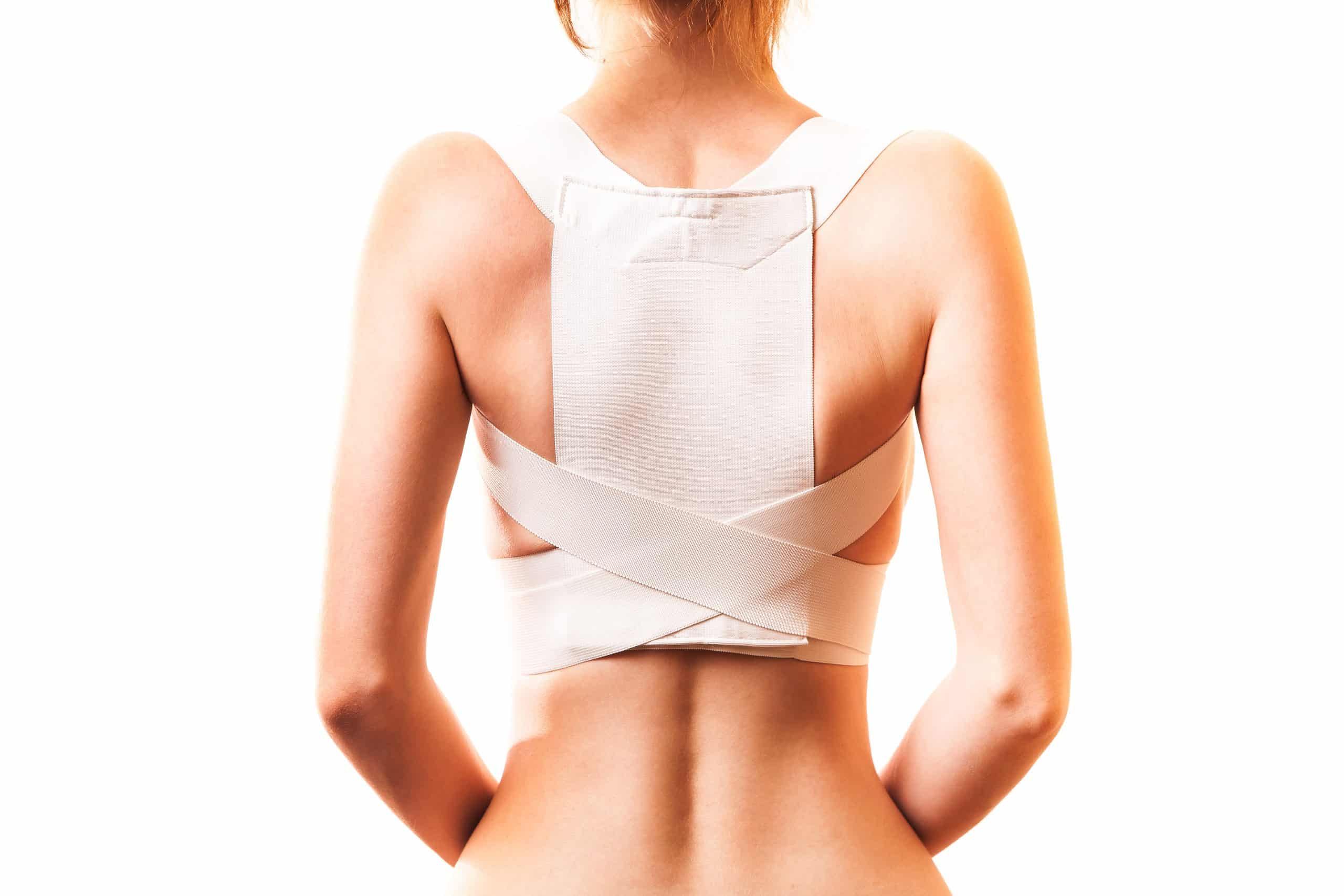
A posture corrector may also be referred to as a posture brace or posture belt. There are many different types of posture correctors on the market but most involve two straps crossed like an “X” that loop around the shoulders, pulling them back.

Some of these posture braces can be adjusted and tightened. They work to sustain forward shoulder positioning and provide support allowing your spine to maintain a straighter, more neutral neck and back.

Now that we know what posture correctors are, how do they work?


How Do Posture Correctors Work?

The purpose of a posture corrector is to align the shoulder and chest muscles. In short, a posture brace is designed to restrict slouching and the hunching down of your shoulders by holding your back into a fixed, straight position.

These postural correctors entail what is called “tissue adaption.” This means that the body becomes accustomed to its current position for a considerable time.

Here is what happens: the chest muscles shorten while those of the back length in the process of adaptation. A brace can modify this reaction by pulling the muscles into a neutral position. You should stop slouching!

It gradually allows you to maintain a straight posture automatically after prolonged use. Some find it uncomfortable at first, but since you will wear it for some time, you will get used to the way it holds you up.

Remember, as your muscles are trained to keep an upright position, they eventually learn to be in this posture without the trainer. You won’t revert to the old stance after your muscles are lengthened.


Do Posture Correctors Work According to Medicine and Science?

Let’s have a look at the benefits of posture correctors and see whether they have been proved by science. Here they are:


1. Improves Alignment

When you have a desk job and spend more than 8 hours there daily, you tend to exhibit a slouched posture with a forward head and rounded shoulders.

Posture correctors help to realign your spine, pulling back your shoulders back and lifting your chest to get proper alignment.


2. Improves Self-esteem

An erect posture is certainly a sign of high self-esteem and confidence. This is the position of many Studies. The results are clear: those who stand or sit with good posture are more likely to experience better concentration and attentiveness. The ensuing confidence builds self-esteem.

A posture corrector brace enhances better posture and improves appearance, building self-confidence and improving productivity in work.


3. Pain Management

We all have had some degree of neck pain, no doubt from sitting in poorly-designed chairs at the office. Busy execs can’t even take a moment to relax and stretch.

A posture corrector brace decreases the external, unwanted forces on the body due to incorrect posture, thus relieving neck pain back pain or pain in the shoulders. You get more shoulder and spine support, with a bit of immobilization, to ease discomfort and chronic pain.


4. Rehabilitation

Those with neck, shoulder or spine injuries need extra help. You want to reduce movement in these areas. This entails some degree of immobilization to ensure rehabilitation and a speedy recovery.  Many don’t realize that posture correctors work wonders on injuries.


5. Improves Mental State and Mood

Numerous studies have found correlations between posture and mood disorders, including depression and anxiety.

Again, try sitting upright as you are reading this; you may feel more ready, in charge, and even more powerful.

In one study, 86% of the participant students reported that it was easier to recall negative memories and emotions when in the slouched forward position. In comparison, 87% found it was easier to access positive memories and emotions when sitting in an erect position.


6. Prevention

It is not just about improving bad posture, but also about prevention. If you are concerned, why not take precautions before anything happens. We all want good posture but are often lax about it with our sedentary lifestyle.

The old saying, “an ounce of prevention ….” is quite true. Nip bad posture in the bud before chronic pain becomes your condition.

Those who sit at a computer are the worst culprits. They need posture correctors more than anyone else.

It is not inconvenient for most executives to don a brace for some period during the work day. You will want to do it knowing the many health benefits.


7. Reduces Headaches

 If you are a chronic headache sufferer, you may find your headaches improve after using a posture brace, as many are caused by neck tension. In fact, tension headaches are present in approximately 78% of chronic headache sufferers. Improving posture is one of the first suggestions when it comes to the nonpharmacologic treatment of chronic headaches.


8. Biofeedback

Some posture correctors work as biofeedback to the brain by sending signals when the body is about to reach a bad posture, such that the brain alerts the person to revert to a more aligned posture.


9. Fights Lethargy

So many people complain of feeling tired and lazy. It may be due to poor posture. Why feel down about it when you can correct lethargy. The experts know that energy is enhanced from better alignment of the spine, thus impacting productivity.

A posture corrector brace can fix spine alignment, eventually making you less lethargic and more energetic.


10. Better Breathing

It is scientifically proven that a straight back makes breathing easier, as the lungs are less compressed and have more breathing space. The proper posture will improve mood, energy and the intake of oxygen. Oxygen-rich blood is extremely healthy for your muscles, circulation, digestion, and skin.


11. Reduces Stress

Cortisol is produced when the body is in a state of stress. Just by straightening up, you can become more relaxed.


Many readers ask not only “do posture correctors work”, but also when and for how long can they be used.


When Can Posture Correctors Be Used?

In general terms, they can be used any time you show bad posture, feel neck or back pain or if you slouch or have rounded shoulders.

Incorrect posture and alignment create a muscular imbalance that negatively impacts your emotional state, sitting position and ability to live an active lifestyle; and they can cause postural abnormalities like kyphosis, lordosis, scoliosis, a flat back, rounded shoulders, etc.

Thus, posture correctors can be used to treat the following conditions:

– Sports injuries like strains, sprains, shoulder instability, a clavicle fracture, and broken collar bone.

– Bad posture like lordosis, kyphoscoliosis, thoracic kyphosis, hunchback, and a misaligned spine.

– Pain associated with slouching, osteoporosis and collarbone injury.

– Loose ligaments.


How Long Should We Use Posture Correctors?

 We have heard this question over and over. People expect an instant result, although it’s not how it works. Improvement doesn’t happen overnight.

Correctors may fix your posture in the moment and make you look taller and more in shape, but your body will revert to its original posture after you remove the brace. Give the process adequate time and you will surely see results.

Let wearing a corrector become your new habit. The time length will, of course, vary from person to person, but the device will eventually strengthen and straighten your spine. On average, users wear it for about 20-25 minutes each day. When not in use, try to maintain good posture.

With the device on, you will experience mild muscle soreness, prompting you to keep good posture and not revert to your old stance. Wearing posture correctors for a few months (at least 4 to 6 weeks) can make a remarkable difference.

So what is the final answer to the question, “do posture correctors work? The answer is yes, posture correctors work and we recommend them. Most are reasonably priced and may, indeed, prove to be a good investment, especially if you spend the majority of your day sitting at a desk.

Before you buy one, please read the following recommendations.


Recommendations for Using a Posture Corrector

– It is highly recommended that you get a brace made specifically for you as everybody has a different posture.

– Go through customer reviews thoroughly before purchasing a posture corrector brace to find the trustworthy products available on the market.

– Buy one that can be worn hidden beneath your clothing.

– Ensure that the device fits properly (tight enough) and pulls your shoulders back without strain on the neck and back.

– Learn to use the device when your posture is deficient, which may be at work, particularly in the afternoon. If you start to slough, it is definitely time.

– Wear the posture corrector often as needed at first. The more the better as you will eventually decrease the time when your posture improves.

– You may choose to wear posture corrector while exercising if you don’t find that it restricts your movement. Never wear it if you experience back pain or difficulty breathing. If it is too tight, just loosen it as needed.

Interested in Other Tools for a Good Posture?

Try a Standing Desk to Avoid Too Much Sitting in the Office

Have a Look at this Simple and Discreet Posture Coach

Do you have a posture corrector? Please, share your comments with us!

Do Stress Balls Really Work?

Stress balls have become very fashionable since the first day they first appeared. The evidence of their popularity is striking. Every year, more than a million executives in North America and Europe search on the internet for information on them.

But do stress balls really work?  Do they have really stress relieving benefits? Are the benefits confirmed by scientific research?

I am sure you have seen many of your colleagues using stress balls.  They squeeze them to release tension before an important presentation, a difficult meeting with the boss or tough negotiations.

For sure you have asked yourself many times if these small colorful toys really reduce stress. Can you actually relax using these silly stress balls?  Should you invest in them or rather focus on other stress management techniques?

This article will answer the question, “do stress balls really work?” We will present the scientific evidence and all the potential benefits of these small stress-relieving gadgets.

But before jumping in, let’s see how stress balls work.


How Do Stress Balls Work According to Their Manufacturers?

The producers of stress balls maintain that they block the so-called sensory channel and, in this way reduce stress.

What is a sensory channel? Let me explain.

Neuroscience says you feel stressed if your body receives stress signals simultaneously from two channels: the sensory and the intellectual channel. The sensory channel consists of your five senses: sight, touch, sound, etc.  The intellectual channel is your brain’s reasoning function. The theory says that to reduce stress, you need to block one of the channels.

Squeezing a stress ball helps obstruct the sensory channel. It keeps the hand occupied doing a simple, repetitive activity that directs the stress toward the ball. And the mind is now free to focus on other tasks. When the sensory channel is occupied, the brain experiences external stressors less intensely, hence it focuses less on the object of stress and anxiety.

This means that a good portion of the brain’s resources is dedicated to distraction. In simple words, your brain is more focused on the squeezing motion and less on your stress.


And What Does Science Say?

Let’s a look at the scientific perspective on the question: “Do stress balls work?”

First of all, scientific literature confirms the strong connection between the hands and the brain. According to medical research, our hands are very strong sensory organs. They are equipped with 17,000 touch receptors and nerves that pass on the information arriving from the environment to the brain.

The neurologist, Frank Wilson, in his famous book, “The Hand”, saw a direct evolutionary link between human intelligence and the hands.

If you are like me, you learn by writing. Putting words down helps me assimilate new concepts much faster. Is this also true for other people?  Yes, it is! Here is the link to the respective study.

Taking the above into account, there is no doubt that when we squeeze a stress ball, our hands send signals to the brain.

But do stress balls work for stress specifically?  This is, at least, is what their manufacturers claim. 

In fact, according to some studies, stress balls do work for stress.

For example, the American Psychological Association (APA) published German research from the University of Munich that proved that squeezing a stress ball with the left hand helped some athletes reduce game pressure and maximize performance. 

Did you pay attention to the last sentence?

With the left hand!

The athletes who used the right hand were less successful in stress reduction!

Each hand activates a different hemisphere of the brain. To achieve stress reduction, you need to activate the right hemisphere by squeezing the stress ball in the left hand.  

In addition, stress causes muscle tension as body muscles flinch when stressed out due to hormones such as cortisol, adrenaline, and noradrenaline. These hormones prepare the body for fighting or running away (the “fight or flight” reaction). But at the office, neither is an option. Therefore, you need to reverse the symptoms of the hormonal reaction.

Stress balls can help release muscle tension by rhythmically squeezing them. This technique is called PMR: progressive muscle relaxation. According to stress experts such as  David Posen, the author of, “Is Work Killing You?”, the benefit of squeezing (stress balls) is that it releases some type of energy which, in turn, reduces stress hormones and induces relaxation.

The University of Michigan confirms that progressive muscle relaxation does work against stress.

So, we recommend you put a stress ball at your desk to beat the stress you deal with in the workplace.

Are you interested in other stress relief toys? 

The Best Stress Relief Toys for Busy Executives


Other Benefits of Stress Balls for Executives

But do stress balls work only for stress? Despite the name of these balls, their benefits are not limited to stress.

Research supports other psychological and health benefits as a consequence of squeezing these small balls at the office or home. Here you have a list:


1. Stress Balls Improve Your Concentration

Intense focus at work wanes after some time for most executives. Read this study on diversions that improve productivity: A study at the University of Illinois.

One of these diversions to improve focus is squeezing a stress ball. This benefit is not only for executives. Stress balls help people in other spheres of life, such as students. A research study done with sixth-grade students in a rural South Georgia school showed that using stress balls improved focus and concentration as well as performance during language arts.

Don’t hesitate to take a stress ball next time you need to increase your attention span and avoid distractions at work!

Do you want to stay focused and prevent the wearing out of your brain at work?

Learn How to Train Your Brain to Focus


2. Stress Balls Reduce Anxiety

Another benefit associated with stress balls use is the reduction of anxiety. Researchers at the University of Surrey assessed patients undergoing varicose vein surgery. They tracked the patients’ anxiety levels prior to surgery, some with and some without stress balls. The patients using stress ball showed less anxiety as well as reduced pain.

So, next time you feel anxious at the office after an argument with your boss or a co-workes, take your stress ball and squeeze away! Use this simple distraction tool to reduce your anxiety.


3. Stress Balls Improve Mood

Stress balls can also improve mood among executives. It can’t help with the workload, of course, but it does allow the brain to rest, reset and focus.

With distractions, it gets easier to deal with the piles of work staring you down at your desk.


4. Stress Balls Boost Memory

Additionally, these balls boost memory. College students were provided with a list of words to learn while using stress balls during memorizing. The squeezing movement activated the side of the brain that deals with this function and the result was better scores.

So, why don’t you squeeze a stress ball while you try to memorize data for a presentation with your clients?


5. Stress Balls Improve Your Sleep

Stress balls not only reduce stress and anxiety levels, but these balls also improve the quality of sleep. Stress-related issues interfere with sleep and, in turn, further aggravates stress levels.

Using stress balls before sleep and during the day, whether at work or home, can help with a poor sleep situation.


6. Stress Balls Control Your Blood Pressure

High blood pressure is a very common health concern among adults. Stress balls can help control it. As the hand muscles experience bursts of action while squeezing the ball, blood pressure goes lower, according to professor of medicine, Dr. Robert D. Brook, at  the University of Michigan.

A sedentary lifestyle is one of the key causes of high blood pressure, as confirmed by this study. Importantly, the correlation between sitting long hours and blood pressure is independent from physical activity done after working hours.


7. Stress Balls Reduce Arthritis Symptoms

Another important health benefit of using stress balls is reducing arthritis pain and symptoms. Arthritis is a common ailment that results from inflammation in the joints, causing discomfort and stiffness.

It is difficult to focus on the tasks at hand or type on your computer when you have pain at your wrists.

According to research at the University of Oxford, stress balls are an effective tool in relieving arthritis of the hands. Patients using stress balls coupled with their normal treatment protocol showed improvement in muscle strength and flexibility.

Stress balls can be used anywhere and although they don’t cure arthritis, they make it more manageable.


Conclusion

Managing home and work life is a challenge for everyone, not just for executives and entrepreneurs.  The world runs at a fast pace and many want off the emotional roller coaster. There are so many stressors with long hours and looming deadlines.

No wonder executives feel overwhelmed, making tension relief and reduced stress a must.  Stress balls cannot directly change these situations but squeezing these toys can greatly improve one’s ability to deal with stress.

They let you take a breath and relax while you gain other benefits, such as improved concentration and mood or a boost in memory function. All of these are supported by Science!

Whether you need more information about the usefulness of stress balls or to want to share your personal experiences, please leave a comment!

If you are looking for advice to reduce your stress in the office, consider reading one of these Stress Management Books or this Guide with 70+Ways to Relieve Stress Permanently That Really Work!

Can You Die From Drinking Too Much Water at the Office?

 My bottle of water stands right next to my keyboard. And yours? Do you sip water throughout the entire working day?

Like me, do you want to avoid dehydration and maximize your brain performance, energy and attention span? We all know that water helps with that.

But not everybody knows that drinking too much water can be dangerous. Are you aware that drinking too much water can even lead to death?

Anything we consume in excess is toxic. Water is no different. It can be the elixir of life, but it is also a poison.

The good news is that it is extremely unlikely to be a problem in the office environment, unless you suffer from certain life-threatening diseases.

This article is important for those who do a lot of sports. After intensive physical exercise (like a marathon), we tend to drink large amounts of water, and that can be dangerous.

Did I get your attention?  Please read on.


Is Drinking Too Much Water Harmful?

The short answer is, yes.

Think about it. The kidneys can only do so much filtration. Yes, they control water and sodium content in the bloodstream, but too much consumption can tax these organs. They can become flooded!

Here is what happens. When you drink too much water, the blood actually becomes “waterlogged” believe it or not and the cells become saturated. Most of the time everything is in balance as water passes through cellular membranes. Your kidneys are trying their hardest to flush out the water, but if they can’t the sodium content is diluted.

The result of over doing it is swelling of the cells as water rushes in to balance sodium dilution. This condition is known as water intoxication or poisoning. Another name for it is hyponatremia. In short, the sodium concentration is too low.

Most of our bodies can handle some degree of swelling. We know that fat and muscle tissue can expand and stretch as it is soft and flexible. But what about the brain? Bone is pretty hard so don’t expect it to adapt.

Swelling in the brain causes undue pressure resulting in headaches, drowsiness, confusion or other unnatural states. The more pressure there is, the more the likelihood of damage, coma, and possible death. This only takes about ten hours.


Is It Frequent To Die From Water Intoxication?

No, it is not.

The British “Mirror” reported that people have died drinking too much water, but it was during activities like yoga and lawn bowling. But deaths from water intoxication are not common.

Although deaths caused by water intoxication are very rare, it is quite common during sport events. For example, 13% of Boston Marathon participants in 2002 showed signs of over hydration.


Is Drinking Too Much Water A Real Danger for Sedentary People Like Managers and Executives?

The risk of dying after drinking too much water at your desk is close to zero. It is also not very likely that you will get water intoxication when you sip the water in front of your PC. So please do not stop drinking water as it has a lot of benefits for your cognitive functions and performance.

Find Out 5 Science-Based Benefits of Drinking Water at Workplace


Where there is cause for concern is during intense exercise like a marathon race or during military training. The New England Journal of Medicine reported in 2005 that almost one-sixth of marathon runners experience debilitating conditions like hyponatremia.

In addition, excess water consumption can result from some type of forced situation or abuse. Of course this is unusual.

It may happen during a fraternity hazing. Such was the case in 2005 at Cal State Chico when A\a pledge who was forced to drink enormous quantities of water between push-up sessions died on site.

These cases do not apply to the corporate world. However, certain kidney conditions may send up a red flag warning about water consumption in any location. The afflicted must be coached to avoid over hydration at all costs to avoid water intoxication and stress on these vital organs.


How To Know I Am Drinking Too Much Water?

If you are used to intense thirst after exercise, you might well be taking in too much fluid. Overhydration is a scary situation – and quite dangerous.

There are signs, however, to help us stay in control. Do you experience any of the following?


1.You want more water even after quenching your thirst.

2.You seem to urinate quite often and through the night.

3. You notice that your urine is very light, almost clear.

4. You have bad headaches, usually in the day time.

5. You feel drowsy and confused and don’t know why.

6. You are tired all the time.

7. You notice that your hands, lips and feet look swollen.

8. Muscle cramping and weakness are frequent.


How Much Water Is Too Much?

You might not have experienced it, but over hydration is possible at any time you drink too much water for the body to process. Experts say drink eight glasses a day but some people think they are healthier at ten or more.

Intake guidelines are flexible but no one wants to have the life-threatening condition called water poisoning. You must consider what is average for you and stick with it. Factor in your exercise level, age, gender, type of nutrition and general health.

Never gulp it all at once. It is best over a longer period of time. Your kidneys can only flush from 20 to 28 liters of water per day. If you look at the hourly amount, it is only one liter.

The kidneys excrete 0.21 to 0.26 gallons, so you have to limit your intake to accommodate this rate, and it is for a healthy kidney only. You can’t take in more than can be excreted out.

A marathon runner does worry about hydration, but the person must also consider vasopressin levels. If they go up under the duress of the competition, kidney function drops. Yes, the runner sweats, but it is worse to achieve a net gain in water.

People who exercise are often ignorant of the basics and they assume they must replenish sweat. But you can get hyponatremia after a few sports drinks. If you sweat 500 milliliters per hour, then it is okay to take that much in.

But who knows how much they sweat anyway? Experience will help for a marathon runner or active athlete. Be cautious and listen to your body as there is no tool for absolute accurate measurement. It should be about thirst, and nothing more.

Get more information about drinking water in the following post: 

How Much Water Should I Drink a Day?


Ways To Prevent Over Hydration

Given that you want to avoid this condition, pay attention to certain guidelines:


1. Stop fluid and water intake at the first sign of a symptom and do not resume for at least a few hours.

2. Eat salty foods to balance your sodium/water balance.

3. Always stay hydrated and opt for an electrolyte drink with sodium so you never feel the need to over imbibe liquid.


How To Treat Over Hydration

There are safe ways to treat over hydration, such as after intense exercise, when symptoms often appear. The cause of the over hydration will determine the best treatment:


1. Cut back on water intake, or other fluids.

2. Diuretics will eliminate fluids in the urine, increasing its volume.

3. Eliminate the cause of the over hydration.

4. Cessation of medications that cause the problem.

5. Adjusting sodium intake as needed.


Conclusion

While it’s possible to succumb from excess water intake, it’s practically impossible at the office.

It is still good to know how the kidneys function and what happens under duress as in a marathon race. You can always tell by the color of the urine if there is a problem. You should drink when thirsty, but don’t overdo it.

Anyone concerned about improper or over hydration can speak to their physician. Guidelines are available according to age, body size and type, and other factors.

How to Fix Rounded Shoulders

Yes, your mother was right when she told you stand up straight, shoulders back and chin high. she sub-consciously knew that posture (particularly shoulders) reveals information.

Body language gurus say that our emotions are reflected in the position of our shoulders. People can discern a lot about our moods. Perhaps we are expressing confidence and strength, even virility.

Think of the famous statue of David. The male “V” shape is particularly appealing to women. Menswear designers know this well and create jackets that are padded in the shoulders to enhance masculinity.

In another vein, you can communicate positive qualities like dominance, pride and respect with your shoulders. Savvy manager do this all the time. They know how to convey leadership. They avoid the bad hunched look that denotes weakness.

Posture is everything, especially in the workplace. No one wants to look shorter and more feeble. Plus, rounded shoulders can cause chronic aches and pain. But you can stop this bad habit with a few well-chosen exercises. Stop that chicken neck and get with it!


What Exactly Are Rounded Shoulders?

The term “rounded shoulders” describes a resting or relaxed shoulder position where the area has moved forward from ideal alignment. Different terms are used, most negative, such as slouching, hunchbacked, forward head posture, slumped shoulders, “mom posture” and more.

Someone has dubbed the problem the “Upper Cross syndrome.” Anatomically, it implies a tightness of the upper trapezius and levator scapulae in back and pectoral tightness in the front.

There is a weakness of the deep neck flexors in the front and lower trapezius, rhomboids and serratus anterior in the back. In short, the neck, back and shoulder muscles are clenched. Pain and tension are a vicious cycle caused by poor posture.

Rounded shoulders stem any activity that involves looking down or forward for a long time. Some of the activities that may contribute to rounded shoulders include:

– Poor desk ergonomics

– Using a smartphone or tablet

– Using a computer or laptop

– Sitting for long periods

– Driving a vehicle

– Bending over repeatedly

– Carrying heavy objects all day


Test for Rounded Shoulders

A way to tell if you have rounded shoulders is to stand in front of a mirror and let your arms hang naturally by your sides. If your knuckles face forward, it could indicate that you have a tight chest and a weak upper back, resulting in the appearance of rounded shoulders.

A correct standing posture will see the hands facing towards the body with the thumbs facing ahead. This is a simple test, but it gives doctors a good indication of a person’s basic posture.


How to Fix Rounded Shoulders

Over a period of time, we have trained our muscles and joints to slouch/hunch forward, so we have to retrain them to find the correct posture and alleviate any associated symptoms.

The good news is that rounded shoulders can be easily fixed or prevented in most cases.

You may buy a posture coach or even a posture corrector. Yes, posture correctors work! Here you have the Scientific and Medical Reasons Why You May Need a Posture Brace.

However,  a cheaper alternative is to do exercise. A routine of devoting 20-30 minutes a day to certain exercises 3-5 times a week can help correct rounded shoulders.

To get started, you don’t even need a lot of equipment apart from an exercise band and a foam roller.

Exercises to fix rounded shoulders can be divided into Three types:


1. Releases

Tight muscles lock the shoulders in a forward position so it’s important to release and them reposition correctly.

1.a) Chest Release:

This move will release the chest muscles (pectoralis major and minor) that are usually very tight in a rounded shoulder posture.

Procedure: Grab the hook of a cane or a tennis ball. Position it just below your collarbone (in the groove area). Apply appropriate pressure to release the trigger point. If you find a tender spot or tightness, hold it there and perform gentle circular motion for at least 30 seconds. Apply the pressure at different angles so you cover the entire muscle.

Give yourself at least one massage each day for maximum benefit.


1.b) Thoracic Release:  

This exercise relaxes the upper trapezius muscle which is generally tight in rounded shoulders.

Procedure: Lie on your back on an exercise mat with your hands locked behind the neck. Place a foam roller in a horizontal position under your back and roll it up and down the spine. When you reach the top and bottom parts of your spine, hold that position for 15 to 20 seconds and repeat the process. You may prefer to do 2 sets of 10 reps.


1.c) Side Release:

This relaxes the latissimus dorsi and serratus anterior muscles that generally tight in rounded shoulders.

Procedure: Lie on one side on an exercise mat. Place a foam roller/ball under these muscles and roll it up and down. Apply appropriate pressure to help release the trigger point. If you find a tender spot of tightness, hold it there and perform gentle circular motion for at least 30 seconds. Apply the pressure at different angles so you cover the whole muscle.


2. Shoulder Stretching  

2.a) The T Stretch:  

This should be the first thing you do in the morning to help loosen your pectorals throughout the day. It can also be done before sleeping.

Procedure: Lie flat on an exercise mat with your knees bent and feet flat on the floor. Your arms should be extended to the side of the body with palms facing up. The body will looks like a T from above.

Hold this position to give a slight stretch in the back and shoulders, loosening up the pecs.


2.b) Door Chest Stretch:

After the shoulders, the next area to be stretched is the chest muscles to keep your posture strong. This convenient stretch involves a doorframe. It helps you control how far you can stretch forward. It can be done as often as you want and almost anywhere.

Procedure: Stand up straight in front of a doorframe. Place your hands on either side of the frame, just above your head and set your elbows at a 90-degree angle. Place your forearms flat against the door jamb, move one foot forward and gently lunge past the frame.

This will stretch the chest and shoulders. Hold this position for 30 seconds. Rock back into your original position and repeat 3 times.


2.c) Wall Stretch:

This is one of the most important exercises for rounded shoulders.

Procedure: Stand up with your tailbone, lower back, upper back and head against a wall. The feet should be positioned slightly away from the wall. The arms are pressed flat against the wall, keeping the elbows at a 90-degree angle. Hold for 30 seconds and repeat 3 times.


2.d) Wall Angles:

Procedure: Wall angle can be done by standing upright with the back against the wall, arms pulled back to touch the wall throughout the exercise with the feet positioned slightly forward. The hands are placed in a “W” position against the wall.

Then, extend the arms upwards towards the ceiling while keeping the shoulders down and flexed, and bring them back to the starting position. Repeat 10 times.


2.e) Handclasp:

This stretch is done by standing up straight with the hands by your sides. Try to reach behind the back and clasp them together. Then pull the shoulders back gently until the chest opens.

Don’t allow the neck to push forward. Hold this position for 30 seconds.


Note: All  stretches are to be done daily and the position held for 30 seconds. Repeat 3 times.


3. Shoulder Strengthening 

After these stretching exercises, you will have much more flexibility in your shoulders.

But this is not enough as flexibility alone does not allow the shoulders to remain in a food position. Strengthening the muscles will help you attain the correct posture.


3.a) Shoulder Blade Squeeze:

This is a simple exercise that builds strength throughout the day, reminding the body what good posture feels like. It can be easily done anywhere.

Procedure: Sit/stand up tall and straight and slowly flex your shoulder blades together. Imagine holding a tennis ball between them. As they flex, the shoulders should move down and away from the ears.

Hold this position for 10 seconds, repeat 10 times  3-4 times a day.


3.b) The Eccentric Push Up:

You can eccentrically strengthen your chest muscles after a neutral shoulder position is achieved.

Eccentrically strengthening means when the muscle is in its lengthening stage, it helps the chest muscles open even more.

Procedure: Stand in a push up position in front of a door frame. Then transfer your weight to your hands by lowering your chest down towards the wall as you bend your elbows (without flaring them outwards). Keep your shoulders pulled back and down throughout the exercise.

Try to go as down as possible to get a deep stretch in the chest muscles. Restart and perform 3 sets of 15 reps each.

Progression:  Perform on the floor. Use weights while lying on your back. Wide push up.


3.c) Wall Slide:

This exercise helps strengthen the lower trapezius and serratus anterior muscles as well as opens the shoulders and chest.

Procedure: Stand up with your back and arms pulled backwards against a wall. Bend your elbows at a 90-degree angle with your arms and forearms pressed against the wall.

Slowly glide your arms toward the ceiling until your thumbs touch one another and then go back down to  the starting position (grazing knuckles against the wall). Perform 1 set of 10 reps daily. 

Progression: 3 sets of 15 reps by adding weight cuffs to your wrists


3.d) Planks

The plank can ease round shoulders back into correct alignment.

Procedure: Lie on the floor with face towards the floor, propped up on the forearms and toes. The legs are straight and hips raised to create a straight and rigid line from head to toe. Planks help strengthen the core and lower back muscles.


3.e) Pull-Ups or Seated Rows:

In the gym, doing pull-ups or seated rowing with moderate weights can be quite helpful. It can be done without gym equipment as well.

These exercises build strength in the shoulders and all the major muscles of the back, including the middle trapezius and the rhomboids, thus bringing the shoulders into a neutral position.

Procedure: Hold a resistance band with the ends in each hand with the arms extended with palms facing each other.

Then, wrap the band around the bottom of your feet. Pull the ends of the band towards your chest by bending your elbows and squeezing your shoulder blades together so that your hands reach your torso. Move slightly behind the torso. Keep your arms close to the body to avoid leaning forwards/backwards.

Hold and return to the starting position by straightening your arms. Aim for 3 sets of 10 repetitions.


3.f) Chin Tuck:

Procedure: Lie flat on your back on an exercise mat with your arms to your sides and your knees bent. Without lifting your head off the mat, do your best to create a double chin or multiple double chins. Then, hold your head just off the ground and try the same movement.

This exercise is often used by swimmers to prevent the rounded swimmers back or shoulders. It helps stretch out the neck muscles gently.

You can repeat this exercise as often as you like but do it at least once daily for best results. 


Other Tools: 

1. Tape Your Posture

Taping the shoulders by a professional therapist helps remind you to maintain good posture.

Procedure: The shoulders are gently pulled to its neutral position. The tape is placed starting from above collar bone and pulled back and down to the middle of the thoracic spine. Firm downward pressure is applied on both sides.

You can leave the tape on for up to 2 days depending on your skin irritability.

A brace prevents your shoulders from rolling forward and is helpful in the initial stages of fixing your posture.

But, do posture braces work? Here, you have the answer.

Scientific and Medical Reasons Why You Need a Posture Brace


2. Ergonomic Advice

Since most of the causes of rounded shoulders are related to desk job work, here are some helpful ergonomic tips for desk potatoes to maintain a correct posture and prevent a recurrence of rounded shoulders.

– Use an Ergonomic Chair with Lumbar Support:

Don’t slouch or be uncomfortable while working at desktops or laptops. Use a chair with proper back support.

– Place Your Monitor in a Good Location:

Keep the top of your monitor at or below eye level and about 20-22” away from the body. Use well distributed soft lighting that has less glare to avoid eye strain

– Focus on Your Posture:

While sitting at the desk, keep the body in neutral position to avoid excessive stress and strain on your muscles. Your forearms, wrists, thighs and hips should be parallel to the floor, with shoulders relaxed and elbows close to the body. Follow the 90-90-90 rule while sitting on a desk chair — i.e. your hips, knees, ankles and elbows are at 90-degree angles. Your feet should rest flat on the floor or use a footrest or stool.    

– Keyboard and Mouse Placement:

The keyboard and mouse should be close enough so you don’t strain your shoulders and arms. Use a wrist or edge pad to prevent injuries due to sharp edges.

– Keep Moving:

Do not sustain the same posture for an extended time; take frequent breaks and follow the 20-20 rule — after every 20 minutes take a quick 20 seconds break. Walk out in the corridor, have a cup of coffee or do some basic stretches. 

The ultimate anxiety prayers guide for busy people 

Going through our day-to-day lives, it’s hard not to experience the feeling of anxiety, no matter whether you are a top executive, an entrepreneur or a low-level manager. In an interview with Oprah Winfrey on the Oprah TV show, Curtis Jackson, the entrepreneur and musician, sometimes known as 50 Cent, had this to say about anxiety: 

“You should either pray or worry, but not do both. When anxiety creeps up on you, say a prayer to release those feelings that you haven’t been able to shake off by worrying.” 

Although there are many different ways to overcome anxiety, the power of prayers can never be over-emphasized. Let’s take an example from the touching story of the blogging entrepreneur Stephen Althea, the owner of The Blazing Center. In one of his posts tagged “Prayer for Anxiety”, he decided to share with us how prayer helped him get through his anxiety issues. He said, and I quote, 

“After so many failed attempts from many medical treatments, I later realized how much I misplaced my priorities. I should have gone to prayers rather than medications. So, one day, after discussing with my wife and having realized my mistakes, I decided to switch sides on my treatment by facing my anxiety problems spiritually. And here I am today, sound and in control of my life once more.” 

Therefore, here’s my recommendation: 

– If you’re having anxiety as a result of a difficult period at work, pray. 

– Having anxiety over an uncertain future due to dismissal? Pray. 

– Are you seeking to find peace of mind for an upcoming presentation at work? Pray. 

– How about social anxiety? All you have to do is pray. 

The best and cheapest cure for anxiety, no matter the cause: prayer 

But, if you don’t know how to pray or what to say when you come in contact with any of your anxieties,  this guide is certainly for you. We have compiled prayers for different types of anxiety.  

There are also many different ways to pray. Religious prayers are only one way of praying over anxiety in an uncertain situation. In this article, we will give many other options, such as songs or mantras. 

So, get your notepads ready as we share with you every single prayer you’ll ever need for any anxiety problems that may arise in your professional life. 

Part I – Prayers for Different Types of Anxiety  

Prayer for Anxiety in a Difficult Situation

Many of you may have trouble managing difficult or stressful situations at work or even other family situations. Maybe you have to dismiss an employee or explain to your boss why your objectives were not reached. Maybe you had an extremely difficult negotiation with a tough customer. Or you are facing a divorce or a serious illness of one of your family members or do not know how to communicate to your spouse that you have just lost your job.  

Prayer:

Dear God, give me the strength to focus beyond this difficult situation and make the most out of it. Reinforce my resolve to manage anxiety. 

You may replace “this difficult situation” with a specific description of the situation you are facing, as in the example below. 

Dear God, give me the strength to focus beyond this difficult negotiation and make the most of it. Reinforce my resolve to manage anxiety. 

Prayer for Social Anxiety

It is very difficult to have a happy and successful life without social relationships. We are social creatures. Socializing is an important part of our work and family life. But some of you may suffer from so-called social anxiety. It may unveil itself when you have to speak publicly or you simply enter into a room with many people present.  

Don’t confuse it with shyness. Shyness generates manageable stress, whereas people with social anxiety disorder experience a kind of stress that is difficult to cope with

As a matter of fact, social anxiety disorder is one of the most common mental disorders. The best way to overcome it is to gradually improve your social skills. 

But a prayer for anxiety can be also quite helpful. 

Prayer: 

Dear God, 

Please help me to control my emotions when I confront other people/speak publicly. I know that you will be with me when the fear comes, and you will help me perform well. 

Prayer for Anxiety to Achieve Peace of Mind

“Thou wilt keep him in perfect peace, whose mind is stayed on thee because he trusteth in thee.” (Is 25:3). 

These words written by the prophet Isaiah centuries ago ring true today as they did back then. Are you in and out of peace of mind frequently? Real peace of mind is worth more than gold. Why is peace of mind so important?  

It is simply one of the most powerful ways to fight anxiety. Having peace of mind helps you see things clearly at work and at home without fear and worry.  

You may even say that anxiety is the opposite of peace of mind.  

There are many prayers for anxiety that help achieve peace of mind.  Let me propose one. 

Prayer:

Dear Almighty, 

Please calm my thoughts, calm my worries, calm my fears. Please help me to be happy with the current situation and the things I have and to choose to live in peace from now on. 

Part II – Prayers for Anxiety Using Different Inspirational Sources 

Prayer for Anxiety Using Religious Literature 

Different religious groups use literature as a source of reference. Christians have the Christian Bible. Muslims turn to the Quran, Jews to the Torah, and Buddhists to the Dhammapada. 

Prayer changes things if you believe. Prayer for anxiety is communicating how you feel to the higher power. There are a lot of people who actually have gotten rid of their anxiety through their religious beliefs.

People like Kenneth Copeland, the renowned Christian preacher who lives in the United States, is one such person. In one of his preaching, he stated how anxious he was before starting up his ministry. But one day, after listening to preaching on the radio on how God can heal us of our anxieties, Copeland decided to read the bible and pray over his anxiety problems. Today, Kenneth Copeland is one of the richest men of God in the United States. He is a good example that prayer for anxiety works. 

In the Christian Bible, we find the following prayer for anxiety: 

Philippians 4:6, 

 “…do not be anxious about anything, but in everything by prayer and supplication with thanksgiving let your requests be made known to God.” 

 In the Quran:

“Oh Allah, there is no ease except in that which you have made easy, and you make the difficulty, if you wish, easy.”   

In Judaism: 

In the Jewish Bible, in many places, we read “Fear Not,” and in Psalms, you will find the following prayer for anxiety: 

“….Out of my straits I called upon the Lord; He answered me with great enlargement, the Lord is for me; I will not fear what can man do unto me the Lord is for me as my helper….” 

Here is the link to the full psalm 

In Buddhism, the Dhammapada book vs. 199 states: 

“We the unfrenzied live happily midst the frenzied. Among the frenzied humans from frenzy dwell we free.” 

Prayer for Anxiety Using Quotes

Prayer for anxiety is not limited to the religious literature discussed above. You want release from anxiety. Use a quote from an authority figure to call upon the higher power for deliverance from the grip of anxiety. 

The following prayer for anxiety combines quotes of Mandy Hale, Dan Millman and Thich Nhat Hanh. They are slightly modified from the originals so that you can pray in the first person. 

Prayer:

It’s OKAY to be scared. Being scared means, I am about to do something really, really brave.  I don’t have to control my thoughts. I will just stop letting them control me. (I will) smile, breathe, and go slowly. 

Prayer for Anxiety Through Songs

Music is the universal language of the soul. Many times, you are transported back in time by a song you attach to a past difficult situation. Why not do the opposite and use the song as a prayer and source of comfort and inspiration to connect you with a higher power. 

“Let it be” by The Beatles is a typical song voicing concerns over anxiety with a Christian undertone.  

Christian Prayer for anxiety based on “Let it be”:  

When I find myself in times of trouble, Mother Mary comes to me
Speaking words of wisdom, “let it be”
And in my hour of darkness, she is standing right in front of me
Speaking words of wisdom, “let it be 
Let it be, let it be, let it be, let it be, whisper words of wisdom, let it be 
 
And when the brokenhearted people living in the world agree 
There will be an answer, let it be 
For though they may be parted, there is still a chance that they will see
There will be an answer, let it be 

Let it be, let it be, let it be, let it be, there will be an answer, let it be 

For everyone (not only Christians) we recommend another “prayer” song:  

Non-religious prayer for anxiety based on “OK (Anxiety Anthem)” by Mabel: Cause it’s okay not to be okay 
It’s okay if you feel the pain 
Don’t gotta wipe your tears away 
Tomorrow’s another day 
It’s okay not to be okay 
It’s fine, you’re allowed to break (Oh-oh) 
As long as you know, as long as you know 
Everything’s gonna be okay (Everything’s gonna be okay) 
Okay 


The two songs above and many other similar compositions ease tension, relax muscles and pacify anxiety. Importantly, not only can music relax your mind and spirit, but it is also an antidote to any anxiety disorder.  

There are a great number of professionals today who had their anxiety worries quenched through music, and one is the amazing music icon, Celine Dion, who we all know today. Born into a poor Roman Catholic family, she never had the experience of singing in front of a crowd. Thus, it was only natural that Celine became overanxious at the time of her first Debut English Album in 1990.  

As she stated in an interview on Larry King Live, she was so anxious that she had to pause for a moment and leave the studio. According to Celine, the music director at the time suggested she listen to her favorite music, saying that she would feel better afterward. And as you might expect, the method worked. Today, she has won numerous awards and will always go down in history as one of the finest female artists in the world. 

Prayer for Anxiety Using Mantra 

A mantra, often associated with yoga, is the words we speak in our minds without anyone hearing us. They are often meant to condition the brain into believing something, and you can use them whenever you’re feeling anxious, perhaps when trying to close an important but difficult deal or signing a contract with a challenging partner. 

However, the golden rule in using a mantra is that you must be consistent and persistent. You have to keep saying the words in your mind until they stick. For instance, if you’re convincing a prospective shareholder, and are feeling anxious, say over and over  

“I can do this.”  

Repeat it consistently and be persistent until it sticks in your brain. Once you meditate, instantly, you’ll feel a rush of confidence flowing through your body.  

A lot of professionals do use this technique to achieve their dreams.  The most notable is Ronaldinho, the famous Brazilian player, who in an interview with the Spanish press while playing for Barcelona, revealed that he often used this local mantra prayer for anxiety:  

“Deus placere manere mecum, ego scire possum hoc facere”  

which means:  

“God, please stay with me; I know I can do this.”

Learn Other Mantras to Fight Anxiety Here

Conclusion 

In a nutshell, the way you can actually face and get rid of your anxiety disorder is through prayer. If it worked for successful people such as Curtis Jackson, Stephen Althea, Ronaldinho, Kenneth Copeland and a host of others, then you should try it for anxiety too! 

Please let us know if you have found this post helpful. We would like also to hear which prayers for anxiety you used in your difficult moments of life. 

Interested in other prayers? Have a look at these proposals:

Why You Should Use Prayer for Stress, According to Science… (and 3 Different Prayers for Stressful Situations at Work)

Prayers for Employment