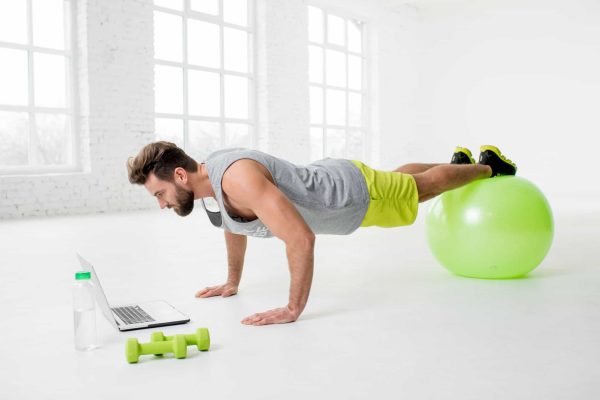
Working out at work

In general, when we think about what we do with our time at work it consists of meetings, to-do lists and overseeing the operations of our companies. Working out at work is likely never on this list and these activities usually require a lot of sitting.

Sitting increases our chances of back problems and is more likely to lead to obesity-related illnesses.

According to a study done by the Norwegian University of Science and Technology, they concluded that exercise has a tremendous and preventative effect on morbidity and premature death. We can conclude from this that exercise can increase our lifespan!

Part of leading an organization is caring for the well-being of yourself as well as that of the employees. Not taking care of yourself will reflect poorly on your company and subordinates.

 As executives and managers, we’re likely busy from the moment we walk into the office to the moment we go home, so how would there be any time to workout at work?

One solution is to try walking more. Walk to work or, park far away from the door of your office so you can get in a few extra steps before you start your day and before you head home in the evening.

There are so many easy ways to get in an easy workout at work! Don’t worry, you won’t be sweaty or out of breath for your next meeting but, you’ll be able to get in some movement and activity that can easily be added to your daily work routine.

Executive Summary:

workout at work

1. Take the Stairs

Taking the stairs is the single easiest way to get in a workout at work. Most office buildings have a few sets of stairs so challenge yourself to stop using the elevator and get your heart rate up. By taking the stairs you’ll be burning calories, building strong leg muscles, and working to keep your heart strong and healthy.

2. Use a Cycling or Treadmill Desk

exercise at your desk

According to a study done by the American Heart Association sedentary jobs have increased by 83% since 1950 and, with the reliance on technology, people are having to find more creative ways to combat this.

Enter the cycling desk or the desk exercise bike.  These are great options for someone who just really needs to stay put at their desk most of the day.

BURN CALORIES WITHOUT LEAVING YOUR DESK!

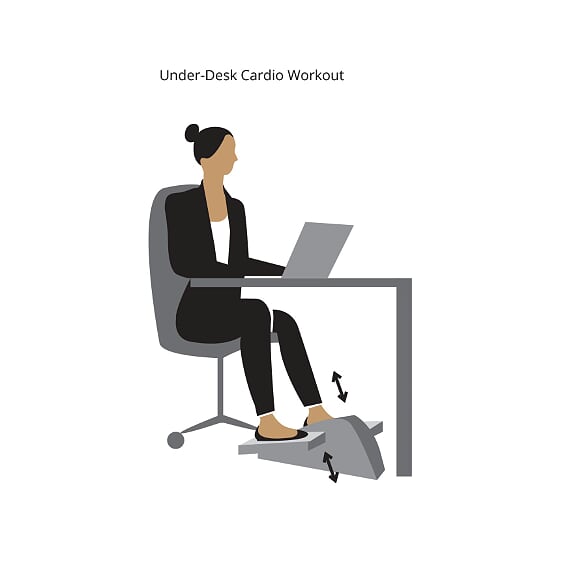
3. Under Desk Elliptical
exercise at your desk

Under Desk Elliptical is another great option for the executive who needs to stay put at their desk! This compact device sits under your desk and can help you stay more active while staying seated.

You can take phones calls and meet with others and not have to worry because it’s quiet and won’t bother anyone else. Just sit at your desk and use the pedals for an easy low impact exercise!

EXERCISE DISCRETELY AT THE OFFICE!

4. Have a Walking Meeting or Wander

Walking and talking, so simple. This is another easy way to kill two birds with one stone and work out at work! Wander is another way of saying, just get up and move.

An easy tip: set a timer on your phone for every 30 min, every time it goes off take a lap around the building. This can actually make you MORE productive by keeping your brain engaged and getting the blood pumping! Encourage your employees to try this, too!

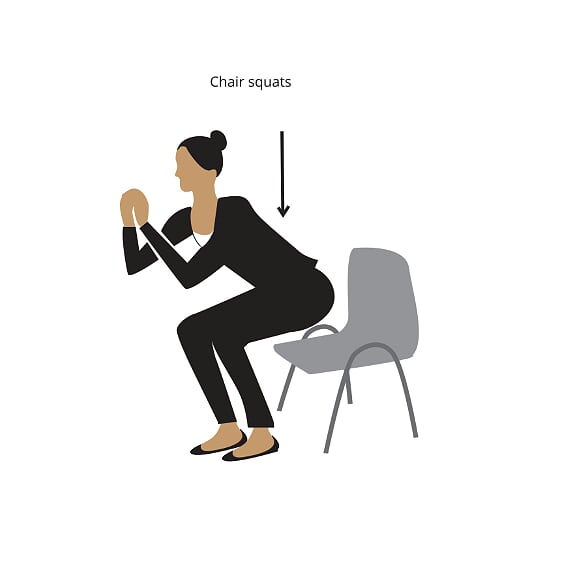
5. Chair Squats
exercise at your desk

Squats are a staple in every workout routine, and for good reason! Think of how many times a day you stand up and sit down in your office chair, this small movement is essential to your corporate job function. There are many benefits an executive can gain from squats including improving the mobility in the hips and ankles, strengthen and tone the core and improve posture.

When you go to sit in your office chair squat down until you’re almost seated and then stand back up. Do this every time you go to sit and you’ll begin to reap the benefits!

6. Desk Pushups

exercise at your desk

Doing a pushup at your office might not be the easiest exercise to tackle but using your desk as a prop can help. Put both hands on the edge of your desk with your arms straight and walk your feet back until your body is slightly at an angle with your upper body leaning towards the desk. Bend your arms to 90 degrees (or whatever you can muster!) and push yourself back to the starting position. Try doing 2 sets of 10 every hour. That’s 80 pushups in a single day!

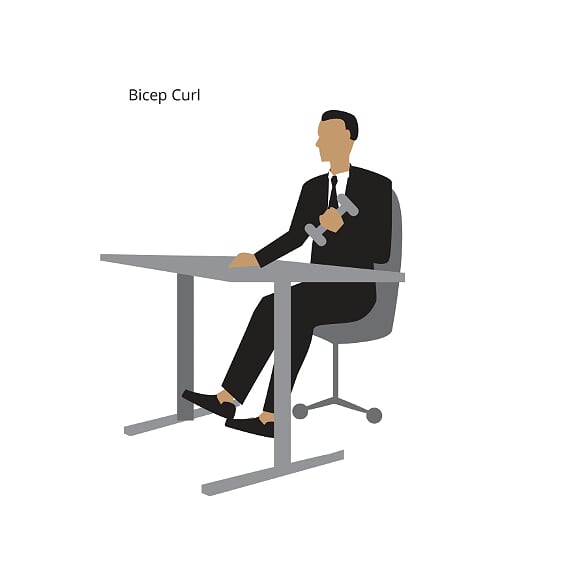
7. Arm Exercises
exercise at your desk

Have a heavy book at your desk? Grab it for some overhead triceps exercises! Hold the book overhead with both arms straight, lower the book behind your head until your elbows reach 90 degrees, straighten arms to starting position. Repeat!

8. Calf Raises

The next time you are waiting in line for the copy machine or for your turn to use the microwave start doing some calf raises. Calf raises will help tone your legs as well as help with balance. See how many reps you can get before you have to sit down again!

9. Hamstring Curls

Using a rolling desk chair press both feet firmly into the ground with knees bent at 90 degrees. Straighten both legs and then slowly return to the starting position by bending the knees. Want to make it a little more challenging? Try doing one leg at a time!

10. Leg Lifts

Seated leg lifts are great for the quads and abdomen. Sitting in an upright position with your back pressed into your chair, straighten both legs and left them up as high as you can. Engage your core and don’t slump over while doing this! If lifting both legs is too intense try doing one at a time.

11. Side Bends

A great core exercise, side bends can help strengthen the obliques and stretch out the side of the body. Place one hand on your hip while letting the other hand hang towards the floor, slowly reach the lengthened arm toward the ground. Go as far as you can without turning your torso towards the floor, slowly return towards the start. Repeat on both sides.

Working out at work doesn’t have to be complicated and it doesn’t have to be time-consuming. As executives, we need to change our mindset and attitude about working out at work. Begin with trying out one or two of the exercises listed every single day and work your way up getting in as much activity as you can throughout the workday.

These are also great tips to pass along to your employees, and by doing so it might even hold your more accountable as well! These 11 tips are simple and can be done in any office setting with minimal equipment. So, get moving and start working out at work!

Are you interested in seeing how easy it is to get fit? Check out our Books section exclusively selected for executives.

SEE HOW EASY IT IS TO GET FIT!

Any other tips or tricks for working out at work please comment below!

5 Quick and Easy Healthy Energy Drinks for Breakfast

Your breakfast is the most important meal of the day. It is a fact that has been accepted by a large percentage of Americans.

Statistics reveal that 93% of the Americans believe breakfast is the most important meal of the day, while 44% actually put this belief in practice by eating a breakfast daily. It is also estimated that 22% of the Americans who did not eat breakfast regularly suffered from obesity.

These numbers reveal that what you eat or drink for your breakfast can have a huge impact on your activities throughout the day.

Having healthy drinks for breakfast can help you stay fresh and breeze through all the commitments at the workplace with ease.


Executive Summary:

healthy drinks for breakfast

1. Turmeric Tea for Energy and Productivity

Turmeric tea is one of the healthy drinks for breakfast for executives who have to juggle between multiple tasks.

Research aimed at evaluating the effect of turmeric on the symptoms of Alzheimer’s disease has proved that this spice has the ability to improve your memory. It can be used on a regular basis to improve brain functions.

So, even if you are working on several projects at the same time, it won’t be difficult for you to remember the details of each project.

Turmeric tea can be prepared by adding about one teaspoonful of turmeric powder in a glass of milk. Allow it to boil for a few minutes, strain it and drink it while it’s still warm.


2. Hot Dark Chocolate for Energy

Hot dark chocolate is considered one of the healthiest drinks for breakfast for the executives who lead an extremely hectic lifestyle. Dark chocolate contains a high amount of caffeine, which acts as a stimulant. It can support the functions of the nervous system and help you stay alert and focused during meetings as well as other tasks.

Dark chocolate provides a rich source of carbohydrates to your body to ensure persistently high levels of energy throughout the day.

Dark Chocolate can help you avoid fatigue at the workplace. It can also prevent reduced concentration levels that usually occurs due to the dip in the energy levels.

Research conducted by the scientists at the British Journal Of Clinical Pharmacology have found that dark chocolate contains a large number of flavonoids that possess antioxidant properties. It can prevent oxidative damage to the vital organs and stimulate the functions of the brain thus improving your cognitive skills.

You can prepare the perfect energy drink for breakfast by adding dark chocolate powder of your choice to a glass of warm milk.


3. Protein Smoothies

A clinical study to evaluate the role of proteins in maintaining health and fitness has shown encouraging results. The intake of proteins is linked to an improved physical performance.

Hence, Protein smoothies are considered healthy drinks for breakfast for active executives whose job involves working under strenuous physical conditions. It can promote the body’s repair processes and help in the faster healing of the injured parts.

Protein smoothies also promote the cognitive skills and improve physical and intellectual productivity at work.

Protein smoothies offer a rich dose of nutrients apart from, of course, the proteins. For example; The blueberry-almond smoothie can provide a natural source of proteins, antioxidants, and fibers while being low in calories.

You can also try orange protein smoothie by adding Greek yogurt rich in proteins, and calcium to a blend of orange.

PUMP UP YOUR PRODUCTIVITY WITH SMOOTHIES NOW!


You can prepare these smoothies quickly by simply grinding the ingredients to make a smooth paste. You can enjoy it immediately.

Alternatively, you can keep it in the refrigerator for about 15 minutes and drink it chilled.


4. Green Tea for Your Brain

If your job involves using a lot of creativity, imagination and problem-solving skills, you can begin your day with the healthy drinks for breakfast such as green tea.

Research conducted at the International Journal of Phototherapy And Phytopharmacology has proven that Green tea can produce an encouraging effect on the brain functions.  It can boost your cognitive skills, concertration, and memory.

Green tea can improve your ability to evaluate the project details such as carrying out SWOT (Strengths-Weakness-Opportunity-Threat) analysis by enhancing the logical reasoning skills.

It can also improve your mood and restrain you from being irritable or frustrated even during the challenging situations. This will boost your job performance and help you avoid work-related stress.

These benefits can be derived simply by drinking a cup of green tea for breakfast. All you need to do is let the green tea leaves brew for about 5 minutes in boiling water, strain it, and drink.


5. Juice of High Dose of Vitamin C

Mental stress, weakness, and a low immunity are the side effects of your job. You can avoid these side effect by providing healthy doses of vitamin C to your body.

The immune-enhancing role of vitamin C has been proven during a clinical research conducted at the Annals of Nutrition and Metabolism.

You can prepare a vitamin-rich juice by grinding fresh fruits such as oranges, kiwis, and berries. Strain the juice and drink it for breakfast to refresh your senses.

It will also protect your body against the free radical damage and prevent the diseases caused due to oxidative stress such as cancer and autoimmune conditions.

This will help you stay focused on your work and allow you to balance your health as well as career.


Conclusions

A simple step like having a glass of these healthy drinks for breakfast will provide you multiple benefits such as improved brain functions, increased productivity, and enhanced overall health.

Read our post How to Make a Healthy Executive Breakfast to start your business day right or Check out our Healthy Diet Books Section to get more effective diet ideas.

This will allow you to meet your professional commitments and help you achieve success.

GET MORE SIMPLE DIET IDEAS NOW! 


If you know any quick, healthy recipes for breakfast, please leave a comment to share the recipes with us. You will also find several healthy breakfast tips in our cookbook section.

10 Books on Confidence That Can Change Your Career

As a manager, one of your primary tasks is to inspire your employees to believe in themselves so that they, as well as your organization, can reach their full potential.

It is impossible to inspire others, however, if you do not believe and have confidence in yourself.

Even the strongest leader, no matter how competent, can be plagued by momentary bouts of self-doubt and low self-esteem as they ponder critical decisions affecting their personal career as well as their organizations and employees.

Fortunately, the subject of confidence and self-esteem has been widely researched and written about by leaders from a variety of different fields.

The following are our favorite books on confidence and self-esteem from a wide range of experts that we believe will help empower you to take your career and business to the next level.

1. Managing the Mental Game: How to Think More Effectively, Navigate Uncertainty, and Build Mental Fortitude

By Jeff Boss.

Books on Confidence

Boss, a former Navy SEAL, has compiled mental exercises specifically designed to enhance self-belief and mental toughness to enable you to reach your full potential.

He outlines essential tools for controlling inner thoughts that make it easier to cut through negativity, noise, and chaos, remain focused on the positives, and to execute your personal goals.

In addition to providing advice on avoiding common mental traps that can lead to self-doubt, Boss offers a series of lessons and best practices for building mental fortitude and navigating the inevitable moments of chaos.

2. StrengthsFinder 2.0

By Tom Rath.

https://ws-na.amazon-adsystem.com/widgets/q?_encoding=UTF8&MarketPlace=US&ASIN=159562015X&ServiceVersion=20070822&ID=AsinImage&WS=1&Format=_SL250_&tag=healthymanage-20

This reference guide offers a self-assessment to help you identify and maximize your personal strengths.

Rath, a best-selling author, filmmaker, and a student and researcher of human behavior, developed the StrengthsFinder assessment in conjunction with Gallup.

The theory behind the assessment is that we are more successful when we focus on developing our unique strengths and talents instead of devoting our energy to correcting our weaknesses.

Along with the assessment, this latest edition of the book also offers action plans and strategies for applying and building upon your strengths.

3. Discover Your True North: Becoming an Authentic Leader

By Bill George.

In one of the seminal books on confidence, Bill George has compiled interviews from 173 leaders from around the world representing all areas of business that will help you find your leadership purpose and chart a personal path to success.

George has served as CEO of Medtronic, authored six best-selling books, and is currently a Senior Fellow at Harvard Business School.

Discover Your True North has been one of the must-read books on confidence since it was first published in 2007.

George shares his personal stories along with case studies from such global leaders as Michael Bloomberg, Warren Buffett, and Arianna Huffington to show how discovering your leadership purpose will help you pave the way to success.

4. Feel the Fear and Do It Anyway

By Susan Jeffers.

Books on Confidence

Jeffers, a noted workshop leader, internationally renowned author and media personality, offers practical advice on conquering fear and self-doubt that can serve as roadblocks to personal and professional success.

She explores how our inner fears of risk, rejection, and failure keep us from realizing personal and professional success and how our focus should be on making a decision with boldness and confidence instead of worrying about whether the decision is right or wrong.

5. Step Up: Confidence, Success, and Your Stellar Career in 10 Minute a Day

By Phanella Mayall Fine and Alice Olins.

Step Up is somewhat different from the other books on confidence on our list in that it was written by women for women who are looking to change their career trajectory, start their own business, or simply make themselves heard in the workplace.

Fine and Olin use their experience as executives and personal development coaches to create short career-building exercises in such areas as networking and harnessing the influence of others.

They offer advice to women who may be struggling with making their voices heard in the workplace or who want to advance their careers more quickly without compromising other aspects of their life.

6. The Confidence Code: The Science and Art of Self-Assurance—What Women Should Know

By Katty Kay and Claire Shipman.

Noted journalists Kay and Shipman share advice from successful women from the fields of media, politics, and business.

The Confidence Code is a practical guide to understanding the importance of confidence at work.

While it may seem like an easy to understand quality, this book gets into how women of all ages and career stages can achieve it.

The authors provide food for thought on topics such as why women apologize more, why humility is more worn by women, and more, and combine research in genetics, gender, behaviors, and cognitions with their own experiences and those of other successful women.

7. The Little Book of Confidence

By Susan Jeffers.

In her second book to make our list of favorite books on confidence, Jeffers offers practical advice and affirmations designed to turn fear into a source of confidence and energy.

She explores such themes as developing self-awareness of our fears, affirming the positives in life, and learning to say “yes” instead of worrying about the potential outcomes of our decisions.

8. Mindset: How You Can Fulfil Your Potential

By Carol Dweck.

Carol Dweck explores how your state of mind may play more of a role in your success than your particular skills.

Dweck is a Stanford University psychologist and a leading researcher in the fields of developmental and social psychology and personality.

In Mindset, Dweck explains why our abilities and talents are not enough to bring about success. Instead, the key is fostering a growth mindset that will motivate us to push toward our personal and professional goals.

9. Black Box Thinking: Marginal Gains and the Secrets of High Performance

By Matthew Syed.

The author explores how you can use business failures as stepping-stones to success.

While we all know that it is important to learn from our mistakes and failures, we rarely approach these instances in an analytical manner that can turn them into a tool for success.

Matthew Syed, a best-selling author, award-willing journalist, and public speaker based in London, advocates using an approach similar to that employed by the aviation industry following a plane crash to identify the root cause of a failure so that policies and procedures can be implemented to prevent the same mistake from happening again.

10. The Power of Self-Confidence: Become Unstoppable, Irresistible, and Unafraid in Every Area of Your Life

By Brian Tracy.

Brian Tracy has penned more than 50 books on confidence that have been translated into 38 languages and has conducted personal development and leadership seminars around the world.

Tracy offers a systematic guide and daily mental exercises designed to get you thinking like a top performer and willing to step out of your comfort zone so that fear will no longer stand in the way of your success or productivity.

If you would like to read more about leadership and motivation specially for executives and entrepreneurs, be sure to check out our exclusive Books on motivation and confidence.

We would love to hear about your favorite books on confidence. Leave us a comment below.

Chronic Stress at Work. Can It Cause Depression?

Stress is an inevitable part of your professional life. However, that doesn’t mean you accept it or ignore its implications. According to a survey conducted by the Health And Safety Executives, UK, more than 5 lac workers are suffering from work-related stress and depression resulting in a loss of 12.5 million working days in just the last 2 years.

These findings are as disturbing for you as they are for your employer. Depression arising out of stress at the workplace can not just affect your own productivity, but also hamper the performance of your organization. Hence, it is highly important to manage stress before it worsens and leads to serious depression. Here’s how stress and depression in the workplace are linked.

Depression is the obvious consequence of improperly managed stress. If ignored, job-related stress can increase your risk of depression substantially. CLICK TO TWEET

Executive Summary:

stress and depression

1. Affects Your Moods

The first effect of stress is evident in your moods. According to research conducted at the Psychoneuroendocrinology, a possible mechanism for how stress and depression are linked is the improper biological response of the body to stress.

Stress disrupts the functioning of the glands that regulate the production and release of hormones in the body. This results in the excess synthesis of cortisol. Cortisol causes mood disturbances and paves way for negative emotions such as anger, frustration, agitation, and restlessness.

Over a period of time, these symptoms worsen resulting in extreme irritability, loss of appetite, and sleep disruption. These symptoms mark the beginning of a mild depression.

Stress can also result in cognitive changes and affect your intellectual abilities thus causing impaired memory, focus, and concentration. These effects of stress can hamper your performance at work resulting in a low appraisal rating or even a loss of job thus allowing serious depression to take hold.

2. Disrupts Healthy Coping Strategies

According to the research published in the Medical Science Monitor, the risk of stress-induced depression can be reduced considerably by adopting strategies such as focusing on emotions, planning, and seeking social support.

However, busy executives may not be able to adopt and stick to these coping strategies due to their hectic lifestyle. Hence, they are more likely to experience chronic stress and depression.

Working for extra hours every day and even on weekends is common in executives due to strict deadlines, and job insecurity. When you have to work for extra hours, you are more likely to skip healthy coping strategies such as practicing yoga and meditation. This can prevent you from avoiding the effect of stress and worsen your risk of depression.

3. Adopting Unhealthy Coping Strategies

Chronic stress and depression have one thing in common and that’s alcohol consumption. Constant work pressure, job insecurity, failure to achieve success and lack of work-life balance may force you to adopt unhealthy coping strategies such as excessive alcohol consumption and the use of recreational drugs. This tendency is more common in the executives who do not have strong support from family, or friends.

These strategies may provide an instant feeling of gratification. But, they are nonetheless dangerous for your health. According to a study conducted by the Canadian Journal of Psychiatry, alcohol consumption can increase your risk of major depression.

Recreational drugs produce a sense of euphoria that lasts only for a short duration. Alcohol and recreational drugs result in addictions or dependence. These consequences can affect your mental as well as physical health and even lead to the loss of job. These factors can worse your risk of depression significantly.

4. Strained Professional Relations

Research published in the International Journal of Disability Human Development, the overall atmosphere and relations with colleagues can impact your mood and job performance. Excessive work pressure can make your irritable resulting in angry outbursts.

However, this can lead to strained relations with your colleagues and create a hostile atmosphere at your workplace. As a result, your colleagues and subordinates may not cooperate with you or give you a cold shoulder.

Recurrent episodes of angry outbursts can also result in social isolation at your workplace. This can add to your existing stress and over a period of time, lead to depression.

5. Induces Inflammation

Research published in the Psychology Bulletin has indicated that stress and depression are linked to each other through inflammatory processes of the body. Work stressors in executives such as the inability to cope with higher expectations from the employers, poor performance appraisal ratings can disrupt the neural, and molecular mechanisms of the body. This can drive the pathogenesis of depression.

Executives who experience chronic stress have a high risk of depression due to the involvement of the immune system cells. Stress results in the production of certain chemicals that promote inflammation and cause damage to healthy organs. These chemicals can also elicit a profound change in your behavior. This can trigger the symptoms of major depression such as persistent sad mood, psychomotor retardation, fatigue, and social-behavioral withdrawal.

Stress may be good for you if it keeps you motivated, and alert. However, too much stress over a prolonged duration due to work pressure can increase your risk of depression through various mechanisms. Depression, in turn, can have a huge negative influence on your career, personal life as well as physical and psychological health. Hence, you must never ignore the consequential relationship between stress and depression and take steps to avoid them.

Find Out 7 Easy Ways To Cope With Depression at Work

If you have experienced stress linked depression, please leave a comment below to share your story.

Surprising Benefits of a Standing Desk at Your Workplace

Is sitting behind a desk all day affecting your productivity? Yes, it is. It’s that same sitting desk going to lead to health issues? Yes.

The idea of a standing desk first reached national attention when a young Georgia Representative in Congress, Newt Gingrich, used one. He told anyone who asked that he did not have time to sit down. The standing desk kept him always going, always moving and always ready.

Let’s take a look at what a standing desk does for you.

Executive Summary:

benefits of standing desks

1. 45% Productivity Boost

Texas A&M University looked at standing desk benefits in a research study. ” We found that increased stand-capable desk use is a likely contributor to increased productivity over traditional seated desk use. These findings indicate that use of stand-capable desks as ergonomic interventions to improve physical health among employees may also positively impact their work productivity,” the six researchers wrote.

How much? “Users of stand-capable desks were 45% more productive on a daily basis compared to their seated counterparts. Further, productivity of the stand-capable desk users significantly increased over time, from 23% in the 1st month to 53% over the next 6 months.”

Google and Facebook offer employees standing desks.

2. Be Ready

Writing for Forbes Magazine, Steve Mullis talks about moving from a sitting to a standing desk and what it did for him. He said the standing desk benefits are being “ready for action: When you’re sitting and sedentary, it can take a few moments to get up and away from your desk in the case of an emergency or you just realized you’re late for a meeting.”

FF Venture Capital installed electronic desks that move quickly from standing to sitting positions. The company is tracking standing desk benefits and is pleased with the results so far. “We’ve found that the standing-only work set up encourages much more active participation and sharing of ideas on the white boards (just as we had hoped!),” David Teten told Business Insider.

3. Better Health

Miracle Desk links to numerous studies about the standing desk benefits in this article. This story has 18 reasons why a standing desk will improve your health. A few critical points are:

– Better circulation. Improved circulation means more blood to the brain. That means you are better able to concentrate on your work and be more productive.

– Burning calories means losing weight. Workers who stood at their desk all afternoon burned on average 170 more calories per day than those who sat all afternoon. This is almost 1000 calories/week.

– Keeps energy up. Standing helps keep your blood flowing, and makes you less likely to want to fall asleep at work.

– Improves digestion. In this area, standing desk benefits mean lower blood sugar. Your chance of diabetes and related issues goes down.

– Fewer hemorrhoids. Sitting is a main cause of this posterior problem. Ask long-haul truck drivers.

4. Reduces Disease Risk

Standing desk benefits include cutting the risk of several diseases, like diabetes. Because standing makes your body work more, it improves circulation giving you better cardiovascular health. Dr. Axe notes sitting a lot increases your chance of heart problems significant.

“A study from 2011 reported that 43,000 cases of colon cancer and 49,000 cases of breast cancer annually are caused by prolonged sitting,” says a story in the Huffington Post.

Stand more. Cut your risk of long-term health problems.

5. Less Pain

Back and neck pain wearing you down at the end of the day? Standing desk benefits including pain relief and reduction, “Upper back and neck pain declined significantly from T1 to T2 (the groups in the study) for the intervention group,” says a report from the Centers for Disease Control.

We also know why a standing desk reduces pain – posture. Better posture means less pain because it reduces strain on your spine. “The improvement in posture does not only apply in the office but is carried on into the rest of your life as well. This is because you train your back and other muscles to assume the right position,” says an article .

6. Live Longer

Healthline says standing desk benefits include a longer life. Joe Leech looked over 18 studies all of which said people who spend a lot of time sitting are 49 percent more likely to die early than those who do not sit as much.

Again, we also know why people live longer. Standing desk benefits include forcing more of your body to work. When you stand, you are moving far more muscles than when you sit. This is exercise, very mild exercise yes, but as you read above it does deliver health benefits.

Extra tip: Go Slow

Before you invest in standing desks, a word of advice, Start slow. You can’t go from sitting all day to standing all day overnight. Work up to it. Spend 30 minutes standing, then sit a while. Gradually increase the time spent standing.

If possible, invest in a desk that moves between standing a sitting. That way you can break when you need to until you can stand for long periods.

You Win

When it comes to standing desk benefits, you are the big winner. You become more productive and your energy levels will go up while the pain goes down. You will live longer and have better health. Once your employees see how much you improve they may ask for standing desks too. If so, you win again. Better employee health means fewer sick days. More productivity means increased profits.

What do you think? Interested in trying a standing desk? Take a look at our SHOP section. You will find amazing products exclusively selected for executives that, among others, will teach you how to strengthen your focus and attention, take your fitness to a new level, reduce stress, sleep well, be free from anxieties, have a healthier body and get more things done.

shop page

If you do implement a standing desk workplace, we want to know how it worked for you. If you already have this kind of arrangement, tell us so we can share your story with others.

7 easy fitness guidelines for the professional executive

Starting an exercise regimen can be a daunting task for any executive, especially for a fitness beginner.

Our work days are usually packed to the brim with meetings, phone calls, and all the other important day-to-day tasks every executive faces, so adding a workout routine to the mix isn’t always a top priority.

There are many benefits for executives to start doing regular physical activity, one of them being to help reduce the rate of depression among managers and supervisors.

Research done at Columbia University concluded that leaders in a manager or supervisor role were 19% more likely to be depressed than their subordinates.

Instead of going right to medication or therapy, we can try exercise.

Regular physical activity can help curb symptoms of depression by releasing endorphins, taking your mind off work, helping to gain confidence, and facilitating healthy coping.  Resources geared toward fitness for beginners are abundant.

Give these tips a try, and let us know what you think!

Executive Summary:

fitness for beginners

1. Get A Fitness Assessment

It is wise to consult a doctor before starting any exercise program.

If you are a true beginner getting this initial assessment will allow your doctor to relay any health concerns and possible limitations for physical activity.

You will also be able to get your starting weight and muscle mass, good information to have as a reference when starting your fitness journey!

2. Choose A Program You Enjoy

All executives know that if you love the job you’re doing, then it doesn’t feel like work. The same can be said for exercise! There are many resources geared toward fitness for beginners.

Try looking into different classes at your local gym, free online workouts or possibly hiring a personal trainer. You won’t know what you like or dislike until you try it out!

Are you looking for inspiration? Check out our Fitness Books exclusively selected for Executives and Entrepreneurs with several fitness programs.

SEE HOW EASY IT IS TO GET FIT!

3.  Begin Slowly

If you’re an executive new to fitness this tip is pretty important. Starting out slow allows for your body (and mind) to get used to exercising with less chance that you’ll be discouraged.

Trying to do an intense workout, when you rarely or never workout, is going to leave your body sore and your mind weak.

This will likely cause you to want to forgo your next gym session. To help on a beginner fitness journey try using a fitness tracker!

Wearing a tracker will help you monitor your long-term progress and movement.

Starting with a fitness tracker and a beginner fitness workout will allow you to build muscle and endurance over time so that you will then be able to conquer the tougher workouts.

INCREASE YOUR PHYSICAL ACTIVITY NOW!

4. Bodyweight Exercises

Bodyweight exercises are great for fitness beginners because they allow you to build muscle and become more coordinated without the intimidation of weights.

Beginner friendly exercises include squats, lunges, plank, and push-ups.

For squats start outstanding with feet hip-width apart, keeping chest up and back straight lower down so knees come to 90 degrees (or as close as you feel comfortable), press into heels to return to standing.

In a lunge, we step the right foot forward and mindfully bend both knees until the right knee comes almost to 90 degrees and the left knee almost touches the ground. Press into feet to straighten legs and step left foot forward, repeat on this side.

For planks, we start on the ground on hands and knees keeping shoulders directly over wrists, curl toes under and lift knees so that your body is in a straight line from heels to the crown of the head.

Push-ups start out in a plank position, then, by bending elbows bring your body closer to the ground until elbows are close to 90 degrees. Press into palms to return to plank position. Plank and push-up can both be done modified with knees on the ground.

Take an executive approach to these movements and practice them until you are comfortable and have proper form. Once this is achieved slowly start to add weight. Don’t underestimate the power of bodyweight workouts!

5. Progression

Fitness for beginners can always be a good workout for an executive at any fitness level but, don’t let yourself get too comfortable or else you will become stagnant and possibly discouraged.

Progression in workouts is key to keeping the body strong and active.

Try out a new class, some different exercises or adding resistance to the exercises you already know.

Resistance bands are a great choice for executives because they are easily portable and can virtually work every body part.

Adding resistance bands to simple exercises, such as squats, can help burn more calories and increase muscle mass over time.

FIND OUT MORE HERE!

6. Accountability

Accountability is essential for a lifetime of health for any executive.

Some easy ways to hold yourself accountable are working out with friends or hiring a personal trainer.

Fitness with friends is a good option because someone close to you can hold you accountable, which will make you less likely to drive home after work instead of straight to the gym.

Personal trainers are great for executives because a specific time can be set each day or week to workout that revolves around your busy schedule.

Recovery is often forgotten in a workout regimen but it is just as essential as the actual workouts.

Working out breaks down the body’s tissues, rest days allow for them to recover and rebuild stronger than before.

Another essential aspect of recovery is hydration and fuel. 60% of our bodies are made of water and when we sweat we lose it, staying hydrated allows our bodily functions to work at maximum capacity and feel our best.

READ MORE ABOUT BEING HYDRATED AT WORK!

Along with hydration, the food we ingest must be nourishing, such as high protein and low-fat meals or snacks.

Conclusion

Executives need exercise for a healthy body and mind.

These are essential for running a healthy business. Fitness for beginners doesn’t have to be complicated!

Try starting out small with a fitness tracker and see how many steps you can get each day, continually try and match or beat yourself daily!

For instance, Leaf Urban Health Tracker is a fashionable fitness tracker for women.

FIND OUT MORE HERE!

After that try adding in some strength training and cardio, whatever works for you.

If you need some continued inspiration check out these books to help you get encouraged!

Do you have any suggestion or tip for fitness for beginners? Please share in the comments!

Drinking On A Plane. The Important Truth About Alcohol.

Business trips by air have to happen. With that comes stress of work and travel and, a likely way to combat this is with alcohol. While that may seem like an easy option drinking on a plane has many negative side effects. And drinking on a plane not only affects you during the flight but possibly for days after as well.

The next time you have to fly, avoid the booze. You will be more alert and readier to take care of business when you get there.

Sans alcohol, air travel already affects the body and mind in many ways. With the addition of alcohol, those side effects can have negative consequences.

Let’s take a look at what people think happens by drinking on a plane and what really happens. Then, we will take a look at seven things that can put you off your game because you were drinking on a plane.

Conventional Wisdom Says a Drink Helps

Some people say they must have something to drink when flying. “Steadies the nerves,” is a common reason. Other people just have a fear of flying and a drink helps allay that fear. Many people equate flying with vacations, thus vacations perpetuate having a few drinks. Whatever the reason is conventional wisdom says alcohol helps overcome these concerns or is the norm for air travel.

Although alcohol is perceived as a sedating drink that induces sleep, it can actually create insomnia and disturbed sleep patterns. Some studies show that 15-28% of subjects used alcohol to help them fall asleep. And according to The National Sleep Foundation, 20% of Americans use alcohol to help them fall asleep each night.

While this may help initially, the use of alcohol quickly loses its effectiveness as a hypnotic, while retaining its sleep disturbing properties.

The Reality Is Drinking Makes It Worse

Well, alcohol does “steady the nerves.” Alcohol does lower inhibitions. It also leads some people to a false sense of security. A report at Bryn Mawr College compares the effects of alcohol on the brain to what happened to Phineas Gage. Mr. Gage is famous for surviving a railroad rod penetrating through this skull. The accident destroyed his prefrontal cortex. It also changed the man from an easy-going, hard worker to a brawler. Why? Not having a prefrontal cortex eliminated his impulse control.

While this is an extreme example it is a good reminder that situations and substances can alter our impulse control. According to a study done by Oregon State University and UCLA, alcohol can restrict impulse control. This means that simple tasks will become harder to finish and finding a solution to simple problems becomes nearly impossible. This is important to keep in mind if you are flying for business.

Drinking anywhere but especially drinking on a plane can create that loose feeling, which is your impulse control slipping away. You are more likely to make a rash decision. As a person who makes decisions that have dollar values into the millions, you need all your wits about you all the time.

When you are on a plane, especially going from one time zone to another, these effects are magnified.

Effects of Drinking on a Plane:

1. Alcohol Develops Anxiety and Mood Swings

While alcohol may seem to lower your inhibitions at first, it is linked to the development of anxiety and mood swings in generally asymptomatic people. Drinking on a plane can even affect your next-day behavior and moods. From an executive standpoint, this can be detrimental to that big business deal that you’re flying half-way across the globe to solidify.

KLM Airlines takes the matter so seriously, they cover it on the company website. It is common knowledge that having a few drinks can lower your inhibitions and ease slight anxiety. This same principle should not be applied during air travel. Being at high altitudes and going from one time zone to another is already a shock to our body and alcohol will one exacerbate this effect.

2. Alcohol Affects Your Cognition

The interior pressure of an airplane drops as it rises. It never gets dangerously low but at high altitude, we are receiving about 4% less oxygen than we would on the ground. A 1985 Federal Aviation Report (FAA) found that the lower levels of oxygen on an airplane impaired cognitive function more than alcohol. This means that the second we reach higher altitude our bodies are already struggling to regulate internal functions. Coupling this with a few alcoholic beverages can lead to sickness and cognitive impairment.

It’s important to note this decrease in oxygen while flying. This means that the same number of drinks you would have on the ground can impair you significantly more when having that amount of drinks on a plane. Simply put, altitude and alcohol do not mix.

3. Drinking on a Plane Causes Dehydration

Another complicating factor of drinking on a plane is the air in a plane is very dry. You dehydrate more rapidly in a plane than you do on the ground. Alcohol is a diuretic. The combination means you lose vital fluids faster than normal.

The University of Connecticut has studied mild dehydration and found it does affect how people act and feel. The report claims that mild dehydration in men and women caused headaches, fatigue, and difficulty concentrating. Problem-solving skills were altered as test subjects perceived more tasks as difficult. Test subjects, predominantly the males, also experienced difficulty with mental tasks, particularly in the areas of vigilance and working memory.

Mild dehydration can cause a whole shift in your body’s short-term cognitive abilities. While flying it is already a challenge to maintain proper hydration, add alcohol into the mix and it’s a recipe for disaster.

As an executive when you walk into a business meeting, you need all your mental faculties intact. Getting off an airplane and going straight to sort out a business deal can already be slightly disorienting due to mild dehydration and time zone changes so, nix the alcohol to set up for success.

4. Alcohol Exacerbates Jet Lag Symptoms

According to the Mayo Clinic symptoms of jet lag can include mood swings, disturbed sleep, daytime fatigue, difficulty function or concentrating and a general feeling of being unwell. This is something your body will most definitely go through if your air travel requires time zone changes.

Drinking on a plane and the effect it has on a body makes the situation and side effects worse. Alcohol exacerbates jet leg symptoms. As a result of rapidly crossing different time zones, your body needs time to adjust. Alcohol disturbs your circadian rhythm or your internal body clock. So, it makes it more difficult to adjust your internal body clock to your new destination time.

Harvard Health, a publication of Harvard University, says to avoid caffeine and alcohol. Both promote dehydration and can disturb your sleep. As previously discussed, mild dehydration has many side effects. Especially for high functions business executives.

If you are interested in how to get over jet lag, have a look at the post How to Fight Jet Lag. An Executive Survival Guide.

5. Drinking on a Plane Increases the Risk of Deep Vein Thrombosis.

In general, alcohol lowers your risk of deep vein thrombosis (DVT), which is a blood clot in a deep vein, usually in the legs. However, the situation reverses on long trips where you are in a seat, especially on plane trips.

According to the Centers for Disease Control (CDC), air travelers with long periods on the plane are at an increased risk of DVT. DVT can happen to anyone, especially those who sit for long periods. Air travelers are at a higher risk because of sitting and being in a cramped position for longer periods, with less chance of getting up and walking around.

If you are drinking on a plane, you are less likely to feel the need to get up and walk around. Your natural inhibitions are put to the wayside. The more you learn, the more you know that drinking on a plane is just a bad idea all the way around.

6. Alcohol Can Hinder Your Rest and Energy

Probably one of the most detrimental consequences for drinking on a plane is the loss of energy. For busy executives, this is something that cannot be forfeited on a business trip.

According to the National Sleep Foundation, alcohol disturbs your internal clock. When you have a drink, it may help you fall asleep right away during the flight, but you will likely wake up feeling wide-eyed in the middle of the flight. This can obviously put a damper on your daytime energy, which will leave you feeling exhausted and unable to concentrate once you reach your destination.

While sleeping on a plane isn’t ideal sometimes it is necessary to be able to do your best work on a business trip. Drinking alcohol on a plane can hinder your rest by contributing to poor quality of sleep.

According to the National Sleep Foundation, alcohol can block REM sleep. REM sleep is considered to be the most restorative type of sleep. With less REM you will feel groggy and unfocused. Both a likely consequence of drinking on a plane.

Lastly, drinking on a plane leads to extra bathroom trips. Typically, your body knows when it is time for sleep and not time for trips to the bathroom. This means that your body has learned to put your bladder into hibernation for the night. But alcohol, a diuretic, can more your need to use the restroom more, which in turn will interrupt your normal sleep pattern.

GET MORE INFORMATION ON HOW SLEEP DEPRIVATION CAN AFFECT YOUR WORK PERFORMANCE

7. Drinking on a Plane Aggravates Breathing Problems.

 Since alcohol causes your whole body to relax, including the muscles of your throat, it increases the risk of snoring sleep apnea. Sleep apnea does not allow you to get a good night’s rest as your body continuously wakes up throughout the night because of air restriction. This will most certainly leave you tired and groggy the next day because it’s like you didn’t even sleep at all.

All of these consequences of drinking on a plane are negative and far outweigh the fact that having a drink while traveling will “steady the nerves.” For executives, it’s important to remember this as business travel is a normal part of our routines.


Extra Tip: Getting to Point B

When you touch down, are you going to rent a car or is someone picking you up? If a rental car is in your future then drinking on a plane is a recipe for disaster for sure.

First, driving while intoxicated illegal and dangerous for your safety and that of others. NEVER drive under the influence.

Second, when you are getting to your destination, you are already tired and probably frustrated from being on a plane, working your way through security and delays. Add alcohol on top of that, and you are certainly not in shape to drive a strange city in a vehicle you are not familiar with.

The DUI limit may be .08, but you will likely be charged with an offense with less than .08 Blood Alcohol Content. New York State can charge you if your BAC is more than .05. Battling a ticket or even a criminal charge is not something you need to do at any time, much less on a business trip.

Did you know these negative effects on your body on drinking alcohol on a plane? Have you ever had a bad experience drinking on a plane on your business trip? Feel free to share your comments with us.

Healthy Foods to Eat at Night to Have Energy in the Morning

Ideally, you would get out of the office every day by 6 p.m., eat an early dinner, and avoid evening snacking. In reality, you are more likely to be stuck at the office until well after dark working on a presentation due bright and early the next morning.

It leaves you scrambling for a snack that you can eat at your desk or when you finally make it home.

While a large meal or grabbing something from the nearest fast-food restaurant or vending machine will leave you falling asleep in front of your computer or feeling sluggish and mentally foggy the next morning, healthy foods can help you power through your work without leaving you with a “food hangover” the next morning.

The following are our favorite healthy foods to eat at night that are guaranteed to keep your stomach from grumbling while still leaving you feeling refreshed and energetic the next day.

When looking for healthy foods to eat at night that will help you focus, increase your productivity, and provide the energy that you will need to power through your overtime hours as well the next morning, keep these tips in mind:


Executive Summary:

healthy foods to eat at night

1. Choosing Healthy Nighttime Snacks Over Processed Foods

When you are physically and mentally exhausted after a 12 to 14-hour day at the office, it is tempting to turn to comfort foods, such as chips, a greasy burger, and fries, or even an entire package of cookies. Unfortunately, the saturated fat and high sugar content of these foods can cause you to experience less deep sleep during the night along with more frequent sleep arousals, which can leave you feeling tired and sluggish the next morning. The increased blood sugar may also contribute to an increase in cortisol in your system, which can impair cognition and memory. That is the last thing that you need when faced with a morning full of meetings with clients.

• Healthy Snack Tip

Instead of chips or fries, opt for hummus and a handful of whole-wheat pita chips for a healthy nighttime snack. The protein and healthy fats in the hummus will help you feel full and provide energy while the pita chips will provide a satisfying crunch.


2. Keeping Portion Sizes In Check

Your body still requires calories for energy even during sleep. Your digestive system and metabolism, however, slow down at night as part of your natural circadian rhythm. The effort of digesting a large meal at night can leave you tossing and turning so that your body does not get the healing, restorative sleep that it needs to deal with the mental and physical stress that you face at work. There is also a study that shows that eating a large meal while trying to perform cognitive tasks, such as preparing a report or analyzing complex data, can trigger an immune response in the body that can produce cognitive deficits similar to Alzheimer’s.

• Healthy Snack Tip

If you are eating a meal late at night, select an appetizer or half-size portion. You can also keep snack portions in check by using a bowl or plate instead of eating straight from the package.


3. Choose Easy-to-Digest Foods When Eating Late

Foods that are high in animal protein, highly acidic, or fried take longer for the body to digest and can lead to indigestion and a fitful night’s sleep if eaten too close to bedtime. Instead, opt for foods that are high in water content and plant-based proteins and fats that are easier for the body to process.

• Healthy Snack Tip

Low-fat yogurt, bananas, and apples with peanut butter are healthy options when snacking at night that will not put too much of a burden on your digestive system. If you need something a little more substantial, try a salad topped with a little chicken or tuna.


4. Choose Foods That Will Stabilize Your Blood Sugar

Your body and brain need a steady supply of glucose for fuel. Simple carbohydrates, such as those found in most processed sweets and snack foods, are metabolized very quickly and release a large amount of glucose into the body within a short amount of time. This means that you will get a sudden rush of energy followed by a sudden crash about an hour later. Complex carbohydrates, such as those found in whole grains, legumes, fruits, and vegetables, are digested slowly, which provides a steady stream of glucose for both short and long-term energy.

• Healthy Snack Tip:

For a healthy nighttime snack on those nights when you get out of the office too late to cook dinner, try some spicy black beans wrapped in a corn or whole-wheat tortilla.


5. Coping With a Sweet Tooth

After a long day of meetings, phone calls, and endless paperwork, you deserve to end your day with something sweet. Instead of reaching for a tub of chocolate ice cream, opt for fresh fruit and yogurt or fruit sorbet flavored with natural sweeteners that are easier to digest but will still satisfy your sweet tooth.

• Healthy Snack Tip

Bananas and cherries are particularly beneficial foods to eat at night since they can help increase your levels of the sleep hormone melatonin so that you fall asleep quicker and stay asleep longer.

Interested in more healthy tips?

healthy diet books

Now that you know our tips for choosing healthy foods to eat at night, share your favorite late-night snack in the comments below.

Am I Burned-Out?

The role of an executive requires a high level of expertise in various capacities such as managing projects, staff, and budgets. These duties may often require your attention outside of your regular shift and because of your commitment to achieving company goals, you don’t hesitate when it comes to meeting the demand. This may cause you to ask yourself, am I burned out?

Depending on how long you’ve been working, your career may be affecting the way you manage your personal life. Symptoms of burnout are not always recognizable due to the sense of feeling like you can’t shake off the tiredness. Despite your desire to maintain control, there are signals your body may be sent to let you know that you’re overworked.

You don’t have to struggle any longer trying to solve the am I burned-out puzzle. Here are seven ways you can tell if you may be suffering from burnout symptoms

1. Fatigue Stays Longer than Expected

Burnout can creep into your life subtly. You may have convinced yourself that working a little longer to finish a report, responding to emails, and preparing for a meeting won’t hurt you.

However, if you’ve been experiencing fatigue that won’t go away after getting at least seven to eight hours of sleep, your work could be the cause of why you keep thinking am I burned-out? You may not want to admit that your body can’t handle the prolonged excessive stress, but if left unaddressed, the stress may begin to affect you emotionally.

2. Loss of Interest that Leads to Low Morale

Working hard may be the core of your career ethics standard, but working without incentive or mental stimulation can be very challenging. If your goal is to attain a high level of success on your work projects, but you’re struggling to find worth in the tasks you’re assigned, burnout may be the factor behind your apathy.

Results from a survey designed to evaluate the burnout status of more than 400 employees who worked at a university revealed that when an employee’s job does not provide an environment that fosters personal development, employees will lose interest or leave their job.

3. Your Appetite has Increased or Decreased

Eating to sustain your energy is a requirement everyone needs to meet. However, if you’re opting for food that is increasing your body weight or contributing to your high blood pressure or sugar levels, burnout could be the underlying reason you’re craving high carb foods.

On the other hand, you may have lost your appetite because you’re constantly thinking about work especially if you’ve been thinking am I burned-out? Statistics indicate that change in appetite is a result of stress.

4. Falling Asleep Quickly Is a Challenge

Sleep can be refreshing and contributes to the healing of your body. However, it can be difficult to obtain when your body is in work mode while you are in bed. Your body and mind should work in harmony when it comes to maintaining a healthy sleep rhythm. When this pattern is interrupted, sometimes your body thinks it should be up when it is time to fall asleep. This can cause you to think am I burned-out?

5. Health Problems Are not Subsiding

Medical problems can arise due to a poor diet, but stress can also cause and exacerbate existing health issues. Burnout can cause a constant state of anxiety and depression can present physical symptoms.

The only way to rule out these conditions and link low work performance to burnout symptoms is to conduct a thorough physical and mental assessment. Your doctor can evaluate any existing medical conditions you may have to ensure that your vitals are normal. He or she will also be able to assess if any new health situations are prevalent and answer your question am I burned-out?

Your doctor may also make recommendations in helping you with burnout symptoms. Seeking support from an expert can help you avoid crashing which can be a physical state you may not be able to recover from if you don’t seek help now.

6. Loss of Concentration Increases Everyday

Forgetting a phone number or your thought pattern periodically is normal. However, when your inability to sustain your attention while working can put your career at risk. Burnout syndrome can affect your mental performance for a long time if steps are not taken to recharge your mind. High work performers generally feel apprehensive about admitting their inability to handle everything successfully. So they avoid asking themselves the question am I burned-out?

However, when projects, your family life, and your health begin to suffer the consequences of your divided attention, it’s time to reduce your stress level. This means taking a step back, reassessing what’s really important to you, and implementing the help you need to thrive instead of just surviving.

7. Anger is Quickly Sparked

Your ability to respond to conflict situations or questions in a kind manner can be challenged when you’re burned-out. When you’re tired and haven’t been fueling your body with the right food, you will respond based on how you’re feeling. You might even feel guilty after you snap at others, but don’t have the mental energy to correct your behavior. Asking yourself am I burned-out can help you sort out mental and emotional challenges.

We want to hear from you. Share your thoughts about how your job may be affecting your family life or health, and what course of action you plan to take. If you’ve received help, share how you were able to recover from being overworked, and the answer you received regarding your am I burned-out question.

Tips And Tricks For Battling Belly Fat

The long hours, lunches on the run, lack of time for exercise, and chronic stress associated with leading a business or organization are just a few of the reasons why so many managers and executives find themselves accumulating extra fat around their midsection. Unfortunately, it is this type of fat that is associated with the majority of obesity-related health conditions. While genetics plays a large role in determining whether you gain weight around your belly like an apple or around your thighs like a pear, it is possible to implement a few simple lifestyle changes to help you keep your waistline in check. The following are the most effective methods that we have found to lose belly fat.

You do not have to spend hours in the gym or go on overly restrictive diets in order to lose belly fat. The following are five effective techniques for avoiding the dreaded managerial spread that are easy to incorporate into even the busiest lifestyle.

Executive Summary:

lose belly fat

1. Lose Belly Fat by Doing Interval Training

While any type of exercise will provide health benefits, not all exercises are created equal when it comes to altering body composition.  A study published in the Journal of Obesity found that high-intensity intermittent exercise, also known and HIIE, was more effective in targeting subcutaneous fat than other forms of exercise. HIIE uses short bursts of intense exercise targeting multiple muscle groups followed by short recovery periods. HIIE takes less time out of your busy day than a traditional workout and helps rev up your metabolism so that you more calories and fat even when you are back at your desk.

2. Getting Enough Sleep Can Help You Lose Belly Fat

Long hours at the office and constant deadlines crying for attention make managers and executives especially susceptible to chronic sleep deprivation. According to a survey sponsored by pharmaceutical company Sanofi-Aventis, only 45 percent of the more than 4,000 workers surveyed described themselves as good sleepers. The remaining 55 percent reported having trouble sleeping or chronic insomnia. Setting a goal of getting 7 to 9 hours of quality sleep each night can help reduce sugar and fat cravings, reduce cortisol levels, and improve insulin sensitivity, which can help you lose belly fat and feel better mentally and physically at work.

3. Lose Belly Fat by Cutting Sugar

Sugar is calorie-dense and nutrient-poor. Sugar and other simple carbs are also stored by the body in the form of fat. Even if you are careful to avoid the doughnuts and cookies in the office break room, you may still be getting too much added sugar in the form of supposedly healthy foods, such as fruit juice concentrates or “raw” sugar. According to the American Heart Association, added sugars should make up no more than half of your daily discretionary calories. The difference between the amount of calories that your body needs to simply function and the number of calories that you burn through physical activity is considered discretionary calories. As a general rule, women should have no more than 100 calories per day of added sugar and men should have no more than 150 calories per day. To put that in perspective, one soda has approximately 8 teaspoons of sugar totaling 130 calories.

4. Eating Fat Can Help You Lose Belly Fat

Contrary to what some diet gurus would have you believe, fat is not a dirty word. In fact, fats are necessary for energy, the processing of nutrients, and even proper cellular function. Fat also helps the body burn excess fat. Of course, this does not mean that all fat is created equal. Saturated fats, such as those found in fried and process foods, are associated with weight gain, increased cholesterol levels, and other health concerns. Instead, you should focus on monounsaturated and polyunsaturated fats, such as those found in nuts, fish, and olive oil.

5. Lose Belly Fat by Reducing Stress

The fact that you work in a fast-paced, high-stress environment may predispose you to develop excess abdominal fat. Chronic stress causes the body to release more cortisol, which is commonly known as the stress hormone. Over time, high levels of cortisol alter metabolism and can increase cravings for fats and sugars, which can promote belly fat. Although it will not give you six-pack abs, implementing stress reduction techniques into your daily routine may help you lose belly fat. Consider signing up for a yoga class or practicing meditation. According to Psychology Today by becoming more mindful of your thoughts and emotions, you may be able to avoid the triggers that lead to poor food choices.

We would love to hear about your favorite ways to beat belly fat. Join the conversation by leaving a comment below.