How to Be Fit Over 40 As a Busy Executive

You work hard to achieve the results you want in your career, but are you functioning at your optimal level? What if you could program your body to work as efficiently as your computer- like a well-oiled machine that delivers speed and perfection under even the most strenuous demands?

Take steps right now to shape and redefine the new you.

fit over 40

1. Setting Goals

The first step to achieving success in your endeavor to be fit over 40 is to set goals. As a busy executive, you know this and do it quite well. Now it is time to apply what you are already so good at doing on the job to the rest of your life.

Your goals must be measurable, not vague. Stating that you want to get healthier is not a measurable goal. Be specific in your language just like you would when setting expectations for your employees.

What exactly do you want? Perhaps finishing a race would satisfy your competitive edge. Or maybe you’ve always wanted to cross chin-ups off of your bucket list. Could it be time to listen to your doctor’s advice and finally shed that extra 10 pounds? These are things that can be definitively measured and tracked on your journey to being fit over 40.

Go ahead and make a list. Like rungs on your business career ladder, those little checkmarks might be just the motivational push you need to press on. Engage your entire office in this new way of life. Set up office fitness goals and competitions, such as who can walk the most steps or who can climb the most stairs. Keep the time ranges small in order to keep spirits high. Provide incentives in order to motivate your employees.

2. Formulate a Plan

Your list of accomplishments is long in the workplace. How did you get there? You made plans and followed them. If you plan to be fit over 40, think of this new lifestyle change as your job. Approach it with focus and determination and write down your plan of action. Start simple, and stay consistent. You didn’t go from college graduate to CEO overnight, nor will you move from couch potato to gladiator in one day.

As a busy executive, your time is valuable; use it wisely. If exercising before work is the only way you’ll get it done, lay out your workout clothes the night before, and get moving first thing in the morning.

Perhaps your workout is your de-stress time after a busy day. Pack your gym bag, and take it with you to work so you can head straight to the gym with no excuses. Stay active on your lunch break, move your body whenever possible.

3. Invest Well

Stay focused on the expertise and accountability of a personal trainer. A trainer can assist you in formulating a detailed blueprint of your fitness and nutrition plan. Consider this a valuable investment of your time and resources.

4. Settle In

Rome wasn’t built in a day. Brick by brick, you will lay this foundation for your new lifestyle. If these changes are to stick, it will be the every day, small steps that get you where you want to be, fit over 40.

Focus on the small changes, such as parking your car farther from the office, forcing yourself to cover more ground and boost your step count each day. View the elevator as “in case of emergency only”; the stairs are your new best friend.

Set a reminder on your phone to get up and move every 30 minutes. Buy a standing desk. Staying sedentary for extended periods of time does not jive with the new you, the you that is fit over 40. Keep that metabolism revved up with frequent trips to the water cooler. Not only will you stay hydrated and not miss a morsel of office gossip, but you will also log more steps.

5. Power of Positive Talk

How you think and what you say greatly influences the hormones responses coming from your body. Commit to stop using phrases such as “I want” or “I wish”. Replace them with powerful phrases, including “I will” and “I am”. Your language is a reflection of what you believe, and what you believe defines who you are. Your lifestyles choices are in your hands. Dominate your decisions with the power of positive self-talk.

6. Time as Currency

You have a busy schedule to maintain; you don’t have hours to linger in the gym. Try some High-Intensity Interval Training, or HIIT cardio, to get more bang for your buck. This can be done using any format, including running, swimming, rowing, biking, or stair climbing.

SEE HOW EASY IS TO GET FIT!

Warm up in order to prevent injury and set your body up to burn fat rather than sugar. A thorough warmup will elevate your core temperate and deliver oxygen to the working muscles. After a warmup, alternate periods of high intensity with recovery.

For example, run hard for one to two minutes, and then walk briskly for one to two minutes. Continue this pattern for 20 to 30 minutes. Cool down with a comfortable walk to allow the blood to return to your heart. Stretching or foam rolling afterwards will help the muscles recover and prevent soreness.

Leave a comment detailing how you’re doing on your journey to being fit over 40.

Best New Year’s Resolution Ideas for Executives Looking for Work-Life Balance

Let’s face it. You are sacrificing your personal life and health for your professional commitments.

Work-life balance is clearly missing from your life. We have left the days of 9 to 5 behind – a long way back and entered the new world of executives: a world that uses a different clock. A clock that works 24/7.

You devote all days of the week and almost all hours of each day to your work.

But, what if I tell you that you can maintain perfect work-life balance this year? I bet you are interested in knowing how. So read on to find out the New Year’s resolutions you can make to improve your work-life balance.

Stressed out juggling career and family commitments? Here are some interesting work-life balance ideas.CLICK TO TWEET

Set Up Regular Family Reunions

Make family reunions a regular affair. It can be weekly or monthly. Just set aside an hour or so in your weekly schedule. Use this time to have an open discussion in which you can set expectations for your personal life. Also, discuss with your family what they expect from you. Plan short term, or weekend outings during the discussion so that everyone can make arrangements to manage their other responsibilities accordingly.

New Year's Resolutions Work life balance

Rearrange Your Routine

If you feel that 24 hours are too few for a day, then try to make your days longer. Yes, it is possible. Start by getting up early. Start work earlier in the morning and even get to your office earlier. This way, you will be able to leave the office earlier in the afternoon and have more time to spend with your family.

Adopt The Home Office Concept

Today, we live in a virtual world. Why not take advantage of that? You can ask your boss for permission to work from home. This would help you save the time you spend on commuting. It will also improve your health and reduce your stress and frustration as you don’t have to battle traffic and can also stay protected against outside pollution.

Make Vacations a Yearly Ritual

Vacations are the perfect time to fill in the gaps created in your personal life due to your hectic schedule. Make New Year’s resolutions to set aside a week or two for undisturbed family time. Inform your superiors, colleagues, subordinates, and the clients about your vacation plans in advance.

While you are away on vacation, do everything that you have been missing. Play with your kids, and give undivided attention to your spouse. This will help you maintain great work-life balance. And you will cherish these moments for forever!

Even when you are back to work, the happy moments you spent with your family will stay with you. According to a study conducted by the researcher at the Tel Aviv University, going on vacation can help you avoid stress and reduce the risk of burnout.

Remember, it’s not just you who is facing difficulties maintaining proper work-life balance! Patrick Pichette, Google’s CFO, faced a similar situation too and announced that he was stepping down to focus on personal pursuits.

By now, you must have attended umpteen seminars in which the importance of work-life balance was stressed upon. But its likely you were never told how exactly you could go about it!

Now that you have learned these New Year’s resolutions to keep both your career and your family happy, take the proper steps to implement them. Begin the new year with great joy at home and prosperity in your career!

If you have better New Year’s resolutions ideas to improve your work life balance, please leave a comment to share them with us.

How To Begin The New Year With Healthy Eating Habits?

The successful executive within you is already aware of the benefits of healthy eating habits. It cannot just help you to avoid diseases and stay fit. Healthy eating habits can also improve your energy, focus, and productivity. On the other hand, improper eating habits can only lead to weight gain and make you feel tired all the time. This can reduce your productivity and even affect the way you respond to stress at the workplace or at home.

With the new year already here, why not spend a few minutes thinking about your diet and health and make some interesting New Year´s Resolutions to change your eating habits? If you are ready for this change, read on to find some interesting New Year´s Resolution ideas for busy executives like you.

Executive Summary:

New Year's Resolutions Eating Habits

1. Don’t Blow Off Your Breakfast. Or Lunch! Or Dinner!!!

When you are too busy and have to rush through your morning hours, the most common thing is to sacrifice your breakfast. However, skipping your breakfast, or for that matter, any meal, is the most common mistake executives do.

These eating habits are surely going to backfire. When you skip a meal, you set yourself up for a poor eating pattern for the day ahead.

According to a study conducted by the Front Public Health, skipping breakfasts can cause a net energy deficit of approximately 400 kcal a day. This calorie deficit can make you feel lethargic and affect your focus, concentration, and productivity.

Also, these eating habits can cause your blood sugar levels to drop and this will result in you feeling hungrier later on. Hence, this time, make a new year’s resolution to not skip your meals.


2. Prepare Yourself Mentally

Before getting started with changes in your diet, it’s important to prepare yourself mentally. Take time to think through the changes you are going to make in your diet.

Read books on how healthy eating habits can change your focus, and concentration. When you read about the benefits of your new eating habits, you will be motivated to stick to them for longer.

Also, educate yourself about the herbs and spices that you can include in your diet to prevent diseases.

You can also practice yoga and meditation to gain better control over your mind and senses. This will enable you to counter the food cravings so that you can stick to your healthy eating habits for years after years.

Remember this: adopting healthy eating habits is like a marathon and not a sprint!

Before you implement your new year’s resolutions, you need to plan and prepare yourself mentally for the changes you are making! If you’re not ready, the healthy eating habits will not be sustainable.


3. Learn Healthy Cooking Methods

If you are a proud owner of a deep-fryer, it’s time to give it a premature retirement because it will add to the fat content in your food. And as you may already know, it can increase your risk of heart diseases, diabeteshypertension, and stroke.

Research conducted in 2013 to evaluate the safety of cooking methods such as deep-frying showed that it could also increase the risk of certain forms of cancer. Hence, it’s best to avoid fried foods. Instead, choose traditional cooking methods like roasting and baking, which limit the fat content while adding flavor. These are also the best ways to drain away the fats.

With this new year´s resolution, you will be able to stay fit and contribute better to your professional commitments.


4. Don’t Go Overboard

You’re more likely to stick to your new year’s resolution if you start with small and short steps at a time, even if you are desperate to lose weight. Avoid going overboard with your new diet and eating habits all at once.

According to the Obesity Action Coalition, extreme dieting habits such as a crash diet can have dangerous consequences.

Commit to not more than two new changes per week and build on them rather than going overboard with a sudden drastic change. Start with skipping your after-dinner treats. You surely wouldn’t want to be a rabbit and begin with a bang only to lose the race to a tortoise in the end!


5. Sub-Size Portions

If you are overweight, it’s likely that you are accustomed to large portions of foods. This is something that cannot be emphasized enough.

Instead of eating for filling, make it a habit to start with a smaller portion and eat only until you feel satisfied, not stuffed. The best way to do this is to take a small bowl or plate for your meals. This will ensure the quantity is less even though it seems to be full.

Even when you have a team lunch or outing, make sure you hang out with those who are health conscious so that you are not tempted into eating more of the unhealthy foods.

Let food be thy medicine and medicine be thy food” – Hippocrates

Hippocrates, the Father of Medicine, said this centuries ago. Perhaps, he knew that humans, over time, would be overdependent on medication. That is why he gave us a solution in the form of healthy eating habits.

Your eating habits decide what you eat, when you eat and how much you eat.

Even though most of your eating habits were established during your childhood, it doesn’t mean you cannot change them now. If you want to stay fit or lose weight in a healthy way, you must first change your diet.

Make a note of these interesting New Year´s Resolutions and begin the next year with greater determination and dedication towards your health and fitness.


If you have better new year’s resolutions ideas to improve your eating habits, please leave a comment to share them with us.

Business Women And Stress. How They Can Fight It.

Let us look first at some interesting data on women and stress. Figures from the Health and Safety Executive show that British women between the ages of 35 and 44 are 67 percent more likely to experience work-related stress than their male colleagues.

Furthermore, a study by the University of Cambridge reports that North American and Western European women suffer nearly twice as often from anxiety as men. So, what gives–and what can you do about it?

Executive Summary:

women and stress

Why are Women More Stressed Than Men?

As more women entered the workforce full-time, abandoning traditional roles as stay-at-home wives and mothers, the spotlight was cast on the idea that businesswomen seem to be more stressed than their male counterparts. In recent years, several studies have been done to explore this phenomenon. Not surprisingly, hormones appear to play a crucial role.

When  women and men  face stressful situations, their brains release two stress hormones: cortisol and epinephrine. These hormones are the impetus behind what is known as the “flight or fight” response. There’s a key difference in the way in which men’s and women’s brains react to stress, however: Women’s brains release a lot more of another hormone, oxytocin, than men’s brains.

Oxytocin is known as the nurturing and attachment hormone. It is associated with calming and relaxing emotions. As a result, women have an innate tendency to want to “tend and befriend” when under stress. They often worry more about others’ well-being than their own, and they turn to co-workers, friends, and other intimates for guidance.

Because cortisol and epinephrine are the dominant hormones among men facing stress, guys are much likelier to simply run away. First, they tend to make a strong effort to solve the problem at hand. If it fails, however, they seek diversions and tend to be good at dropping the matter from their minds.

How Stress Affects Business Women

Let’s put the preceding information into context from a business standpoint.

Due to the way that their hormones respond to stress, professional women are much more likely to dwell on and ruminate over stressors in their lives. Their male colleagues, on the other hand, are much better at essentially saying, “who cares?” and walking away.

For this reason, stressful situations tend to drag on far longer for women–and they  affect them for far longer  too.

According to the American Psychological Association, women are more likely than men to report physical and emotional symptoms of stress. That’s particularly true about symptoms like headaches, which are reported by 41 percent of women versus 30 percent of men; indigestion and stomach upsets, which are reported by 32 percent of women versus 21 percent of men; feeling like crying, which is reported by 44 percent of women versus 15 percent of men; and feeling depressed or sad, which is reported by 38 percent of women versus 30 percent of men.

What’s worse is that  according to a study  that was published in the Annals of Behavioral Medicine, dwelling on stressors, as women are susceptible to doing, can double the risk of chronic health problems.

7 Ways Women Can Manage and Reduce Stress Effectively

If the above information sounds all too familiar to you, you’re probably feeling pretty discouraged by now. Luckily, there’s a lot that you can do to reduce the effects of stress on your life.

By implementing the following tips, you may be able to reduce the impact that stress has on not just your personal life but on your professional career as well.

1. Don’t Dwell

This is a tough one because women are basically wired to fret over things. When something goes wrong at work, though, focus on solving the issue–if it is solvable. Don’t focus on how you feel. If the problem is one that can’t be solved, let it go.

2. Identify Stressors in Your Life

When you’re feeling especially stressed, sit down and figure out what’s causing it. For professional women, one common cause is a seemingly insurmountable workload. Learn how to delegate responsibilities better to give yourself more of a break.

3. Set Boundaries

Women often have a hard time saying no when someone asks them for help; this goes back to oxytocin, and it’s especially problematic at work. Practice saying no to people. Don’t try to be everything to everyone at the expense of your mental health.

4. Focus on Gratitude

It’s easy to get so caught up in day-to-day stressors that you lose sight of all of the good things in your life. A study that was published in Applied Psychology showed that people who list what they’re grateful for at bedtime tend to be less worried and anxious the following day. Adopt this habit to see if it helps.

5. Exercise Regularly

This one is especially important for businesswomen, who are often stuck at their desks all day. Set a goal of getting at least 30 minutes of exercise each day. The hormones that are released, including endorphins, will make it easier to cope.

All executives can make time in their busy schedule to get some form of activity each day.

TRY THESE 10 EASY EXERCISES TO DO AT HOME!

6. Help Others

While you should set boundaries when it’s appropriate, helping others is often a great way to get outside your own head. Look for small things that you can do to help others to see if the stress is reduced a little.

7. Engage in Relaxing Activities

Particularly before bed, do something relaxing. Massages are especially good because firm pressure on the skin triggers responses from the parasympathetic nervous system, causing the adrenal glands to cut back their release of stress hormones and the brain to boost the production of serotonin, the feel-good neurotransmitter.

Do you agree with this post? What other strategies would you add to this list? Please share your ideas with us in the comments!

The Best Work-Life Balance Tips for Busy Executives

Having a good balance between work and home life is more than just a good idea. It’s proven to be better for the bottom line and productivity. The most successful and satisfied people have a balance.

A study by the CEB Corporate Leadership Board, a conglomeration of CEOs from 80 percent of the Fortune 500 companies, studied 50,000 employees across the globe. Their findings? “Employees who believe that they have good work-life balance work 21% harder than those who don’t.” Inc Magazine took a long look at what balancing work and home life means to business and industry.

We’ve identified six areas that can deliver these kinds of results.

Here are six work-life balance tips you can implement right now to make this possible.

1. Identify Imbalances

This is the most important part and sometimes the hardest. You need to try to stand back and objectively view the situation. You’ve got the skill set to analyze business situations. Use these skills in your personal life.

Anja Hume, (website in German) from Germany, is a balance coach. She developed a pie chart with eight sections: Work, Friends, Family, Body, Spirituality, Home, Personal Development, Free time. Each section is filled in to represent how happy you are with that part of your overall life.

Areas that are not filled in need probably more attention. You can generally assume that the more balance you have, the better you will be in every area of your life including work.

The higher life satisfaction you will have. At the same time, the sections don’t have to be equal, but you do have to understand and accept that sometimes the sectors are out of balance. Sometimes accepting these imbalances is enough to significantly increase your overall happiness.

2. Set New Life Priorities

With the whole picture in front of you, set new life priorities to bring more balance into the pie chart in the future. More balance will help you be more productive.

Plan specific goals for your life. Your business should be a part of this, but you also need goals not connected to the business.

A lot of people have a bucket list. What’s on yours? How close are you to achieving everything on the list? What must you do to achieve those goals? Are the goals realistic?

3. Slow Down

This is the second most important part. Look at it this way: no machine can run 24/7 indefinitely. It must have downtime for maintenance and repair. The harder the work, the more maintenance, and downtime must be planned. Work for the machine must be arranged by priority. What’s the most effective and efficient use of the machine that delivers the best results? The same applies to you.

Your employees look to you for instruction, guidance, and inspiration. They are going to try to copy what you are doing. Help them to slow-down after a tough project by leading the way. You set the pace.

You can also try a meditation headband that monitors and improves your meditation practice and guides you to a calm mind.

4. Adapt

“No battle plan survives contact with the enemy,” said Helmuth von Moltke, a German strategist. You have to be willing to make changes, sometimes on the fly, to meet the circumstances. Former NFL player and immensely respected NFL coach Tony Dungy put it this way, “You can’t always control circumstances. However, you can always control your attitude, approach, and response. Your options are to complain or to look ahead and figure out how to make the situation better.”

This is another area where you have the skills needed to succeed. When things go in a different direction at the office, you are flexible. You can react and cope. Your life doesn’t always go the way you want it to, but you can change plans and still come out ahead if you pay attention and use what you have.

5. Simplify

Find out what you need and keep that. Get rid of the things you don’t need. You already do this in business. If something is not meeting the bottom line, you either change things so it does or you get rid of it. A good work-life balance pays big dividends across the board.

To go simple, start simple. Pick one area of your life an examine. Start with your wardrobe. How many shoes do you really need? How many suits do you need? If there’s something the closet you haven’t worn for years, get rid of it. That done, move on to the next part of your life.

6. Delegate

This is one more area where you have the skills in business. Apply to the other parts of your life. Where can you delegate? How much can you delegate?

Some stuff, you must handle it. There’s no substitute for you being at your kid’s birthday party. Some can be put on others. As kids get older, they should take on more responsibilities around the house. Get a housekeeper. You may have to pay the household bills, but someone else in the house can sort them and send you the important parts.

When delegating in your personal life, always remember to ask instead of telling. When you ask, you are inviting the other person to step in and help you. That makes a big difference.

Got ideas to better balance work and life? Share them with us. Let us hear from you.

The Best Music for Productivity Depends on the Task You Perform

Like many people, you probably select music to listen to based on your mood. When you’re happy, upbeat music is a natural choice; when you’re stressed, low-key, relaxing music tends to be the most appealing. While this approach makes sense, it isn’t optimal–at least not from a business standpoint. Rather than matching music to your current mood, you should select music based on your immediate goals. In the business world, this approach can boost productivity, enhance concentration and enhance your capabilities in many other exciting ways.

Music for productivity? Listen to the right music at the right time with these tipsCLICK TO TWEET

While listening to music is overwhelmingly done for fun, it can also be a useful tool for business professionals. Keep these tips in mind to enhance your ability to reach new heights of success in your career.

Executive Summary:

music for productivity

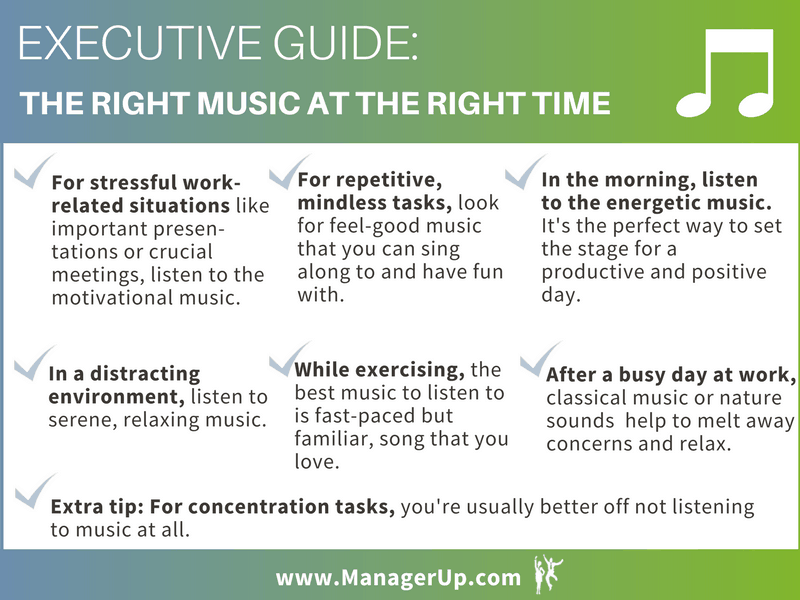
1. Preparing for a Stressful Situation

When getting ready for important presentations, crucial meetings, intense negotiations or other stressful work-related situations, try blasting some motivational music. What’s motivational to one person may leave another cold, but certain genres and songs are pretty universal in this regard. Songs like “Tubthumping” by Chumbawumba and “Eye of the Tiger” by Survivor are just a few examples. There are also plenty of motivational playlists available online.

2. Concentrating on a Project or Other Work

Playing music is useful in virtually all work-related situations. One exception, however, is when you really need to concentrate intently on a project or other types of work. This is especially true if you are working solo. In this situation, you’re usually better off not listening to music at all. If you are used to doing so, however, you should stick with unfamiliar songs, instrumental music, and other ambient tunes. The goal here is to let your subconscious absorb the music while your conscious brain focuses on the task at hand.

3. Completing Repetitive, Mindless Tasks

Even high-powered executives get stuck completing repetitive, mind-numbingly boring tasks from time to time. This type of work seems to drag on forever, so it helps to play some fast-paced, upbeat music in the background to pass the time. Unlike with other types of work, there is no harm in playing music that distracts you in this situation. Look for feel-good music that you can sing along to and have fun with. Whether it’s something that you’re already familiar with or a special playlist of feel-good songs that you’ve found online, playing fun, lighthearted music while completing boring busywork can make a huge difference.

4. Getting Going for the Day

As a busy professional, you probably burn the candle at both ends. This often means feeling burned out and exhausted even first thing in the morning. The best solution for this is to take an extended vacation. The next best thing–and the more practical option–is to pump yourself up with some fast-paced, energetic music. Nothing can clear the morning doldrums like jamming to some of your favorite upbeat music. It’s the perfect way to set the stage for a productive and positive day. Create a playlist of your favorite upbeat songs to listen to in the morning, or download some playlists from the internet. Suddenly, mornings don’t seem so bad.

5. Focusing While in a Distracting Environment

An ideal work environment is quiet, comfortable and free of distractions. Unfortunately, we don’t always have the luxury of getting work done under such circumstances. Busy executives are often on the go, and this usually means having to catch up on work while on a train, on a plane or in other distracting environments. A great pair of headphones and the right music can be a lifesaver under these circumstances. As for which type of music to listen to, serene, relaxing tunes tend to work best. Have a playlist of such music queued up and ready to go whenever you will be out and about for the day.

6. Exercising for Physical and Mental Health

Exercise is one of the best stress relievers out there, so it’s important for working professionals to squeeze at least a little into each day. Workouts can be grueling when you are consumed with distracting thoughts about work. Music helps to take your mind off of such matters, allowing you to lose yourself in sound and movement. The best music to listen to while breaking a sweat is something that is fast-paced but familiar. Listening to songs that you know and love while getting in your workout makes the time fly too, ensuring that you reach your workout goal without any trouble.

7. Unwinding

Like most working professionals, you probably prefer to leave your work at work. However, it can be difficult to let go of the workday even after arriving home. The right music helps to melt away those concerns, allowing you to kick back, relax and enjoy yourself while off the clock. Upon arriving home, cue up some slow-paced tunes. Aim for something that has a tempo of about 60 beats per minute. Classical music works well under these circumstances, and there’s a wealth of it to choose from. Nature sounds and other types of ambient noise also help a lot. By the time your listening session is over, you’ll have rid yourself of the day’s work stresses and will be ready to enjoy life at home.

From the minute that you wake up until the time that you arrive home from work, the right soundtrack can make your workday unfold a whole lot easier. By being a bit strategic about the kind of music that you play and when you play it, you can more easily put your best, most professional foot forward from the second you walk through the office door until the moment that you walk back out.

What other strategies would you add to this list? Please, share your comments!

Do you want to read more tips on productivity?  Check the link below!

best productivity books

MUST-READ BOOKS ON FOCUS AND PRODUCTIVITY TO GET THINGS DONE

Busy schedule? How to get the most out of your workout.

The average busy executive doesn’t have time to do a ‘Rocky-style’ training montage each day, even if he does have the perfect soundtrack to go with it. No matter how organized you are, you probably don’t have the luxury of spending hours a day in the gym or devoting as much time as you might like to leisurely get into shape.

Many have found that they can only visit the gym 1-3 times a week and spend every time about 45-60 minutes there and that this time often ends up unproductive or it doesn’t produce the desired results. How to get the most out of your workout?

Be as productive in the gym as you are at your office. Learn how to get the most of your workout. CLICK TO TWEET

Executive Summary:

get-out-the-best-of-your-workout

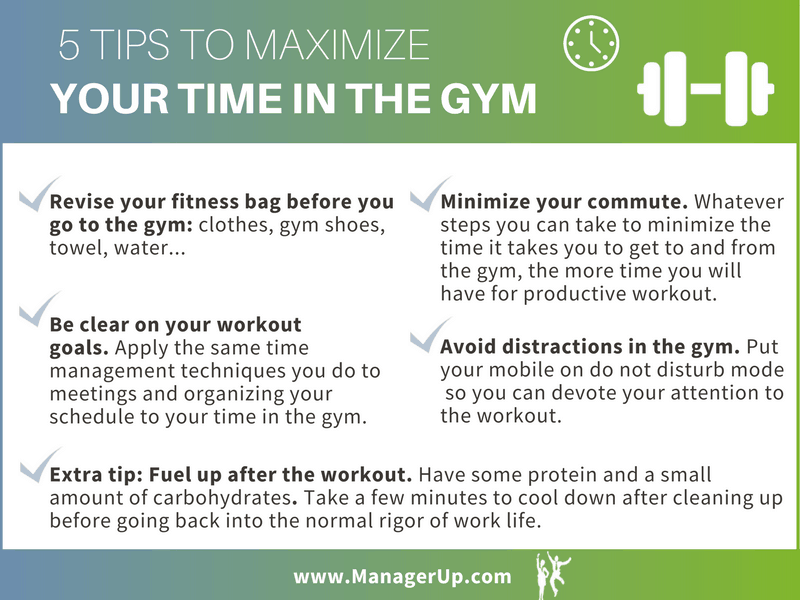
1. Revise Your Fitness Bag

If you only have an hour or so to go to the gym, you need to prepare in advance. Have a bag packed with everything you need. Finding you forgot your clothes, shoes or socks is sure to discourage you from making the extra effort to hit the gym. Don’t forget to pack essential items, such as clean workout clothes,  gym shoes and socks, towel and shampoo if your gym doesn’t provide them and other toiletries like deodorant and hair products.

Most people like to listen to music when they work out. If the gym’s sound system selection isn’t working for you, create a playlist on your phone and buy some gym-friendly headphones so your tunes are ready when you are. Many enthusiasts prefer Bluetooth headphones since there are no wires, which provides better freedom of movement while exercising.

2. Minimize Your Commute

Even a ten-minute drive to the nearest gym cuts into the time you can spend working out. If you work in a large city business center, there are usually gyms on site. Although they often charge more than one that may be down the street, the time you save can make it well worth your time.

Occasionally there are physical therapy businesses that also allow a limited number of people in the building to pay to work out there as well. Whatever steps you can take to minimize the time it takes you to get to and from the gym, the more likely you will have a productive workout.

3. Be Clear on Your Workout Goals

We’ve probably all seen the guy in the gym who is clearly aimless. Usually, he’s out of shape, wandering randomly from one machine to another and absorbed in his phone. You should apply the same time management techniques you do to meetings and organize your schedule for your time in the gym. You wouldn’t schedule an hour-long meeting with no agenda, and you shouldn’t go to the gym without one either.

Make a plan in advance. It may be as simple as some notes on your phone about what body groups you will work out each day. Others use apps like Seconds in order to create time-based workouts ahead of time.

Another way to optimize the limited time you have is to hire a personal trainer. Their advice will help you be more productive in the gym. You can find some great 45-60 minute workout routines to try.

4. Avoid Distractions

If you keep your phone with you during your workout, it will likely distract you. Put it on do not disturb mode or airplane mode so you can devote your attention to the workout. A good workout needs to keep your heart rate elevated for at least 30 minutes to have a lasting impact on your metabolism. If you stop to take a 5-minute phone call or put together a quick email, you will cause your heart rate to drop down again.

It can take some self-control, but try to view it like you would a meeting. The workout has an agenda, you aren’t going to deal with other things during it and you’re going to give it the attention it needs.

5. Fuel up After the Workout

Post-workout, your goal is not just to get back to your desk before your next appointment but also to fuel up. In the first 45 minutes after a workout, you should have some protein and a small number of carbohydrates in order to refuel efficiently.

You’ll, of course, also want to give yourself time to shower, redress and clean up. Depending on your hairstyle, this can be a few minutes or a larger amount of time. You should calculate this into your time for working out.

Many like to take a few minutes to cool down after cleaning up and listen to some relaxing music before going back into the normal rigor of work life. Many “lunchtime” fitness enthusiasts enjoy the flush of endorphins the workout gives them and use this to fuel their afternoon.

Do you use other strategies for maximizing your time in the gym? Feel free to leave your comments.

Have You Ever Tried Working out at Work?

11 IDEAS TO GET STARTED AND BE MORE ACTIVE IN THE OFFICE!

Yoga at Work. What Are the Benefits for Executives?

Does it feel like you’re becoming more overwhelmed by work by the day? You’re not alone. According to the third annual  Work Stress Survey  by Harris International, eight out of 10 Americans are stressed about their jobs. Feeling stressed and anxious at work often turns into a vicious cycle, as feelings of stress and anxiety negatively affect job performance, making existing problems even worse.

Increasingly, workers are turning to yoga to manage feelings of stress and anxiety in the workplace. While engaging in yoga, you must focus on breathing and staying calm while assuming difficult or stressful poses. In so doing, you essentially  retrain your brain  to deal more effectively with such feelings. With regular practice, yoga at work can strengthen your ability to cope with stress and anxiety on the job.

That’s not the extent of its benefits, however.

Executive Summary:

yoga at work

5 Ways in Which Yoga at Work Can Benefit Your Career

Countless studies have been performed regarding the benefits that yoga brings to the table. When such benefits are discussed, it’s usually in the context of everyday life. However, business professionals can derive special benefits from engaging in yoga on a regular basis–and reducing stress and anxiety is just one example.

1. Yoga at Work Increases Focus

While engaging in yoga, the instructor will gently remind you to focus on your breathing and to clear your mind. On paper, this probably sounds simple enough to do. In reality, however, it takes a lot of practice to achieve any level of proficiency in this area. You are expected to hold complicated and sometimes difficult poses for extended periods of time while maintaining a calm breathing pattern and a clear mind. At first, this will be very difficult. With practice, though, it will get easier and easier.

In real life, an improved ability to focus will come very much in handy in the workplace, where distractions are constantly coming at you from every direction. As you gain more experience and skill, your ability to focus on what matters at work will improve. In turn, your productivity will go up, as you won’t be constantly interrupted to attend to distractions.

2. Yoga at Work Reduces Stress

As mentioned earlier, stress and anxiety tend to have a snowballing effect. When you become overwhelmed by stress and anxiety, your ability to cope with even simple matters becomes compromised. In turn, your performance may falter, and you’ll run into more and more problems. These problems will increase your stress and anxiety levels even more.

While engaging in yoga, the meditation and breathing help you learn how to free your mind even in the face of very stressful situations. The more experienced that you become, the easier it will be for you to hold difficult poses while remaining calm and at peace. This skill translates well in the workplace, where it will come in handy while giving presentations and in other situations where stress and anxiety are sure to strike.

3. Yoga at Work Alleviates Physical Ailments

Have you ever tried to focus on work with a stiff neck, a sore back or other physical issues? It isn’t easy, is it? Yoga can make a huge difference. You may be thinking that those very ailments will prevent you from engaging in yoga at all, but that’s not the case. The reality is that yoga is a very low-impact activity. Rather than exacerbate existing physical ailments, it improves them. Over time, you will notice that those pesky aches and pains that used to plague you have all but disappeared. When you’re not preoccupied by pain, you’re better able to focus.

At work, this means that your productivity will improve. Your overall mood and outlook will too. Suddenly, work doesn’t seem nearly as difficult as it used to.

4. Yoga at Work Unleashes Unparalleled Creativity

The daily grind often saps even the most talented professionals of creativity. If you’ve become stuck in a rut, yoga might just be the answer. One of the key tenets of yoga is freeing the mind of your worries and staying in the moment at hand. This is also referred to as “freeing your mind,” and it isn’t just advantageous while engaging in yoga. Its benefits spill over into work in many ways too. When your mind is freed of the usual worries and cares, it is free to move into unexplored territory.

This is how the best, most innovative ideas are born. With regular practice, yoga can give you the creativity that you need to achieve new levels of success in your career.

5. Yoga at Work Increases Energy

Are you often dragging by the middle of the workday even after getting a full night’s sleep? Chances are that it’s because you are working too hard over excessive periods of time without any breaks. Research has shown that when workers step away from their desks here and there throughout the day, they tend to be less fatigued and have more energy. If you engage in yoga while stepping away–even if only for 10 minutes here and 10 minutes there–the benefits are even better.  Numerous studies, including one that was published in the Journal of Physical Activity and Health, have shown that yoga improved workers’ performance. Much of that likely has to do with the increased energy that goes along with practicing yoga.

One of the best things about yoga is that it’s easy to get started. You don’t even have to sign up for a class-free tutorial are readily available on YouTube and around the internet. Yoga may be the key to unleashing your full potential at work, and the sooner you get started, the sooner you can find out.

Are you looking for easy poses to do at work or at home? Check out our yoga books exclusively selected for executives. Read how yoga helps you calm your mind and body and integrate yoga into your busy schedule.

Have you already introduced yoga to your life? Is yoga helping manage your thoughts, reduce stress or increase focus at the workplace?

Share your comments with us!

Can You Die of Stress at Your Workplace?

You’ve probably said from time to time “My job is killing me.” But is that the truth? Can you die of stress at the workplace?

You’ve probably said work is “causing me to pull my hair out.”You are probably not really pulling your hair out (we sure hope not!), but job stress could be hurting your health.

In a stress management article by Mayo Clinic researchers, they say, “The long-term activation of the stress-response system — and the subsequent overexposure to cortisol and other stress hormones — can disrupt almost all your body’s processes. This puts you at increased risk of numerous health problems.”

die of stress

1. What stress does to you

Naila Rasheed writes in the International Journal of Health Sciences that “Stress is well-known fact involved significantly in the onset of almost all major depressive disorders. Moreover, prolonged stress in humans caused serious neurological disorders, cardiac problems (including heart attack), gastric ulcers, asthma, diabetes, headaches, accelerated aging, and premature death.”

The MD Anderson Cancer Center in Texas is a world leader in cancer treatment and study. Markham Heid said long-term stress is the one that does harm. “This type of no-end-in-sight stress can weaken your immune system, leaving you prone to diseases like cancer,” he wrote:

Too much mental stress can also kill you quickly and well before you should really die.

“Yale researchers have found that psychological stress can facilitate sudden death by increasing the chances that arrhythmias — abnormal heart rhythms — are more lethal in susceptible patients,” says a news report from the Yale about a stress and mortality study. The two-year study was published in the journal of the American Heart Association.

British researchers also studied psychological stress. Their findings are published in the British Medical Journal. Among other things, the six medical professionals found an increased risk of mortality associated with long-term stress, and more specifically “cardiovascular disease.” Their findings also found an increased risk of cancer “with psychological distress at higher levels.”

The Huffington Post has an infographic in this article that walks you through stress and how it will affect you days, weeks and months later.

2. How Much Life You Are Losing

The question then becomes, how much of your life is being cut short because of stress?

The Independent, a British newspaper, reported on a study from Harvard and Stanford universities. The study is behind a paywall. Graphics in the newspaper article point to people losing quite a bit of life expectancy for a variety of reasons. One of the bar graphs in the newspaper article shows unemployment and layoffs being the second biggest stress factors on the job.

Losing your job is definitely a stressful situation. Even the threat of it will cause more stress than you need.

Finnish researchers also took a look at work stress from being tired and its effect on longevity. “These data suggest that work-related exhaustion is related to the acceleration of the rate of biological aging. This hypothesis awaits confirmation in a prospective study measuring changes in relative telomere length over time,” they wrote.

“When we’re under ongoing stress, it creates that fight-or-flight reaction in an unrelenting way, and as a result, stress chemicals are released into the body. What we know so far is that the release of those stress chemicals creates biological changes,” Dr. Vivian Diller, Ph.D., tells the Huffington Post. “It’s very possible that if you have a life filled with that constant stress, little by little the body is breaking down.”

3. What  You Can Do

The first part of getting a handle on the stress that is ruining your health is to admit it exists. As a successful professional, you are used to taking in uncomfortable facts and working with them. This situation is no different. So embrace this reality – work-related stress is the second-highest stress people experience. Only worrying about money is worse. The difference between being concerned about money and worrying about work is only 4 percent in the American Psychological Association poll.

 Step two is to find out how much stress you are under. How bad is it? More importantly, where is the stress coming from? The American Institute of Stress (talk about a stressful job!) has studied this. The breakdown shows 46 percent of job stress comes from the workload. Another 28 percent comes from dealing with people, co-workers, customers, bosses, employees, and vendors all come under this heading. Twenty percent is from trying to have a healthy work-personal life balance.

Let’s make this simpler. Stress at the job comes from:

– 46% work

– 28% of people

– 20% work-life balance

Now, which category creates the most headaches for you?

4. Implement the Plan

Beat stress. You can do it. You just need to have a solid plan and a good follow-through. Here are five tips:

1) Improve your relationship will important people in your life. Tell someone you love them.

2) Get more productive. Take control of your work environment.

3) Get enough sleep. Meditate. Exercise. Eat healthy.

4) Learn to relax.

5) Subscribe to our newsletter for regular stress-busting tips for professionals and business executives.

Do you think we are exaggerating? Feel free to leave your comments!

Want to work stress-free, sleep well, and free yourself from anxieties? Here are some of our favorite books on stress management selected with executives in mind. Relieve stress, calm your mind and body and boost your health from the comfort of your own home or office.

stress management books

Paleo Diet Pros and Cons for Executives.

It is difficult for busy executives to maintain consistent healthy eating habits. From pastries in the office conference room to business dinners with clients, the temptation to eat unhealthy food is lurking around every corner. And the diet advice of different experts is so confusing. Therefore, every business executive is looking for something simple and easy to execute. The paleo diet is simple and relatively easy to implement, but a coin has two sides. You should know what paleo diet pros and cons are.

Paleo diet has more cons than pros for executives, but you can include these Paleo concepts in your lifeCLICK TO TWEET

Executive Summary:

You may have heard about this ‘new’ way of eating that has become part of the lifestyles of many celebrities in the western world. Familiar entertainment personalities such as LeBron James, Miley Cyrus, Megan Fox, and Matthew McConaughey have spoken publicly about the benefits of the Paleo diet.

Let’s face the facts. The Paleo diet has been the subject of thousands of online publications. Many articles praise the health benefits of the diet. Others articles report the dangers of this revolutionary way of eating. Quite frankly, all of this conflicting information can be confusing.

To help you sort through the maze of Paleo diet information, this post will provide you with the essential facts about this diet. By the end of this post, you will understand the components of the Paleo diet as well as the benefits and possible drawbacks of committing to this diet. You will be able to make an informed decision about which parts of the program to incorporate and the parts to leave behind.

1. The Paleo Diet Explained

Popularized in 2002 by a professor named Dr. Loren Cordain, the Paleo diet is based on the foods that our hunter-gather ancestors ate during the Paleolithic Era. This food includes healthy amounts of lean meats, saturated fats, vegetables, nuts and fruits that are low in sugar.

According to Dr. Cordain, the Paleo diet mimics prehistoric eating habits and helps people avoid the onset of modern diseases. Aliments such as high blood pressure, cancer, Parkinson’s, depression, Alzheimer’s, infertility, acne, and diabetes can be eliminated with a Paleo lifestyle.

Although Dr. Cordain is responsible for igniting the modern Paleo movement, he did not develop the idea. In January 1985, S. Boyd Eaton and Melvin Konner published an article in the New England Journal of Medicine that provided insight into Paleolithic nutrition. This article is entitled “Paleolithic Nutrition: A Consideration of Its Nature and Current Implications”. This report marked the beginning of a new way of thinking about the types of foods we consume.

 2. Paleo Diet: Fact or Fiction

The Paleo diet has legions of fans who swear by its benefits. However, this diet is not without its critics who attack its assertions. One of the most interesting arguments against the Paleo diet is a lecture by Professor Mark Zuk. Professor Zuk is the author of “Paleophantasy”.

Here are a few key highlights of additional anti-Paleo arguments:

 2.1.  The Assumption that Humans Stopped Evolving 40,000 Years Ago Is False.

According to John Hawks of the University of Wisconsin, human beings are constantly evolving and adapting. As a result, humans have developed the tolerance to eat foods that were not eaten during the Paleolithic Era such as milk and nuts.

 2.2. Consuming Too Much Meat Can Contribute to the Development of Cardiovascular Disease and Cancer.

The cavemen in the Paleolithic Era ate meat that was not chemically-laden. The meat that is eaten today is less healthy than the meat that was eaten by cavemen.

2.3. There Are No Conclusive Studies that Show the Effects of the Paleo Diet.

Many historians believe that cavemen had a short lifespan during the Paleolithic Era. The only real evidence of longevity that is linked to diet comes from Sardinia (Italy) and Okinawa (Japan). However, the diets of the people who resided in these regions do not include a Paleo lifestyle.

2.4. Consuming Healthy Amounts of Whole Grains Provides Fuel for Your Brain.

These power foods contain healthy amounts of glucose that keep you mentally alert and focused throughout the day.

2.5. Dairy Contains Nutrients that Help Your Body Combat Stress.

Dairy is an excellent source of Vitamin D. Many recent studies show the correlation between vitamin D deficiency and mental disorders.

These scientific arguments offer different opinions of the drawbacks of this diet. Paleo diet is probably not the best option for business executives. The lifestyle difference between the cavemen and the business people is obvious.

3. How to Adopt a Paleo Lifestyle

The Paleo diet must have some benefits because many people have changed their bodies by eating in this manner. The proof is in the testimonies of the people who have experienced amazing benefits from incorporating it into their daily routines. This diet can be easily added to your lifestyle. In order to experience success and optimal health from the Paleo diet, here are some things you can do.

– Eliminate foods with high amounts of sugars from your diet. This includes soda, fruit juice, candy, and cakes. These foods contribute to heart disease and diabetes.

– Avoid processed foods. Canned and packaged foods are often low in fiber and high in refined carbohydrates.

– Eat fresh vegetables, fruits, and nuts. Everyone knows that they are low-calorie sources of vitamins, nutrients, and dietary fiber.

– Get active. Your body and mind require at least 30 minutes of physical activity each day.

An important thing to remember is every person is different. The Paleo diet does not have to be an ‘all or nothing proposition’. You can transition into a Paleo lifestyle by applying the parts that make sense for your lifestyle.

Do you have another opinion about the Paleo diet? Feel free to share your comments with us!