Productivity is the holy grail of the business world. Many confuse the word, however, with terms like profitability, performance, effectiveness, and efficiency. In this article, I will provide a definition of productivity that is easy to understand.
I will also tell you about “healthy” productivity and its drivers. You have probably never heard this term before, but it is one of the key productivity concepts we use at Manager Up.
It is highly likely that you want to increase your and your team’s productivity. But how to do more with less effort? Maybe you think that only working longer hours will achieve better results.
Wrong!
The founders of Facebook, Google, and Amazon all had the same number of hours in a day as you have now, but their results were significantly different.
They simply had a different approach to productivity! So, how did they accomplish more with less effort? Do you want to learn how?
If so, let me take you on a journey through the productivity world. This is our road map:
– What is productivity?
– Are there productivity short cuts?
– What is healthy productivity?
– What are the 12 drivers of healthy productivity?
– Positive drivers
– Negative drivers
So, let’s start with answering the key question:
What Is Productivity?
We have already indicated that productivity is not the same as efficiency, profitability, effectiveness or performance.
Personal productivity is simply defined as the ratio between the value generated by your activity and the resources used.
The value generated by an activity
Productivity = ——————————————————
Resources used during this activity
Obviously, in order to increase your productivity, you should:
– Focus on activities that generate significant value
– Minimize the resources involved
It would be best to do both!
Are There Productivity Short Cuts?
When talking about productivity, some authors and bloggers try to convince you that an improvement of two or three elements in your business conduct will step up your productivity level.
You may try to “do the right things” and focus on those activities that generate high value. This is a good approach, but it has two weak points.
First, unless you are a CEO or own your own business, it is almost impossible to do only big things. Your daily business life consists of dozens of small things that need to be done.
Second, big projects often eat up a lot of resources. We end up exhausted and stressed out, drained of energy.
Therefore, simplistic approaches to productivity never work. Productivity is a complex animal, and to see it roar, you need to leverage different drivers to maximize value and minimize resources.
What drivers am I talking about? You will soon see it.
Most of us fail to realize that to become more productive, we need to take a 360-degree approach to our well-being and the way we work. Our cognitive functions will never be at their best if we don’t pay attention to what haunts us in the course of our working lives. For instance, stress, mental fatigue and exhaustion.
Ask yourself, how long you sleep?
How energetic are you during the day?
How well do you manage your stress level?
How efficient do you use your time?
Do you procrastinate? And so on…
All these factors influence work productivity. If you overinvest your human resources, it may negatively affect your health. You must have heard that some executives and managers end up with serious diseases, so this shouldn’t come as a surprise.
Therefore, the question is not how to be productive, but how to be productive in a healthy way.
What Is Healthy Productivity, Then?
We said before that the productivity is proportional to the value you generate and inversely to the resources you use. In fact, the main resources we have are our physical and mental capabilities. In short, personal productivity depends very much on how much individual effort and energy we invest.
An extremely high personal investment makes our bodies suffer. In the long run, it may have very unfavorable consequences for our health and well-being.
Jim Rohn once said: “take care of your body. It is the only place you have to live”.
To be highly productive, it is important to invest our human resources in the healthiest way.
The healthy productivity ratio looks like this:
The value generated by your activities
Healthy Productivity = ——————————————————
Your healthy personal human effort
12 Healthy Productivity Drivers
At Manager Up, after carrying out massive in-depth research, we have identified 12 key elements that directly influence productivity and health. We decided to call them the 12 Drivers of Healthy Productivity.
Eight of the twelve drivers are positive and four are negative. To be more productive, your objective should be to maximize (or improve) the positive drivers and minimize the negative drivers.
Let’s first focus on the positive drivers:
8 Positive Drivers of Healthy Productivity
1. Productivity and Human Energy
This is the key driver of healthy productivity. I think it is not difficult to see the correlation between personal energy and productivity. When you are very tired, your productivity is close to zero. In fact, you often feel like sleeping.
On the other hand, when you have had a good night’s sleep, then go to the gym for a moderate physical workout and eat a good energetic breakfast, you feel like a young god or goddess. Your energy makes you fly, and you are able to do a great many things with minimal effort.
In 2007, the Harvard Business Review published an excellent article: “Manage Your Energy and Not your Time”. The article says that a day has a limited number of 24 hours: it cannot be stretched. But our human energy can be increased in a practically infinite way.
Tony Schwartz and Catherine McCarthy point out that our energy originates from four different sources: emotions, body, spirit and mind. If you cleverly manage these wellsprings, you have practically endless possibilities to recharge yourself.
2. Productivity and the Quality of Sleep
Do you remember the last time you had a long business dinner and afterward you went to a bar with your team? And then you ended up in bed very late. When the alarm clock rang the next morning, you felt like anything but working, but you had to push yourself out of bed. The meeting was supposed to start on time, and you didn’t want to arrive late.
How productive were you in that meeting? Was it easy to focus? Or you were simply trying to get through the day?
A lack of sleep undermines performance and productivity. Without enough sleep, we cannot think, learn and solve problems efficiently. Attention and memory are impaired. Our productivity is at the rock bottom.
By the way, sleep problems are not only caused by late business events. More common causes are stress, jet lag or eating too much for dinner.
One study estimates that sleep-related productivity loss amounts to almost $2,000 per employee each year. Plus, chronic sleep deprivation may lead to illnesses that increase absenteeism. That, of course, decreases productivity in a significant way.
Sleep deprivation may be related to both sleep duration and to quality. Research shows that poor sleep quality makes us less stress resilient.
Do you want to be productive tomorrow? Make sure that you sleep like a baby tonight.
3. Productivity and Physical Exercise
“I don’t have time for a gym” is something I hear from many readers.
The same readers complain that their careers are not progressing well. They are not as successful as they would like to be. Their relationships do not give them satisfaction and, and, and…
Your career and success depend very strongly on your productivity. There are dozens of studies [1] [2] [3] that have proved that exercise boosts productivity. This means that gym goers do more in the same period of time than couch and desk potatoes.
Physical exercise makes you healthier, taking fewer sick leaves, while experiencing less disabilities. Furthermore, being fit will change your physical appearance. Believe me, people perceive obese individuals as less capable and successful.
No doubt, physical exercise is one of the foundations of healthy productivity.
4. Productivity and Task Management Systems
Most of you have heard at least once about the Eisenhower Matrix or the Getting-Things-Done method by David Allen. Some of you use these or similar productivity systems at work.
But has science really proved that we need a task management system to be more productive? Our intuition says that we do and… that’s true. Science confirms what we know by instinct.
Task management systems are useful as they reduce the time needed to define priorities. And it is proven that our brains work at their highest productivity level if there are clear directions and things are ranked in the order of importance.
They also serve as a kind of external memory. Knowing that everything is saved in one place and no critical data gets lost reduces stress and confusion.
It is said that the best task management system for productivity should measure the delivered results and not just the objectives and strategies. In this way, you can measure your real productivity.
5. Productivity and Time Management Systems
Your day has 24 hours. Do you use them well?
Even if you have a good task management system, you must ask yourself if managing your time in the most effective practice.
Do you deliver projects on time or do you procrastinate? It is obvious that procrastinators are less productive, but how to stop procrastinating?
Do you do one thing at a time or juggle many priorities simultaneously? The former is typical of monochromic people and the latter for polychromic folks. Your attitude may be culturally driven.
Do you have days when you do more than on other days? Why? Maybe it has something to do with the way you invest your time on the productive days?
How do you manage interruptions? Do you know how to say no to incoming requests?
These are all important questions to be answered. It is crucial to analyze your time-wasting behaviors. Research shows that there is a relationship between certain time management systems and productivity.
6. Productivity and Personal Confidence
We seldom understand the real importance of self-confidence. Believing or not in yourself may decide not only your project’s but also your career’s success.
All projects face issues, problems and obstacles. Self-confidence creates an inner strength to overcome any form of adversity. By being self-confident, you embrace challenges. You do not give up after failures. You simply deliver again and again.
Self-esteem moves us from thinking about something to really doing it. It speeds up the creation process. Thus, it increases your productivity.
Why productivity?
Richard E. Petty, a professor of psychology at the University of Ohio, says that without self-esteem there is no action. When facing a challenge, we first judge our ability to overcome it; and only if we are confident that we can do it, do we jump into action. For Petty, confidence is a magnifier of thought. Self-confident people have a growth mindset. This is a concept further developed by Professor Carol Dweck from Stanford University.
People with a growth mindset strongly believe they can achieve more. They are more stress resilient and challenge themselves more frequently.
7. Productivity and Office Ergonomics
When people are asked what drives productivity, office ergonomics seldom sits on the top of the list. People either do not understand the connection between ergonomics and productivity or they think that the influence is very limited.
Although from the short-term perspective the importance of ergonomics is not significant, the wrong ergonomics has significant consequences on productivity and health long term.
First of all, a lack of office ergonomics significantly increases the risk of back and neck pains as well as other musculoskeletal disorders. These medical conditions increase absenteeism and disabilities, which directly influences productivity.
Interestingly, sick leave days depend not only on the type of desk we have, but also on the type of office. For example, people working in large open spaces become ill more frequently than people working in small cells.
Furthermore, inadequate workplace lighting causes visual stress, such that our eyes suffer and our productivity decreases. The productivity difference between ergonomically optimized and suboptimal spaces could be as high as 17%.
Moreover, beautiful, well-lit offices are simply nice places to spend your time. Ergonomics likely indirectly influences employee motivation, which again raises productivity. Therefore, it makes a lot of sense to have a closer look at your workspace.
8. Productivity and motivation
The conventional wisdom says that motivated people work better and faster.
They are more creative and persistent. They are simply more productive.
Once again, the conventional wisdom is right. Motivation is the force inside which makes you do things. It pushes you to act.
What drives this force? People are motivated by many different things. Some by money and some by intangible benefits like recognition. We also are motivated by our goals and ambitions. The ambitious (and realistic) goals inspire us. But be careful not to set unrealistic objectives for yourself or your team.
Furthermore, we are driven by our thoughts and beliefs. If you believe that you are good at something, it is easier to be motivated during this activity. If you believe that your manager does not like you, your motivation drops, even if he/she really likes and respects you. Our thoughts and beliefs determine the things we will focus on and will do in the future.
Self-motivation determines whether you will adhere to your plan. This is especially critical if you find obstacles in the way. Your degree of motivation will decide whether you give up or continue on. To increase your own motivation or the motivation of your team members, please analyze first the motivational driver of a particular person.
I think you now get the point that motivation drives productivity. But how is it related to your health? Motivated people overcome life and work obstacles easier. They have higher stress resilience. They are simply happier.
The opposite is also true. People who are not motivated suffer in their jobs and are more prone to burnout and depression.
Negative Productivity Drivers
9. Productivity and Excessive Stress
Is feeling stressed a cheap excuse for lousy productivity? Stress belongs to an executive job, doesn’t it? So, what’s the deal?
While on one hand it is true that stress is a part of life, actually it is often helpful. Facing a challenging situation, we need a certain level to reach our goals. In this case, we speak about positive stress (eustress). A classic example is a job promotion.
The issue arises when this stress crosses a certain threshold and becomes really burdensome. This is not difficult in our hyperconnected world. Then we speak about negative stress (distress).
Chronic distress is not an illness. However, not only does it make us unhappy, but it can lead to burnout and physical illness, too. In both cases, productivity will suffer.
Interestingly when you complain about stress in most of the cases you mean the “distress” rather than “eustress”. The eustress is perceived as something pleasant and motivational.
To sum up, we need the right amount of pressure to perform well, but distress decreases job satisfaction and mental well-being. And last but not least, it has a very high productivity cost both for you and the organization you work for.
10. Productivity and Illnesses
This is a no brainer. When you are ill, you do not work and your productivity is zero. Well, not all people who report their illness, injuries or important medical treatments tell the truth, but this is a story for another post.
Today we are focusing on the real impact of illness on productivity. Especially in the wintertime during the so-called cold and flu season many people have to stay home. This has important benefits as our ill co-workers will not spread viruses in the office.
Additionally, the sick leave of chronically ill employees causes productivity losses in the billions of USD each year. By chronic illnesses we define, depression, diabetes, asthma, cardiovascular diseases, cancer and obesity.
How to avoid being ill? In particular, how to avoid the serious chronic diseases that can significantly decrease your and your company’s productivity. One of the ways is to follow effective stress reduction strategies. It is crucial to lead a healthy lifestyle, which is much easier than you think.
11. Productivity and Procrastination
Procrastination is defined as intention ally avoiding completing a task on time. It is actually one of the biggest barriers to productivity.
Procrastination is much more, however, than just postponing an important call from one day to the next or not delivering a management report on time. As Mel Robbins says, procrastination is a habit. The problem is not this particular call or that particular report. The problem is that procrastinators procrastinate again and again.
Have you ever asked yourself why people procrastinate? The answer may surprise you. Procrastination is a powerful relaxation technique. Yes! Procrastination is the way to reduce stress. Procrastinators postpone stressful tasks and do pleasant things instead.
Of course, they know they procrastinate, and the act of procrastinating creates negative emotions and… additional stress. It’s a vicious circle that shrink productivity.
12. Productivity and Interruptions
In their report on interruptions, Jonathan Spira and Joshua Feintuch estimate that interruptions cost the US economy almost 600 billion/year. They estimate that almost a third of the working day is consumed by interruptions.
But it is not only the time consumed by the interruptions themselves that makes us less productive. The issue is that the interruption effect is prolonged for 23 minutes afterward. For more details ,please read this interview with Professor Gloria Mark.
Sometimes, we can do very little about our boss’ interruptions. But the good thing is that almost half of all interruptions are caused by …us! Social media, surfing the internet or frequent trips to the coffee machine, etc.
So why is it good? Because by getting a grip on ourselves, we can significantly increase our productivity.
On our website we invite you to take a journey through healthy productivity. We encourage you to assess yourself and find out where you stand in terms of these 12 drivers.
We also offer you tons of free advice on how to improve your healthy productivity:
Do you often scratch your head and wonder about ways how to increase your and your team’s productivity at work, so that you can all be more productive and healthier?
ManagerUp helps managers, executives and entrepreneurs reach maximum productivity and energy level to be successful in their business lives without sacrificing their health and private life.
We have done massive research to offer you a list of surprisingly easy productivity tips that you can implement and share with your colleagues at work. Below are 120+ effective tips and ideas about how to be productive in the office, during business meetings, and while traveling.
Some of us are unaware of the fact that to be more productive, we need to take a 360o approach to our well-being. Indeed, our cognitive function will never be at its best if we fail to pay attention to other issues that usually haunt us in the course of our work lives, for instance, stress, mental fatigue, and exhaustion.
In other words, how long you sleep, how energetic you are during the day, and how well you manage stress usually influence work productivity. With these tips, you’ll be able to do more every day while staying healthy in your workplace. You will also improve your overall wellbeing.
In summary, these ideas will help you:
– Reduce any lingering stress and anxiety
– Remain energetic throughout the day
– Sleep better
– Eat healthier
– Create time for essentials like exercise
– Boost your confidence in and out of the office
Let’s dive right in and make the first step towards improving your productivity.
General Tips to Increase Your Productivity at the Office
1. Use A Standing Desk To Increase Productivity
Our roles usually involve a lot of sitting which, as we all know, could be detrimental to your health.
And we often wonder how to escape the threat of chronic health problems that could result from too much sitting in our offices.
Now, there seems to be some light at the end of the tunnel.
According to one study by the prestigious University of Pittsburgh, a standing desk can help increase your energy expenditure ( and by extension grow your productivity at work).
6. Use Computer Glasses To Combat Digital Eye Strain
You have to jealously protect your eyes if you want to work for more hours strain-free.
And when it comes to combating damaging digital eye strain, computer glasses are better equipped than regular glasses because of their built-in eye safety properties.
They do a whole lot more and might even help you sleep better.
On that account, computer glasses for managers can potentially lift your productivity to record levels.
Studies have indicated that computer, tablets, and smartphone users usually blink less than people who spend less time on digital screens.
But blinking is crucial for your eye health since it moistens and soothes your eyes effectively averting dry eye symptoms that cause your eyes to feel gritty, sticky, and even painful.
We thus encourage you to try your best to implement the 20-20-20 rule.
This simply requires that you observe a 20-second break from your computer/device every 20 minutes to gaze at an object 20 feet away.
Make it a habit and see your productivity snowball naturally.
8. Keep Your Computer Screen at a Suitable Level for Your Height
Your office computer is a double-edged sword. On the one hand, it simplifies your work. But on the other hand, you might occasionally suffer neck/back pains and throbbing headaches.
This certainly hinders your productivity in your organization.
You have to take charge and cushion your neck and back from such suffering.
First, adjust your monitor’s height so that the top of your screen is at or just below your eye level. Your eyes should be looking slightly downward when viewing the middle of the screen.
Then, position your monitor no closer than 20” (51 cms) from your eyes (or at an arm’s length distance).
The University of Auckland contends that such actions also brighten your mood and raise your self-confidence.
You should also consider implementing additional tips to get rid of back and neck pains permanently.
9. Expose Yourself To Sunlight To Light up Your Productivity
Cornell University recently commissioned a study on the effect of daylight on worker’s productivity in office environments.
And the results were quite interesting…
Just to highlight a few of the findings, 78% of the participating employees reported feeling better after exposure to natural lighting.
Then, 70% had a much-improved work performance in the aftermath of light exposure.
Still there, some of the workers registered a 56% drop in drowsiness.
To put it briefly, sun exposure can lift your energy levels and mood. And from the above outcomes, it’s clear that light can also help to swell your productivity.
And so you need to take a dose of sunlight every day to increase productivity.
You may start by placing your desk near a window where you can directly access some sun.
10. Tweak Your Lighting Systems and Boost Your Output
Be aware that desk lamps can be extremely beneficial to your eyes as their light helps minimize strain as you work.
Install a Task Management System To Be More Productive and Less Stressed
Brian Tracy wrote that productive people are happy people. I would add that productive people are also less stressed. The way you manage your goals and daily to-do lists has a direct impact on your health. Executives who do not have the right task management system in place are not only less successful but also act under huge mental pressure in a hectic and chaotic way. This has direct implications for their own health and that of their co-workers.
In this section, we will propose how to manage your tasks. You will become the star of the office and more relaxed, calmer and happier than the other executives.
12. Set Yourself Big Motivational Goals
You can boost performance by setting well-defined major goals. These become the real motivators that help prioritize work tasks. Importantly, big goals help us mitigate stress and increase our overall happiness.
13. Visualize Next Week With the “2-Hour Solution”
Do you have the feeling that your life is running you, that you don’t control your priorities? Are you frustrated and stressed out at the end of each week because you were not able to execute important tasks? There is an easy way to change all that and bring calmness and direction to your life. I am referring to Roger Seips’s Train Your Brain for Success with its 2-hour solution.
What does the method entail? Basically, you spend a designated two hours weekly to think of the following week’s activities. It is not normal scheduling. Instead, you break up the time into areas as follows:
– Green time: paid work
– Red time: that supports green time
– Flex time: free time to help keep your plans in place
– Re-creation time: for yourself, including hobbies, exercise, and rest
After a while, you’ll find that you don’t even need the full two hours to implement the 2-Hour Solution.
14. Set Realistic Goals (Follow the SMART Rule)
There is nothing as frustrating as not being able to achieve your goals. It often happens when the goals you set for yourself are too ambitious.
A word to the wise: set goals that are:
– Specific: this means that if your goals are designated, they are more likely to be completed. Vagueness brings about misunderstanding and a failure to launch. Always be precise and clear.
– Measurable: progress comes from measuring achievement. Analyze your efforts toward your goal and notice the tangible consequences. It is easier to succeed when you break down goals into measurable units.
– Attainable: don ‘t go for impossible goals. One failure breeds more. Know your own skills and the reality of what you can accomplish.
– Realistic: everyone becomes demotivated by failure. So be realistic about your goals and what is likely to accomplish in a given amount of time. Don’t fly too high and stay down on the earth.
– Timely: Allow a set time frame for each goal to help you stick to your scheduled deadline. There is nothing better for morale than completing tasks on time.
Working with SMART goals will bring the missing motivation back to your life and significantly reduce your stress level.
15. Learn To Delegate Some Tasks To Increase Productivity
We agree you must personally handle sensitive and strategic stuff.
But there are plenty of less critical tasks that eat away your minutes without really adding value to your role.
This is our advice: Identify such tasks and delegate.
You will move much faster, achieve your set business targets earlier, and generally become a benchmark when it comes to productivity at your workplace.
As a bonus, you’ll feel more relaxed, focused, and love your work even more.
16. Check Your Scheduled Goals and Mark the Accomplished Ones
While working toward goals, it helps to stay focused and committed. Confidence comes from completing them on time. Analyze what worked and measure your productivity. Quality is always better than quantity, or so they say. Measuring your achievements will show you how to improve.
Remember that what is not accomplished can be rescheduled.
17. Set Rewards into Your Schedule
Experts say that rewards help productivity by motivating us to achieve more. Putting regular rewards into your schedule will make you focus on reaching new goals, even those hard to attain. Let the reward motivate you so that extra effort becomes a habit.
Productivity is a major goal and it is sure to bring pride and happiness to those who enter its realm. Even if you are your own boss, you can reward yourself with something, such as a free afternoon. Maybe go to a movie or eat at your favorite restaurant.
18. Seek Clarifications About the Tasks Assigned
Have you ever completed a task and found out later that it was not what you were expected to do? It may have been due to the unclear goals or instructions.
No matter how long you have been at your job – ten years or ten minutes – confused goals are common. You must seek clarification when goals are unclear. Otherwise, you may be wasting time on the wrong task.
Each time, ask what Is the end goal of this task? Assess the big picture with your boss if necessary to avoid going down the wrong path. Ask him or her to clarify anything you don’t understand. “What do you mean” is a great way to get more information. Ask for an example or the focal point of request.
19. Prioritize Tasks
No goal can be reached if you don’t prioritize the tasks involved so you know what is most important to tackle first. Have a look at Stephen Covey’s book The Seven Habits of Highly Effective People in which he explains the meaning of “first things first.” One method of note is the Eisenhower Decision Matrix. Basically, each task is broken into four quadrants:
1. Important: those activities that lead to reaching professional or personal goals.
2. Urgent: those activities of utmost priority, often leading to another’s goals. They demand our attention first.
3. Neither.
4. Both.
You can more easily decide what to do with this method. You can always delegate what is not important but urgent.
Prioritizing is a well-known approach to any task to reach goals faster and more efficiently. It is the basis of time management.
20. Do 2-minute Tasks Immediately
Huge to-do lists are scary and stressful. The short ones are motivating. One of the best ways to reduce stress and be more productive is to shorten your to-do list. There are many ways to do it. One of them is to do some easy tasks immediately.
David Allen in his book, “Getting Things Done”, recommends to always apply the two-minutes rule. If any action items on your project list takes less than two minutes, do it immediately.
21.Protect One Week Day in Your Schedule Just for Yourself. No Meetings.
Time flies when our days are filled with meetings and diversions. Many people complain of a lack of productivity as a result.
To improve work output, it helps to follow a schedule and protect your time. You must allow for meeting-free off-time so you can concentrate on what is at hand.
22. Schedule Recurring Tasks That Can Be Executed Regularly Per Day or Week
The essence of an effective schedule is to set time each week for regular tasks. This rule has saved many from burn out.
On-going projects can get boring, but they must be done, so why not make them routine. You will get more done and feel confident and productive.
23. Work in 90-minute Intervals
Research shows that successful people in every field work in intervals. Ideally, they should be 90 minutes to maximize productivity.
What you should do? In the evening, decide which tasks are the most important for the following day. I suggest you list a maximum of 2-3 tasks.
On the next day, start working on the first one for 90 minutes without interruption. And then take a 20-30-minute break. During the break, walk or exercise. After the break take on the second task. It works wonders for productivity!
24. Meet With Your Team Members to Clarify the Goals and Expectations Each Monday Morning.
Sit with your team members to strategize how to best accomplish their goals and how to be more productive. Next week, sit down with them and go over lessons from the previous week. With a few simple instructions, everyone can get on the same page and understand their role.
Such a weekly procedure will not only increase your team’s productivity but also significantly decrease the stress level of all team members. They will feel your leadership and know that you are for them when they need your help.
25. Work With Clear Daily, Weekly, and Monthly Goals
Here you subdivide a project into manageable daily to-dos, weekly achievement goals, monthly deliverables, and such.
And so you only think about tomorrow once done today. And about next week once you have fulfilled this week’s mission.
That way, even a gigantic-looking undertaking will look more attainable. And because of that, you’ll be more motivated to take on big jobs.
And so the question of how to be productive won’t bother you again.
26. Declutter Your Mind Before Reading the Important Stuff
Sometimes you are supposed to pour through volumes upon volumes of exhausting business reports and concentration is vital.
Clearing your mind before commencing will help improve your concentration.
For example, you can spend some moments meditating.
This will not only help you declutter but will also tune-up your mind to focus on the reading task.
And the best bit?
It won’t take too much of your time either it is a complex activity to get into.
We also propose that you check out our simple tips on becoming a highly effective reader.
According to a series of experiments by one psychologist at the University of Sussex, our memories tend to differ in efficiency at different times of the day.
This means that you may find that you are more fruitful at certain tasks in the morning, mid-day, and in the late afternoon.
According to the analysis, you should pursue research activities in the early morning hours.
Then, you’ll achieve more at midday if you pre-occupy yourself with activities such as running errands and demanding work.
Finally, immerse yourself in deeds that involve applying new information and ideas during the late afternoon hours.
Well, these times may slightly vary based on whether you are a morning or night person so it’s upon you to find your sweet spot.
28. Schedule Breaks While Working in the Office
You obviously risk a burn out (now recognized as a medical condition by WHO) if you don’t take breaks.
To avoid this, program breaks of 10 minutes after working for about 60 minutes.
After resuming, you will find that you are more alert and concentrating much better.
That isn’t too much to ask of you. Or is it?
Manage Your Time Efficiently
29. Avoid Multitasking. Keep Your Attention On Just One Thing Before Moving On.
Productivity can be impaired by too many tasks, known as multitasking. Multitasking can destroy your brain, memory, concentration and even your relationships.
Are you in the rut of doing too many things at one time? Multi-tasking doesn’t always work if it means you lose focus and reduce your overall importance.
Why not do one well instead of three poorly-executed tasks? Just commit to the most important goal and move on.
30. Set Weekly Time With Your Team To Not Disturb One Another in the Office
Free time is golden in the office. Make sure you get enough by limiting interruptions from your team. Then you can tackle the most challenging tasks. Repeated questions from staff is deadly to one’s productivity.
31. Set a Time for Every Call Before Starting It
Calls eat up time so limit them when you can in number and length – say, to five minutes. Try to wind it up politely. Gabby friends can be a challenge! Some smart workers use a clock to avoid wasting valuable time. Unimportant calls should be shirked.
It may be hard to end a conversation, but there are ways.
“Your idea sounds great. Let’s put it into action soon. can’t wait to see them in action. I’ll get back to you.”
“I will answer your question promptly, but for now I am bogged down.”
“Thanks for calling, but I am on another call. Can I get back to you?”
32. Use Time Management Tools
There is nothing more productive and efficient than time management. A lot of research has been devoted to organization in life and at work.
Some of the principles include the use time tracking software. There are several good ones like Time Doctor that will guide you by computer. You get reports on how you spent your time.
Apps like Boomerang work wonders with Gmail so you can schedule your messages.
RescueTime is valuable to run any mobile devices or a computer so you know how you allocated your schedule.
Many prefer Evernote, a digital notepad to sync with the cloud or 15Five, a form of task manager, to get staff feedback. It is quick and easy to communicate with your team and review results.
You might like StayFocused, a tool that is self-evident. It will control your access to websites to prevent distraction.
Finally, take a look at Todoist, a chrome extension full of valuable features to help you set deadlines and get project reminders.
33. Set Self-Imposed Deadlines
Stress, surprisingly, is not always bad. Some degree of stress prompts us to become more productive and meet more goals.
It is a natural part of having deadlines, an essential way to control open-ended tasks. Focus is of the essence no matter what you do.
34. Schedule Less Time for the Task Than You Think You’ll Need
Words of wisdom are found in “Train Your Brain for Success” so take a look. It will tell you why it is important to control the time spend on tasks so you don’t wander off into the stratosphere.
35. Communicate Your Expectations To Your Team
We all know how important communication is. Business thrive on good communication and fail when it is lacking.
Managers must learn the art of two-way communication when expressing their team’s responsibilities and goals. Make your expectations clear and reward staff efforts.
36. Listen To What the Other Side Is Saying
Listening is an art and it pays off in the work context.
Let the person addressing you know that you have understood what is important.
Furthermore, tell them you are on board and provide relevant feedback. Getting the other to repeat their message helps them stay clear. This way, you will avoid wasting time on misconstrued projects.
37. Schedule a Specific Hour to Answer Non-Urgent Calls and Emails
As you very well know, constant phone calls and emails popping up right, left, and center can be distracting, especially while you are engaged in absorbing tasks.
For instance, the last thing you want while preparing an important business presentation is a salesy email from an online gift shop, reminding you about their ‘awesome’ promotion.
But since you cannot always 100% barricade the annoying calls, social media alerts, or these kinds of emails, try to set a specific hour to attend to them.
Start by Informing your colleagues that you will henceforth be answering incoming emails or calling back during a certain window unless it is really urgent.
In fact, you are likely to become a more efficient communicator since your mind is dedicated to pending communication tasks at the appointed time.
Undoubtedly, this will, in the long run, make you more productive and a star at your workplace.
Plus, it can help to keep stress at bay.
38. Wake Up Early
The most successful CEOs and leaders get up early to maximize their day. Sleeping in means wasted opportunities.
Morning time can be the most valuable as you are fresh and rested. Don’t rush out the door. Quiet time is the secret of daytime success.
39. Provide You and Your Team With the Right Tools and Equipment
No one can work effectively without the right tools and equipment for the job. If you want efficiency, make sure that your staff has appropriate supplies.
For example, you can’t expect prompt reports if your printer is slow and outdated. Get the most advanced equipment to save time and effort. This means anything from a printer and scanner to a copier and fax machine.
Software must be the latest as well. It all adds up to a more streamlined work flow.
40. Use Collaboration Tools
Teamwork implies greater productivity so enable your staff to collaborate when possible. Two heads are better than one!
Using project management adds is a boon to teams, making their goals simpler and faster to reach.
Think of the most popular apps like Basecamp, Asana and Trello. You can avail yourself of file storage and access apps like Google Drive.
41. Use Communication Apps
There are many good communication apps for the office, whether actual or virtual.
To avoid losing track of email messages, use instant messaging like Slack or Twist. They help organize conversations, especially those with many threads.
Plus, many communication platforms allow for multiple access and file sharing to help the team stay in touch.
42. Take Advantage of Your Commute Time
A lot can happen during your commute time so take advantage of it. It is like a bonus so don’t waste it with mobile games or texting.
However, work emails can be done and you can get a leg up on your to-do list. Or sit quietly and brainstorm ideas for the day.
43. Improve Your Working Skills With Training
Listen to the research. A study from 2013 in the International Journal of Science and Research shows how valuable training can be for both employers and employees.
You can expect greater efficiency and productivity as a result. Teach staff how to run new software and equipment to maximize their abilities. More work will get done in less time.
Avoid Interruptions
44. Put Your Phone and Inbox on Silent/Turn off Notifications
It goes without saying that the phone and email inbox are your enemies. Excessive use will impair your productivity in the short and long run.
Try to stop the bad habit of constantly checking your social media or text messages. Workplace distractions are a major cause of delayed goals. This includes too many bathroom breaks or chats with colleagues.
Nothing stops the work flow like a phone call so turn it off or silence it at the office. If your boss wants something, he or she will likely send an email or come and see you at your desk.
45. Limit Meaningless Time With Co-Workers in the Office
Talking all day long will waste countless minutes, if not hours. Don’t let it be your pattern at the office. It is fun but reduces productivity every time.
Discourage colleagues that want your ear. Set aside break time for chats. You can politely mention how busy you are. Try the following:
“I’ve got a time-sensitive project. Let’s catch up at lunch!”
“I’ll let you get back to you soon. My schedule is crazy but I want to help.”
“Let’s table that until later. I have a break at two.”
“I’m bogged down in emails so give me a moment. I’ll come by your desk in an hour.”
46. Get More Done Remotely As Possible
Remote working has been a boon to many industries. Virtual staff can work any time and any place, enhancing company productivity. Research shows that remote workers take less sick leave and get more done.
The office is a great social environment but there are multiple distractions. Someone is always out and about disrupting the work flow, affecting time-sensitive projects.
To make the point, a study in the Harvard Business Review found that working from home is the most productive.
An added bonus is that remote workers remain longer on the job. As companies set up remote systems, they are gaining an advantage over their competitors. In fact, working a home has increased from 39% to 43% according to Gallup.
Similarly, a Global Workplace Analytic survey reveals a 103% jump in telecommuters over the last ten years. Maye a change of scene is required now and then to boost productivity.
47. Wear Headphones To Avoid Being Disturbed
A simple usage of headphones can help dispel work distractions and make the day more productive. This is especially true for teams working in collaborations. People will see that you are preoccupied. It is a simple trick that wards off interruptions limits inappropriate comments.
While colleagues will think you are listening to messages, it could be music that filters out surrounding disruptions.
48. Use Plants Strategically to Avoid Distractions and Increase Productivity
Everyone loves a plant-filled environment. It is not just about décor. It is said that plants improve health, especially in poorly-ventilated offices.
They also reduce stress by producing oxygen. Studies show that a good garden design can impact productivity and foster better decision making by as much as 38%. What’s more creativity can rise by 45%. These are impressive numbers.
In addition, plants can be barriers to hide distractions. They can create designated spaces and act as vision-blocking “walls.” You will stay focused when you aren’t noticing all the hubbub around you. Your newfound privacy will deter interruptions.
49. Use Signs To Avoid Interruptions If Your Work in an Open-Space Office
Open space offices are at a disadvantage since noise and interruptions abound. You get used to it, but they are known productivity killers. You can devise ways to ward off disruptions, visual or auditory so that you are, in effect, working alone.
A whopping 70% of office workers complain of interruptions in open-plan spaces. You may not have a choice, but you can certainly give off signals of “do not disturb” to protect your valuable time. You can put an actual sign on your desk or wave your hand politely when you are busy. A simple gesture says it all.
There are some pretty creative gadgets that will do this for you. Get tech-savvy and use Luxafor, a glowing color-changing flag that goes from green to red (obviously denoting stay away).
Avoid Procrastination
50. Conquer Procrastination With the 2-Minute Anti-Procrastination Rule
This tried and true rule is simple. When starting a new task, take less than two minutes to finish it. Most anything can be scaled down dramatically. It will reduce time and effort, therefore the type of stress that plagues us at home or the office.
Reducing the time it takes to accomplish a goal means focusing more acutely. It also implies warding off procrastination because you have a time limit. Believe us, it is a powerful tool for better concentration and productivity. Just get in the habit of applying the 2-minute anti-procrastination rule right from the start.
A good piece of advice is to “standardize before you can optimize.” Consistency is the secret to productivity success.
51. Use The 5-Second Rule to Dive Into Tasks You Don’t Want To Do
There is another option: the 5-second rule. This one will help you avoid procrastination when you have something you don’t want to do.
The rule comes from motivational speaker, Mel Robbins, who advocates a 5-4-3-2-1 countdown before launching an undesirable task.
Anyone can overcome their bad habits and gain personal control. The rule empowers even the laziest among us to get with it and reach our goals.
Increase Energy to Be Productive
We occasionally receive emails about how to be productive from some of our readers. One of the questions we always pose is how well the person manages his/her energy.
Just how precisely can you be a bundle of energy at all times even when dealing with onerous tasks?
Well, understand that your overall energy level is the sum total of:
This means that you have to maximize all four aspects.
In this part of our discussion on how to be productive, we will highlight tips that can help you optimize all the aforementioned energy facets so you can maintain your early morning vibrancy all day long.
Let’s go!
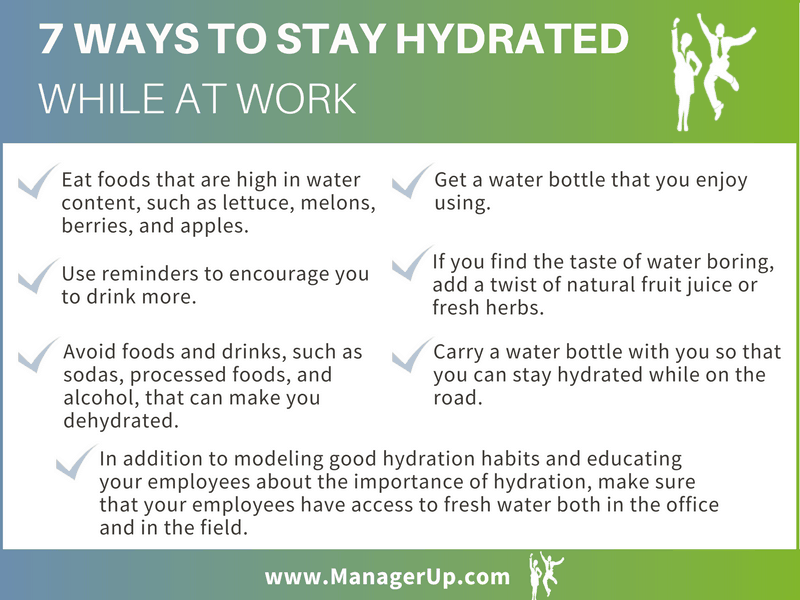
52. Make Staying Hydrated at Work a Priority
When you’re even mildly dehydrated, you develop headaches, feel chronically fatigued and experience difficulty paying attention. In short, dehydration is the perfect recipe for a non-productive day at work.
The remedy here is straightforward. Just drink as much water as you can regularly throughout the day.
You will be feeling like a bull, and your colleagues will be happy to have your energy in their teams.
53. Place a Therapy Lamp at the Place You Want to Dedicate to Focus at Work
Therapy lamps produce an effect similar to that of antidepressants and can massively boost mood. Installing one at your favorite working location might there help you experience a surge in output.
Having such a lamp will always make you feel like you’re on top of the world.
Read about this gold-standard therapy lamp to learn how these lamps battle work-related fatigue to increase productivity.
If you feel groggy at work, try essential oils and aromatic plant extracts. These provide executives and managers with mind clarity while also boosting concentration.
Aromatherapy also packs other benefits, such as reducing your perception of pain and anxiety.
Some are portable mists; you can carry them to wherever you desire to gain concentration and focus.
56. Learn Easy Office/Home Recipes to Help You Quickly Prepare Fulfilling Meals for Improved Energy and Productivity at Work
The food you eat may make you more energetic and productive. On the other hand, bad meal choices can drain your energy level.
And since you lead a hyper-busy life as an executive or entrepreneur, you have little time to prepare your own healthy breakfast, lunch, dinner and so forth.
This means you often have meals prepared by someone else that aren’t necessarily healthy. This may be one of the reasons why you sometimes feel sleepy, weak, and dazed after lunch. Other days you just feel worn out and your body is unwilling to work.
By good fortune, there are cookbooks with yummy, exciting and nutritious recipes that you can easily and quickly prepare at home in the morning or during lunch breaks at the office.
Even more conveniently, you won’t need fancy cooking equipment to fix yourself a healthy bite- most work with your basic kitchen setup.
Our list of healthy cookbooks for busy people will help you start off.
57. Avoid the Vending Machine at Work to Satisfy Your Snack Cravings
You should avoid indulging your sweet tooth as much as possible. That’s because high carbohydrates, high bad fats, and foodstuffs like doughnuts, cake, and pie which are stuffed with sugar, slow you down.
Instead, to sustain your energies and mental focus, replace these with healthy office-friendly snacks.
Our favorite healthy office snack proposals will point you to the right direction.
When your leg muscles move, your blood circulation increases, meaning that more oxygen is reaching your brain cells.
Can you train yourself to take the stairs instead of the elevator whenever going a few flights? As a consequence, you will be full of vim and vigor the entire day.
Here are more tips to help you sit less and be more productive.
59. Cut Sugary Drinks at Work. Instead, Drink Green Tea
Sugar is a stimulant that actually eats away your energy and increases body tension.
In a small study published in the Journal of Personality and Social Psychology, people reported more tiredness, lower energy and higher tension after eating a candy bar (compared to walking briskly for ten minutes).
Some evidence blames a high-sugar diet for impairing the human cognitive function.
Animal studies have further indicated that high-sugar diets blunt normal brain function. On the whole, we all know that you can’t perform if your thinking is blunted.
Green tea is a great alternative. It will not only help your cognitive function and energy, but it can also prevent killer sicknesses like obesity, diabetes and coronary artery disease.
60. Try Ginseng Capsules to Have Energy at Work and Avoid Being Sleepy
Also very helpful for energy are ginseng tablets. They are manufactured from ginseng, an Asian herb famous for its energy-boosting and immunity boosting properties.
61.Read in the morning
If you are one of those who wake up a bit groggy, take time to read something to get focused and motivated. I suggest about fifteen minutes to a half hour each morning to start off a productive day.
You can also listen to an audio book in your car on the way to the office. Anything of interest is valid whether on business, self-motivation and personal development or economics. A good read will inspire your day.
Reduce STRESS to Increase Productivity
Let’s face it: Your job demands and long hours that eventually take their toll on your mental wellbeing, triggering stress and anxiety at work. Therefore, if you want to learn how to be productive at work you must learn some stress management techniques.
Stress induces a plethora of illnesses, disrupts your sleep and kills your productivity. Again, you need to counter it if you’re going to meet your set productivity targets.
Fortunately, most of the stress-busting methods are easy to put into practice. For example, participating in yoga, mindful meditation, or just taking some “me time” to recollect your thoughts can go a long way in fighting stress.
You should select what works for you and carry it through. In a nutshell, do whatever it takes to overcome stress if you’re to boost your productivity.
Here are some amazing tips to help smoke out stress:
62. Cut the Coffee After the Third Hour at Work
Coffee contains caffeine, a stimulant known to amplify your stress at work.
You don’t have much choice here but to drastically cut down on your trips to the coffee machine or completely shun it.
Go through this post to discover how caffeine exactly affects your responses to workplace stress.
63. Practice Mindfulness to Reduce Stress and Anxiety at Work
Mindfulness can effectively ease the nerve-racking pressure from your brain. Through this practice, you return your brain to the present moment.
By becoming more aware of the prevailing circumstances, you start seeing situations more clearly and regain your calm.
And since you operate from a more collected position rather than agitation, you can focus on what matters the most and be more productive at work.
Kelp, cashews, almonds, parsley, soybeans, avocado, and leafy greens contain magnesium, a mineral that produces bucketloads of beneficial effects on human health.
Magnesium helps you beat back symptoms of stress like anxiety, memory loss, apathy, irritability, slowed responses, and a persistent inability to focus.
It also inhibits brain degeneration and the release of the stress hormone, cortisol.
Including the above magnesium-rich foods in your diet will work wonders for your overall productivity.
65. Use Mantras to Reduce Stress in Just Two Minutes
According to Dr. Herbert Benson, President and Founder of the Mind/Body Medical Institute at Harvard Medical School, chanting mantras can give you a psychological boost.
The resulting mental feel-good factor can be a shot in the arm for your productivity objectives. Note that chanting mantras is a straightforward affair and has no side effects.
Let me ask you: Since the benefits of using mantras are very immediate, why not use them to free from stress and heighten your productivity?
Relaxation and deep breathing techniques are very impactful, and you can conduct them anywhere, anytime. They are thus one of the best daily stress relief methods for busy executives.
Spend a few minutes in the morning before work and embark on deep breathing exercises. Here is how to do them:
If not, “steal” a few minutes from your hectic daily schedule at the office to reset and compose your mind with a meditation session.
67. Accept Things You Cannot Change to Avoid Anxiety at Work
Generalized Anxiety Disorder is a psychological disorder characterized by excessive and persistent worry about different things, including those beyond your control.
For instance, you cannot change the bad attitude of a colleague at work or people gossiping behind your back. Yet, many of us spend more time worrying about such things and inadvertently lower our productivity.
To fix this, simply accept that you will never change these situations and move on. This way, your mind will learn to ignore such happenings and refocus on important events.
Now, life will never be smooth sailing. Problems are an integral part of life. How you react matters immensely. You can choose to confront issues head on and try to solve them.
Unfortunately, some of us get really frustrated when we fail to crack teething problems and enter into denial instead of letting go.
Well, over-dwelling on defeats blocks us from moving forward. And, thus, rather than linger on such problems, you can contribute positively to your results at work if you quickly forget them and re-channel your energies into other pending tasks.
Another tip we often recommend to those asking how to be productive is to never try to please everyone because it’s not practical.
Whatever your position, you will certainly have people requesting your help at various points.
And because of oxytocin, the hormone that makes you feel love and compassionate towards others, you may feel guilty saying “no” even when you are not in a position to assist your colleagues.
This could aggravate your stress as it means you prioritize making others happy at your expense. What’s our advice?
Set clear boundaries as to who you can help (whenever possible) and learn to answer NO instead of allowing stress to torment you and mess with your productivity.
70. Remain Calm at the Office With Some Stimulating Stress Relief Toys
Every manager or executive will, at some point, feel super frustrated at an unexpected turn of events at work. Some of us lose our cool and end up venting on coworkers.
You shouldn’t let it reach this level because the consequence of slapping a colleague down could be grave.
Try to walk away from your desk to ease off or grab and start to stimulate a stress relief toy. A stress-relieving toy may also entertain, challenge, and refresh your brain.
72. Look for Advice to Reduce Anxiety and Stress at Work
Sometimes seeking a helping hand can make all the difference in your struggle against stress. Reach for helpful stress management books and reduce your anxiety levels from the comfort of your sofa.
Most have easy practical tips that help you instantly calm your mind. As we said earlier on, the first step towards a better performance is a peaceful mind.
73. Try to Meditate With Some Help to Become More Regular and Effective
Negative experiences, like dismissal by a coworker when you need their help, are often devastating and derail productivity.
Studies like this have repeatedly provided compelling evidence that meditation can alter how your brain perceives unfortunate incidents by fostering positive emotions.
As a result, you are able to erase the frustrating feelings and soldier on with work. But since it might be difficult to achieve results at first, aids such as an easy-to-learn meditation headband come in very handy.
A good example is Muse, revered for its fantastic relaxing properties.
74. Control Your Breath Patterns and Anxiety With Biofeedback
When you are anxious or under pressure, your breathing pattern tends to be faster and irregular.
Biofeedback tracks your breathing throughout the day and provides helpful insights into your stress resistance.
By measuring your bio-signals continuously, biofeedback can help you regain control of your mental wellbeing and subsequently boost your productivity at work.
Take a look at our review of Spire, a biofeedback device that works well for high-flying executives.
75. Use Aromatherapy to Beat Stressful Situations
Recent studies have finally confirmed what some of them suspected all along: essential oils have powerful medicinal properties that reduce stress and depression.
We, therefore, encourage you to start using portable aromatherapy mists if you want to expand your productivity.
Its fans have been all praised because of its powerful calming action on one’s mind.
Massage can ease muscle pain/tension, improve your circulation and enhance flexibility.
But you may lack time to visit the massage parlor over the weekend or after work. That’s where office full body massagers come in.
With them, you can enjoy an intensely relieving spa experience from the privacy of your office, saving time and money. And nobody will outperform you at the office if you’re always jovial and relaxed.
A messy, disorganized desk and clutter are key stress factors at the office. It behooves us to organize our stuff for easier access.
Clutter is deadly for productivity. It denotes a cluttered mind and a lack of focus. No one likes spending hours looking for that one missing document. It is fun to throw old things away and work at a cleared desk.
78. Create a Calming Morning Routine
If you’re somebody who suffers from stress and anxiety at work, you know how difficult it can sometimes be to start the day with energy and mood to be productive in the office.
Create a calming morning routine for home and morning at the office to reduce stress and increase your focus and productivity at work. We propose the following:
– Limiting phone time immediately upon rising. Forget about what you think you might have missed and focus on today. Stress comes from all those rambling email and text messages and anxiety ensues from bothersome notifications.
– Take time each morning to enjoy something special like exercise (such as yoga), a good breakfast, playing with pets or your kids, and listening to your favorite tunes.
– Scheduled goals will guide your day by providing much-needed structure. You won’t be distracted and will get more done. No more restlessness and nervous energy.
– Breaks every once in a while are invaluable. Say once an hour. It is best to get up and move about to loosen up the joints.
Final result? A wholesome executive who will break long-standing productivity records, one after another.
The question is, what should you do to afford at least 7 hours of shuteye every single night, as recommended by the American Sleep Foundation?
Read on to get the answers.
79. Relax in Bed to Fall Asleep
As soon as you jump into bed, try to inhale through your nose for about 4 seconds. You then slowly exhale out via your mouth for 7 -8 seconds. Do it for 5-10 minutes.
This breathing activity engages your abdominal and chest muscles easing tension and puts your mind in a relaxed state, eventually nudging it to sleep.
80. Stay Away From the Artificial Blue Light at Night
If you are not aware of it, the light emitted by your favorite, must-use gadgets like smartphones, laptops, tablets, and more could be “stealing” your sleep. This light is technically called artificial blue light.
It’s because this lighting confuses your natural sleep-wake cycle by creating an impression of daytime during the night.
Our advice? Stay away from these devices for at least one hour before going to bed. You will experience sound sleep and wake up refreshed and pumped up for a new workday.
Melatonin is a hormone that induces sleep. But, sometimes, your schedule is in disarray or your body doesn’t produce enough of it to help you get those coveted Z’s.
Fortunately, melatonin is readily available as a supplement and can fill in the gap.
Please read our melatonin for sleep post to learn how these godsent supplements work.
Exposing yourself to natural light during the day is one of the best ways to kick insomnia to the curb.
According to one study, doing so helped participants fall asleep 83% faster.
In another study, older adults who enjoyed 2 hours of daylight would out sleep those who didn’t by 2 hours besides lifting their sleep efficiency to 80%.
Some of us are sometimes overwhelmed and carry work home.
Ooh, please stop.
When you take assignments home and plug away at them, falling asleep becomes an uphill task because your work worries are still fresh in your mind. Moreover, the aforementioned blue light effects are still stalking your body.
Please believe me. Resisting the temptation to bring tasks home will make you a better executive (and person) in the long term.
Sleep apnea is yet another sleep disorder that can be potentially serious.
The question is: could sleep apnea be dampening your efforts to sleep like a log? Well, you can tell by testing yourself for symptoms.
Let me ask you:
1. Do you struggle with your breath while sleeping (it repeatedly stops and starts)?
2. Do you snore loudly?
3. Do you wake up feeling drained even after oversleeping?
Well, you could have sleep apnea if you have any of these symptoms. A visit to a Health Care Professional(HCP) would be recommended in this case.
The HCP may give you a suitable sleep apnea testing device and assess your breathing and/or blood oxygen level to confirm. Either way, don’t panic since numerous natural sleep apnea remedies exist.
You should soon be sleeping well and waking up raring to go.
EAT HEALTHY to Increase Productivity
Our bodies are like finely-tuned machines; and as we all know, most machines need fuel. For our bodies, this fuel comes from what you eat. For this reason, you must observe a proper dietary routine.
Scientific studies have shown that some foods can potentially upgrade your brain capacity and critical thinking function.
We also know that certain nutrients influence you and can strengthen our problem solving ability.
The bottom line: the answer to the question of how to be productive could lie in tweaking your eating habits. Start with the following:
85. Never, Ever, Skip Breakfast
Breakfast is essential for supplying the brain with the energy it needs for sustained concentration and problem-solving during work.
Make it a habit to take a healthy executive breakfast to improve your productivity and stay alert all day long.
The elements of a healthy executive breakfast include proteins, fiber, complex carbs and healthy fats.
86. If You Don’t Have Time for a Normal Breakfast, Drink It!
Work is unpredictable and sometimes it’s practically impossible to spare time to enjoy a heavy breakfast. Yet, you don’t want to ignore your early morning meal because skipping your breakfast limits your energy levels.
This is the time to take a liquid breakfast. The good news is that, for example, a green smoothie will still supply all the nutrients you need to get your day going and increase productivity.
Chewing sugar-free gum provides you a brain boost, thereby boosting your productivity.
Indeed, you’re likely to attain faster reaction time since chewing pumps more blood to the brain.
Can you give it a try?
89. Avoid Fast Food and Highly Processed Food at Night
Back to processed foods. I know that they’re tempting, but bread and rolls, cold cuts and cured meats, pizza, burritos and tacos, soup, cookies, cakes and their ilk shouldn’t be on your dinner plate.
Otherwise, you’ll rise up feeling sluggish and mentally foggy. Of course, you can guess how the rest of the day will pan out.
By contrast, healthy night eating gives you a good morning and helps your productivity.
Here’s the deal: We have compiled some healthy night-time food ideas for you to try.
90. Create a Simple and Healthy Executive Lunch to Increase Productivity
Yes, we often really struggle after lunch! Do you know why your mind unfailingly enters into a lull after lunchtime?
Well, it’s mainly because the food you eat for lunch redirects blood from your mind to aid the digestion process.
Shifting to lighter healthier) lunches could solve this early-afternoon sleepiness. For example, a single-serve pack of tuna contains 12 grams of protein along with omega-3 fatty acids plus vitamin D.
It would be thus very intelligent to store packets of tuna at your desk.
Also, stock broth-based soups that are low in sodium and contain combination of beans, carrots, spinach and other vegetables to add protein and fiber. Your colleagues will be in awe of your afternoon productivity
Again you can find a list of healthier and fulfilling executive lunch ideas here.
CONFIDENCE Helps to Increase Productivity
Studies show that confidence increases productivity at work and self-confidence motivates you to pick tougher tasks and hence stand out from the crowd.
So, what is confidence? Richard Petty, a veteran psychology professor at Ohio State University simply explains it as that which turns your thoughts into action.
To him, confidence is like gas and powers us to conquer untold obstacles. And the best part? Raising your self-confidence isn’t rocket science.
Here’s how.
91. Read Self-Help Books on Self-Esteem
To deal with inevitable work challenges, learn from experts, business leaders or authors who have been there and done it.
Search for self-confidence texts by best-selling authors like Tom Rath and add them to your reading queue.
Such great reads will help you overcome issues that hurt your self-esteem like a dressing down by a moody boss. And your confidence (plus productivity) will be back up soon.
You won’t get any better at work if you are always beating yourself up. Change this approach and talk to yourself kindly and encouragingly, rather than ragging on yourself for simple mistakes.
A positive mindset and being easy on yourself will help you learn from such mistakes and boost confidence.
Furthermore, changing your language from “I can’t…” to “How can I…?” opens your mind to solutions that can help you progress.
The resultant optimism will help you rise to any challenge and achieve more even when the odds are heavily stacked against you.
93. Build on Your Strengths
In a study dubbed Strengths Meta-Analysis, the renowned consultancy firm, Gallup, discovered that focusing on strengths rather than weaknesses boosts your chances of success on your job.
However, improving weaknesses is no mean feat and seldom brings expected results. It is thus much better to spend your time on tasks that further develop your strengths at work.
You need to identify these strengths first, then find ways you can use and enhance them each day. For example, identify projects which perfectly match you, and offer to be involved or lead them.
You may also develop ideas that you’re sure to successfully execute.
94. Learn From All Your Failures
Failure is to man and man is to failure. Even your most successful role models make mistakes despite their peerless competence.
The difference between them and you is that they take each failure as yet another learning opportunity, and so they keep getting better.
You should copy that approach. Write down the lesson you learn from every new mistake and think of how you can avoid replicating your errors.
Your productivity will soar.
95. To Gain Confidence, Use a Posture Coach
According to the American social psychologist, Amy Cuddy, there is a relationship between body language and confidence.
Exercise raises productivity levels to levels you thought you could never reach.
That’s because, according to Science, the raised heart rate sends more blood to the brain, boosting your cognitive function tremendously.
Even simple walking improves your brain function and will sharpen your mind, resulting in higher output.
Sweating it out additionally betters your overall fitness and hence your immune system. This improved immunity shields you from myriad illnesses and pains, including back and neck pain, so you can focus on work instead of pain.
But our hectic schedules make getting time to visit a gym an enormous challenge. That’s why we urge you to try these tips.
96. Get Up and Move Throughout the Day in the Office
Resist the temptation to sit throughout the workday. For instance, you can receive the phone while standing and talk while walking. Also, walk to your co-worker’s desk and chat a bit at intervals.
Also, walk upstairs to colleagues working from the next floor and catch up a bit.
In short, take advantage of every possible opportunity to move around. You will be happier, more creative, and you will ultimately concentrate better.
97. At Least Once a Day, Leave the Office for a 15 Minute Walk
Even if it’s lunch time, try to squeeze 15 minutes from somewhere and walk. I know they may appear little, but the 15 minutes total up to 30 minutes work (if you achieve two trips).
It can be very beneficial to your weight loss efforts. For instance, a 185-pound person burns as much as 222 calories walking just 30 minutes!
98. Practice Yoga at Your Workplace
Yoga strengthens many of the qualities needed to excel in business. While engaging in yoga, you focus more on breathing and staying calm, while assuming difficult or stressful poses.
By so doing, you slowly retrain your brain to deal better with negative feelings. If you make it a regular habit, yoga will strengthen your capacity to fight stress and job anxiety in addition to alleviating physical ailments.
The increased focus and reduced stress usually enhances your creativity and lifts your energy at work.
101. Implement Low Back Stretches into Your Daily Workday Routine
When your hamstrings tighten, they start to pull your lower back muscles and create tension and pain.
Can you focus while your back is aching? Hell NO! Luckily, you can easily prevent this.
You start by taking off your jacket to allow yourself some relaxation. You then select and engage in one of these simplistic lower back stretching office exercises.
Do them daily and watch your focus and production soar.
How To Be Productive at Business Meetings
You cannot run away from the fact that our performance during meetings can have a huge impact on our company’s bottom-line and your personal career success.
For example, if you flunk a sales presentation for a new product, your boss will be on your neck since such a mis-step can lead to a lukewarm market reception.
The good news is that you can easily shine during meetings by:
– Learning how to manage your meetings effectively.
– Controlling time and distractions during meetings.
– Avoiding foodstuffs and drinks that can decrease your productivity in the course of meetings.
We shall devote now a segment to the tips that can help you achieve the above. Let’s start.
102. Limit the Number of Attendees
In most cases, smaller meetings are simpler to control and more productive.
You should only invite those key to the debate instead of the entire community.
103. Create a Smartphone Free Zone in the Meetings
The presence of smartphones not only lessens the quality of discussions (the frequent beeps are disruptive), but they may also offend some attendees.
You should thus create a smartphone free zone to avoid distractions during big meetings.
104. Create and Distribute a Meeting Agenda
To avoid wasting time, always endeavor to draw up and distribute the agenda of your meetings to all participants, well in advance.
Also, ensure that all discussion items have been assigned to the respective parties and time allowed for each item or idea clearly stated.
105. Assign Clear Action Items and Clear Responsibilities To Do After Meetings
To avoid feeling let down by your colleagues or team members who fail to follow up on action items and resolutions, allocate to each person a clear to-do items as per the past decisions.
This won’t take more than ten minutes at the end of the meeting and can help your meetings produce the desired results.
106. Listen to Motivational Music Before Important Meetings
Listening to motivational music ahead of important presentations or crucial meetings can help raise your spirit and confidence.
You will thus be more compelling in your arguments, meaning you will probably get the result you amed for.
We discuss how to best use music to boost your productivity:
With short meetings, things get done quickly, and you are back to other business issues soon.
You can also hold a stand-up meeting where attendees participate while standing. Because standing is uncomfortable, you and your colleagues will take a shorter time.
Standing up also helps creativity and problem-solving, so participants make better quality contributions.
108. Never, Ever, Go Hungry To Business Meetings
The typical meeting snacks drag you down and may make you less productive.
And since you’ll be tempted to eat if you show up hungry, it is best that you have a healthy meal before every meeting.
This means a healthier you and higher productivity during the debate.
109. Water or Green Tea Are Perfect Drinks for Important Meetings
Coffee and sugary beverages reduce body energy and negatively affect your stress response at work.
According to a study, your brain activity and productivity will rise if you gulp down a beverage containing green tea when preparing for a meeting.
Water has identical positive effects and, accordingly, we recommend that you replace coffee and sweet drinks with water and green tea.
110. Make Good Food Choices at the Business Lunches or Dinners
If you are at a business lunch or dinner, politely decline high-carb foods as well as alcohol and sugary beverages.
Why? They slow you down and decrease your cognitive functioning, thereby lowering productivity.
How To Be Productive During Business Traveling
The biggest challenges during business travels are a lack of deep or enough sleep and unhealthy eating. Obviously, jet lag (a sleep disorder that affects people flying across multiple time zones) worsens these sleeping problems.
Failure to attack them means that you’ll rarely be productive while traveling for business.
Here is how to launch an onslaught on the above problems.
111. Consider Arriving a Day Ahead
As a successful executive, you know that a less-than-stellar performance can significantly affect your company.
And as you might be aware, jet lag affects your ability to think critically.
One remedy is arrive at your destination earlier. You will have time to become acclimatized and ease jet lag and travel fatigue.
You may subsequently achieve improved performance on the day of your meeting.
Hence, bask in the sun before heading to your hotel room or business meeting to help your internal body clock adjust to your new time zone.
This will ultimately increase your productivity.
114. Sleep Well With Eye Masks on Your Business Flight
Your body uses the sleep time to repair damaged cells and refresh your mind. Eye masks can help you go into the deep sleep stage by creating darkness even in the brightest daylight.
If you experience a night of deep sleep, you will earn praise at your business destination due to your creative suggestions and faster decisions.
115. Use a Neck Cushion While Traveling for Business
Sleeping in an upright position can cause neck cramps. These involuntary muscle contractions make you uncomfortable during the long hours sitting in the plane, and, worse, dampen your mojo in meetings.
A neck cushion is designed to support your neck and prevent stiffness and other resultant discomforts.
People often fall deep sleep during business trips while using one.
You also arrive relaxed so these type of cushions can be wonderful for your performance.
116. Avoid the Food Provided in the Airplane While Traveling for Business
Sadly, the food served on airplanes is mostly packaged and often has scary amounts of harmful saturated fats. You are thus in danger if you consume them during your frequent executive travels. Specifically, such foods escalate your risk of suffering troublesome ailments such as heart disease, obesity, among others.
Please stay away from these foods if you want to avert high cholesterol and conditions such as diabetes and high blood pressure.
117. Take Healthy Travel Snacks To Increase Productivity
Now that we have agreed that packaged foods are packed with health risks, what should you eat during your business trip that is both healthy and energetic?
Well, if your workday is going to be spent on the road, pack your own healthy travel-friendly snacks and bring them along.
Snacks will keep you energized during a long business trip and help you beat the urge to indulge in unhealthy eating from the time you land at the airport all the way to your post-meeting drinks with prospects.
All your engagements will also surely be very productive.
118. Avoid Fatty Foods for Dinner on a Business Trip
Fatty foods worsen indigestion and prevent you from sleeping well.
Favoring easily digestible foods will help you sleep well and be productive the next day.
Therefore, eat easy-to-digest foods like porridge, sandwiches, and fresh fruits.
119. Avoid Caffeine During Your Business Flights
As executives, we need to have better focus and concentration and a calm mind for the business goals we have set.
Now, those of us who drink a lot of caffeine experience increased stress levels and lower output at work.
This is not surprising considering that drinking a cup of coffee before your regular bedtime can delay the release of the circadian system that regulate melatonin by a staggering 40 minutes.
Also, drinking coffee close to nighttime at your destination risks chasing away deep sleep.
Therefore, you have no choice but to avoid caffeine in order to decrease travel-related stress, help you sleep like a baby, and be productive the following day.
120. On long Flights for Business, Eat According to Your New Time Zone
Our body has several clocks some of which are regulated by meal times.
Therefore, once on the plane, start eating meals according to the time zone of your destination in order for your biological systems to remain on track.
This helps your body tune in to the meal times of your new time zone faster, meaning you will be revitalized and can perform exemplarily as everything will be in sync.
121. Fast to Beat Jet Lag in Long Business Flights
If you need to cross more than 5 time zones, you can fast for at least 16 hours during your traveling and only eat a filling breakfast upon arrival at your destination.
This again allows you to adapt to the new time zone and beat jet lag, bringing quicker results.
As a bonus, exhaustion and irritability at your business meetings will also disappear.
122. Keeping Yourself Well-Hydrated While Traveling for Business
Aircraft fly at the height of more than 35,000 feet (10,000 m) from the earth’s surfacAt this height, the air tends to be extremely dry because humidity sinks to just 10-20%.
Breathing in such dry air might reduce the moisture in your body thus, causing dehydration while traveling.
Research has shown that dehydration can affect your moods adversely and make you irritable so you might end up creating a negative impression on a client or business partner.
The solution is your water bottle. Make it your best friend and you will be able to crack the productivity puzzle and hit your business targets.
Do you want to learn more about productivity? On our website we invite you to take a journey through healthy productivity. We also encourage you to assess yourself and find out where you stand in terms of our 12 Drivers of Productivity.
Almost everyone has moments throughout the day when their energy wanes according to a poll conducted by YouGov, and the only thing that sounds appealing is a nap.
However, unless you work at Google’s campus equipped with nap pods, you’ll need a better method to avoid the midday slump. Read on to discover these tried and true methods to avoid feeling sleepy at work.
Dropping energy levels might not seem like a big deal, but constantly feeling sleepy at work can interfere with your productivity and eventually result in undesirable consequences.
Known as hypersomnia, feeling sleepy at work often results from inadequate quantity or poor quality of sleep at night. Addressing the root causes of feeling sleepy at work actually begins at home.
Before you can fix the problem of becoming sleepy at work, you must examine potential root causes:
1.1. Lack of Sleep
It seems obvious enough, but staying up just an hour later to watch a movie or scroll through your social media feed leads to an overall reduction in resting hours that adds up over time. Aim to log between seven to nine hours each night in order to be adequately rested for your workday and not get sleepy at work.
1.2. Cluttered Castle
Your bedroom should be a sleep sanctuary. It must serve as a peaceful and inviting atmosphere that exudes relaxing vibes. Piles of unfinished work will only keep your brain in overdrive. Your beds for sleeping not sorting laundry. Eliminate clutter and promote tranquility with calming colors, scents or an aromatherapy diffuser with lavender oil.
1.3. Inconsistent Schedule
Consistency is key to achieve quality rest. Strive to go to bed and wake up at the same time each day. Contrary to popular belief, your body does not contain a sleep bank from which you can withdraw and deposit a few hours here and there. Sleeping in on the weekends doesn’t make up for lack of sleep throughout the work week. Not feeling sleepy at work begins at home.
2. How to Regain Energy When You Are Sleepy at Work
Eating throughout the day rather than consuming a large lunch can stave off the afternoon desire to laze. Keep a high-protein snack stash in your desk. Nuts, for example, have healthy fats and are high in protein, which will stabilize your blood sugar levels. Additionally, the crunching action keeps you awake as you chew.
2.3. Kick the Can
High sugar snacks and beverages, such as sodas and energy drinks, will give you an instant burst of energy followed by a rapid crash that will inevitably leave you sleepy at work. Rather than putting your body through this unhealthy roller coaster that also leads to weight gain and metabolic syndrome, opt for complex carbs, healthy fats, and protein to ward off blood sugar spikes. Remember to stay hydrated with plenty of water as well.
Whether it’s coffee or tea, choose a natural source of caffeine for a jolt of energy that won’t send your blood sugar soaring. When consuming coffee, avoid the syrups and sugars that pack a detrimental punch of insulin-spiking junk.
2.5. Have a Jam Session
Pop in a pair of headphones and listen to some upbeat music. Music can positively distract you from the monotonous task as it stimulates your mind and body. If you feel so inspired, head to the break room and dance out your tiredness. Just be sure to warn your coworkers, or invite them to the wakeup party.
2.6. Get Your Ginseng
If tea and coffee don’t appeal to your palette, try ginseng capsules. This Asian herb has energy-boosting properties and is great for your immune system. Plus, you avoid the sugar spikes and calorie binges.
2.7. Give In and Go for It
Sometimes your body simply won’t cooperate until you give it what it needs. You might need to cozy up on a couch in the break room or lay your head on your desk and grab a quick 10 to 20-minute power nap to refresh your mind and recharge your batteries.
Better to catch a quick snooze than continue feeling sluggish and sleepy at work. Your productivity and mood will actually increase after this brief respite.
Do you know other tips to avoid staying sleepy at work? Share your experiences with us!
As a manager, one of your primary tasks is to inspire your employees to believe in themselves so that they, as well as your organization, can reach their full potential.
It is impossible to inspire others, however, if you do not believe and have confidence in yourself.
Even the strongest leader, no matter how competent, can be plagued by momentary bouts of self-doubt and low self-esteem as they ponder critical decisions affecting their personal career as well as their organizations and employees.
Fortunately, the subject of confidence and self-esteem has been widely researched and written about by leaders from a variety of different fields.
The following are our favorite books on confidence and self-esteem from a wide range of experts that we believe will help empower you to take your career and business to the next level.
1. Managing the Mental Game: How to Think More Effectively, Navigate Uncertainty, and Build Mental Fortitude
By Jeff Boss.
Boss, a former Navy SEAL, has compiled mental exercises specifically designed to enhance self-belief and mental toughness to enable you to reach your full potential.
He outlines essential tools for controlling inner thoughts that make it easier to cut through negativity, noise, and chaos, remain focused on the positives, and to execute your personal goals.
In addition to providing advice on avoiding common mental traps that can lead to self-doubt, Boss offers a series of lessons and best practices for building mental fortitude and navigating the inevitable moments of chaos.
2. StrengthsFinder 2.0
By Tom Rath.
This reference guide offers a self-assessment to help you identify and maximize your personal strengths.
Rath, a best-selling author, filmmaker, and a student and researcher of human behavior, developed the StrengthsFinder assessment in conjunction with Gallup.
The theory behind the assessment is that we are more successful when we focus on developing our unique strengths and talents instead of devoting our energy to correcting our weaknesses.
Along with the assessment, this latest edition of the book also offers action plans and strategies for applying and building upon your strengths.
3. Discover Your True North: Becoming an Authentic Leader
By Bill George.
In one of the seminal books on confidence, Bill George has compiled interviews from 173 leaders from around the world representing all areas of business that will help you find your leadership purpose and chart a personal path to success.
George has served as CEO of Medtronic, authored six best-selling books, and is currently a Senior Fellow at Harvard Business School.
George shares his personal stories along with case studies from such global leaders as Michael Bloomberg, Warren Buffett, and Arianna Huffington to show how discovering your leadership purpose will help you pave the way to success.
4. Feel the Fear and Do It Anyway
By Susan Jeffers.
Jeffers, a noted workshop leader, internationally renowned author and media personality, offers practical advice on conquering fear and self-doubt that can serve as roadblocks to personal and professional success.
She explores how our inner fears of risk, rejection, and failure keep us from realizing personal and professional success and how our focus should be on making a decision with boldness and confidence instead of worrying about whether the decision is right or wrong.
5. Step Up: Confidence, Success, and Your Stellar Career in 10 Minute a Day
By Phanella Mayall Fine and Alice Olins.
Step Up is somewhat different from the other books on confidence on our list in that it was written by women for women who are looking to change their career trajectory, start their own business, or simply make themselves heard in the workplace.
Fine and Olin use their experience as executives and personal development coaches to create short career-building exercises in such areas as networking and harnessing the influence of others.
They offer advice to women who may be struggling with making their voices heard in the workplace or who want to advance their careers more quickly without compromising other aspects of their life.
6. The Confidence Code: The Science and Art of Self-Assurance—What Women Should Know
By Katty Kay and Claire Shipman.
Noted journalists Kay and Shipman share advice from successful women from the fields of media, politics, and business.
The Confidence Code is a practical guide to understanding the importance of confidence at work.
While it may seem like an easy to understand quality, this book gets into how women of all ages and career stages can achieve it.
The authors provide food for thought on topics such as why women apologize more, why humility is more worn by women, and more, and combine research in genetics, gender, behaviors, and cognitions with their own experiences and those of other successful women.
7. The Little Book of Confidence
By Susan Jeffers.
In her second book to make our list of favorite books on confidence, Jeffers offers practical advice and affirmations designed to turn fear into a source of confidence and energy.
She explores such themes as developing self-awareness of our fears, affirming the positives in life, and learning to say “yes” instead of worrying about the potential outcomes of our decisions.
8. Mindset: How You Can Fulfil Your Potential
By Carol Dweck.
Carol Dweck explores how your state of mind may play more of a role in your success than your particular skills.
Dweck is a Stanford University psychologist and a leading researcher in the fields of developmental and social psychology and personality.
In Mindset, Dweck explains why our abilities and talents are not enough to bring about success. Instead, the key is fostering a growth mindset that will motivate us to push toward our personal and professional goals.
9. Black Box Thinking: Marginal Gains and the Secrets of High Performance
By Matthew Syed.
The author explores how you can use business failures as stepping-stones to success.
While we all know that it is important to learn from our mistakes and failures, we rarely approach these instances in an analytical manner that can turn them into a tool for success.
Matthew Syed, a best-selling author, award-willing journalist, and public speaker based in London, advocates using an approach similar to that employed by the aviation industry following a plane crash to identify the root cause of a failure so that policies and procedures can be implemented to prevent the same mistake from happening again.
10. The Power of Self-Confidence: Become Unstoppable, Irresistible, and Unafraid in Every Area of Your Life
By Brian Tracy.
Brian Tracy has penned more than 50 books on confidence that have been translated into 38 languages and has conducted personal development and leadership seminars around the world.
Tracy offers a systematic guide and daily mental exercises designed to get you thinking like a top performer and willing to step out of your comfort zone so that fear will no longer stand in the way of your success or productivity.
If you would like to read more about leadership and motivation specially for executives and entrepreneurs, be sure to check out our exclusive Books on motivation and confidence.
Is sitting behind a desk all day affecting your productivity? Yes, it is. It’s that same sitting desk going to lead to health issues? Yes.
The idea of a standing desk first reached national attention when a young Georgia Representative in Congress, Newt Gingrich, used one. He told anyone who asked that he did not have time to sit down. The standing desk kept him always going, always moving and always ready.
Let’s take a look at what a standing desk does for you.
Texas A&M University looked at standing desk benefits in a research study. ” We found that increased stand-capable desk use is a likely contributor to increased productivity over traditional seated desk use. These findings indicate that use of stand-capable desks as ergonomic interventions to improve physical health among employees may also positively impact their work productivity,” the six researchers wrote.
How much? “Users of stand-capable desks were 45% more productive on a daily basis compared to their seated counterparts. Further, productivity of the stand-capable desk users significantly increased over time, from 23% in the 1st month to 53% over the next 6 months.”
Google and Facebook offer employees standing desks.
2. Be Ready
Writing for Forbes Magazine, Steve Mullis talks about moving from a sitting to a standing desk and what it did for him. He said the standing desk benefits are being “ready for action: When you’re sitting and sedentary, it can take a few moments to get up and away from your desk in the case of an emergency or you just realized you’re late for a meeting.”
FF Venture Capital installed electronic desks that move quickly from standing to sitting positions. The company is tracking standing desk benefits and is pleased with the results so far. “We’ve found that the standing-only work set up encourages much more active participation and sharing of ideas on the white boards (just as we had hoped!),” David Teten told Business Insider.
3. Better Health
Miracle Desk links to numerous studies about the standing desk benefits in this article. This story has 18 reasons why a standing desk will improve your health. A few critical points are:
– Better circulation. Improved circulation means more blood to the brain. That means you are better able to concentrate on your work and be more productive.
– Burning calories means losing weight. Workers who stood at their desk all afternoon burned on average 170 more calories per day than those who sat all afternoon. This is almost 1000 calories/week.
– Keeps energy up. Standing helps keep your blood flowing, and makes you less likely to want to fall asleep at work.
– Improves digestion. In this area, standing desk benefits mean lower blood sugar. Your chance of diabetes and related issues goes down.
– Fewer hemorrhoids. Sitting is a main cause of this posterior problem. Ask long-haul truck drivers.
Standing desk benefits include cutting the risk of several diseases, like diabetes. Because standing makes your body work more, it improves circulation giving you better cardiovascular health. Dr. Axe notes sitting a lot increases your chance of heart problems significant.
“A study from 2011 reported that 43,000 cases of colon cancer and 49,000 cases of breast cancer annually are caused by prolonged sitting,” says a story in the Huffington Post.
Stand more. Cut your risk of long-term health problems.
5. Less Pain
Back and neck pain wearing you down at the end of the day? Standing desk benefits including pain relief and reduction, “Upper back and neck pain declined significantly from T1 to T2 (the groups in the study) for the intervention group,” says a report from the Centers for Disease Control.
We also know why a standing desk reduces pain – posture. Better posture means less pain because it reduces strain on your spine. “The improvement in posture does not only apply in the office but is carried on into the rest of your life as well. This is because you train your back and other muscles to assume the right position,” says an article .
6. Live Longer
Healthline says standing desk benefits include a longer life. Joe Leech looked over 18 studies all of which said people who spend a lot of time sitting are 49 percent more likely to die early than those who do not sit as much.
Again, we also know why people live longer. Standing desk benefits include forcing more of your body to work. When you stand, you are moving far more muscles than when you sit. This is exercise, very mild exercise yes, but as you read above it does deliver health benefits.
Extra tip: Go Slow
Before you invest in standing desks, a word of advice, Start slow. You can’t go from sitting all day to standing all day overnight. Work up to it. Spend 30 minutes standing, then sit a while. Gradually increase the time spent standing.
When it comes to standing desk benefits, you are the big winner. You become more productive and your energy levels will go up while the pain goes down. You will live longer and have better health. Once your employees see how much you improve they may ask for standing desks too. If so, you win again. Better employee health means fewer sick days. More productivity means increased profits.
What do you think? Interested in trying a standing desk? Take a look at our SHOP section. You will find amazing products exclusively selected for executives that, among others, will teach you how to strengthen your focus and attention, take your fitness to a new level, reduce stress, sleep well, be free from anxieties, have a healthier body and get more things done.
If you do implement a standing desk workplace, we want to know how it worked for you. If you already have this kind of arrangement, tell us so we can share your story with others.
Work environments can be demanding on your body both physically and mentally. It’s no surprise that as a busy executive you often find yourself reaching for your coffee mug or soda bottle as it can be difficult to see the benefits of drinking water. These beverages can provide a quick shot of caffeine and sugar needed to perk back up and stimulate the brain in order to get more done. However, drinking caffeinated and sugary beverages can lead to crashes that leave you feeling worse than before your first sip of joe.
At this point, you might be wondering how you could possibly fuel yourself and feel fresh in a healthy and efficient way. The simple (and perhaps surprising) answer is water! The benefits of drinking water are abundant.
Recent studies have pointed out the link between the higher intake of water and its positive effects on the person’s health, weight, performance, and productivity.
For the executives, drinking plenty of water can result in some particularly important benefits like improved brain functioning, a boost in energy, and even weight loss. Read on to learn the benefits of drinking water and its impact on your overall health, fitness, and efficiency at work.
Executive Summary:
1. Aids in Proper Brain Functioning
Recent research out of The University of East London has proven the cognitive benefits of drinking water. It showed that adequate water intake can improve brain functioning by up to 14 percent. This increase in the brain’s ability to properly function is due to the relief hydration provides to your brain from signaling for thirst. When your body thirsts, it is sending an almost constant signal to the brain to hydrate. Drinking enough water alleviates this and therefore opens the pathways of the brain up to be used in more productive capacities.
If you’ve ever been distracted by a personal life problem while at work, then you know exactly how this feels. Your focus is fuzzy, attention span short, and distractions are easy to follow. Avoid these productivity drags by drinking enough water to keep your body fully hydrated and your brain working at peak performance.
2. Hydration Equals Energy
Similarly to how proper hydration helps the brain perform better, your entire body will function better when you drink enough water. Dehydration is taxing on the body. Energy levels plummet, tiredness and dizziness can set in, and headaches can be frequent. Remember, according to a study of the Defence Institute of Physiology and Allied Sciences in India, it only takes a loss of 1-2 percent of your body water to cause some of these unpleasant symptoms.
Drinking water throughout the day will keep your body energized in a more consistent and reliable manner than stimulants like sugars or caffeine. These products can put you on a rollercoaster of sugar highs and dreadful crashes. Caffeine can enhance your negative physiological responses to stress too.
Clinical research has revealed that drinking water can support the cognitive abilities of the brain and improve your memory, attention span, concentration levels, and problem-solving skills.
Drinking a few sips of water before presentations would prepare your brain to respond to the unexpected queries of the client. Just imagine you are in the middle of a meeting and someone pops up a question to you. Maintaining the hydration of the body by drinking an adequate amount of water will improve your reaction time and help you reply to the client’s queries in the most appropriate way.
Research studies have found that adequate water intake can enhance the attention span and prevent the involuntary wavering of thoughts.
4. Drinking Water and Weight Loss
Perhaps one of the most tangible benefits of drinking enough water is the likelihood that your clothes will fit better and you’ll see lower numbers on the scale. A small study by Dr. Brenda Davy showed that drinking 2 cups of water before meals resulted in fewer calories consumed. If this finding is applied to the workplace, drinking plenty of water throughout the day will result in fewer calories coming from snacks we crave when we are actually thirsty.
Weight loss is one of the most revered benefits of drinking water. In a recent study, a strong correlation was found between improper hydration and elevated levels of obesity and higher BMI totals. This benefit of drinking water is directly linked to the fewer calories consumed due to curbed cravings as well as the increase in energy provided by drinking enough water.
All of the aforementioned benefits culminate in an overall healthier lifestyle which almost always results in a lower body fat percentage and a healthier BMI. Looking and feeling your best is essential to projecting confidence in the workplace. With these improved health benefits of drinking water, you’re sure to be sending a message of health, vigor, and vitality.
5. Improves Mood
It is common for executives to feel frustrated due to work pressure, undue demands of the clients or non-cooperative colleagues.
A recent scientific experiment has revealed that drinking water can have a positive impact on the hormonal balance in the body and improve your moods.
Keeping your body well hydrated will help you avoid negative emotions such as anger, frustration, irritability and aggressiveness at the workplace.
On the contrary, you might be able to turn the tables around by getting your uncooperative colleagues to cooperate with you by your cheerful mood and positive approach towards handling their unfriendly gestures.
Meeting Your RDA
Exactly how much water your body needs to be hydrated is impossible to know. Generally, it is recommended that adult men drink about 3.7 liters per day and adult women drink about 2.7 liters per day. However, it is important to keep in mind that every person is different. Some people may need less or more than these recommendations to remain properly hydrated.
Conclusion
No matter how far you take your water consumption challenge, know that the benefits of drinking water will be noticeable. From a sharper brain to a better BMI, drinking water will have you feeling fit and energetic enough to meet the day’s demands.
There are several methods to deriving the benefits of drinking water. Try drinking a glass of water before any other beverage or meal to keep you from accidentally going most of the day without water. Alternatively, you can challenge yourself to go a full week replacing all beverages with water to see clearly the impact proper hydration can have.
Do you find it difficult to effectively and efficiently manage your day? Are you having difficulty retaining information you read in a short amount of time? Between distractions, multitasking, too little time and too little of you to go around, each second of your day is invaluable.
The good news is that you can learn how to concentrate on reading more effectively with these quick and easy-to-follow tips to save time and money.
How to concentrate on reading best practices begin with the elimination of distractions to optimize your time most effectively. Find a quiet place with good lighting and a good chair that is free of distractions. Get away from your desk if it is not an option for interruption-free reading. Be sure that you also turn off all phone notifications, including your emails and online dating matches.
Notifications are equally as much a distraction as human interruptions. You might also consider some lyric-free music that will help you to concentrate on the reading material at hand. Once you find your sweet spot, try to return to the same spot each time you need to read something with intense focus on how to concentrate on reading in an efficient manner.
2. Ideal Time of Day
The time of day you read is important to how to concentrate on reading. You do not want to read at a time when you are prone to being drowsy. This will be different for everyone. If you become slightly comatose and zombie-like after you eat, do not plan to read after lunch.
– Midday is ideal for activities such as errands and busy work;
– Late afternoon and early evening is best for applying new information.
She also goes on to say that these times may shift earlier or later based on whether or not you are a morning or night person.
3. Reading Intervals
Another top methodology on how to concentrate on reading includes reading in intervals.
The book “The Effective Executive,” by Peter Drucker, who is often considered the father of business management, states that the ideal amount of time for focusing on a single task, such as reading, is 50 minutes. After this amount of time, it is essential to take a 10-minute break for your brain to maximize efficiency.
If you try to power through, you will begin to lose concentration and your will no longer be able to absorb information as effectively. Get more tips about productivity reading some of these books. Read them and start training your attention now!
Another way on how to concentrate on reading is that during your breaks, try to participate in activities other than work such as checking those matches, chatting with friends, working out, cooking or participating in any other personal task you wish to tackle to keep your mind free from work stresses.
4. Clear Your Mind
Try to take a minute or two prior to the start of your reading session to meditate.
A clear mind is a sure way of how to concentrate on reading most effectively. It is recommended that you meditate prior to an intense reading session. If you only have a few minutes to decompress, close your eyes and take several deep breathes which will allow you to clear your mind from clutter and distractions. And, focus on one task at a time and breakdown the reading material into more manageable pieces when the content is technical and complicated.
If you need help to relax your mind in your executive lifestyle, try a meditation headband.
Meditation has been scientifically shown to reduce symptoms of anxiety and clear your mind. A meditation headband monitors and improves your meditation practice.
A few more essential best practices on how to concentrate on reading include scanning and setting goals. Read with a goal in mind. What is the purpose of the material and what do you hope to achieve by the end of your reading session? When you answer these questions before you begin, you will be able to more easily and more quickly spot relevant information and disregard the information that does not add value to your end goal.
And, be sure to scan the headings, titles and body of the material before you dive in without any idea of whether or not the material will be beneficial to your goals.
6. Exercise
A study at Leeds Metropolitan University revealed that the effects and impact of exercise during the day lead to greater productivity, more effective time management, improved relations with coworkers and enhanced levels of satisfaction upon the return home.
This could be as simple as taking the stairs rather than an elevator or walking around the outside of the facility for 20 minutes. Get more easy tips about how to get fit here.
It is imperative for your work productivity and job satisfaction to get up and move throughout the day.
Additional cognitive benefits also occur with the implementation of exercise on a regular basis that can maximize how to concentrate on reading such as:
– Elevate Mood
– Enhanced Creativity
– Faster Learning
– Improved Concentration
– Lower Stress
– Prolonged Mental Stamina
– Sharper Memory
Take advantage of the growth and success of the executive and entrepreneur community by sharing your how to concentrate on reading tips. Leave your ideas below and benefit from the strength of this dynamic community.
Sitting at a desk staring at a computer for eight hours a day doesn’t sound all too appealing but unfortunately, it’s a reality for many of us today. Consider your posture right now. How are you sitting while you’re reading this? Are your shoulders slouched forward and your chin hung low? Do you have any back or neck pain? Any tightness in your shoulders?
There are many benefits to correcting posture and combating slouching.
A randomized trial undertaken by Auckland University tested whether slumped or upright postures affect stress responses.
74 participants were broken into two groups, one maintaining a forced slumped posture and one a forced upright posture. The group who slumped reported feelings of negativity and sadness while the upright group reported feeling high self-esteem and an overall better mood.
The researchers determined that maintaining an upright posture is a possible behavioral strategy for building resilience to stress.
According to an article on Spine-Health, poor posture can incite back pain by constricting blood vessels and nerves while putting unwanted stress on the muscles, discs, and joints.
And according to a Gallup poll 27% of U.S. adults have visited a healthcare provider for significant back or neck pain in the past 12 months, and of those adults 54% had an ongoing problem with neck or back pain for five years or more.
Slouching is a more serious problem than people think and we, as corporate executives, have a lot to benefit from correcting this issue. Keep reading for five simple ways for how to stop slouching!
The first step seems obvious but we’re all guilty. If our work is going to require sitting for long periods of time, we need to do it correctly. According to the Cleveland Clinic we should be sitting with our backs straight and our shoulders pulled back with our buttocks touching the back of the chair. Knees should be bent at a right angle and feet flat on the floor. Good seated posture is key in how to stop slouching. Try this the next time you are at your desk preparing a report or on a conference call or use a posture coach to sit straighter and stand taller!
Stop looking down. Your computer needs to be at a suitable level for your height. No good comes from having your neck forward in the same poor position for eight hours a day, five days a week, year after year. Keeping your neck in a constant state of tension, like when we slouch forward and down, can cause neck and back pain which, if untreated, could result in chronic pain.
A remedy may be to elevate your computer screen to bring it closer to eye level. Sitting on a taller or shorter chair may accomplish the same goal. The same researchers from the University of Auckland study concluded that sitting upright can reduce negative mood while increasing positive mood. Maybe the next time you’re writing emails you try this, your words could come across more positive to your employees, and I think you might agree that creating a positive work environment can have positive impacts on a company’s production.
3) Take Breaks and Move
Working in a corporate office is usually fairly sedentary: you are checking emails, sitting through meetings, reading documents, etc. These are all activities that promote slouching.
By taking small breaks you can reenergize, refocus, and counter slouching. Taking time to get up from your seat and move can be as easy as walking a lap around the office every 30 minutes, using the stairs instead of the elevator, or having a moving meeting (i.e. two people walking and talking instead of sitting at a conference table).
One of the easiest ways for how to stop slouching? Take breaks and move! Researchers from the University of Colorado found that there is a benefit to taking small exercise “microbursts” throughout the day. By doing so it is possible to reduce fatigue and increase energy and mood levels while maintaining cognitive performance.
Stretching and yoga can help strengthen the upper back while opening the chest, and regular practice can help to develop the strength necessary to sit up straight at your desk all day.
Here are some quick stretches you can do at your desk:
-Seated twist: sit up tall with spine long, take a deep breath in and twist to the right bringing right hand to the right ride of your chair and left hand to the outer right knee. Take a few breaths and switch sides;
-Side bends: sit up tall with spine long, inhale and reach right hand to the right hip and the left hand up and over the head, reaching toward the right side. Take a few breaths and switch sides;
-Shoulder rolls: sit up tall with spine long, roll shoulders up towards ears and continue rolling down the back and then back up to the starting position. Roll a few times then reverse direction.
When we’re standing we have more body awareness. Being more aware of our posture will allow us to keep our shoulders back, core engaged, and crown of the head reaching upward. With a standing desk you can adjust the height as needed so you’ll never have to look down towards your screen.
Take a look at yourself right now. How are you sitting while you’re reading this?
If you’re at work right now feeling stressed or tired, maybe you should give it a try. If your back or neck are in pain, what have you got to lose? Just think about it. How can you stop slouching? These are actions that you as an executive can take to help yourself and your team.
Correcting your seated posture can have many benefits for your physical and mental health. Your mood can brighten. Your work productivity can grow. Try these tips today!
Do you have any advice on how to stop slouching? Please comment below with your suggestions!
It is important to learn how to train your brain to focus so that you can use your precious time more productively. Your brain needs to be focused on a task like preparing for a meeting with a prospective client if you want to complete it successfully in a lesser time.
However, your mind may not allow your brain to focus. It can take your focus away from the details of the meeting with a client to the meeting with friends or an outing with family.
According to a study published in the Neuropsychiatric Disease and Treatment, there is a need to address the issues related to the decline in the executive functions of the brain such as focus, attention, and abstract reasoning to enable managers to work more efficiently.
In this article, we will learn some simple ways for how to train your brain to focus so that you can swift through your multiple responsibilities more efficiently. Some of the tips mentioned beneath are to be followed before you begin your work and some can be practiced while working.
Executive Summary:
1. Try These Strategies Before You Begin Your Day at Work to Improve Your Focus:
1.1. Find a Dedicated Area to Focus
Our brain tends to associate certain tasks with certain environments. For example, you feel like working out or doing weights training when you enter a gym even if you are there just to visit a friend.
Similarly, your mind immediately enters a serene zone when you visit a yoga center or a place of worship. This tendency of the brain can be utilized to your advantage to learn how to train your brain to focus.
You can pick a specific location that you want to dedicate to do tasks that need complete focus. This will be the location that your brain will get used to as an environment where no distractions can affect you. Make sure you work on all important tasks at this location. Over a period of time, your brain will recognize this area as a place where distractions are not allowed.
This will train your brain to focus and prevent it from wandering off.
Place a therapy lamp at the place you want to dedicate to focus. It has been found to produce an effect similar to that of antidepressants and boost moods. Researchers at the Harvard Medical School and the Mayo Clinic have recommended using a therapy lamp to manage seasonal disorders and restore balance.
Research conducted at the National Academies Press has shown that insomnia is associated with reduced focus, loss of memory and attention span. Inadequate sleep at night can reduce the ability of your brain to focus during the daytime.
Making sure you get a sound sleep of at least 8 hours every night will improve the functions of your brain and train it to focus better. Some simple ways to beat sleeplessness include setting a fixed time to go to the bed and aromatherapy with lavender oil using an aromatherapy diffuser.
Exercises can stimulate the body’s senses and even improve the brain performance dramatically. Hence, performing exercises like walking, or even simple push-ups and sit-ups is recommended to improve your focus.
2. Strategies to Adopt While Working to Improve the Focus:
2. 1. Note the Thoughts in Your Mind
Your life is a mix of multiple commitments and varying experiences and situations. On some days, you may feel good for something positive happening in your life. On other days, you may feel nervous or frustrated due to an impending appraisal or a low rating.
Your mind is bound to be crowded with the positive or negative thoughts related to these circumstances. And once a specific non-work-related thought enters your mind, your brain takes it from there and keeps pondering over it.
This may land you in embarrassing situations if you are in the middle of a meeting and someone catches you smiling at yourself. Avoid it by taking note of the thoughts that enter your mind. Writing down your thoughts will allow your mind to stop worrying, daydreaming or thinking more about them. You know you have safely recorded your concerns, and you can address them later.
2.2. Turn Off Distractions
Your wandering mind is conveniently supported by the number of distractions surrounding you. Such as the notifications on your smartphones and even the news you read in the morning. So, even while trying to focus on the agenda for the meeting, your mind may actually be thinking of the upcoming elections or the soccer matches in the evening.
The email and social media notifications as trivial as a ‘late’ good morning message can take away your focus from the task. You can learn how to train your brain to focus by avoiding these distractions. Turn off the notifications while you are working on important tasks.
You can also shift your news-reading session to evening instead of morning to keep up your focus on the work during office hours. You can also use a mist to be able to focus better on hectic days.
The attention span, or the duration for which your brain can focus, is about 50 minutes. According to the research conducted at the Aging Clinical And Experimental research, your attention span can reduce further with advancing age as your brain wears out.
You can plan ahead and learn how to train your brain to focus to prevent the age-related decline in your attention span. Take frequent breaks of about 15 minutes after every 40 to 50 minutes of work. That can help you stay focused and prevent the wearing out of the brain.
The focus is like a muscle. Just like you work out your muscles in the gym by lifting weights, you need to work out your brain to improve its ability to focus. Practicing these strategies for how to train your brain to focus will improve your concentration and help you be more successful in business.
You can also take a look at these books specifically meant for the executives to help them increase their focus and productivity.
If a hectic workday finds you being pulled in a thousand different directions simultaneously, it is easy to push that slightly annoying thirst to the back of your mind by telling yourself that you will get something to drink when you finally get a break.
If you are like most managers and executives, that break is unlikely to come until the end of the workday when you can finally slow down a bit and breathe. Not only does this leave you in a constant state of mild dehydration, but failing to stay hydrated at work can also negatively affect your work productivity.
A few changes to your routine can help make staying hydrated at work fun and convenient. The following are simple tips that even the busiest executive can incorporate into their day to ensure that they stay hydrated at work.
Executive Summary:
Why It Is Important to Stay Hydrated at Work
Your body is made up of approximately 60 percent water. This water is necessary for the proper functioning of virtually every body system, including digestion and kidney function, controlling body temperature, facilitating cell function, and cushioning and lubricating your joints. During the course of a day, you lose between 2 and 3 liters of fluid through perspiration, urination, respiration, and other functions. This amount can increase significantly depending on your level of physical activity and specific working conditions. According to the Institute of Medicine of the National Academies, men should consume 3.7 liters of water a day while women should strive for 2.7 liters of water a day.
When you become even mildly dehydrated, you can develop a headache, feel chronically fatigued, and have difficulty focusing and paying attention, which is a recipe for a non-productive day at the office. By making staying hydrated at work a priority, you will have the physical and mental energy that you need to power through your day.
1. Snack on Hydrating Foods
While drinking water is the most effective way to stay hydrated, it is possible to get as much as 20 percent of your daily water needs from the foods that you eat. For example, the lettuce in the salad that you order at lunch is 95 percent water.
Instead of grabbing a snack of chips or cookies from the vending machine, celery, apple wedges, and fresh berries are a healthy and hydrating alternative that you can easily eat at your desk while responding to emails.
2. Use Incentives and Reminders
If you get so engrossed in your work that you forget to go to the water cooler or drink from the bottle sitting next to you on your desk, consider downloading one of the dozens of free apps that will remind you to drink more and help you track your water intake. Even an old-fashioned Post-it note can do the trick. Since the majority of managers and entrepreneurs are somewhat competitive by nature, try creating an incentive that will encourage you to drink more. For example, allow yourself a special treat or purchase if you meet your fluid intake goals for the entire week.
3. Skip Beverages That Can Contribute to Dehydration
Sugary sodas are often easier to find in offices than filtered water. While sodas may seem refreshing and you may crave the jolt of caffeine, they do little to help your hydration. Not only are sodas full of empty calories, but the body requires a significant amount of water to metabolize the sugar, which can actually worsen dehydration.
4. The Right Water Bottle Can Make All the Difference
It is a fact of human nature that if your water bottle is attractive and fun to use that you will be more likely to use it and increase your daily water intake. Look for one that is durable and stainless steel or BPA-free plastic. It should also be easy to disassemble so that you can clean all of the nooks and crannies to prevent the growth of mold and germs. If possible, have a morning and an afternoon water bottle that you mark with time-oriented goals to ensure that you stay on track during the day.
5. Infuse Your Water With Flavor
If your taste buds crave something more than just plain water, consider experimenting with your own infused waters. The idea of infusing water with fruits, vegetables, or herbs is one of the latest trends with designer brands popping up in various high-end grocery stores. Making your own infusions allows you to create your own blends and is much more economical. Some classic combinations include lemon with thyme and pear with fennel.
6. Staying Hydrated When Away From the Office
Staying hydrated at work can be even more of a challenge when you spend time away from the office traveling or in the field. Whenever possible, a super-sized water bottle should be your constant traveling companion. If you know that you are going to be out in the field, set an alarm on your phone to remind you to fill your water bottle so that you will not forget to take it with you.
When traveling by plane, make sure to buy a couple of bottles of water once you get through airport security and pack some hydrating snacks in your carry-on.
As a manager, you should take an active role in educating your employees about the importance of hydration at work. One way that you can do this is by implementing a hydration task force in your workplace that is responsible for ensuring that all employees have access to fresh water. A hydration task force can create educational materials for employees outlining the importance of staying hydrated, and finding fun ways to encourage employees to drink more water.
Do you have tips for helping yourself or your team stay hydrated at work? If so, let us know in the comments below.
We use cookies to give you the best experience on our website, including personalised content and ads, social media features and to analyse traffic.
To alter the types of cookies we use click Cookie Settings.