Coping with stress and anxiety from the workplace is an ongoing task that you must deal with. Something that can help with this is starting a beginner yoga routine.
The practice of yoga has you concentrate on your breathing and staying calm, all while engaging in difficult poses. Doing this can retrain your brain to deal with feelings of stress and anxiety much more effectively.
Medical professionals are now prescribing yoga too! According to a study done by the International Journal of Yoga, yogic practices actually promote recovery in people with anxiety and depression.
Also, the masses are starting to realize the benefits of this ancient practice. According to a “Yoga in America” survey, there has been a growth of more than 50% from 2012 to 2016 in yoga practitioners in America. Approximately 36.7 million people in America practice yoga. It’s time you took this into your life!
With these nine yoga poses, anyone can do them, and everyone will benefit from them. This post is strictly for executive beginners, a beginner yoga routine.
We provide 9 easy poses to de-stress (just 15 minutes!) and useful tips to add the yoga routine to your busy executive schedule.
The Basics Before Starting Your Beginner Yoga Routine
1. Start with letting go of any expectations you have about yoga. Your yogi colleague might tell you she does handstands and backbends in her yoga class. Well, we’re not going there!
You don’t have to be thin and you don’t have to be flexible to start a yoga practice. Yoga is for all body types. In fact, with continued practice, you will become more flexible over time. Flexibility comes from a continued yoga practice; it isn’t necessary to be flexible from the start.
And you do not have to be a woman to do yoga. Yoga is for all genders. Men do yoga, too! Russell Simmons, LeBron James, Orlando Bloom, and Mick Jagger practice yoga!
Yoga isn’t only for flexible women… anyone and everyone can benefit from this practice.
Yoga isn’t just for young people! Yoga is for all ages. The ”Yoga in America” survey explains that the vast majority of yoga practitioners were over the age of 30. 30% of them even fell into the 50+ category.
Drop any other previous yoga expectations and don’t knock it before you try it. The body, mind, and soul benefits of a yoga practice make it unique from other workouts and especially beneficial for executives with stressful schedules.
2. Consistency is key with yoga, so don’t give up after just one session. A study done by the International Journal of Preventative Medicine states that after just 12 yoga sessions, women experienced a significant decrease in depression, anxiety, and stress.
3. Schedule just 15 minutes a day to start your beginner yoga routine. Sometime in the evening, after your workday, would be best to reduce stress and induce relaxation.
4. Find a space to practice. This can be at your office, at a gym, yoga studio or even a hotel room when you’re traveling for business purposes.
5. Stop all distractions and get comfortable. Turn off your phone, computer, and television. Take off your tie and shoes if you’re at work or else make sure you’re in comfortable workout clothes.
6. Get a yoga mat. This is really the only piece of equipment that you need (and if you’re in a pinch you don’t need one at all). Yoga blocks, straps, and blankets can be really helpful but aren’t necessary for a simple beginner yoga practice.
9 Easy Yoga Poses to De-Stress
The goal of these nine yoga poses is to open and stretch the muscles of your chest and rib cage. With this beginner yoga routine, you will learn to retrain your breath to reduce the stress hormones effects on your respiratory system.
Stress can affect the respiratory and cardiovascular systems and cause you to breathe faster and heavier. This puts an adverse effect on the body’s nervous system, which in turn will lead to muscle tension and pain.
Through the breathing exercises:
– You will increase the supply of oxygen to your brain to promote a level of calmness.
– You will reduce muscle tension in the body.
– You will calm the mind from anxiety.
With this beginner yoga routine and by learning to control your breath, you will be able to better cope with your stress and calm anxiety.
In fact, practicing yoga strengthens many of the qualities needed to excel in business!
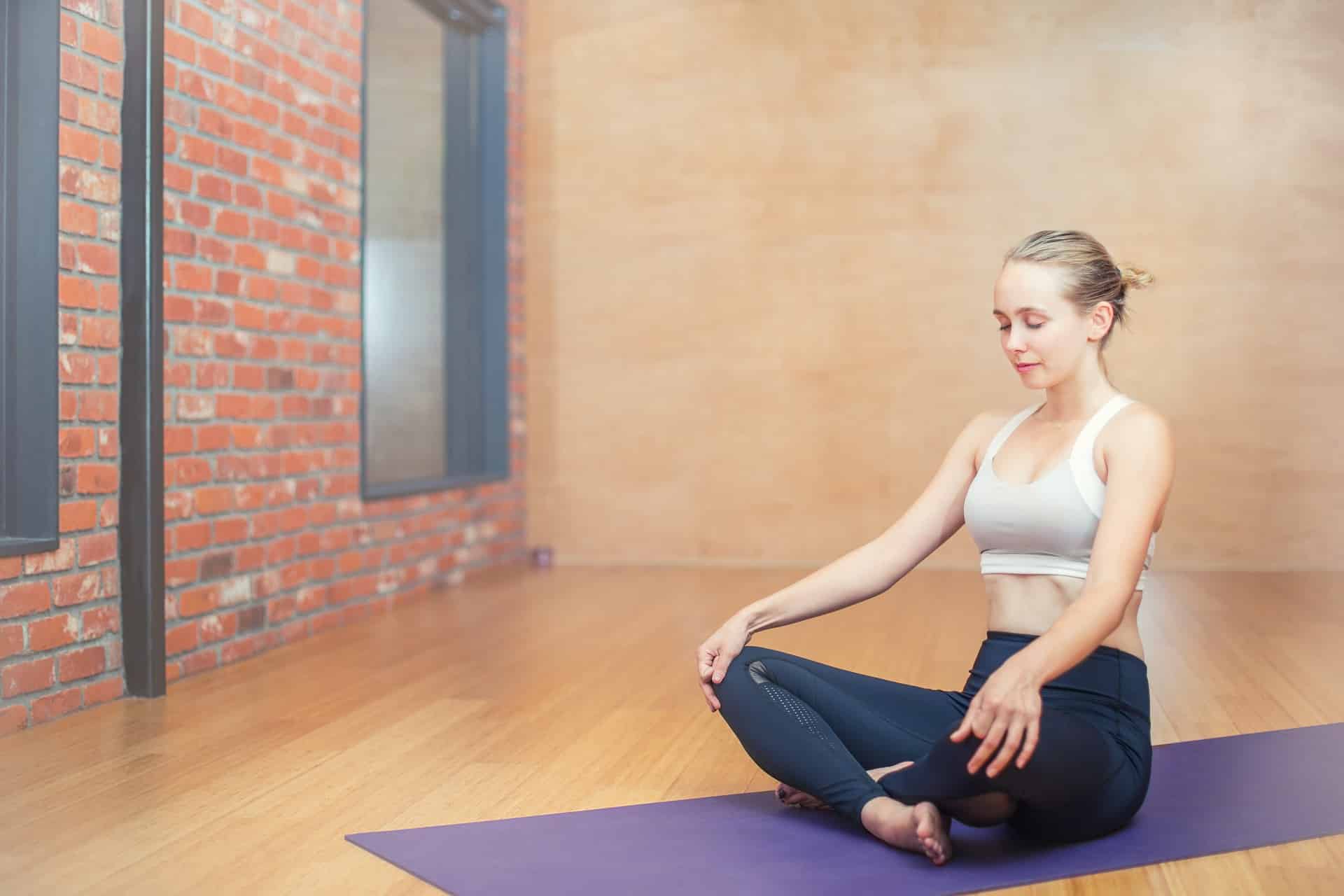
1. Easy Pose (Calms Your Breathing & Reduces Stress and Anxiety)
Easy pose is a great starting point for beginners because it allows you to be still in a simple posture and focus on your breathing. The benefits for executives are to slow down the breathing and work on proper posture. Sitting tall with your spine in alignment can also reduce stress and anxiety.
Executives can use this Easy Pose to their advantage at literally anytime during the workday because all you’re doing it sitting!
For this pose sit comfortably, if possible in a crossed-legged position. Sit nice and tall with your spine long and shoulders down your back and away from the ears. Hands can fall wherever comfortable. Close your eyes and breathe slowly and evenly, in and out through the nose. Do this for at least 20 breaths.
If you’re having trouble sitting comfortably that’s okay, it will get easier in time. Try sitting with your back against the wall or with your bottom on a pillow if you have tight hips.
2. Standing Seal Pose (Harmonizes the Connection Between Your Heart and Mind)
Standing seal pose is beneficial for executives as it opens the shoulders, hamstrings, and lower back. All which suffer when we sit for long periods of time and from tension or stress at work.
This pose is meant to remove tension from specific body parts affected by stress. It will also help with mental function and the heart and mind connection.
Start standing with your feet hip-width apart. Clasp your fingers together behind your back and slowly start to bend at your hips into a forward fold, keep the knees soft. All the while, reaching your clasped hands up towards the ceiling behind you. Hold this pose for 8-10 breaths.
Avoid rounding the shoulders in this posture as it will put unwanted stress on them. If necessary, don’t fold all the way down, and bend the knees as much as needed. Avoid this pose if you have shoulder, elbow, or wrist injuries.
3. Revolved Chair Pose (Powerful Detoxification of Toxic Thoughts)
Revolved chair pose is a little more challenging and takes some core strength. A triple threat pose it will stretch the lower back, spine, and shoulders and challenge your balance- all in one move!
Twisting allows for detoxification of the body and mind, releasing toxic thoughts. This is great for executives with anxiety disorders.
Start standing with feet hip-width apart. Slowly lower your hips back into a squat, as if you were going to sit in a chair. Bring your palms to the prayer position at your heart and gently twist to the right, bringing your left elbow to the outside of your right knee. Keep your shoulders, back, and spine long with your abs pulled in tight. Hold this pose for 8-10 breaths then switch to the other side.
If staying in the squat is too intense, try straightening the legs slightly. This pose is great for core strength and back stretching.
4. Downward Facing Dog (Helps You Focus and Calms Your Mind)
Downward facing dog is one of the main poses in any yoga class and a good foundation for beginners to build from.
While in downward dog, it will reduce tension in your neck, arms, back, and legs and will also calm the brain.
Having the head below the heart brings blow flow to the brain, which will lift energy and support greater focus.
Start on hands and knees with hands about should distance apart. Curl toes under and lift hips toward the sky, making an inverted ‘V’ shape. Keep pressing into both palms, pull your navel in towards the spine, and send your hips to the sky. Take 8-10 breaths in this pose.
Even though this is a beginner yoga pose, it can be quite intense. If holding for a full 8-10 breaths is too long come down to your knees and rest for a few seconds until you complete all the breaths.
5. Pigeon Pose (Removes the Negative Energy From Your Body)
Pigeon pose is a deep hip stretch and can help combat all the hip tightness executives experience after a stressful day at the office. Excessive stress can trigger a primal response of tightness in the body. This often builds in the hips, making them very tight.
This stretch will open your hips and allow for the release of negative energy. Pigeon pose will also stimulate the digestive system, which is often affected by stress.
From downward facing dog pull your right knee forward toward your face. Keep the knee bent and flex your foot as you set the leg down on the ground beneath you. Keep your left leg straight behind you with the top of your left foot pressed into the ground.
You can keep your torso up and prop yourself up on your hands, or you can fold forward to bring your forehead to the ground. Hold this pose for 8-10 breaths and then switch sides.
This is a more advanced pose and can cause problems for people with hip or knee issues. Avoid this pose if it causes pain. To take some pressure off the knee, try placing a yoga block under the hip of your bent leg. Elevating your hips this way can allow you to experience the stretch without compromising your knees.
6. Seated Twist Pose (Decrease Feelings of Anxiousness)
Seated twist is another hip stretch but with a deep twist. Twists are wonderful if you’re dealing with stress or anxiety!
This twist will help open up the chest, shoulders, and back. As with any twist, you will be releasing tension.
Seated twist pose is great for executives because it is a gentle stretch for the lower and upper back, which are areas that can hold tension and stress. Release tension has a calm effect on your mind and decreases feelings of anxiousness.
Sitting down with legs straight in front of you, bring the left heel back towards your body, bending the knee and keeping it on the ground. Bring your right foot across and place it on the outside of your left thigh.
Once here sit up tall with spine long and arms at your sides on the ground. Reach the left arm up high and twist, bringing the left elbow to the outside of the right knee. Hold this pose for 8-10 breaths.
If your hips are too tight to get into the full posture, try working on that first. Master the seated portion with just the legs and then add in the twist when you feel ready.
7. Triangle Pose (Removes Your Worries)
Triangle pose is a standing pose that is great for improving flexibility and core strength.
Executives will benefit from this triangle pose because of the concentration and patience involved, which help you focus and calm the mind.
This pose will improve balance and stability, both physically and mentally, while also opening the chest, shoulders, hamstrings, and lower back.
Start with feet a little wider than the hips and turn your right toes out so that the heel of your right foot is perpendicular to the arch of your left foot. Bending at the waist, reach your right arm toward the right foot while sending the left arm up to the sky. Your chest should be facing out, not down towards the right leg.
Press firmly into both feet and look down toward the ground to be gentle on the neck. Hold the pose for 8-10 breaths and then switch sides.
This pose can be intense for the stretching and strength it requires. If you find yourself concentrating so much that you start holding your breath, return to the beginning and start again when ready.
8. Bound Angle Pose (Unwinds Your Mind, Stabilizes Your Blood Flow)
Bound angle pose is a restorative posture that helps calm the body. It will help regulate blood pressure to decrease anxiety and stress.
Executives should do this yoga pose at the end of their practice or at the end of the workday to unwind.
Starting by laying on your back and bringing the soles of your feet together. Let the knees fall to either side and place hands on your belly. Breathe slowly and deeply. Stay here for at least 20 breaths.
This pose can be bothersome to the knees, so if needed, place a yoga block under each knee or a pillow to reduce the pressure.
9. Child’s Pose (Helps You Rest and Recenter)
Childs pose is a yoga favorite because it is the pose you take whenever you need to rest or recenter.
Executives can use this throughout the day to stretch the hips and lower back while focusing on the breath.
Being in this child’s pose calms the mind and gently relaxes the whole body. It is a passive stretch that relieves stress.
Start on hands and knees, keeping big toes close together and separating the knees to your comfort level. Bring the hips back so that they’re resting on your heels and lower your forehead to the ground. Arms can be outstretched past your head or palms can be resting back by the feet. Hold this pose for 8-10 breaths.
Place a blanket under the knees for any knee pain. This posture can be done between any of the poses as an active resting pose before moving onto the next.
Just Breathe!
Yoga poses are measured in breaths. Instead of using reps, sets, or minutes, use long and slow breaths to hold each pose and reduce tension in the body.
Ideally, you want to take the breaths through the nose and expire by mouth. If you are uncomfortable in a pose, think of sending your breath to that specific area, targeting the tight muscles or sore spots.
If it becomes difficult to breathe in any posture, stop, and rest. Some poses will be more difficult than others, but none should make you short on breath or cause any pain.
Maintain constant, deep breathing throughout your whole practice. This will help oxygenate the body and rid it of stress.
For more instruction on this watch this video on deep breathing and see where you can improve and learn techniques to make it effortless:
All executives deal with some level of anxiety at work, so using a beginner yoga routine can help alleviate stress while allowing you to thrive at your job.
Exercising at your desk is easier and more effective than you might realize. Have you ever exercised at your desk before? If not, why? Exercise is not limited to running on a treadmill or lifting weights at a gym. You can do quick workouts anywhere and still reap the benefits of an active lifestyle.
These exercises are great for the executive who utilizes gym workouts but, also for those who never exercise at all. They will complement your workout routine or kickstart one!
In fact, exercising at your desk makes a lot of sense and its effectiveness has been confirmed by a few studies. According to research done by the Mayo Clinic, nonexercised activity thermogenesis (NEAT) is an important factor in aiding those with sedentary work environments to exercise at their desk. NEAT translates into our common daily activities that we do, usually while sitting. Fidgeting, walking, standing, and pacing are all considered NEAT activities.
Other research has shown that the use of NEAT movements can increase your metabolic rate by 17.6%, as opposed to 7% for normal sedentary behavior.
While NEAT is a great starting point for exercising at your desk, there are so many more effective ways to do this. In this post, we will give you excellent tips on how to perform workouts at your office and exercise at your desk.
Before doing any desk exercises, stretch first! Sitting at a desk all day forces the muscles to be still and stagnant. Stretching is a must if you plan to exercise at your desk. For some examples and ideas please read our post about Office Stretches.
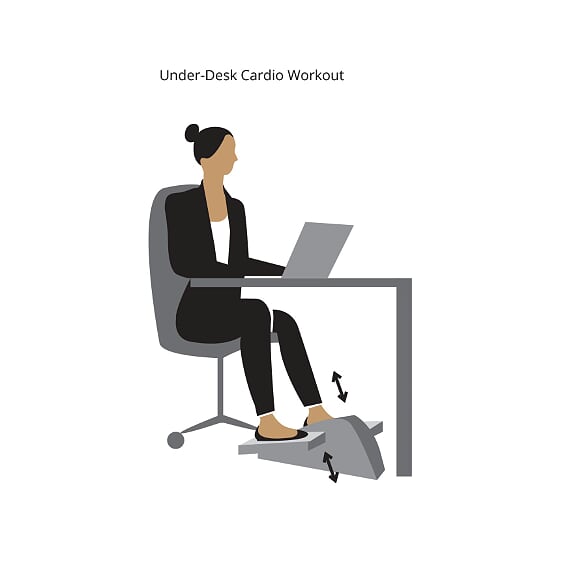
Under-desk cardio is a great option to exercise at your desk. You can keep moving even when you have to sit all day! Keep your heart pumping while using an under-desk elliptical or cycle.
To start, try using the under-desk cardio for 2-3 minutes at a time and gradually working your way up. Start slow so that your legs don’t get too tired right away and/or so you don’t break a sweat. Work your way up to 10 to 15-minute increments for a calorie burning workout without leaving your desk!
Make sure you’re drinking plenty of water during this! Even though you might not feel like your working up a sweat, your body is still working and using energy.
Drinking water will help you recover faster and avoid dehydration.
Bonus- drinking water also helps increase productivity!
While we sit, we tend to slouch. For assistance on your core and proper posture, try doing an ab squeeze. You can do this while walking or seated in a meeting or on a call.
To perform, take a deep breath and tighten your abdominal muscles. Slowly bring them in towards your spine as you exhale. Keep your abs tight for 5-10 seconds and then release. Repeat this exercise 10-15 times. Remember to breath normal!
If you’re having trouble visualizing what to do think of tensing your abs and bringing your belly button toward your spine. This should feel intense like you’re doing a sit-up or ab crunch.
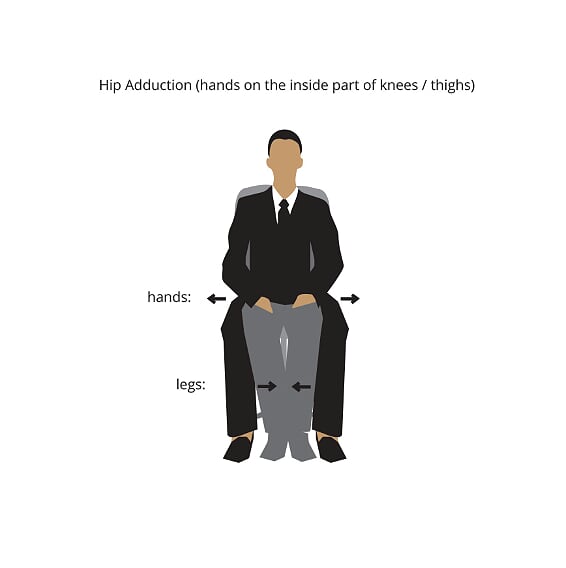
3. Hip Adduction Exercises
With too much sitting and not enough exercise, you may lose muscle strength and endurance in your legs. Seated hip adduction exercises are great for inner thigh toning and slimming!
You can do these exercises at your desk while you’re on a call or reading reports, nothing too involved as you’ll need your upper body as well.
Sit in your chair with knees bent at 90 degrees and feet flat on the floor, keeping knees hip-width apart and place your palms on the inside of your knees/thigh area. Press palms away as you squeeze thighs together, creating resistance. Squeeze hard enough for your hand to touch and then return to start. Repeat 15- 20 times.
Remember to sit upright and engage your core the whole time and to breathe continuously.
4. Hip Abduction
Another exercise to do at your desk that is great for your thighs!
This exercise works the outer thighs and is the opposite movement as hip adduction.
While seated place hands on the outside parts of the thigh, creating resistance try and press thighs/knees away from each other. Press until knees are hip-width apart then return to start. Repeat 15-20 times.
You can also use elastic exercise bands for hip adduction and abduction instead of your hands!
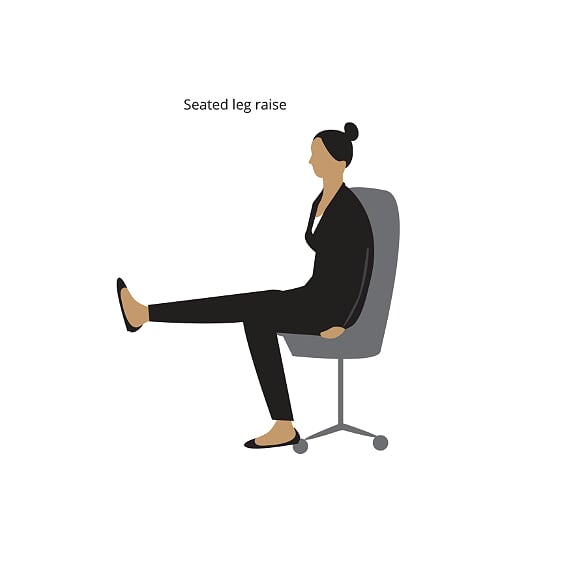
5. Seated Leg Raise
A seated leg raise is perfect for an easy quad and lower ab workout. Just make sure you’re practicing good posture while doing this move or else you’ll put unwanted stress on your back.
Sit tall with feet flat on the floor, and abs pulled in. Straighten right leg and lift it, so your foot is in a straight line with your knee. Breath. Hold for two breaths and release. Repeat on the left leg. Perform 10 times on each leg.
To modify and help with any lower back or knee pain, try bending the knee slightly when lifting the leg. This keeps stress on the body to a minimum, and you can work up to keeping legs straight.
6. Standing
This falls into a category that’s not technically an exercise, but it helps to combat all the sitting executives do.
By standing more throughout the day, you can discreetly strengthen your legs and abdomen by exerting more energy and working the muscles instead of relaxing and sitting.
You can add movement by using a balance board or standing on one leg and then the other. A standing desk is a great option for this! For more ideas read our article here- Stand Up and Feel More Energetic Today!
7. Squeeze the Buttocks
You spend long hours sitting at your desk. To tone and firm the bum, try squeezing the buttocks while sitting.
You can easily implement this exercise into your work routine as you sit at your desk. It takes no equipment and really no brainpower. You just need to do it.
Squeeze the muscle in your buttocks and hold for 10 seconds then release. Repeat 15- 20 times. This shouldn’t be a strenuous exercise, but you will feel this after a few repetitions.
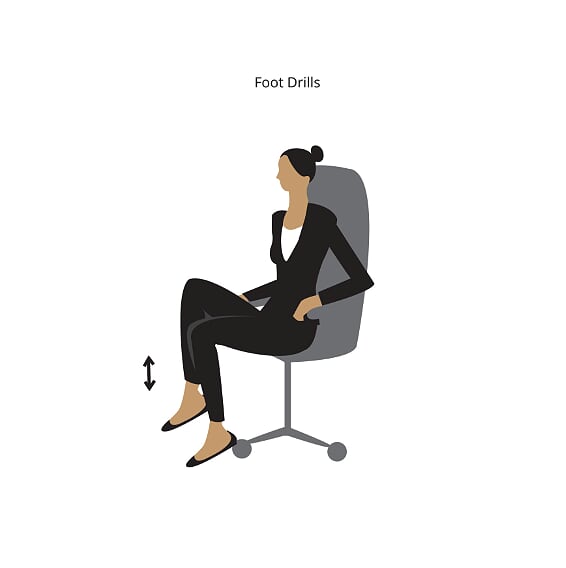
8. Foot Drills
To get a little more movement while staying seated, practice foot drills.
This simple exercise at your desk may reduce the impact of your sedentary life by increasing blood flow.
Similarly to when football players practice agility and speed and tap their feet continuously, you can do the same at your desk. Staying seated, tap your feet for at least 30 seconds. 30 seconds of work and 30 seconds of rest for five minutes total. Once you’ve mastered that, try upping the time to 45 seconds or a minute.
Don’t forget your seated posture while doing this. You’ll be engaging your core as well so no slouching!
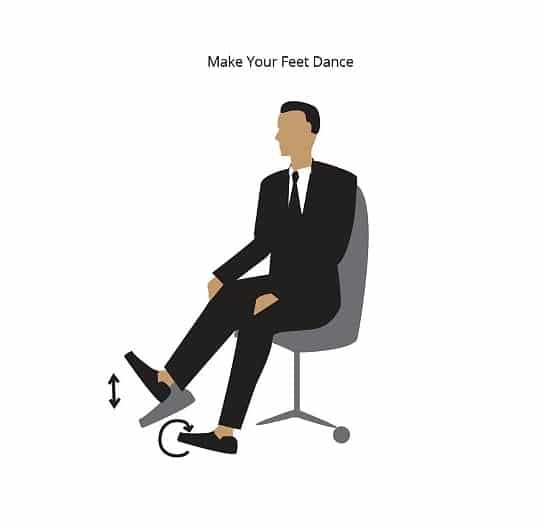
9. Make Your Feet Dance
For an easy exercise at your desk, try making your feet dance. Ankle strength and flexibility are important for balance and lower leg strength.
While seated slowly flex, point and rotate the ankle by drawing circles with your big toe. Doing this slow and steady will help reinforce the joint and prevent any injuries.
For more impact do one ankle at a time. This will allow you to focus on one ankle and notice any pain or weaknesses in the joint.
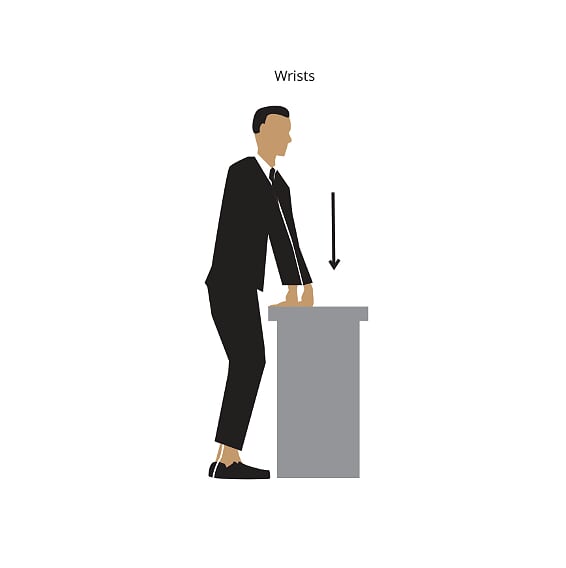
10. Wrist
To counteract typing and writing all day long, don’t neglect your wrists!
Being proactive about wrist health can prevent carpal tunnel syndrome, which is common among people who work at computers daily.
Stand at your desk and flip your palms face up so that your fingers are pointing towards you. Gently put pressure on the back of your palms pressing them into the desk. Take a few deep breaths, relax, and then repeat 1-2 more times.
If there is any pain when you do this stretch, just be gentler and put less pressure on your wrists during the stretch.
Want to be more active in the office? Get in some movement and activity that can easily be added to your daily work routine.
These 11 workouts are simple and you can do them in any office setting with minimal equipment.
Utilizing a treadmill desk is a great option to really move while working. This piece of equipment is a bit of an investment, but it’s worth it for the executive who has to stay planted at the desk for most of the day.
The treadmill desk is great to exercise at your desk because, well, it is your desk!
While you are preparing a presentation or a report, you can get in some cardio with a treadmill desk while also strengthening your legs.
Start out slowly with this one as working while walking may take some getting used to.
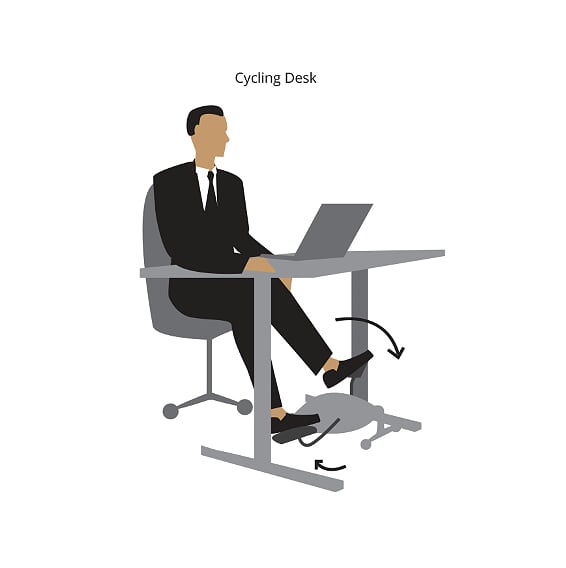
2. Cycling Desk
A cycling desk is another great option for exercising while sitting at your desk. Again, this can be a bit of an investment, but it’s a great option for executives.
Using a cycle desk is another great option to burn calories, develop improved muscle strength, and increase cardiovascular fitness.
Try a cycle desk as it allows you to work from your laptop- great for at work or home.
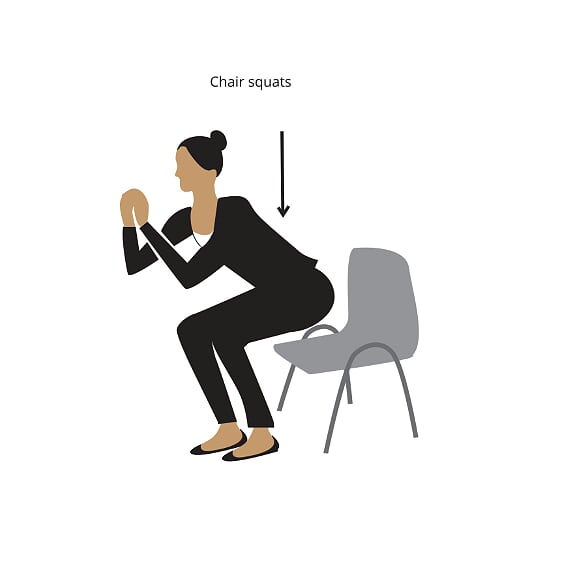
You can do chair squats easily at your work station and engage most major muscle groups.
Squats are great for strengthening the legs. The extra muscle activation can also help stimulate your body for more brain power throughout the workday.
Stand with your feet hip-width apart, keep abs engaged and torso tall. Slowly bend your knees towards a 90-degree angle until your buttocks just touch your chair. Then straighten the knees to return to standing. Repeat 10-15 times.
Take note of your clothes and shoes before attempting this exercise. Pants or skirts that are too tight can restrict the movement. Heels are not recommended so slip off your shoes for this quick exercise at your desk.
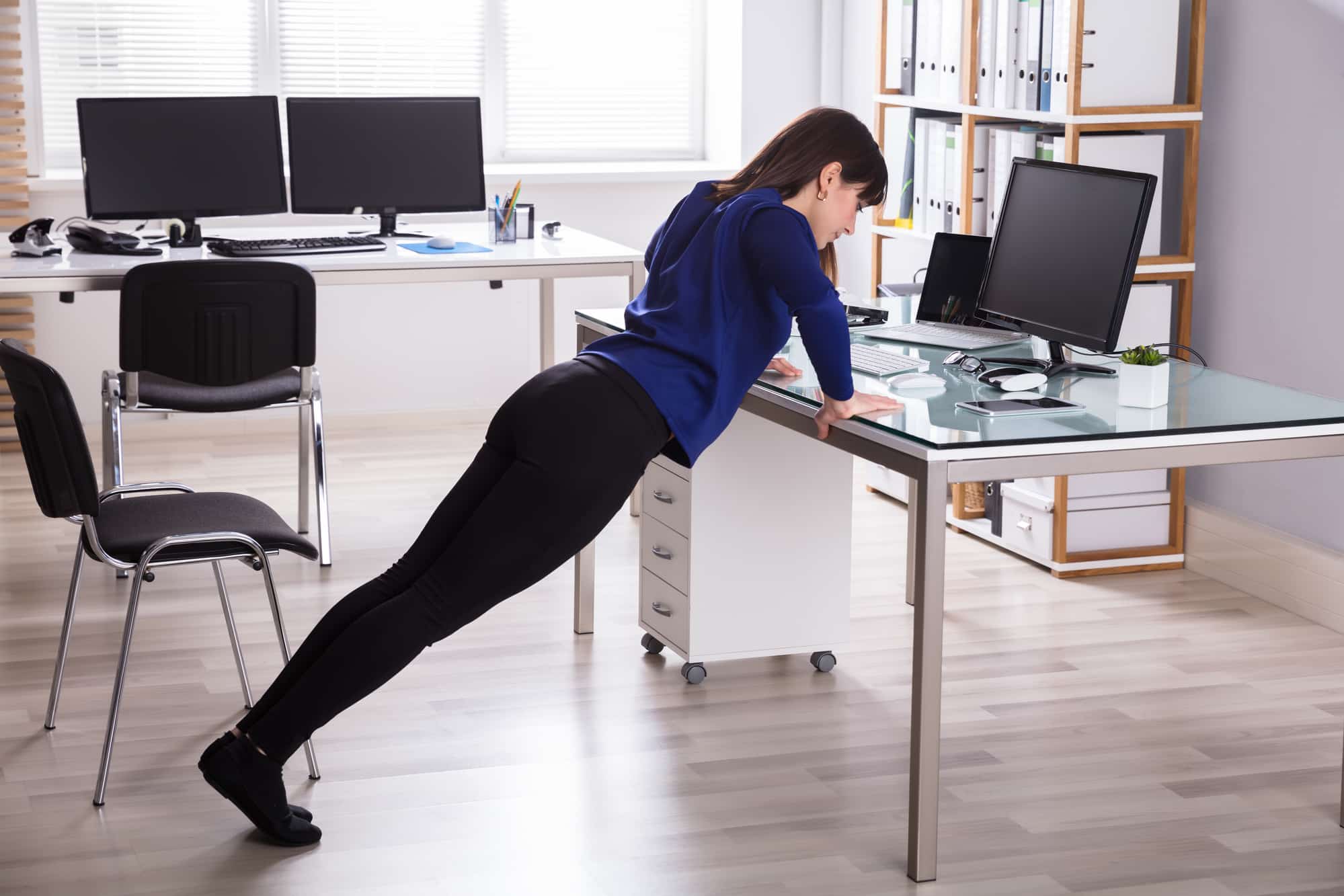
4. Desk Pushups
These pushups are a great option for some upper-body work at your desk.
Push-ups create a strong upper-body and engage your core for a very effective exercise.
First, check the sturdiness of your desk. You want it to stay in place when pushed lightly. Place hands on the edge of the desk and take a few steps back, far enough that your body is slightly diagonal with arms straight. With core engaged bend the elbows to a 90-degree angle and then press into hands to return to starting position. Repeat 10-15 times.
To modify this exercise, keep feet closer to the desk and bend more at the waist as your elbows bend toward 90-degrees. To make this more intense, do regular push-ups on the floor, if possible.
5. Chair or Desk Dips
These exercises are other upper-body exercises that work the chest, shoulders, and triceps.
Chair or desk dips can counterbalance the constant computer work executives must do daily.
Again, check your desk or a chair to see if it is sturdy enough to hold your weight. Stand with your back to the desk and place your hands on the edge with fingers wrapped around the edge and elbows straight back. Step feet out as far as comfortable, engage the core and lower bending elbows to 90-degrees. Repeat 10-15 times.
This exercise is more challenging because it involves strength and chest flexibility. To modify, keep feet closer to the desk or bend knees slightly when doing the dip.
6. Side Lunge
Another effective lower body strengthener is the side lunge. This is great for the quads and hamstrings as well as the inner and outer thighs.
Start with feet together, press into the left foot while lifting the right and slowly stepping it out to the right creating a wide stance. Once the right foot is firmly on the ground start to bend the right knee towards 90 degrees while keeping the left leg straight. Press into the right foot to straighten the leg and then return to starting position. Repeat 15-20 times on each leg.
This is a more advanced exercise, so if you have any knee or hip issues omit this one. To modify, place your hands on your desk or something sturdy to help with balance.
7. Side Leg Raises
With too much sitting in the office, you may lose muscle strength in your legs. Side leg raises target the outer thighs and help with balance.
Stand upright with hands placed on the desk or something sturdy. Press into the left foot, lift the right foot, and keep ankle flexed. Keeping right leg straight lift the leg as high as you can while still keeping your torso upright and then slowly return to start. Try doing 20-25 repetitions on each side.
Want to test your balance? Try doing this without holding onto anything!
8. Knee Pull-ins/Knee Pull-ups
These exercises are great for core work!
Knee pull-ins and ups at your desk may also increase your blood flow and reduce the negative impact of your sedentary life on your heart and health.
Sit up tall on your desk chair with abs engaged. Lift both feet off the floor and pull knees in towards the chest, straighten legs back out so feet aren’t touching the floor. Repeat 10-15 times.
If this puts too much pressure on your back try lifting knees up then tapping feet back on the floor.
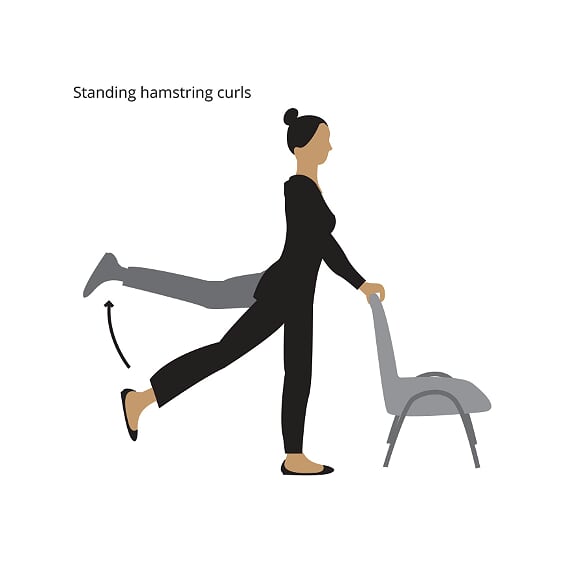
9. Standing Hamstring Curls
Standing hamstring curls help to work the buttocks and create a strong backside.
Stand up tall with hands on the back of a chair. Slowly lift one leg kicking it back behind you while bending your knee bringing the heel towards buttocks. Straighten the knee and return to start. Do 10-15 repetitions on each side.
Remember to keep your core engaged, don’t lean forward, and breathe deeply.
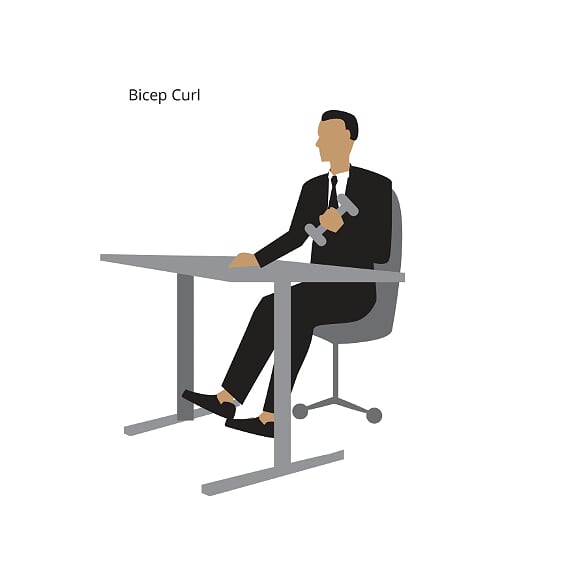
10. Bicep Curl
For an easy arm exercise at your desk try a bicep curl. To keep this office-friendly use a full water bottle or heavy object.
Place a water bottle in one hand and slowly bend elbow bringing hand towards the shoulder. Slowly return back to straight arms. Repeat this for 10-15 repetitions on each arm.
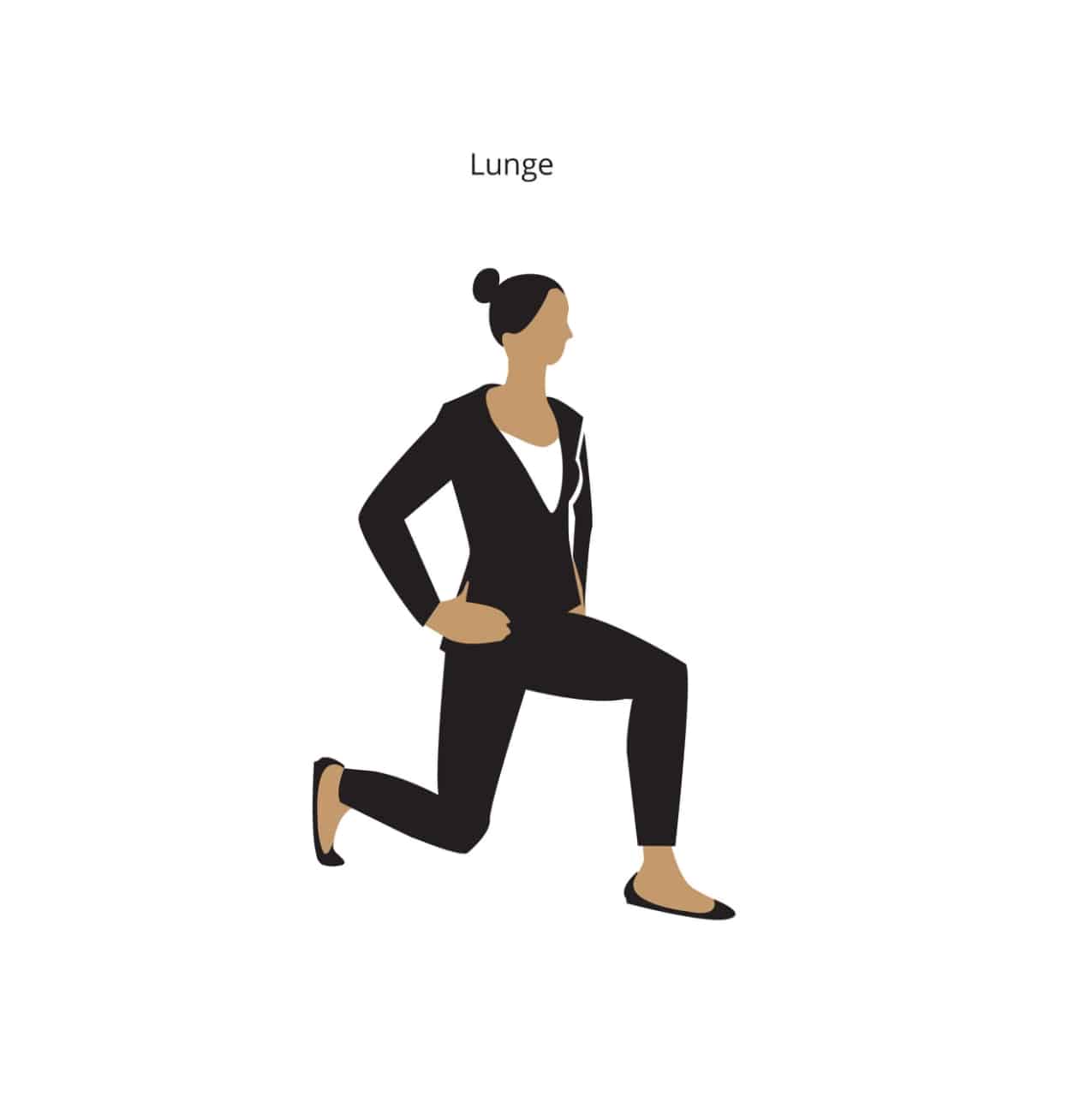
11. Lunges
Lunges are an easy exercise to execute at your desk during the workday.
Step right foot forward as if you’re taking a long step. Once your foot hits the ground bend your right knee so you’re in a lunge position. Straighten leg and return back to start. Repeat on the left side. Continue until you’ve completed 10 repetitions on each side.
12. Wall Sit
A low impact lower body exercise that won’t make you break a sweat is a wall sit!
Sitting often increases our chances of back problems that you can solve with this exercise at your desk.
Stand with back against the wall and bring feet 6-12 inches away from the wall. Squat down until knees are at 90 degrees and back it flat against the wall. Stay here for 20 seconds. If you need more of a challenge, try staying for 1 minute!
Remember to keep core engaged by pulling navel back towards your spine. Pants or skirts that are too tight can also restrict the movement. Heels are not recommended so slip off your shoes.
Extra Bonus: What Not To Do
Don’t sit on a stability ball at your desk! This may seem like a good idea, but your posture will suffer as we tend to slouch when sitting on them.
Do you have any back pain? There are many benefits to correcting posture and combating slouching.
Perhaps you chose a desk job thinking that it wouldn’t cause you nearly as much strain as someone that does manual labor. But guess what? You’re just as susceptible to getting aches, pains, and even injuries as an executive spending 40 hours or more behind your desk.
Luckily, there is something you can do about it! Office stretches are a great way to help your muscles and joints, relieving the aches and pains that come with being tethered to your desk all day, week after week. If you’re been experiencing pain, give these easy office stretches a try. They take no time at all and will help you feel better immediately as well as down the road.
Plus, you’ll be more productive than ever when you feel good, which means you can finish work faster and spend more time doing the things you really love.
We’ve created this list of 20 office stretches that will make you feel great and release the tension, allowing you to boost your work productivity. You should aim to take a break to do these stretches every 45 minutes to an hour. Hold them for a minimum of 15 seconds before moving on to the next stretch.
This simple neck stretch technique is great for relieving you from the tension you get from staring into your computer screen for hours on end. First, tuck your chin down toward your chest. Then, slowly move your head back to a normal position. Now, look up. Hold it until you feel the stretch.
2. Side to Side Neck Stretch
Your head doesn’t just move up and down though, does it? We want you to get the best office stretch in your daily routine, so after you move up and down, try this move.
Sit straight up at your desk and tilt your head toward the side, like you’re trying to touch your ear to your shoulder. Don’t move your shoulder though! With the same arm your ear is now above, gently apply pressure downward to your head so you can feel the stretch. Switch sides to complete a full rep.
3. Shoulder Extension Stretch
For this office stretch, get out of that desk chair and push it away. Stand up straight and raise your arms in front of you, then clasp your fingers together. Slowly bring your linked arms over your head. Hold it, then slowly lower your adjoined arms so they’re straight in front of you again.
4. Behind the Back Stretch
Loosen up everything that’s tight in your upper body with this office stretch! You’ll be more refreshed than after your morning coffee!
Keep standing and stretch both arms behind you as far as you can. Link your fingers together and stick your chest out as you raise your arms up as high as is comfortable. This is a stretch, not a gymnastics move so go only to the point that you can.
There’s no need to look graceful, and should you be worried others will see you, close the door to your office or perform this one in one of the empty meeting rooms.
5. Shrug It Off Stretch
Taylor Swift sang about shaking it off, but for office workers like you, you need to shrug it off. You can stand or sit for this office stretch, whatever works for you.
Simply raise your shoulders up at the same time toward your ears, as if you’ve just been asked if you can turn that project around in less than an hour, only do it repeatedly. When lowering your shoulders, roll them back at the same time to really loosen things up.
6. Trunk Twist Stretch
Sitting at your desk day after day can really mess with your posture. And let’s face it. You need good posture to command confidence in your team and with clients. Don’t be a slouch!
Sit up in your chair and twist from your waist without rotating your chair (if it has wheels) so that you try to grab the back of your chair with both hands. Switch sides for a full rep.
7. Lower Back Love Stretch
Help improve your posture, your confidence, and the way you feel at work with these two office stretches that will work in tandem to help you rock out more hours at work.
First, sit in your desk chair with your back straight. Then use your hands and pull your knee up toward your chest. Switch legs for a full rep. After doing as many of those as you can, lower both feet to the floor and sit up. Then, lean over your knees like you dropped your pen again but this time, hug your legs while you’re down there and enjoy the release.
Are you an executive that suffers from lower back pain?
All that sitting in your office chair can do a number on your circulation. You probably already know how doctors recommend you move around after sitting for a while, but that’s only part of it. You’ll lose mobility if you don’t keep them limber.
Sit down on the edge of your chair and extend both legs out in front of you on the floor. Lean forward, bending from your waist to bring your chest toward your knees. You’ll feel a glorious stretch through the back of your legs.
9. Butt-Kicking Quad Stretch
Your quads are one of the biggest muscles in your lower body. Help them help you by giving them some stretch time during office hours.
Get up out of that chair and stand on one foot. As you balance, lift your other leg back so your heel kicks your butt (no actual or repeated kicking is necessary). Grab that foot with your hand and hold it, then switch legs.
10. Torso Stretch
Here’s another office stretch we know you’ll love for helping keep you from hunching back down at your desk.
You’ll get a nice stretch through your entire upper body and your muscles will breathe a sigh of relief before you dig into your next project.
Stand or sit, whatever feels best, then lace your fingers together and reach them up toward the ceiling, breathing deeply as you do. Exhale and open your arms, flourishing them with drama back down to your sides (drama optional).
11. Triceps Stretch
You might be surprised how much relief you get at the office if you just take the time to stretch your triceps.
Raise one of your arms up above your head with your hand facing forward. Bend that arm at the elbow so your forearm goes behind your head. Take your other hand and grab that bent elbow, giving a little bit of pressure to stretch that backside of your arm. Do the other arm next.
12. Forearm Stretch
It’s likely that you’ve never thought about how typing affects your forearms. We’re right, aren’t we?
You don’t need to be a master typist either to suffer the consequences of tight forearms from working at your desk all day.
You can sit or stand for this office stretch too. Take one arm and stretch it out in front of you with your palm facing downward. Then take your other hand and use it to gently pull your fingers toward you. Not too hard! You don’t want to sprain anything! Just pull enough where you feel the stretch. Then release and switch arms.
13. Wrist Stretch
Tension also builds in your wrists. You know this to be true if you have carpal tunnel. The last office stretch starts to help that feel better but this one will seal the deal and make your boss of your own domain.
Stand up and put your palms flat on your desk, then push down to stretch your wrists. Again, not too hard. You don’t want to upend your desk and cause a scene.
14. Hip Flexor Stretch
Shakira says your hips don’t lie, and we have to agree. Your hips get tight from all the desk chair action, day in and day out.
Stand up, put your right leg back at least a foot behind you, more if you can manage it. Bend the knee on your back leg in a lunge-like fashion. Then lower yourself like the elevators in the lobby, keeping that knee at a 90-degree angle and over your ankle. Squeeze your glutes while doing it to maximize your gluteus maximus and make your rearview more enticing while you’re at it!
15. Seated Hip Stretch
Another one of the office stretches you should be doing for your hips is this one, which you can do right now while you’re reading this instead of answering emails about TPS reports.
As you sit there, cross your right ankle over your left knee, then sit up tall. Lean forward slowly, keeping your back straight and reaching out with your torso. You’ll feel the stretch in your right glute as well as your hip. Deepen the stretch by pressing down on your right knee. Switch sides for a full rep.
16. Inner Thigh Stretch
Here’s one you’ll want to do in private, especially if you’re in a skirt. Even in pants, you’ll raise a few eyebrows.
Stay seated for the starting position and open your legs wide with your toes out. Lean forward and put your elbows on your thighs. Keep your back straight and engage your abs. Now, press forward as you use your elbows to push your thighs further out to hold the stretch and feel the stretch.
17. Wall Push and Stretch
If you do pushups when you actually make it to the gym, try a modified stretch version of it for an office stretch.
Instead of going for the full pushup effect though, you’re going to push with one arm and then twist your torso away from the wall as you push. The result is a glorious shoulder stretch and a great way to release the tension.
18. Big Hug Stretch
Stressful times at work could do with a cuddle. And they say if you can’t be with the one you love, love the one you’re with. All alone in your office, that means you’ve got to be the one to love yourself. Show that love with a great big hug. It’s basically what it sounds like.
Pretend you’re hugging someone else but close the gap and wrap your arms around your own shoulders. It will open up the shoulders and back, and you will see how the power of a hug can brighten your day at the office, even if you’re only hugging yourself.
19. Working Warrior Stretch
If you’ve ever gone to a yoga class outside of work (either willingly or being forced by a friend), you’ll likely recognize this as the exalted warrior pose. But it also serves you well as an office stretch because it opens up the chest, the shoulders, the legs, the abs, and the hips.
Stand up straight and step back with one leg into a lunge. Then raise both arms above your head and feel that stretch.
20. Rockette Kick Stretches
Whether you were born to dance or cringe at the mere mention of it, using some techniques the Rockettes use to master office stretches will bode you well.
Simply kick each leg up just over your desk one at a time while sitting at your desk. Hold each leg up as high as you can for 2 seconds each before releasing. Kick as high as you can without kicking your desk.
So get off your duff, or merely sit on it and enact some of these office stretches. We’d love to know what you think or if you started a desk exercise movement in your office, fell out of your chair and drew the snickers of other employees, or if you came up with a new office stretch everyone will love! Got one? Leave it for us in the comments below!
Do you often scratch your head and wonder about ways how to increase your and your team’s productivity at work, so that you can all be more productive and healthier?
ManagerUp helps managers, executives and entrepreneurs reach maximum productivity and energy level to be successful in their business lives without sacrificing their health and private life.
We have done massive research to offer you a list of surprisingly easy productivity tips that you can implement and share with your colleagues at work. Below are 120+ effective tips and ideas about how to be productive in the office, during business meetings, and while traveling.
Some of us are unaware of the fact that to be more productive, we need to take a 360o approach to our well-being. Indeed, our cognitive function will never be at its best if we fail to pay attention to other issues that usually haunt us in the course of our work lives, for instance, stress, mental fatigue, and exhaustion.
In other words, how long you sleep, how energetic you are during the day, and how well you manage stress usually influence work productivity. With these tips, you’ll be able to do more every day while staying healthy in your workplace. You will also improve your overall wellbeing.
In summary, these ideas will help you:
– Reduce any lingering stress and anxiety
– Remain energetic throughout the day
– Sleep better
– Eat healthier
– Create time for essentials like exercise
– Boost your confidence in and out of the office
Let’s dive right in and make the first step towards improving your productivity.
General Tips to Increase Your Productivity at the Office
1. Use A Standing Desk To Increase Productivity
Our roles usually involve a lot of sitting which, as we all know, could be detrimental to your health.
And we often wonder how to escape the threat of chronic health problems that could result from too much sitting in our offices.
Now, there seems to be some light at the end of the tunnel.
According to one study by the prestigious University of Pittsburgh, a standing desk can help increase your energy expenditure ( and by extension grow your productivity at work).
6. Use Computer Glasses To Combat Digital Eye Strain
You have to jealously protect your eyes if you want to work for more hours strain-free.
And when it comes to combating damaging digital eye strain, computer glasses are better equipped than regular glasses because of their built-in eye safety properties.
They do a whole lot more and might even help you sleep better.
On that account, computer glasses for managers can potentially lift your productivity to record levels.
Studies have indicated that computer, tablets, and smartphone users usually blink less than people who spend less time on digital screens.
But blinking is crucial for your eye health since it moistens and soothes your eyes effectively averting dry eye symptoms that cause your eyes to feel gritty, sticky, and even painful.
We thus encourage you to try your best to implement the 20-20-20 rule.
This simply requires that you observe a 20-second break from your computer/device every 20 minutes to gaze at an object 20 feet away.
Make it a habit and see your productivity snowball naturally.
8. Keep Your Computer Screen at a Suitable Level for Your Height
Your office computer is a double-edged sword. On the one hand, it simplifies your work. But on the other hand, you might occasionally suffer neck/back pains and throbbing headaches.
This certainly hinders your productivity in your organization.
You have to take charge and cushion your neck and back from such suffering.
First, adjust your monitor’s height so that the top of your screen is at or just below your eye level. Your eyes should be looking slightly downward when viewing the middle of the screen.
Then, position your monitor no closer than 20” (51 cms) from your eyes (or at an arm’s length distance).
The University of Auckland contends that such actions also brighten your mood and raise your self-confidence.
You should also consider implementing additional tips to get rid of back and neck pains permanently.
9. Expose Yourself To Sunlight To Light up Your Productivity
Cornell University recently commissioned a study on the effect of daylight on worker’s productivity in office environments.
And the results were quite interesting…
Just to highlight a few of the findings, 78% of the participating employees reported feeling better after exposure to natural lighting.
Then, 70% had a much-improved work performance in the aftermath of light exposure.
Still there, some of the workers registered a 56% drop in drowsiness.
To put it briefly, sun exposure can lift your energy levels and mood. And from the above outcomes, it’s clear that light can also help to swell your productivity.
And so you need to take a dose of sunlight every day to increase productivity.
You may start by placing your desk near a window where you can directly access some sun.
10. Tweak Your Lighting Systems and Boost Your Output
Be aware that desk lamps can be extremely beneficial to your eyes as their light helps minimize strain as you work.
Install a Task Management System To Be More Productive and Less Stressed
Brian Tracy wrote that productive people are happy people. I would add that productive people are also less stressed. The way you manage your goals and daily to-do lists has a direct impact on your health. Executives who do not have the right task management system in place are not only less successful but also act under huge mental pressure in a hectic and chaotic way. This has direct implications for their own health and that of their co-workers.
In this section, we will propose how to manage your tasks. You will become the star of the office and more relaxed, calmer and happier than the other executives.
12. Set Yourself Big Motivational Goals
You can boost performance by setting well-defined major goals. These become the real motivators that help prioritize work tasks. Importantly, big goals help us mitigate stress and increase our overall happiness.
13. Visualize Next Week With the “2-Hour Solution”
Do you have the feeling that your life is running you, that you don’t control your priorities? Are you frustrated and stressed out at the end of each week because you were not able to execute important tasks? There is an easy way to change all that and bring calmness and direction to your life. I am referring to Roger Seips’s Train Your Brain for Success with its 2-hour solution.
What does the method entail? Basically, you spend a designated two hours weekly to think of the following week’s activities. It is not normal scheduling. Instead, you break up the time into areas as follows:
– Green time: paid work
– Red time: that supports green time
– Flex time: free time to help keep your plans in place
– Re-creation time: for yourself, including hobbies, exercise, and rest
After a while, you’ll find that you don’t even need the full two hours to implement the 2-Hour Solution.
14. Set Realistic Goals (Follow the SMART Rule)
There is nothing as frustrating as not being able to achieve your goals. It often happens when the goals you set for yourself are too ambitious.
A word to the wise: set goals that are:
– Specific: this means that if your goals are designated, they are more likely to be completed. Vagueness brings about misunderstanding and a failure to launch. Always be precise and clear.
– Measurable: progress comes from measuring achievement. Analyze your efforts toward your goal and notice the tangible consequences. It is easier to succeed when you break down goals into measurable units.
– Attainable: don ‘t go for impossible goals. One failure breeds more. Know your own skills and the reality of what you can accomplish.
– Realistic: everyone becomes demotivated by failure. So be realistic about your goals and what is likely to accomplish in a given amount of time. Don’t fly too high and stay down on the earth.
– Timely: Allow a set time frame for each goal to help you stick to your scheduled deadline. There is nothing better for morale than completing tasks on time.
Working with SMART goals will bring the missing motivation back to your life and significantly reduce your stress level.
15. Learn To Delegate Some Tasks To Increase Productivity
We agree you must personally handle sensitive and strategic stuff.
But there are plenty of less critical tasks that eat away your minutes without really adding value to your role.
This is our advice: Identify such tasks and delegate.
You will move much faster, achieve your set business targets earlier, and generally become a benchmark when it comes to productivity at your workplace.
As a bonus, you’ll feel more relaxed, focused, and love your work even more.
16. Check Your Scheduled Goals and Mark the Accomplished Ones
While working toward goals, it helps to stay focused and committed. Confidence comes from completing them on time. Analyze what worked and measure your productivity. Quality is always better than quantity, or so they say. Measuring your achievements will show you how to improve.
Remember that what is not accomplished can be rescheduled.
17. Set Rewards into Your Schedule
Experts say that rewards help productivity by motivating us to achieve more. Putting regular rewards into your schedule will make you focus on reaching new goals, even those hard to attain. Let the reward motivate you so that extra effort becomes a habit.
Productivity is a major goal and it is sure to bring pride and happiness to those who enter its realm. Even if you are your own boss, you can reward yourself with something, such as a free afternoon. Maybe go to a movie or eat at your favorite restaurant.
18. Seek Clarifications About the Tasks Assigned
Have you ever completed a task and found out later that it was not what you were expected to do? It may have been due to the unclear goals or instructions.
No matter how long you have been at your job – ten years or ten minutes – confused goals are common. You must seek clarification when goals are unclear. Otherwise, you may be wasting time on the wrong task.
Each time, ask what Is the end goal of this task? Assess the big picture with your boss if necessary to avoid going down the wrong path. Ask him or her to clarify anything you don’t understand. “What do you mean” is a great way to get more information. Ask for an example or the focal point of request.
19. Prioritize Tasks
No goal can be reached if you don’t prioritize the tasks involved so you know what is most important to tackle first. Have a look at Stephen Covey’s book The Seven Habits of Highly Effective People in which he explains the meaning of “first things first.” One method of note is the Eisenhower Decision Matrix. Basically, each task is broken into four quadrants:
1. Important: those activities that lead to reaching professional or personal goals.
2. Urgent: those activities of utmost priority, often leading to another’s goals. They demand our attention first.
3. Neither.
4. Both.
You can more easily decide what to do with this method. You can always delegate what is not important but urgent.
Prioritizing is a well-known approach to any task to reach goals faster and more efficiently. It is the basis of time management.
20. Do 2-minute Tasks Immediately
Huge to-do lists are scary and stressful. The short ones are motivating. One of the best ways to reduce stress and be more productive is to shorten your to-do list. There are many ways to do it. One of them is to do some easy tasks immediately.
David Allen in his book, “Getting Things Done”, recommends to always apply the two-minutes rule. If any action items on your project list takes less than two minutes, do it immediately.
21.Protect One Week Day in Your Schedule Just for Yourself. No Meetings.
Time flies when our days are filled with meetings and diversions. Many people complain of a lack of productivity as a result.
To improve work output, it helps to follow a schedule and protect your time. You must allow for meeting-free off-time so you can concentrate on what is at hand.
22. Schedule Recurring Tasks That Can Be Executed Regularly Per Day or Week
The essence of an effective schedule is to set time each week for regular tasks. This rule has saved many from burn out.
On-going projects can get boring, but they must be done, so why not make them routine. You will get more done and feel confident and productive.
23. Work in 90-minute Intervals
Research shows that successful people in every field work in intervals. Ideally, they should be 90 minutes to maximize productivity.
What you should do? In the evening, decide which tasks are the most important for the following day. I suggest you list a maximum of 2-3 tasks.
On the next day, start working on the first one for 90 minutes without interruption. And then take a 20-30-minute break. During the break, walk or exercise. After the break take on the second task. It works wonders for productivity!
24. Meet With Your Team Members to Clarify the Goals and Expectations Each Monday Morning.
Sit with your team members to strategize how to best accomplish their goals and how to be more productive. Next week, sit down with them and go over lessons from the previous week. With a few simple instructions, everyone can get on the same page and understand their role.
Such a weekly procedure will not only increase your team’s productivity but also significantly decrease the stress level of all team members. They will feel your leadership and know that you are for them when they need your help.
25. Work With Clear Daily, Weekly, and Monthly Goals
Here you subdivide a project into manageable daily to-dos, weekly achievement goals, monthly deliverables, and such.
And so you only think about tomorrow once done today. And about next week once you have fulfilled this week’s mission.
That way, even a gigantic-looking undertaking will look more attainable. And because of that, you’ll be more motivated to take on big jobs.
And so the question of how to be productive won’t bother you again.
26. Declutter Your Mind Before Reading the Important Stuff
Sometimes you are supposed to pour through volumes upon volumes of exhausting business reports and concentration is vital.
Clearing your mind before commencing will help improve your concentration.
For example, you can spend some moments meditating.
This will not only help you declutter but will also tune-up your mind to focus on the reading task.
And the best bit?
It won’t take too much of your time either it is a complex activity to get into.
We also propose that you check out our simple tips on becoming a highly effective reader.
According to a series of experiments by one psychologist at the University of Sussex, our memories tend to differ in efficiency at different times of the day.
This means that you may find that you are more fruitful at certain tasks in the morning, mid-day, and in the late afternoon.
According to the analysis, you should pursue research activities in the early morning hours.
Then, you’ll achieve more at midday if you pre-occupy yourself with activities such as running errands and demanding work.
Finally, immerse yourself in deeds that involve applying new information and ideas during the late afternoon hours.
Well, these times may slightly vary based on whether you are a morning or night person so it’s upon you to find your sweet spot.
28. Schedule Breaks While Working in the Office
You obviously risk a burn out (now recognized as a medical condition by WHO) if you don’t take breaks.
To avoid this, program breaks of 10 minutes after working for about 60 minutes.
After resuming, you will find that you are more alert and concentrating much better.
That isn’t too much to ask of you. Or is it?
Manage Your Time Efficiently
29. Avoid Multitasking. Keep Your Attention On Just One Thing Before Moving On.
Productivity can be impaired by too many tasks, known as multitasking. Multitasking can destroy your brain, memory, concentration and even your relationships.
Are you in the rut of doing too many things at one time? Multi-tasking doesn’t always work if it means you lose focus and reduce your overall importance.
Why not do one well instead of three poorly-executed tasks? Just commit to the most important goal and move on.
30. Set Weekly Time With Your Team To Not Disturb One Another in the Office
Free time is golden in the office. Make sure you get enough by limiting interruptions from your team. Then you can tackle the most challenging tasks. Repeated questions from staff is deadly to one’s productivity.
31. Set a Time for Every Call Before Starting It
Calls eat up time so limit them when you can in number and length – say, to five minutes. Try to wind it up politely. Gabby friends can be a challenge! Some smart workers use a clock to avoid wasting valuable time. Unimportant calls should be shirked.
It may be hard to end a conversation, but there are ways.
“Your idea sounds great. Let’s put it into action soon. can’t wait to see them in action. I’ll get back to you.”
“I will answer your question promptly, but for now I am bogged down.”
“Thanks for calling, but I am on another call. Can I get back to you?”
32. Use Time Management Tools
There is nothing more productive and efficient than time management. A lot of research has been devoted to organization in life and at work.
Some of the principles include the use time tracking software. There are several good ones like Time Doctor that will guide you by computer. You get reports on how you spent your time.
Apps like Boomerang work wonders with Gmail so you can schedule your messages.
RescueTime is valuable to run any mobile devices or a computer so you know how you allocated your schedule.
Many prefer Evernote, a digital notepad to sync with the cloud or 15Five, a form of task manager, to get staff feedback. It is quick and easy to communicate with your team and review results.
You might like StayFocused, a tool that is self-evident. It will control your access to websites to prevent distraction.
Finally, take a look at Todoist, a chrome extension full of valuable features to help you set deadlines and get project reminders.
33. Set Self-Imposed Deadlines
Stress, surprisingly, is not always bad. Some degree of stress prompts us to become more productive and meet more goals.
It is a natural part of having deadlines, an essential way to control open-ended tasks. Focus is of the essence no matter what you do.
34. Schedule Less Time for the Task Than You Think You’ll Need
Words of wisdom are found in “Train Your Brain for Success” so take a look. It will tell you why it is important to control the time spend on tasks so you don’t wander off into the stratosphere.
35. Communicate Your Expectations To Your Team
We all know how important communication is. Business thrive on good communication and fail when it is lacking.
Managers must learn the art of two-way communication when expressing their team’s responsibilities and goals. Make your expectations clear and reward staff efforts.
36. Listen To What the Other Side Is Saying
Listening is an art and it pays off in the work context.
Let the person addressing you know that you have understood what is important.
Furthermore, tell them you are on board and provide relevant feedback. Getting the other to repeat their message helps them stay clear. This way, you will avoid wasting time on misconstrued projects.
37. Schedule a Specific Hour to Answer Non-Urgent Calls and Emails
As you very well know, constant phone calls and emails popping up right, left, and center can be distracting, especially while you are engaged in absorbing tasks.
For instance, the last thing you want while preparing an important business presentation is a salesy email from an online gift shop, reminding you about their ‘awesome’ promotion.
But since you cannot always 100% barricade the annoying calls, social media alerts, or these kinds of emails, try to set a specific hour to attend to them.
Start by Informing your colleagues that you will henceforth be answering incoming emails or calling back during a certain window unless it is really urgent.
In fact, you are likely to become a more efficient communicator since your mind is dedicated to pending communication tasks at the appointed time.
Undoubtedly, this will, in the long run, make you more productive and a star at your workplace.
Plus, it can help to keep stress at bay.
38. Wake Up Early
The most successful CEOs and leaders get up early to maximize their day. Sleeping in means wasted opportunities.
Morning time can be the most valuable as you are fresh and rested. Don’t rush out the door. Quiet time is the secret of daytime success.
39. Provide You and Your Team With the Right Tools and Equipment
No one can work effectively without the right tools and equipment for the job. If you want efficiency, make sure that your staff has appropriate supplies.
For example, you can’t expect prompt reports if your printer is slow and outdated. Get the most advanced equipment to save time and effort. This means anything from a printer and scanner to a copier and fax machine.
Software must be the latest as well. It all adds up to a more streamlined work flow.
40. Use Collaboration Tools
Teamwork implies greater productivity so enable your staff to collaborate when possible. Two heads are better than one!
Using project management adds is a boon to teams, making their goals simpler and faster to reach.
Think of the most popular apps like Basecamp, Asana and Trello. You can avail yourself of file storage and access apps like Google Drive.
41. Use Communication Apps
There are many good communication apps for the office, whether actual or virtual.
To avoid losing track of email messages, use instant messaging like Slack or Twist. They help organize conversations, especially those with many threads.
Plus, many communication platforms allow for multiple access and file sharing to help the team stay in touch.
42. Take Advantage of Your Commute Time
A lot can happen during your commute time so take advantage of it. It is like a bonus so don’t waste it with mobile games or texting.
However, work emails can be done and you can get a leg up on your to-do list. Or sit quietly and brainstorm ideas for the day.
43. Improve Your Working Skills With Training
Listen to the research. A study from 2013 in the International Journal of Science and Research shows how valuable training can be for both employers and employees.
You can expect greater efficiency and productivity as a result. Teach staff how to run new software and equipment to maximize their abilities. More work will get done in less time.
Avoid Interruptions
44. Put Your Phone and Inbox on Silent/Turn off Notifications
It goes without saying that the phone and email inbox are your enemies. Excessive use will impair your productivity in the short and long run.
Try to stop the bad habit of constantly checking your social media or text messages. Workplace distractions are a major cause of delayed goals. This includes too many bathroom breaks or chats with colleagues.
Nothing stops the work flow like a phone call so turn it off or silence it at the office. If your boss wants something, he or she will likely send an email or come and see you at your desk.
45. Limit Meaningless Time With Co-Workers in the Office
Talking all day long will waste countless minutes, if not hours. Don’t let it be your pattern at the office. It is fun but reduces productivity every time.
Discourage colleagues that want your ear. Set aside break time for chats. You can politely mention how busy you are. Try the following:
“I’ve got a time-sensitive project. Let’s catch up at lunch!”
“I’ll let you get back to you soon. My schedule is crazy but I want to help.”
“Let’s table that until later. I have a break at two.”
“I’m bogged down in emails so give me a moment. I’ll come by your desk in an hour.”
46. Get More Done Remotely As Possible
Remote working has been a boon to many industries. Virtual staff can work any time and any place, enhancing company productivity. Research shows that remote workers take less sick leave and get more done.
The office is a great social environment but there are multiple distractions. Someone is always out and about disrupting the work flow, affecting time-sensitive projects.
To make the point, a study in the Harvard Business Review found that working from home is the most productive.
An added bonus is that remote workers remain longer on the job. As companies set up remote systems, they are gaining an advantage over their competitors. In fact, working a home has increased from 39% to 43% according to Gallup.
Similarly, a Global Workplace Analytic survey reveals a 103% jump in telecommuters over the last ten years. Maye a change of scene is required now and then to boost productivity.
47. Wear Headphones To Avoid Being Disturbed
A simple usage of headphones can help dispel work distractions and make the day more productive. This is especially true for teams working in collaborations. People will see that you are preoccupied. It is a simple trick that wards off interruptions limits inappropriate comments.
While colleagues will think you are listening to messages, it could be music that filters out surrounding disruptions.
48. Use Plants Strategically to Avoid Distractions and Increase Productivity
Everyone loves a plant-filled environment. It is not just about décor. It is said that plants improve health, especially in poorly-ventilated offices.
They also reduce stress by producing oxygen. Studies show that a good garden design can impact productivity and foster better decision making by as much as 38%. What’s more creativity can rise by 45%. These are impressive numbers.
In addition, plants can be barriers to hide distractions. They can create designated spaces and act as vision-blocking “walls.” You will stay focused when you aren’t noticing all the hubbub around you. Your newfound privacy will deter interruptions.
49. Use Signs To Avoid Interruptions If Your Work in an Open-Space Office
Open space offices are at a disadvantage since noise and interruptions abound. You get used to it, but they are known productivity killers. You can devise ways to ward off disruptions, visual or auditory so that you are, in effect, working alone.
A whopping 70% of office workers complain of interruptions in open-plan spaces. You may not have a choice, but you can certainly give off signals of “do not disturb” to protect your valuable time. You can put an actual sign on your desk or wave your hand politely when you are busy. A simple gesture says it all.
There are some pretty creative gadgets that will do this for you. Get tech-savvy and use Luxafor, a glowing color-changing flag that goes from green to red (obviously denoting stay away).
Avoid Procrastination
50. Conquer Procrastination With the 2-Minute Anti-Procrastination Rule
This tried and true rule is simple. When starting a new task, take less than two minutes to finish it. Most anything can be scaled down dramatically. It will reduce time and effort, therefore the type of stress that plagues us at home or the office.
Reducing the time it takes to accomplish a goal means focusing more acutely. It also implies warding off procrastination because you have a time limit. Believe us, it is a powerful tool for better concentration and productivity. Just get in the habit of applying the 2-minute anti-procrastination rule right from the start.
A good piece of advice is to “standardize before you can optimize.” Consistency is the secret to productivity success.
51. Use The 5-Second Rule to Dive Into Tasks You Don’t Want To Do
There is another option: the 5-second rule. This one will help you avoid procrastination when you have something you don’t want to do.
The rule comes from motivational speaker, Mel Robbins, who advocates a 5-4-3-2-1 countdown before launching an undesirable task.
Anyone can overcome their bad habits and gain personal control. The rule empowers even the laziest among us to get with it and reach our goals.
Increase Energy to Be Productive
We occasionally receive emails about how to be productive from some of our readers. One of the questions we always pose is how well the person manages his/her energy.
Just how precisely can you be a bundle of energy at all times even when dealing with onerous tasks?
Well, understand that your overall energy level is the sum total of:
This means that you have to maximize all four aspects.
In this part of our discussion on how to be productive, we will highlight tips that can help you optimize all the aforementioned energy facets so you can maintain your early morning vibrancy all day long.
Let’s go!
52. Make Staying Hydrated at Work a Priority
When you’re even mildly dehydrated, you develop headaches, feel chronically fatigued and experience difficulty paying attention. In short, dehydration is the perfect recipe for a non-productive day at work.
The remedy here is straightforward. Just drink as much water as you can regularly throughout the day.
You will be feeling like a bull, and your colleagues will be happy to have your energy in their teams.
53. Place a Therapy Lamp at the Place You Want to Dedicate to Focus at Work
Therapy lamps produce an effect similar to that of antidepressants and can massively boost mood. Installing one at your favorite working location might there help you experience a surge in output.
Having such a lamp will always make you feel like you’re on top of the world.
Read about this gold-standard therapy lamp to learn how these lamps battle work-related fatigue to increase productivity.
If you feel groggy at work, try essential oils and aromatic plant extracts. These provide executives and managers with mind clarity while also boosting concentration.
Aromatherapy also packs other benefits, such as reducing your perception of pain and anxiety.
Some are portable mists; you can carry them to wherever you desire to gain concentration and focus.
56. Learn Easy Office/Home Recipes to Help You Quickly Prepare Fulfilling Meals for Improved Energy and Productivity at Work
The food you eat may make you more energetic and productive. On the other hand, bad meal choices can drain your energy level.
And since you lead a hyper-busy life as an executive or entrepreneur, you have little time to prepare your own healthy breakfast, lunch, dinner and so forth.
This means you often have meals prepared by someone else that aren’t necessarily healthy. This may be one of the reasons why you sometimes feel sleepy, weak, and dazed after lunch. Other days you just feel worn out and your body is unwilling to work.
By good fortune, there are cookbooks with yummy, exciting and nutritious recipes that you can easily and quickly prepare at home in the morning or during lunch breaks at the office.
Even more conveniently, you won’t need fancy cooking equipment to fix yourself a healthy bite- most work with your basic kitchen setup.
Our list of healthy cookbooks for busy people will help you start off.
57. Avoid the Vending Machine at Work to Satisfy Your Snack Cravings
You should avoid indulging your sweet tooth as much as possible. That’s because high carbohydrates, high bad fats, and foodstuffs like doughnuts, cake, and pie which are stuffed with sugar, slow you down.
Instead, to sustain your energies and mental focus, replace these with healthy office-friendly snacks.
Our favorite healthy office snack proposals will point you to the right direction.
When your leg muscles move, your blood circulation increases, meaning that more oxygen is reaching your brain cells.
Can you train yourself to take the stairs instead of the elevator whenever going a few flights? As a consequence, you will be full of vim and vigor the entire day.
Here are more tips to help you sit less and be more productive.
59. Cut Sugary Drinks at Work. Instead, Drink Green Tea
Sugar is a stimulant that actually eats away your energy and increases body tension.
In a small study published in the Journal of Personality and Social Psychology, people reported more tiredness, lower energy and higher tension after eating a candy bar (compared to walking briskly for ten minutes).
Some evidence blames a high-sugar diet for impairing the human cognitive function.
Animal studies have further indicated that high-sugar diets blunt normal brain function. On the whole, we all know that you can’t perform if your thinking is blunted.
Green tea is a great alternative. It will not only help your cognitive function and energy, but it can also prevent killer sicknesses like obesity, diabetes and coronary artery disease.
60. Try Ginseng Capsules to Have Energy at Work and Avoid Being Sleepy
Also very helpful for energy are ginseng tablets. They are manufactured from ginseng, an Asian herb famous for its energy-boosting and immunity boosting properties.
61.Read in the morning
If you are one of those who wake up a bit groggy, take time to read something to get focused and motivated. I suggest about fifteen minutes to a half hour each morning to start off a productive day.
You can also listen to an audio book in your car on the way to the office. Anything of interest is valid whether on business, self-motivation and personal development or economics. A good read will inspire your day.
Reduce STRESS to Increase Productivity
Let’s face it: Your job demands and long hours that eventually take their toll on your mental wellbeing, triggering stress and anxiety at work. Therefore, if you want to learn how to be productive at work you must learn some stress management techniques.
Stress induces a plethora of illnesses, disrupts your sleep and kills your productivity. Again, you need to counter it if you’re going to meet your set productivity targets.
Fortunately, most of the stress-busting methods are easy to put into practice. For example, participating in yoga, mindful meditation, or just taking some “me time” to recollect your thoughts can go a long way in fighting stress.
You should select what works for you and carry it through. In a nutshell, do whatever it takes to overcome stress if you’re to boost your productivity.
Here are some amazing tips to help smoke out stress:
62. Cut the Coffee After the Third Hour at Work
Coffee contains caffeine, a stimulant known to amplify your stress at work.
You don’t have much choice here but to drastically cut down on your trips to the coffee machine or completely shun it.
Go through this post to discover how caffeine exactly affects your responses to workplace stress.
63. Practice Mindfulness to Reduce Stress and Anxiety at Work
Mindfulness can effectively ease the nerve-racking pressure from your brain. Through this practice, you return your brain to the present moment.
By becoming more aware of the prevailing circumstances, you start seeing situations more clearly and regain your calm.
And since you operate from a more collected position rather than agitation, you can focus on what matters the most and be more productive at work.
Kelp, cashews, almonds, parsley, soybeans, avocado, and leafy greens contain magnesium, a mineral that produces bucketloads of beneficial effects on human health.
Magnesium helps you beat back symptoms of stress like anxiety, memory loss, apathy, irritability, slowed responses, and a persistent inability to focus.
It also inhibits brain degeneration and the release of the stress hormone, cortisol.
Including the above magnesium-rich foods in your diet will work wonders for your overall productivity.
65. Use Mantras to Reduce Stress in Just Two Minutes
According to Dr. Herbert Benson, President and Founder of the Mind/Body Medical Institute at Harvard Medical School, chanting mantras can give you a psychological boost.
The resulting mental feel-good factor can be a shot in the arm for your productivity objectives. Note that chanting mantras is a straightforward affair and has no side effects.
Let me ask you: Since the benefits of using mantras are very immediate, why not use them to free from stress and heighten your productivity?
Relaxation and deep breathing techniques are very impactful, and you can conduct them anywhere, anytime. They are thus one of the best daily stress relief methods for busy executives.
Spend a few minutes in the morning before work and embark on deep breathing exercises. Here is how to do them:
If not, “steal” a few minutes from your hectic daily schedule at the office to reset and compose your mind with a meditation session.
67. Accept Things You Cannot Change to Avoid Anxiety at Work
Generalized Anxiety Disorder is a psychological disorder characterized by excessive and persistent worry about different things, including those beyond your control.
For instance, you cannot change the bad attitude of a colleague at work or people gossiping behind your back. Yet, many of us spend more time worrying about such things and inadvertently lower our productivity.
To fix this, simply accept that you will never change these situations and move on. This way, your mind will learn to ignore such happenings and refocus on important events.
Now, life will never be smooth sailing. Problems are an integral part of life. How you react matters immensely. You can choose to confront issues head on and try to solve them.
Unfortunately, some of us get really frustrated when we fail to crack teething problems and enter into denial instead of letting go.
Well, over-dwelling on defeats blocks us from moving forward. And, thus, rather than linger on such problems, you can contribute positively to your results at work if you quickly forget them and re-channel your energies into other pending tasks.
Another tip we often recommend to those asking how to be productive is to never try to please everyone because it’s not practical.
Whatever your position, you will certainly have people requesting your help at various points.
And because of oxytocin, the hormone that makes you feel love and compassionate towards others, you may feel guilty saying “no” even when you are not in a position to assist your colleagues.
This could aggravate your stress as it means you prioritize making others happy at your expense. What’s our advice?
Set clear boundaries as to who you can help (whenever possible) and learn to answer NO instead of allowing stress to torment you and mess with your productivity.
70. Remain Calm at the Office With Some Stimulating Stress Relief Toys
Every manager or executive will, at some point, feel super frustrated at an unexpected turn of events at work. Some of us lose our cool and end up venting on coworkers.
You shouldn’t let it reach this level because the consequence of slapping a colleague down could be grave.
Try to walk away from your desk to ease off or grab and start to stimulate a stress relief toy. A stress-relieving toy may also entertain, challenge, and refresh your brain.
72. Look for Advice to Reduce Anxiety and Stress at Work
Sometimes seeking a helping hand can make all the difference in your struggle against stress. Reach for helpful stress management books and reduce your anxiety levels from the comfort of your sofa.
Most have easy practical tips that help you instantly calm your mind. As we said earlier on, the first step towards a better performance is a peaceful mind.
73. Try to Meditate With Some Help to Become More Regular and Effective
Negative experiences, like dismissal by a coworker when you need their help, are often devastating and derail productivity.
Studies like this have repeatedly provided compelling evidence that meditation can alter how your brain perceives unfortunate incidents by fostering positive emotions.
As a result, you are able to erase the frustrating feelings and soldier on with work. But since it might be difficult to achieve results at first, aids such as an easy-to-learn meditation headband come in very handy.
A good example is Muse, revered for its fantastic relaxing properties.
74. Control Your Breath Patterns and Anxiety With Biofeedback
When you are anxious or under pressure, your breathing pattern tends to be faster and irregular.
Biofeedback tracks your breathing throughout the day and provides helpful insights into your stress resistance.
By measuring your bio-signals continuously, biofeedback can help you regain control of your mental wellbeing and subsequently boost your productivity at work.
Take a look at our review of Spire, a biofeedback device that works well for high-flying executives.
75. Use Aromatherapy to Beat Stressful Situations
Recent studies have finally confirmed what some of them suspected all along: essential oils have powerful medicinal properties that reduce stress and depression.
We, therefore, encourage you to start using portable aromatherapy mists if you want to expand your productivity.
Its fans have been all praised because of its powerful calming action on one’s mind.
Massage can ease muscle pain/tension, improve your circulation and enhance flexibility.
But you may lack time to visit the massage parlor over the weekend or after work. That’s where office full body massagers come in.
With them, you can enjoy an intensely relieving spa experience from the privacy of your office, saving time and money. And nobody will outperform you at the office if you’re always jovial and relaxed.
A messy, disorganized desk and clutter are key stress factors at the office. It behooves us to organize our stuff for easier access.
Clutter is deadly for productivity. It denotes a cluttered mind and a lack of focus. No one likes spending hours looking for that one missing document. It is fun to throw old things away and work at a cleared desk.
78. Create a Calming Morning Routine
If you’re somebody who suffers from stress and anxiety at work, you know how difficult it can sometimes be to start the day with energy and mood to be productive in the office.
Create a calming morning routine for home and morning at the office to reduce stress and increase your focus and productivity at work. We propose the following:
– Limiting phone time immediately upon rising. Forget about what you think you might have missed and focus on today. Stress comes from all those rambling email and text messages and anxiety ensues from bothersome notifications.
– Take time each morning to enjoy something special like exercise (such as yoga), a good breakfast, playing with pets or your kids, and listening to your favorite tunes.
– Scheduled goals will guide your day by providing much-needed structure. You won’t be distracted and will get more done. No more restlessness and nervous energy.
– Breaks every once in a while are invaluable. Say once an hour. It is best to get up and move about to loosen up the joints.
Final result? A wholesome executive who will break long-standing productivity records, one after another.
The question is, what should you do to afford at least 7 hours of shuteye every single night, as recommended by the American Sleep Foundation?
Read on to get the answers.
79. Relax in Bed to Fall Asleep
As soon as you jump into bed, try to inhale through your nose for about 4 seconds. You then slowly exhale out via your mouth for 7 -8 seconds. Do it for 5-10 minutes.
This breathing activity engages your abdominal and chest muscles easing tension and puts your mind in a relaxed state, eventually nudging it to sleep.
80. Stay Away From the Artificial Blue Light at Night
If you are not aware of it, the light emitted by your favorite, must-use gadgets like smartphones, laptops, tablets, and more could be “stealing” your sleep. This light is technically called artificial blue light.
It’s because this lighting confuses your natural sleep-wake cycle by creating an impression of daytime during the night.
Our advice? Stay away from these devices for at least one hour before going to bed. You will experience sound sleep and wake up refreshed and pumped up for a new workday.
Melatonin is a hormone that induces sleep. But, sometimes, your schedule is in disarray or your body doesn’t produce enough of it to help you get those coveted Z’s.
Fortunately, melatonin is readily available as a supplement and can fill in the gap.
Please read our melatonin for sleep post to learn how these godsent supplements work.
Exposing yourself to natural light during the day is one of the best ways to kick insomnia to the curb.
According to one study, doing so helped participants fall asleep 83% faster.
In another study, older adults who enjoyed 2 hours of daylight would out sleep those who didn’t by 2 hours besides lifting their sleep efficiency to 80%.
Some of us are sometimes overwhelmed and carry work home.
Ooh, please stop.
When you take assignments home and plug away at them, falling asleep becomes an uphill task because your work worries are still fresh in your mind. Moreover, the aforementioned blue light effects are still stalking your body.
Please believe me. Resisting the temptation to bring tasks home will make you a better executive (and person) in the long term.
Sleep apnea is yet another sleep disorder that can be potentially serious.
The question is: could sleep apnea be dampening your efforts to sleep like a log? Well, you can tell by testing yourself for symptoms.
Let me ask you:
1. Do you struggle with your breath while sleeping (it repeatedly stops and starts)?
2. Do you snore loudly?
3. Do you wake up feeling drained even after oversleeping?
Well, you could have sleep apnea if you have any of these symptoms. A visit to a Health Care Professional(HCP) would be recommended in this case.
The HCP may give you a suitable sleep apnea testing device and assess your breathing and/or blood oxygen level to confirm. Either way, don’t panic since numerous natural sleep apnea remedies exist.
You should soon be sleeping well and waking up raring to go.
EAT HEALTHY to Increase Productivity
Our bodies are like finely-tuned machines; and as we all know, most machines need fuel. For our bodies, this fuel comes from what you eat. For this reason, you must observe a proper dietary routine.
Scientific studies have shown that some foods can potentially upgrade your brain capacity and critical thinking function.
We also know that certain nutrients influence you and can strengthen our problem solving ability.
The bottom line: the answer to the question of how to be productive could lie in tweaking your eating habits. Start with the following:
85. Never, Ever, Skip Breakfast
Breakfast is essential for supplying the brain with the energy it needs for sustained concentration and problem-solving during work.
Make it a habit to take a healthy executive breakfast to improve your productivity and stay alert all day long.
The elements of a healthy executive breakfast include proteins, fiber, complex carbs and healthy fats.
86. If You Don’t Have Time for a Normal Breakfast, Drink It!
Work is unpredictable and sometimes it’s practically impossible to spare time to enjoy a heavy breakfast. Yet, you don’t want to ignore your early morning meal because skipping your breakfast limits your energy levels.
This is the time to take a liquid breakfast. The good news is that, for example, a green smoothie will still supply all the nutrients you need to get your day going and increase productivity.
Chewing sugar-free gum provides you a brain boost, thereby boosting your productivity.
Indeed, you’re likely to attain faster reaction time since chewing pumps more blood to the brain.
Can you give it a try?
89. Avoid Fast Food and Highly Processed Food at Night
Back to processed foods. I know that they’re tempting, but bread and rolls, cold cuts and cured meats, pizza, burritos and tacos, soup, cookies, cakes and their ilk shouldn’t be on your dinner plate.
Otherwise, you’ll rise up feeling sluggish and mentally foggy. Of course, you can guess how the rest of the day will pan out.
By contrast, healthy night eating gives you a good morning and helps your productivity.
Here’s the deal: We have compiled some healthy night-time food ideas for you to try.
90. Create a Simple and Healthy Executive Lunch to Increase Productivity
Yes, we often really struggle after lunch! Do you know why your mind unfailingly enters into a lull after lunchtime?
Well, it’s mainly because the food you eat for lunch redirects blood from your mind to aid the digestion process.
Shifting to lighter healthier) lunches could solve this early-afternoon sleepiness. For example, a single-serve pack of tuna contains 12 grams of protein along with omega-3 fatty acids plus vitamin D.
It would be thus very intelligent to store packets of tuna at your desk.
Also, stock broth-based soups that are low in sodium and contain combination of beans, carrots, spinach and other vegetables to add protein and fiber. Your colleagues will be in awe of your afternoon productivity
Again you can find a list of healthier and fulfilling executive lunch ideas here.
CONFIDENCE Helps to Increase Productivity
Studies show that confidence increases productivity at work and self-confidence motivates you to pick tougher tasks and hence stand out from the crowd.
So, what is confidence? Richard Petty, a veteran psychology professor at Ohio State University simply explains it as that which turns your thoughts into action.
To him, confidence is like gas and powers us to conquer untold obstacles. And the best part? Raising your self-confidence isn’t rocket science.
Here’s how.
91. Read Self-Help Books on Self-Esteem
To deal with inevitable work challenges, learn from experts, business leaders or authors who have been there and done it.
Search for self-confidence texts by best-selling authors like Tom Rath and add them to your reading queue.
Such great reads will help you overcome issues that hurt your self-esteem like a dressing down by a moody boss. And your confidence (plus productivity) will be back up soon.
You won’t get any better at work if you are always beating yourself up. Change this approach and talk to yourself kindly and encouragingly, rather than ragging on yourself for simple mistakes.
A positive mindset and being easy on yourself will help you learn from such mistakes and boost confidence.
Furthermore, changing your language from “I can’t…” to “How can I…?” opens your mind to solutions that can help you progress.
The resultant optimism will help you rise to any challenge and achieve more even when the odds are heavily stacked against you.
93. Build on Your Strengths
In a study dubbed Strengths Meta-Analysis, the renowned consultancy firm, Gallup, discovered that focusing on strengths rather than weaknesses boosts your chances of success on your job.
However, improving weaknesses is no mean feat and seldom brings expected results. It is thus much better to spend your time on tasks that further develop your strengths at work.
You need to identify these strengths first, then find ways you can use and enhance them each day. For example, identify projects which perfectly match you, and offer to be involved or lead them.
You may also develop ideas that you’re sure to successfully execute.
94. Learn From All Your Failures
Failure is to man and man is to failure. Even your most successful role models make mistakes despite their peerless competence.
The difference between them and you is that they take each failure as yet another learning opportunity, and so they keep getting better.
You should copy that approach. Write down the lesson you learn from every new mistake and think of how you can avoid replicating your errors.
Your productivity will soar.
95. To Gain Confidence, Use a Posture Coach
According to the American social psychologist, Amy Cuddy, there is a relationship between body language and confidence.
Exercise raises productivity levels to levels you thought you could never reach.
That’s because, according to Science, the raised heart rate sends more blood to the brain, boosting your cognitive function tremendously.
Even simple walking improves your brain function and will sharpen your mind, resulting in higher output.
Sweating it out additionally betters your overall fitness and hence your immune system. This improved immunity shields you from myriad illnesses and pains, including back and neck pain, so you can focus on work instead of pain.
But our hectic schedules make getting time to visit a gym an enormous challenge. That’s why we urge you to try these tips.
96. Get Up and Move Throughout the Day in the Office
Resist the temptation to sit throughout the workday. For instance, you can receive the phone while standing and talk while walking. Also, walk to your co-worker’s desk and chat a bit at intervals.
Also, walk upstairs to colleagues working from the next floor and catch up a bit.
In short, take advantage of every possible opportunity to move around. You will be happier, more creative, and you will ultimately concentrate better.
97. At Least Once a Day, Leave the Office for a 15 Minute Walk
Even if it’s lunch time, try to squeeze 15 minutes from somewhere and walk. I know they may appear little, but the 15 minutes total up to 30 minutes work (if you achieve two trips).
It can be very beneficial to your weight loss efforts. For instance, a 185-pound person burns as much as 222 calories walking just 30 minutes!
98. Practice Yoga at Your Workplace
Yoga strengthens many of the qualities needed to excel in business. While engaging in yoga, you focus more on breathing and staying calm, while assuming difficult or stressful poses.
By so doing, you slowly retrain your brain to deal better with negative feelings. If you make it a regular habit, yoga will strengthen your capacity to fight stress and job anxiety in addition to alleviating physical ailments.
The increased focus and reduced stress usually enhances your creativity and lifts your energy at work.
101. Implement Low Back Stretches into Your Daily Workday Routine
When your hamstrings tighten, they start to pull your lower back muscles and create tension and pain.
Can you focus while your back is aching? Hell NO! Luckily, you can easily prevent this.
You start by taking off your jacket to allow yourself some relaxation. You then select and engage in one of these simplistic lower back stretching office exercises.
Do them daily and watch your focus and production soar.
How To Be Productive at Business Meetings
You cannot run away from the fact that our performance during meetings can have a huge impact on our company’s bottom-line and your personal career success.
For example, if you flunk a sales presentation for a new product, your boss will be on your neck since such a mis-step can lead to a lukewarm market reception.
The good news is that you can easily shine during meetings by:
– Learning how to manage your meetings effectively.
– Controlling time and distractions during meetings.
– Avoiding foodstuffs and drinks that can decrease your productivity in the course of meetings.
We shall devote now a segment to the tips that can help you achieve the above. Let’s start.
102. Limit the Number of Attendees
In most cases, smaller meetings are simpler to control and more productive.
You should only invite those key to the debate instead of the entire community.
103. Create a Smartphone Free Zone in the Meetings
The presence of smartphones not only lessens the quality of discussions (the frequent beeps are disruptive), but they may also offend some attendees.
You should thus create a smartphone free zone to avoid distractions during big meetings.
104. Create and Distribute a Meeting Agenda
To avoid wasting time, always endeavor to draw up and distribute the agenda of your meetings to all participants, well in advance.
Also, ensure that all discussion items have been assigned to the respective parties and time allowed for each item or idea clearly stated.
105. Assign Clear Action Items and Clear Responsibilities To Do After Meetings
To avoid feeling let down by your colleagues or team members who fail to follow up on action items and resolutions, allocate to each person a clear to-do items as per the past decisions.
This won’t take more than ten minutes at the end of the meeting and can help your meetings produce the desired results.
106. Listen to Motivational Music Before Important Meetings
Listening to motivational music ahead of important presentations or crucial meetings can help raise your spirit and confidence.
You will thus be more compelling in your arguments, meaning you will probably get the result you amed for.
We discuss how to best use music to boost your productivity:
With short meetings, things get done quickly, and you are back to other business issues soon.
You can also hold a stand-up meeting where attendees participate while standing. Because standing is uncomfortable, you and your colleagues will take a shorter time.
Standing up also helps creativity and problem-solving, so participants make better quality contributions.
108. Never, Ever, Go Hungry To Business Meetings
The typical meeting snacks drag you down and may make you less productive.
And since you’ll be tempted to eat if you show up hungry, it is best that you have a healthy meal before every meeting.
This means a healthier you and higher productivity during the debate.
109. Water or Green Tea Are Perfect Drinks for Important Meetings
Coffee and sugary beverages reduce body energy and negatively affect your stress response at work.
According to a study, your brain activity and productivity will rise if you gulp down a beverage containing green tea when preparing for a meeting.
Water has identical positive effects and, accordingly, we recommend that you replace coffee and sweet drinks with water and green tea.
110. Make Good Food Choices at the Business Lunches or Dinners
If you are at a business lunch or dinner, politely decline high-carb foods as well as alcohol and sugary beverages.
Why? They slow you down and decrease your cognitive functioning, thereby lowering productivity.
How To Be Productive During Business Traveling
The biggest challenges during business travels are a lack of deep or enough sleep and unhealthy eating. Obviously, jet lag (a sleep disorder that affects people flying across multiple time zones) worsens these sleeping problems.
Failure to attack them means that you’ll rarely be productive while traveling for business.
Here is how to launch an onslaught on the above problems.
111. Consider Arriving a Day Ahead
As a successful executive, you know that a less-than-stellar performance can significantly affect your company.
And as you might be aware, jet lag affects your ability to think critically.
One remedy is arrive at your destination earlier. You will have time to become acclimatized and ease jet lag and travel fatigue.
You may subsequently achieve improved performance on the day of your meeting.
Hence, bask in the sun before heading to your hotel room or business meeting to help your internal body clock adjust to your new time zone.
This will ultimately increase your productivity.
114. Sleep Well With Eye Masks on Your Business Flight
Your body uses the sleep time to repair damaged cells and refresh your mind. Eye masks can help you go into the deep sleep stage by creating darkness even in the brightest daylight.
If you experience a night of deep sleep, you will earn praise at your business destination due to your creative suggestions and faster decisions.
115. Use a Neck Cushion While Traveling for Business
Sleeping in an upright position can cause neck cramps. These involuntary muscle contractions make you uncomfortable during the long hours sitting in the plane, and, worse, dampen your mojo in meetings.
A neck cushion is designed to support your neck and prevent stiffness and other resultant discomforts.
People often fall deep sleep during business trips while using one.
You also arrive relaxed so these type of cushions can be wonderful for your performance.
116. Avoid the Food Provided in the Airplane While Traveling for Business
Sadly, the food served on airplanes is mostly packaged and often has scary amounts of harmful saturated fats. You are thus in danger if you consume them during your frequent executive travels. Specifically, such foods escalate your risk of suffering troublesome ailments such as heart disease, obesity, among others.
Please stay away from these foods if you want to avert high cholesterol and conditions such as diabetes and high blood pressure.
117. Take Healthy Travel Snacks To Increase Productivity
Now that we have agreed that packaged foods are packed with health risks, what should you eat during your business trip that is both healthy and energetic?
Well, if your workday is going to be spent on the road, pack your own healthy travel-friendly snacks and bring them along.
Snacks will keep you energized during a long business trip and help you beat the urge to indulge in unhealthy eating from the time you land at the airport all the way to your post-meeting drinks with prospects.
All your engagements will also surely be very productive.
118. Avoid Fatty Foods for Dinner on a Business Trip
Fatty foods worsen indigestion and prevent you from sleeping well.
Favoring easily digestible foods will help you sleep well and be productive the next day.
Therefore, eat easy-to-digest foods like porridge, sandwiches, and fresh fruits.
119. Avoid Caffeine During Your Business Flights
As executives, we need to have better focus and concentration and a calm mind for the business goals we have set.
Now, those of us who drink a lot of caffeine experience increased stress levels and lower output at work.
This is not surprising considering that drinking a cup of coffee before your regular bedtime can delay the release of the circadian system that regulate melatonin by a staggering 40 minutes.
Also, drinking coffee close to nighttime at your destination risks chasing away deep sleep.
Therefore, you have no choice but to avoid caffeine in order to decrease travel-related stress, help you sleep like a baby, and be productive the following day.
120. On long Flights for Business, Eat According to Your New Time Zone
Our body has several clocks some of which are regulated by meal times.
Therefore, once on the plane, start eating meals according to the time zone of your destination in order for your biological systems to remain on track.
This helps your body tune in to the meal times of your new time zone faster, meaning you will be revitalized and can perform exemplarily as everything will be in sync.
121. Fast to Beat Jet Lag in Long Business Flights
If you need to cross more than 5 time zones, you can fast for at least 16 hours during your traveling and only eat a filling breakfast upon arrival at your destination.
This again allows you to adapt to the new time zone and beat jet lag, bringing quicker results.
As a bonus, exhaustion and irritability at your business meetings will also disappear.
122. Keeping Yourself Well-Hydrated While Traveling for Business
Aircraft fly at the height of more than 35,000 feet (10,000 m) from the earth’s surfacAt this height, the air tends to be extremely dry because humidity sinks to just 10-20%.
Breathing in such dry air might reduce the moisture in your body thus, causing dehydration while traveling.
Research has shown that dehydration can affect your moods adversely and make you irritable so you might end up creating a negative impression on a client or business partner.
The solution is your water bottle. Make it your best friend and you will be able to crack the productivity puzzle and hit your business targets.
Do you want to learn more about productivity? On our website we invite you to take a journey through healthy productivity. We also encourage you to assess yourself and find out where you stand in terms of our 12 Drivers of Productivity.
Traveling for work can be exciting when you’re off to new destinations, however, it’s still work. Being out of your normal surroundings can cause travel fatigue, which in turn, can affect your performance when jetting off to meet with clients or drum up a new business.
Knowing a few business travel tips will help make all your trips for work more fruitful though, and will have the added bonus of allowing you extra energy to take in a few sights while you’re there too.
Pack your bags and get ready to win that new contract or present your product to a new market with absolute aplomb. These business travel tips are the cure for your travel fatigue.
How can you be at your best without a good plan of action? The trio, ‘shelter, clothing, and food’, have been long-believed to be the three basic needs of all human beings. And planning these three basic needs ahead of your trip is one of our top business travel hacks.
Your first step is knowing more about where you’re going. If you’ve been there before, that makes it a little easier but you’ll still be a victim to travel fatigue if you just wing it.
If it’s a new destination for you, ask your fellow colleagues if they’ve been there and what business travel tips they recommend for that location. Once you know more about where you’re going, choose a hotel that is close to your meetings. You don’t want to risk having trouble finding your way or getting stuck in traffic. Being late will make you look unprofessional and unpolished.
Now, what shall you pack? Consider the tone of the trip. Business attire should be packed properly to avoid wrinkling. A travel steamer works wonders though to tidy up your clothing for a fresh-pressed style. Will you be attending a fancy dinner or gala during this trip? Be sure you have the right evening attire that fits the mood of the event.
Additionally, it helps to take comfortable clothes for travel, especially if your flight is a lengthy one. Packing clothes for your workouts including your sneakers and swimwear so you can do laps in the pool will ensure you squeeze in that exercise. Pack a jump rope or resistance bands if your hotel doesn’t have a gym. If you think you’re too tired to exercise, push past it. A study in Japan found that it helped relieve travel fatigue.
Don’t forget nutritious and healthy snacks! Your carry-on should have all the essentials like fresh fruits, seeds, and protein bars. Pack more in your checked luggage too, like jerky or dried fruits. Be sure to read our post about healthy travel snacks for a more comprehensive guide!
Before you jet off to the airport, make sure you handle all the necessary work arrangements at the office. Delegate projects and call a meeting prior to your leaving to ensure everyone knows what is expected of them in your absence.
The same diligence must be taken at home as well. Children and partners tend to take frequent travel hard. Try to spend time with them before leaving and set a date for a fun family outing for when you return to minimize your travel-related stresses.
2. Be Flexible and Confident During Inconveniences
Another important business travel tip to remember is that sometimes things happen that are beyond your control. Exert mindfulness over yourself during these times. A prominent example of this is when your flight becomes delayed, or even results in missing your connection, or your luggage has been lost.
When things happen that are beyond your control, find a space to sit in and breathe deeply. The stress isn’t good for you and must be released. Stress will only add to your travel fatigue. After breathing, take the first steps toward resolving the issue at hand. Notify your office, notify those waiting on you at the destination, and try to get work done from the airport if possible.
As executives, we aren’t infallible to irritation in the face of inconvenience. However, we must act accordingly to represent our companies with prestige. Tackle inconveniences with a positive attitude and use them as an opportunity. You cannot prevent such inconveniences from arising, but, you can definitely control your response in the face of such travel impedances. Network with other passengers or set up with your laptop while you wait.
3. Reduce Health Problems During Your Flight to Avoid Travel Fatigue
One of the biggest struggles you’ll have as a business traveler is staying hydrated. Air travel causes dehydration which is why it’s so important to drink plenty of water. It might be annoying to get up to go to the bathroom during your flight, but you’ll stave off illnesses related to dehydration.
Additionally, with so many people in a cramped space, it’s easier to be susceptible to germs. Your chances of that increase when you’re burning the candle at both ends. Flying frequently exposes you to radiation and jet lag throws your circadian rhythm out of whack. Let’s not forget that sitting for prolonged periods at a higher altitude is terrible for circulation too.
What can you do? Try these business travel hacks for preventing health problems:
– Drink water every 50 minutes.
– Get up and do stretches every hour while you’re on the flight. Stretching your arms, legs, back, and neck can avoid cramps.
– Wear an eye mask to help you sleep on the plane to prevent jet jag.
– Bring a travel pillow to help keep your neck in a good position and avoid pain.
You’ll find even more ways to stay healthy on a plane in our other post so you’ll always feel your best wherever your work takes you.
Bonus tip: Avoid alcohol during the flight. As alcohol’s dehydrating effects can be amplified with the strain of flying, it’s best to avoid it until you’re firmly on the ground.
4. Choose Healthy Meals to Avoid Gaining Weight and Be More Energetic at Your Destination
Research has found that foods rich in sugar, fats, and salt can make you feel bloated and drowsy affecting your productivity. Such foodstuffs can also affect your concentration and distract you from work. Look good and feel good by opting for healthier cuisine during your business travels.
Eating fresh foods rather than processed or pre-packaged foods will nourish your body and prevent travel fatigue. A great business travel tip is to lean toward vegetables, fruits, and water as much as possible.
Don’t skip breakfast either. Your body is counting on you to supply it with steady nutrients. By the same token, avoid those muffins, cakes, or croissants, tempting as they are. Instead, reach for those fruits, yogurts, and eggs for healthy proteins.
Do you love coffee? While trying to cope with your travels, we suggest you swap it out for green tea. You’ll get that energetic vibe from the caffeine, plus all the benefits of green tea. It contains catechins, a special type of antioxidant, and is known for boosting the brain in both creativity and problem-solving.
Time for lunch? Choose steamed, grilled, boiled, baked, or poached items. Skip those heavy sauces, gravies, and cheeses. Always control your portions at restaurants and during business meetings. If you feel hungry at a buffet-style luncheon, fill up on vegetables and broth first to help curb your appetite and supplement your hydration.
Dinner can be as big a challenge. Because you’ll likely be sleeping soon, choose foods that are easier to digest. Again, vegetables are one of the great business travel hacks that you want in your corner. Fish is another healthy option, giving your body the good fats it needs. Feel like something sweet? Enjoy low-fat yogurt and let that calcium help your body produce more melatonin that will help you sleep better. Taking a stroll or a light walk after dinner can also help your metabolism and improve digestion.
Avoid drinking alcohol too. It’s empty calories, and it reduces your energy and productivity. Walking after your meals will also soothe your digestion and prime you for sleep, getting you ready for the next busy day of working while traveling.
When you travel for business, it can be even more stressful. You’re in a new place and out of your comfort zone. Even the most well-traveled people experience stress, so making the time for relaxation is vital. We encourage you to take care of your stress levels while you’re away to avoid travel fatigue. There are many activities that you can engage in to relieve stress.
Go for walks after meals and after those big meetings. It’s great to stretch your legs and can be an instant mood-booster. Another bonus to that is you can explore the city. Whenever possible, try to schedule some down time to see what makes your destination so special. It will lend a new perspective to your business.
Miss your loved ones? Get them on a video call and enjoy their faces and voices. When we talk to our family and friends, it feels less lonely when we’re far from home.
Another great business travel tip: meditation or yoga. It’s the perfect activity right before bed. Practicing meditation or yoga in your hotel room can increase mindfulness and help you feel relaxed.
We mentioned earlier how exercise benefits you for fighting travel fatigue. It reduces stress and anxiety, improves energy and productivity, and leads to better health and wellness. You might be on a different schedule, but don’t use that as an excuse to be lazy. Regular exercising is a must-do-everyday business travel tip. You’ll feel so much better once you get moving.
Practice running in the early hours to start your day on a fit note. You can even try using the hotel pool for a more relaxed workout. No gym? Go for a walk or run around the city or try doing body weight exercises in your hotel room. Need more ideas for workouts while away from home? Read about our quick travel workouts!
Sleep is one of the biggest business travel tips there is. Even if you think there aren’t enough hours in the day to get everything done, sleep must be a priority. We recommend 7 to 8 hours of sleep each night of your stay to reduce travel fatigue. Our article about sleep deprivation can help you understand more about why it’s so important to get good sleep.
It can be challenging to fall asleep in an unfamiliar place while in a different time zone. A warm bath before bed can help prime the body for a lovely rest. This can soothe your nerves and help you sleep better.
While trying to sleep, take note of your room’s exposure to natural light. Our body’s circadian rhythm (sleep-wake cycle) is triggered by natural light and darkness. A well-balanced circadian rhythm can help you sleep better at night. Therefore, make sure that your hotel room is dark while sleeping. Taking an eye mask and earplugs along can help banish bright lights and strange sounds to put you into a deeper, uninterrupted slumber. For quality sleep at night, it is highly important to ditch electronic devices before bedtime. Electronic devices can biologically affect your circadian rhythm. Try to complete your laptop work at least half-hour before bedtime, so as not to disrupt your sleep quality.
Essential oils like a lavender spray can add a soothing smell to your room. Phone up room service and ask for some chamomile tea bags in your room, or better yet, bring some of them along in your snack stash to ensure you have everything you need.
We don’t recommend taking medications for sleep. Instead, we’d love to tell you more about natural sleep aids that will help you catch those elusive z’s on your business travels.
Melatonin can help you avoid jet lag too. It’s a natural hormone your body produces, but when your system is thrown off, taking some melatonin supplements can help. We encourage you to read our article about melatonin supplements to learn more.
8. Take Time to Recover Properly when You Return Home
After returning from your business trip, it can take some time for you to recover. To avoid any health issues due to changes in the food, water, or the surrounding environment, eat simple and healthy food. This is important as the body can take some time to adjust to different types of climate, environmental factors, foods, and water. Let go of the stress of jumping right back into work.
Avoid travel fatigue once you’re returned by getting that 7 to 8 hours of sleep your body needs. Again, rely on melatonin if needed. If you’re too tired, you won’t be productive.
One of the best business travel tips is to schedule your priorities at work once you return. Make use of lists to manage things and enlist your team to tackle other matters for a perfect strategy.
Business travel takes a lot out of you. It’s important to keep an open line of communication with family and friends to get the emotional support you need. We need our connections to help keep us strong and motivated. Make good on scheduling that extra time with them to hit the refresh button on your life.
These tips are sure to increase your productivity, as well as, help you enjoy your business travel experience. Have you found business travel hacks that reduce your travel fatigue? Share them below in our comments!
We know you’re eager to get started with meditation. Over 18 million Americans are experiencing the benefits of meditation, which can be particularly useful for executives who experience high-stress levels.
But just before, check out these meditation tips. They will help you get the most from each of your sessions:
One of the best meditation tips for executives lies in the power of planning Like in your work, you need a masterplan. Make one and be disciplined enough to follow it. Haphazard never works!
2. Clear Your Mind
This is one of the best meditation tips. Write things down before you meditate to avoid thinking about everything when you start.
3. Start With a Ritual
Create something to open your session with. For example, listen to a special tune.
4. Concentrate on Any One Thing
Breath, image, or a phrase when you meditate.
5. Keep Raising Your Bar
Keep upping your efforts to lift your motivation levels.
6. Use a Meditation Headband
A Meditation Headband is one of the best meditation tips of all! This wearable device helps users quickly find their focus by utilizing their own brainpower.
Plus, it tracks the activity in your brain to help you set better goals and make you next meditating session more fruitful.
The market has a plethora of them, but we believe in the best.
In today’s tech-obsessed world, there are some handy meditation apps. They blend innovative technologies with meditation techniques to fine-tune the entire process.
Head over to your app store and search for meditation-related apps. You’ll be surprised by the avalanche of options.
13. Use Meditation Accessories
Some accessories can help supercharge your meditation training. Allow us to explain a few. Try these meditation tips to maximize your meditation session!
– Full Body Massager: You can get a body massage that promotes relaxation and help you meditate by using a full body massager.
For managers, a portable massager like this is amazing as you can haul it along when traveling to conferences.
Just lie on it after the meeting and let it work on all your knots and stressed body spots.
– Essential Oil Diffuser: Essential oils such as lavender and Chamomile are regarded as natural sedatives and promote brain relaxation during meditation. The simplest way to apply them is by dispersing them around your meditation room using an essential oil diffuser.
This aromatherapy diffuser has been all the rage for some time now amongst managers mainly due to its unlimited customization options and could be useful.
You need to somehow find time from your hectic timetable (its best that you consistently meditate daily at the same hour). You also require a serene space to cool off from (certain practices can be done at the office) and a meditation coach/mentor too (in some techniques).
15. Set Up the Perfect Meditating Environment/Room
As I have mentioned above, a meditation room will be a must to optimize the rewards. If you have a chance, raise this with your management team. Alternatively, build yourself a cool private space at home where you can tend to your personal soundness needs.
Either way, locate this away from the noise and any other distractions. Then:
– Avoid harsh artificial lights.
– Decorate it with soothing colors/patterns and install dark curtains.
– Add potted plants for their soothing and composed ambiance.
– Maximize sunlight, as sun’s rays are awesome for your physical and mental goodness.
– Keep it neat and tidy.
16. Tour Dedicated Meditation Sites Occasionally
Even though we recommend that you use your ‘consecrated space’ for meditation always, sometimes a change of scenery will do you more good than harm.
We especially suggest that you tour special meditation ‘holy’ places. You will not only meet others who share in your new hobby, but you also acquire an in-depth understanding of the gurus. You can even attend a meditation retreat.
17. Outdoor Meditation
Practice your meditation session outside. Here are some fantastic outdoor places you can plan on visiting for a hugely satisfying session:
– Nearby mountains.
– Rivers/fountains near you.
– Nature gardens
– Permitted rooftops
These meditation tips will make all the difference during your meditation sessions.
Do you suffer narrow attention span as your mind is pre-occupied with other things during meetings and daily tasks?
Do you feel physically exhausted even when involved in routine office assignments? Have become arguing your second nature at work? Do you often have muscle tension and headaches?
Out of these, 25% say they have felt like shouting or screaming because of work-related stress.
Even more scaring, 14% of the respondents reported being tempted to smack a colleague hard at some point during work.
Go through this list and identify your causes of stress at work. This is the first step to give up work-related stress and transform your job and life!
Causes of Stress at Work
Managers who hurt from stress at work blame the nature of the workplace today. Everything is fast-paced and pressure-cooker like.
Let’s now look at the primary factors promoting work-related stress.
1. Bad Work Management
Work-related stress is, to an extent, a question of how we manage our duties, the office ambiance, and the people we work with.
Consequently, you may end up stressed on account of:
– Lack of delegation or bad control of delegated tasks: You become miserable from burnouts (and potentially stress) for failing to share tasks with your juniors or inappropriately supervising delegated tasks.
– Lack or bad control of job interruptions: A study shows that on average, 28% of our productivity is lost because of disruptions such as social media, text, and email notifications. In the long run, you fall behind deadlines resulting in stress at work.
– Lack or poor prioritization of tasks: Getting your priorities wrong can bring disagreements with your seniors, again possibly fostering stress at work.
2. Job Content and Demands
Sometimes your day job may become exceedingly taxing and you, therefore, develop stress at work. This is precipitated by events such as:
– Fearing that you lack the proper skills to excel in your job.
– Unclear roles/expectations…you don’t grasp what your line managers want.
– Being allocated responsibilities that are seemingly not sufficiently challenging.
– An increase in workload and new responsibilities without commensurate compensation.
– Increased working hours
– Changed (tighter) deadlines/shifts
– You feel that you are being over-supervised
– Conflicting demands: Your various seniors may set you different performance parameters.
– Absence of feedback: Lack of work feedback can take its toll due to increased anxiety.
3. Organization Culture
Culture refers to your organization’s way of doing things and includes all decisions and actions that your company takes in its day to day operations.
Now, some aspects of these customs could be stressors.
To illustrate, you will, almost certainly, become distressed if you are not provided with proper working tools/equipment since it will contribute to some poor results.
Similarly, you’re a prospective victim if your firm tends to:
– Pressurize you to keep breaking job records.
– Cut remuneration/bonuses without an explanation.
– Doggedly push you to unrealistic perfection levels.
– Introduce huge changes in operations without adequate consultations.
– Excludes you from decision-making related to your work.
Lastly, the condition may arise if your seniors normally block you from pursuing self-growth or career advancement opportunities thus stagnating your career.
4. Work Environment
A warm working environment is crucial in making you feel peaceful and keep you safe from stress at work.
This covers both the physical surroundings as well as the existing work procedures/processes.
For this reason, circumstances such as uncomfortable office facilities e.g. furniture, congestion, and workplace incidents such as deaths or armed hold-ups in the office can be traumatic.
You can also be upset by incidences of violence, sexual harassment, and bullying at your station of work.
5. Abandonment and Failing Relationships at Work
The feeling that senior management/colleagues/juniors have abandoned you, and worsening relationship with your top-level managers or fellow executives may also be disturbing.
Moreover, perceiving that you have been unfairly treated during assignments can be stressful.
6. Other Causes
Lastly, loneliness owing to your frequent official trips may also lead to stress.
Risk Factors for Stress at Work
You are more at risk if you also suffer from the following risk factors:
1. Poorly Managed Change
Organizations which are introducing reforms without preparing their staff psychologically usually destabilize and stresses up even the senior-most executives.
2. Hostile Working Relationships
Unfriendly policies at the workplace and unhealthy competition may create a situation where colleagues spend more time backbiting and politicking.
This is mentally tiring and magnifies your risk of falling to stress at work.
3. Conflicting Demands of Work and Home (Work-Life Balance)
Managers who sacrifice family and leisure/social time in favor of working overtime hours are at more risk of exhaustion and hence stress.
4. Personal Causes
Additionally, turmoil in your personal life, for example, because of losing a loved one can be painful as would fears that you will soon be laid off.
How to Beat Stress at Work
Defeating the problem needs you to follow a lifestyle that shields you from all the issues that are instrumental in bringing work-place stress.
You must also rein in on the sources of your stress. But how?
For instance, if your cause of stress at work is bad work management, this is what we recommend:
Work smarter, not harder.
Well, this means that you aim at being more efficient. Precisely, you will need to make decisions that save you time while yielding handsome results.
Some of the actions you can take immediately include:
– Be flexible in your schedule and observe work-life balance.
– Take regular breaks to freshen up.
– Prioritize tasks: Have a to-do list and commit to it.
– Delegate: Entrust your juniors with relevant tasks to enjoy free up more time and beat deadlines.
– Seek clarifications where instructions are hazy instead of groping in darkness.
– Resist perfectionism: Accept that you’re a normal human being and will err.
– Stop negative thoughts: Don’t crucify yourself because of criticism and negative feedback.
According to the National Institutes of Health, over 18 million Americans are experiencing the benefits of meditation.
It’s not clear how many of these users are executives, but it’s safe to assume that we have many managers like you indulging in this hugely beneficial practice.
But, what are the benefits of meditation? Why is meditation good for you and your business?
Don’t miss out on bucketloads of wellness and health benefits associated with meditation. Read on and find out these benefits of meditation. Participating in meditation exercises such as mindfulness and progressive relaxation could help you immeasurably!
Benefit of Meditation #1: Transform Your Mind
Research shows that meditation is a powerful psychological medicine.
Indeed, one study has suggested that pursuing a mindfulness meditation course for a couple of weeks could dramatically uplift your mental wellness. The fruits include reduced stress, mental tenacity, smarter decision making, a revamped memory, and admirable levels of creativity in your official duties. Even practicing meditation helps reduce mental problems, such as depression or anxiety.
Benefit of Meditation #2: Sleep Better
By easing some of the triggers of insomnia such as blood pressure, anxiety, depression, and pain, meditation radically enhances your sleep quality and rest.
From their findings, by venturing into meditation, your systems gain more endorphins (the happiness hormone) triggering a positive outlook on what’s ahead.
In the meantime, more blood also flows to your brain, magnifying your conscious processing powers.
Ultimately, the improved circulation and positivity recharge your batteries and you’ll be ready to conquer duty targets on a daily basis.
The benefit of Meditation #4: Improves Heart Rates and Reduces Blood Pressure
By reducing stress and anxiety, meditation raises your heart rate and lowers your blood pressure.
This is very good news for your health as it can help keep heart attacks and stroke at bay.
In fact, cardiologists at Harvard medical school recommend as part of their cardiovascular risk reduction programs.
Benefit of Meditation #5: Boosts Your Immune System
A study found that meditation training helps boost your antibody levels (proteins that attack disease-causing bacteria, viruses, and toxins) thus improving your body’s defense against illnesses.
Benefit of Meditation #6: Helps Lose Weight
Because you’re more conscious of self, you’re likely to shun binge and emotional eating.
Weight loss can, therefore, come naturally, as you’re watching your diet.
Benefit of Meditation #7: Increases Your Sense Connectedness and Empathy
By helping to balance your emotions, meditation generates positivity and makes you more receptive of colleagues and their ideas.
You will also feel closer to those surrounding you at home.
Benefit of Meditation #8: Helps You Fight Addiction
Meditation introduces inner peace and helps you escape from impulses and terrible thoughts that make you crave for drugs and alcohol.
Benefit of Meditation #9: Helps Job Satisfaction
Another study found that the reduced emotional exhaustion, decreased work-life conflict, and higher productivity helps you get fulfillment and satisfaction regardless of your position at your workplace.
Benefit of Meditation #10: Reduces Absenteeism
In general, you feel refreshed, more focused, and you’re generally more productive. This result into increased motivation to achieve your professional goals meaning you don’t want to miss work.
There is a lot of information out there about the harmful effects of blue light. Let me clarify something here. Blue light from sunlight is pure and very valuable to man. Daily exposure to blue light can do your health immense good. The problem is blue light from your digital devices.
Excessive exposure to our digital screens and other installations using blue light can be detrimental to your wellbeing.
Myriad studies suggest that about 60% of human beings spend 6+ hours daily in front of digital devices. Needless to say, most of us, executives are right in this mix, spending a majority of our working time staring at screens. The best news is that there are ways to protect from harmful effects of blue light.
Let me take you through some of these beneficial and harmful effects of blue light.
Beneficial Effects of Blue Light on Health
Blue light is literary all around us. Its main source is the sun but you can find artificial blue light in dozens of your home and office devices.
Exposing your body to blue light daily can help various aspects of your health.
Here are the many benefits:
1. Effects of Blue Light on Alertness
According to Harvard Medical School, you’re likely to remain highly alert during the day when you interact with blue light wavelengths from electronics or overhead lights early in the morning.
This can be hugely beneficial especially during days where you’re handling tasks that require utmost alertness.
Basking in sunlight can also produce the same effect.
2. Effects of Blue Light on Reaction
In the meantime, perhaps because it activates your noradrenergic system (a system of brain neurons that helps the release of essential chemicals), blue light as well helps you react faster to various stimuli.
For instance, you may be able to offer a fast and appropriate comment during an important business meeting.
3. Effects of Blue Light on Cognitive Function
Research has indicated that blue light exposure can enhance cognitive functioning such as boosting your remembrance.
That’s because it causes brain changes in the prefrontal brain section associated with optimal functioning in sensitive settings. This includes roles where memory and quicker decision-making are crucial, like during an important meeting with your team or clients.
4. Effects of Blue Light on Mood
Some studies have suggested that blue light has a clear positive impact on one’s mood. That’s because contact with projected blue light induces the release of your happy hormones such as endorphins by your brain.
This helps regulate mood disorders.
You may hence experience a positive mood even after a terrible event such as after a failed project at work or after arguments with colleagues.
5. Effects of Blue Light on Body Clock
In yet another study, scholars found blue light helpful in regulating your circadian rhythm, the 24-hour biological cycle that controls many of our internal functions. This is because some photoreceptor cells in our eyes respond to such wavelengths. For this reason, you can potentially shift your circadian clock by scheduling an exposure.
For example, you can re-align your circadian clocks and hence eliminate jet lag by exposing yourself to artificial blue light sources such as therapy lamps. You can again ease jet lag by relaxing in warm sunshine for at least one hour as soon as you land.
Exposure to blue light might also lower your blood pressure and thus your probability of developing heart disease. In their widely covered research, the University of Surrey proposes a whole body exposure for patients with high blood pressure.
Since your job as an executive involves long hours sitting in the office, this can help keep you safe from blood pressure issues.
7. Other Beneficial Effects of Blue Light
Various experts contend that you can also use blue light therapy to tackle several other conditions, including depression, eating disorders, and even age-related dementia.
Harmful effects of blue light
Despite all its goodness, blue light from digital devices has its weaknesses.
While our eyes effectively block UV rays from penetrating to and damaging the retina, they’re not as successful at blocking blue light.
It’s even worse for our children. This is because a kid’s crystalline lens is more permeating for short wavelengths – like blue light – than in adults, making children more susceptible to blue light effects.
In the end, nearly all visible blue light bypasses everything and reaches our retina.
This causes you to gradually encounter some of the blue light’s damaging effects as you accumulate exposure hours.
Here are some of the harmful effects of blue light:
1. Digital Eye Strain
This is the temporary eye discomfort that you sometimes feel after using a digital device for two hours going upwards.
And while you can face this challenge due to other problems, blue light is a common trigger due to its wavelength.
Because it penetrates through to your retina (hurting the cells in there), acute exposure to blue light may also lead to the age-related macular degeneration. Scaringly, it might cause you to lose vision permanently.
3. Difficulty Falling Asleep
In as much as it can help regularize your circadian rhythm, night exposure to blue light, for example, from your phone, can lower the excretion of melatonin.
As a result, you may extremely struggle to find sleep.
By killing cells in your eye’s retina, blue light speeds up blindness, according to scholars at the University of Toledo.
5. Other Harmful Effects of Blue Light
Some experts have linked your exposure to high-energy lights such as blue light to difficult-to-treat ailments like breast and prostate cancers.
Why Are Executives Especially Affected by the Harmful Effects of Blue Light?
As I mentioned, executives spend the majority of their working time staring at screens. But there are other reasons to consider.
To begin with, many executives prioritize their jobs and career success over their health. Sometimes you even feel helpless considering the persistent performance pressure at work, tough deadlines, make-or-break presentations, and more.
Some of us go as far as carrying work home!
At the same time, hitting your targets and meeting other job expectations becomes a tall order.
In the end, you ail from deteriorating vision, dried eyes, disturbed (or lack) sleep, and constant headaches.
Sadly, a majority of us don’t take these symptoms seriously, and we choose to look the other way instead of acting to lessen your discomfort.
To illustrate, the vision council found that almost 70% of adult users of digital media devices showed symptoms of digital eye strain but made no attempt to reduce their suffering.
The best news is that these are challenges you can defeat. And that’s what we are looking at next.
How To Protect From the Effects of Blue Light of Your Devices?
Since, as I mentioned, our eyes are poor at blocking blue light, you must help them protect you from the various harmful effects of blue light.
The question is:
How can you shield your eyes and your health from the worrying consequences?
Well, you can try the following:
1. Limit Your Exposure Time As Much As Possible
This requires that you spend just your regular working time in front of digital devices. Then, try your best not to take work home. And train to always unplug from your digital devices once home.
To distract from your phone, engage in useful activities like making a small talk with your partner or kids.
2. Learn to Blink Often and To Take Breaks at Intervals.
Perhaps you can use the 20-20-20-20 rule which recommends that you blink 20 times (in a row) after every 20 minutes.
In addition, look away from your screen for 20 seconds every 20 minutes and at an item, 20 feet away.
This helps you ease macular degeneration and eye strain too.
I personally have attached a note on my laptop screen that says “Blink” and I religiously obey it!
3.Avoid Looking at Digital Screens Ahead of Bedtime
Sleeping for at least the recommended 8 hours can dramatically uplift your mood and general wellness. To help the release of melatonin, don’t look at bright screens at least 2-3 hours before bedtime to normalize your sleep.
Moreover, since we are usually tempted to turn our gadgets back on at night, create a habit of charging them in another room.
Since your eyes aren’t that good at blocking invasive light, give them a helping hand by wearing light blocking glasses.
In an experiment, the University of Toronto discovered that those who typically wear glasses with blue light wavelengths blocking technology during night shifts had more melatonin than participants who didn’t.
Other studies have realized that short wavelengths subdue delta brainwaves, thus stimulating sleep, and invigorate alpha wavelengths, which swell your alertness.
5. Activate Blue Light Filtering of Your Digital Devices
Most of the smart devices manufacturers are these days including a handy blue light filtering option.
They coin distinctive names so you might have to visit your device maker’s website for confirmation and activation steps.
You can always use a third-party app if you’re unlucky to own a smartphone without the tool or you find the installed one limited.
Recap
The blue light lighting technology has essentially brought a mixed bag of results to humankind.
On one side, you can find artificial blue light in dozens of your home and office devices. Blue light is also hugely beneficial as far as mood disorders, mental alertness, and memory sharpness is concerned.
But excessive exposure to our digital screens and other installations using blue light can be detrimental to your wellbeing.
Luckily, there are solutions to help you benefit while remaining safe abound.
As we saw, avoid your digital screens just before sleep time and use aids such as light blocking glasses.
Furthermore, follow the 20-20-20-20 blinking rule at work and activate the blue light filtering tool on your devices.
See, you can’t focus at work, have foul mood, feeling worn out, you’re throwing tantrums at every juncture, can’t learn anything new,… In short, your days feel like hell.
Now, what you don’t know is that the cause of all these troubles is the artificial blue light that’s in your beloved devices like your office computer and LED lights.
Shocked?
Well, stress may affect your sleep, but it’s not the only cause. Read on to understand the connection between blue light and sleep and how you can reclaim your sleep.
Since you now understand it better, let’s look at why I am insisting that you need to blame this light spectrum (not stress) for your sleep woes.
2. a) Studies Say That Blue Light Disrupts Your Sleep
According to a study by Harvard University scholars, blue light suppresses your brain’s ability to release melatonin– the sleep-inducing hormone- more powerfully than green light (the other hue that suppresses melatonin).
US National library of medicine also found that chronically exposing yourself to electrical lighting late in the evening interferes hampers melatonin onset and could potentially impact your sleep.
It’s worth noting that modern-day LED bulbs and fluorescent bulbs use artificial blue light.
Moving on, additional studies have suggested that encountering blue light late in the evening distorts the production of sleep-inducing brain waves later at night.
To make matters worse, it enhances the brain wavelengths associated with mental coordination, an action which makes you become more alert.
That explains why you sometimes suddenly arouse from your sleep feeling super alert (and subsequently take hours before falling asleep again)!
2. b) Executives Spend Most of the Workday Staring at Digital Devices
Your work requires that you constantly gaze at computer screens, iPads, iPhones and similar devices.
Of course, you have an LED TV (at work /home) besides other electronic gadgets like hand-held gaming consoles and LED digital clocks.
We also often carry work home (and continue using our laptops), checking and replying to work-emails, or even chatting with our teams.
In a nutshell, you’re constantly surrounded by harmful artificial blue light and its spoiling your sleep.
2. c)Many Executives Don’t Experience Stress Every Single Day at Work
Although many executives experience stress at work, they don’t experience stress every single day at work. However, they are exposed to blue light for long hours every single day.
Our jobs are not all gloom and there are days you experience joyous moments. For instance, you celebrate after landing a new big client or getting a promotion.
Does that mean that you’ll also sleep like a baby on such days?
Mostly not.
Chances are, you may as yet face long sleepless nights because you’re still suffering from the consequences of exposure to the shorter wavelengths from artificial blue light.
Bottom-line? As long as you are subjecting yourself to the detrimental blue light, forget about enjoying a good night’s sleep even when you’re in high spirits.
2. d)Blue Light Negative Effects on Sleep Are Silent
You see, you can easily tell whether you’re distressed.
That’s because stress symptoms such as feeling nervous, tense, anxious, and increased irritability are more conspicuous.
Unfortunately, this is not the case with blue light.
In fact, there is no known scientific method of testing whether your shut-eye difficulties are as a result of blue light.
To cut a long story short, blue light is a silent destroyer.
As you can see, all the factors I have mentioned strongly suggest that the real-trigger of your sleep tribulations isn’t necessarily stress.
It’s, rather, the hard-to-detect blue light.
Luckily, all is not lost, as you will see next.
3. Good News: You Can Still Reclaim Your Sleep!
While our eyes are pretty good at preventing other dangerous lights like UV rays from injuring us, their natural biological setup makes them helpless against blue light.
As a result, these type of light rays effortlessly pierce through and reaches the eye’s light-sensitive retina.
The retina then converts the blue light into neural form and forwards them to our brains for visual recognition, sparking off confusion in our melatonin release timetable.
This is how our sleep issues start.
And so you have to take some precautions to help your eyes lower the harm arising from your continued contact with blue light.
Try the following:
3. a) Unplug From Tech Once Home
Looking at bright screens before bedtime baffles your circadian system (and messes up your natural melatonin release schedule).
To be safe, keep off the TV, computers, tablets, smartphones, and all such devices beginning at least two-three hours to bedtime.
3. b) Use Computer Glasses
We also advise you to wear approved computer glasses (with yellow-tinted or orange lenses) when at work.
These block the rays from penetrating (and wreaking havoc) in your eye and have already been proven to be effective.
For example, one University of Toronto research report concluded that you tend to emit more melatonin when wearing approved computer glasses than when you don’t during night shifts.
These glasses are usually available from your neighboring hardware store or from internet shops for a few bucks.
4. Other Tips to Avoid the Negative Effects of Blue Light on Sleep
The surest way to rediscover your former undisturbed sleep pattern would be to totally stop using any artificial lights rich in the short wave “blue”.
But that’s like daydreaming if you carefully look at our modern lifestyles.
Nevertheless, there are quite several alternative practical ways that could help you.
Let me briefly take you through them:
4. a) Maximize Daylight Exposure
You can permanently fix your sleep struggles by exposing yourself to natural bright light during your day time hours.
A study team at the sleep health journal writes that this helps to calibrate your body’s circadian clock.
Creating time to bask in the morning before you get down to the days business is essentially a win-win since sunlight is also wonderful in easing workplace stress.
But sometimes we spend long hours in our offices making it impossible for you to access direct sunlight.
There is also the question of what you should do during winters.
By simulating natural sunlight, these lamps help you make up for your sunlight deficiencies and could reinstate your biological balance.
4.b) Take Melatonin Supplements
The role of melatonin is to tell your body when its time to sleep. But with blue light exposure, your brain experiences subdued levels of this crucial hormone.
Consequently, you might have to cover this gap to sleep well.
Now, one of the best ways to cancel out this deficit is to consume melatonin supplements.
These supplements have been very beneficial even for busy managers suffering from stress symptoms.
Firelight contains the ‘safe’ yellow and red wavelengths and can save you.
You simply ask your technician to reconfigure your lighting system at home to mimic the firelight.
You can as well install dim red light bulbs at home seeing that studies suggest that they are less disruptive on our circadian pattern. This will keep your blue lights contact to a minimum after work and can promote good sleep.
Furthermore, you can procure smart home lighting solutions which set lights to either turn off at a specific time or gradually, to aid your body’s natural sleep/wake cycle.
Lastly, keep your rooms dark, as much as you can, and your regular bedroom pitch black.
You can achieve this, for example, by not leaving lamps on and getting blackout blinds to diminish outside light.
4. d) Use Anti-Reflective (AR) Lenses
These are lenses which have an additional antireflective (or anti-reflection) coating applied to help minimize the impact of stray lights like blue light on our visual systems.
The AR coating eliminates reflections making your eyeglass lenses appear nearly invisible enabling your colleagues to see your facial gestures more clearly. Moreover, the anti-reflective layer reduces glare so you see well even when driving from work at night.
Over and above that, these also beat back blue light from practically the entire environment, including your TV.
4. e) Use a Blue Light Filter
Technology makers are finally waking up to the reality that blue light could be bad for business as awareness about the trauma exposure to blue light causes skyrockets.
From Windows 10, Apple iOS, macOS, Android, and even Amazon’s Fire tablets, all the dominant operating systems come with a built-in blue light filtering option.
All you need is to activate it in your digital device.
Check for the instructions on the device’s website in case you are facing problems.
What if your gadget doesn’t have the filter?
Well, don’t panic. Simply use the myriad blue light wavelength obstructing tools as you will see next.
5. Specific Tools (Software) To Avoid Blue Light
For your computer (mostly those using order operating systems), download Flux.
It won’t cost you a penny and will adapt your PC’s screen to the actual time of day and then change its hue at sunset thereby becoming easier on your eyes.
And I love that the app is easy to install whether on Windows, Mac, or Linux.
If you’re on Android, Twilight should serve you as greatly as Flux.
It actually gives you more controls over the intensity and hue not to mention that you can set it to be coming on and going off every sunrise/sunset.
Away from software, you may choose to buy a suitable screen protector.
These again wage war on blue light at all times from your screen.
When it comes to deciding the very best, I suggest that you read the reviews left by others online to single out the most ideal screen protector brand.
Recap
That’s the end of our epic blue light and sleep discussion.
And as we have seen, since blue light is all around us, the best you can do is to take the protective measures we have highlighted.
In summary, unplug from tech after work, wear reinforced computer glasses, and also activate blue light filters in your gadgets (or download a functional app).
By the same token, put yourself out there in the sun whenever possible and take melatonin supplements.
Also, don’t forget the other helpful recommendations, like installing a screen protector.
This way, you will sleep the whole night and reap all the benefits of a good night’s sleep the following day at work.
We use cookies to give you the best experience on our website, including personalised content and ads, social media features and to analyse traffic.
To alter the types of cookies we use click Cookie Settings.